

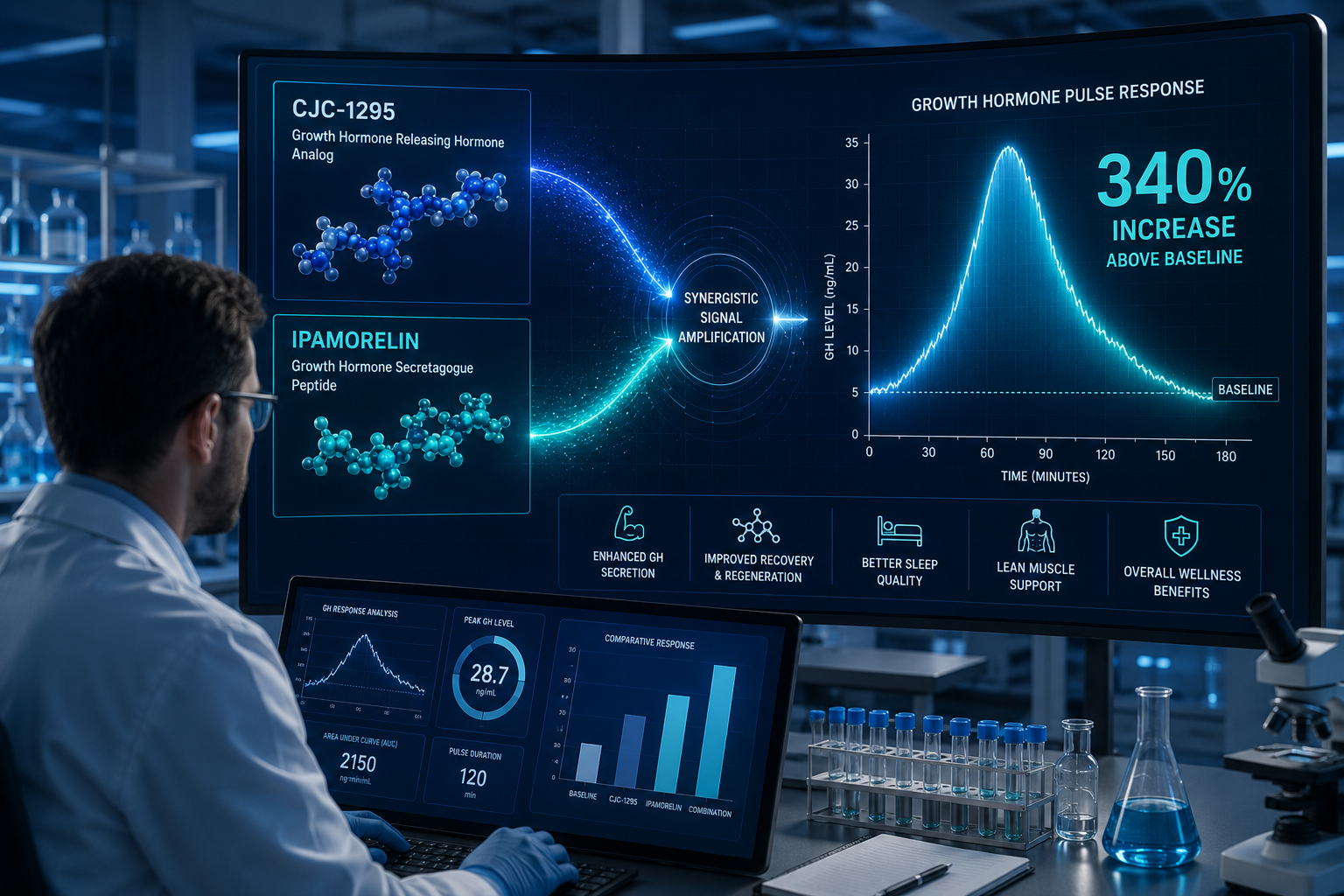
Growth hormone pulse amplitudes reaching 340% above baseline from a single timed dosing sequence, that figure alone explains why researchers studying CJC-1295 with Ipamorelin: Synergistic Effects and Optimized Protocols in Growth Hormone Research have made this peptide pairing one of the most actively investigated combinations in endocrinology today.
Neither compound achieves that magnitude alone. CJC-1295 (no-DAC) activates GHRH receptors, while Ipamorelin targets ghrelin/GHSR-1a receptors, two separate pathways that, when triggered in sequence, produce a larger yet still pulsatile growth hormone release. That pulsatility matters because it more closely mirrors natural GH physiology than flat, supraphysiologic exposure.
Key Takeaways
- Combining CJC-1295 no-DAC with Ipamorelin within a 30-minute dosing window produces GH pulses approximately 340% above baseline, significantly higher than either peptide alone.
- The synergy stems from dual receptor activation: GHRH receptors (CJC-1295) and ghrelin/GHSR-1a receptors (Ipamorelin), preserving natural pulsatility.
- Co-administration in research settings has produced IGF-1 elevations of roughly 1.8-2.3 times baseline compared with single-agent protocols.
- Phase II and Phase III trials in 2026 are actively investigating this pairing for age-related GH deficiency, metabolic dysfunction, and body-composition outcomes.
- As of 2026, neither peptide holds FDA approval; both remain strictly research-use compounds.
Mechanism Behind the Synergistic Effects
The core reason researchers prioritize CJC-1295 with Ipamorelin: Synergistic Effects and Optimized Protocols in Growth Hormone Research lies in complementary receptor biology.
CJC-1295 no-DAC is a modified GHRH analogue. It binds GHRH receptors on somatotroph cells in the anterior pituitary, stimulating GH synthesis and release. Its relatively short active window, compared with the DAC version, makes it well-suited for protocols that aim to replicate natural pulsatile GH secretion. For a deeper look at the structural differences, the CJC-1295 with DAC deeper dive resource provides useful mechanistic context.
Ipamorelin is a selective growth hormone secretagogue and ghrelin receptor agonist. It stimulates GH release through GHSR-1a receptors while showing minimal effect on cortisol or prolactin, a selectivity profile that makes it a preferred research tool. Researchers exploring the broader secretagogue landscape will find the Ipamorelin as the most important GHRH secretagogue overview informative.
When both peptides are administered within a 30-minute window, the two receptor systems amplify each other's downstream signaling. The result is a GH pulse that is substantially larger than additive effects would predict, a true pharmacological synergy.
"Sequential activation of GHRH and ghrelin receptors generates a larger yet still pulsatile GH release, preserving physiological rhythm while amplifying amplitude."
Optimized Protocols in Growth Hormone Research Settings
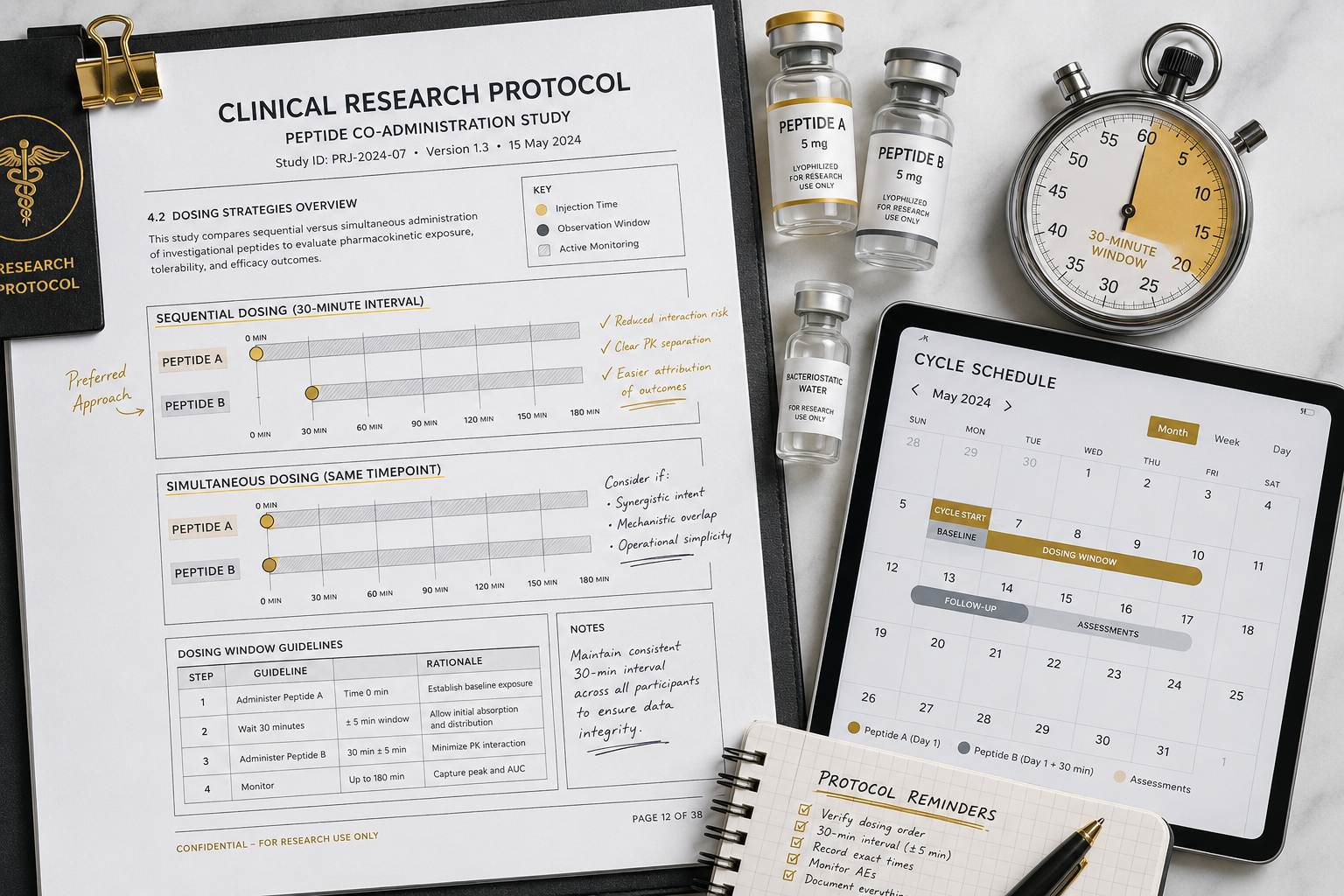
Translating receptor biology into practical research protocols requires attention to timing, frequency, and cycle structure. Current data from ongoing Phase II and Phase III trials in 2026 point toward several consistent design principles.
Timing and Sequencing
Administering CJC-1295 no-DAC first, followed by Ipamorelin within a 30-minute window, consistently outperforms simultaneous injection in terms of peak GH amplitude. The sequential approach allows GHRH receptor priming before ghrelin receptor activation compounds the signal.
Dosing Frequency
Most active research protocols use twice-daily administration, once in the morning and once before sleep, to align with natural GH secretory patterns. Sleep-time dosing is particularly relevant because endogenous GH pulses are largest during slow-wave sleep.
Cycle Length and IGF-1 Outcomes
| Protocol Variable | Research Finding |
|---|---|
| Dosing window | Sequential, within 30 minutes |
| GH pulse amplitude | ~340% above baseline |
| IGF-1 elevation | 1.8-2.3x baseline (co-administration) |
| Frequency | Twice daily in most active trials |
Researchers combining these peptides with broader metabolic interventions have also explored Tesamorelin, CJC-1295, and Ipamorelin blend protocols to address body-composition endpoints more comprehensively.
For those examining metabolic outcomes specifically, the Tesamorelin body composition research themes page offers relevant parallel data.
2026 Clinical Trial Landscape and Regulatory Considerations
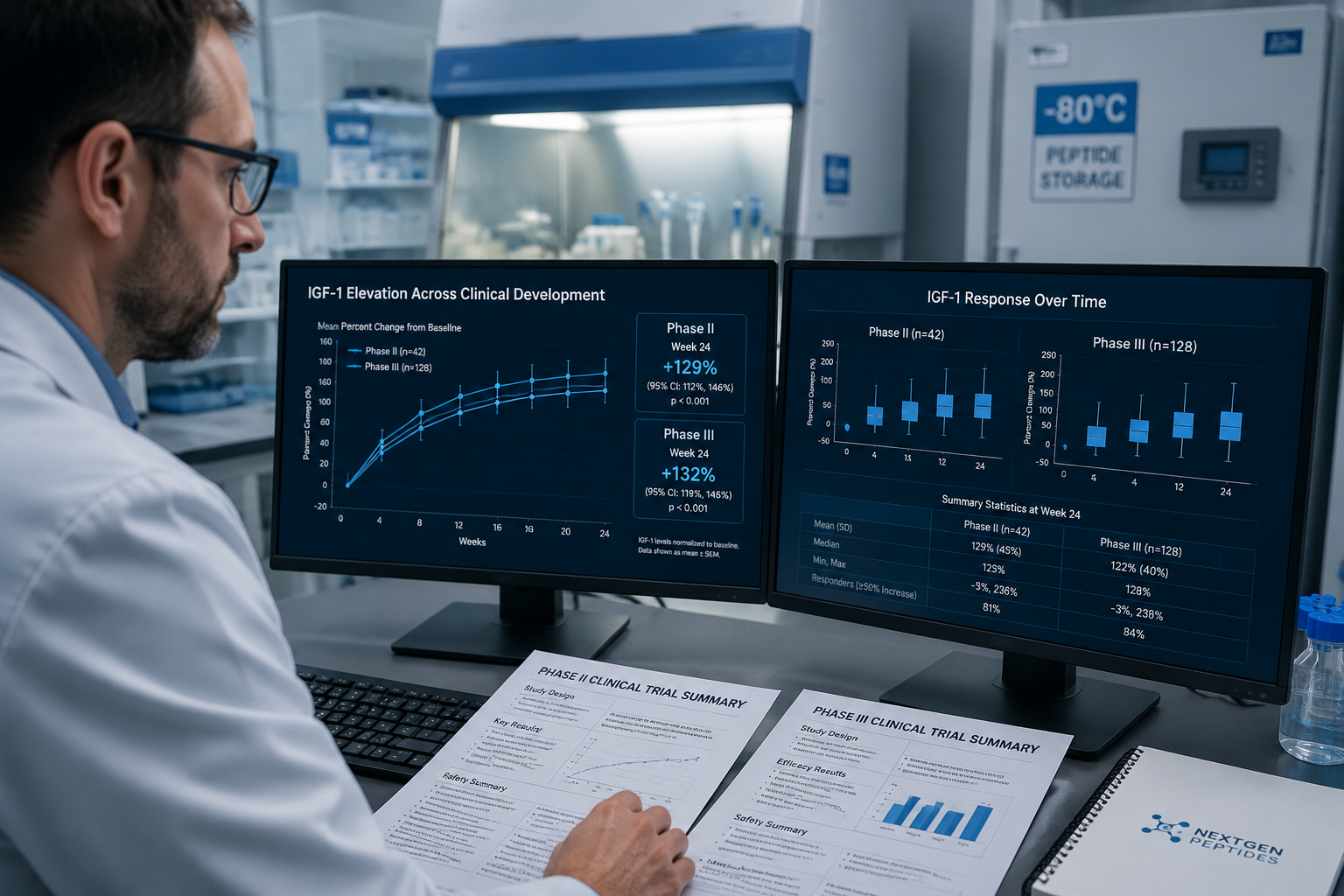
Active Phase II and Phase III trials in 2026 are examining CJC-1295 with Ipamorelin: Synergistic Effects and Optimized Protocols in Growth Hormone Research across three primary indications: age-related GH deficiency, metabolic dysfunction, and body-composition optimization.
Investigators are specifically studying:
- Sequential vs. simultaneous dosing to determine which produces superior IGF-1 outcomes with fewer desensitization effects
- Injection frequency optimization, balancing pulse amplitude against receptor downregulation over extended cycles
- Cycle length variables to identify the minimum effective duration for meaningful IGF-1 and lean-mass endpoints
Much of this trial data remains unpublished, though secondary summaries from 2026 trial overviews confirm the dual-peptide design as the central mechanistic feature.
Regulatory status as of 2026: Neither CJC-1295 nor Ipamorelin holds FDA approval for any clinical indication. Both remain research-use compounds subject to increasingly strict compounding guidance. Researchers and institutions should review current regulatory frameworks before initiating any protocol. For context on related peptide regulatory considerations, the Ipamorelin and Sermorelin stack research page addresses comparable compliance questions.
Researchers interested in expanding their GH axis investigation may also find value in reviewing what is somatotropin for foundational context, or exploring NAD+ energetics and longevity research themes for adjacent metabolic pathways.
Conclusion
The evidence base for CJC-1295 with Ipamorelin: Synergistic Effects and Optimized Protocols in Growth Hormone Research continues to strengthen in 2026, with mechanistic data confirming 340% GH pulse amplification and IGF-1 elevations nearly 2.3 times baseline under optimized sequential protocols. The dual receptor mechanism, GHRH and GHSR-1a activation in sequence, represents a reproducible and physiologically coherent research strategy.
Actionable next steps for researchers:
- Prioritize sequential dosing with a 30-minute window between CJC-1295 no-DAC and Ipamorelin administration
- Design protocols around twice-daily injection schedules aligned with natural GH secretory rhythms
- Monitor IGF-1 at regular intervals to detect desensitization before it affects endpoint data
- Stay current with FDA and compounding regulatory updates, as guidance continues to evolve in 2026
- Review active trial registries for emerging dose and cycle-length data as Phase III results are published
Leave a Reply
Want to join the discussion?Feel free to contribute!