
Circulating levels of MOTS-c, a peptide encoded directly inside mitochondrial DNA, drop measurably as humans age, tracking closely with the rise of insulin resistance and metabolic dysfunction. That single fact reframes a long-standing assumption: that mitochondria are passive energy factories. The emerging science of Mitochondria, MOTS-c, and 5-Amino-1MQ: How Polypeptide Peptides Rewire Cellular Energy Metabolism reveals these organelles as active hormonal broadcasters, capable of dispatching peptide signals that reshape how every cell burns fuel.
Key Takeaways
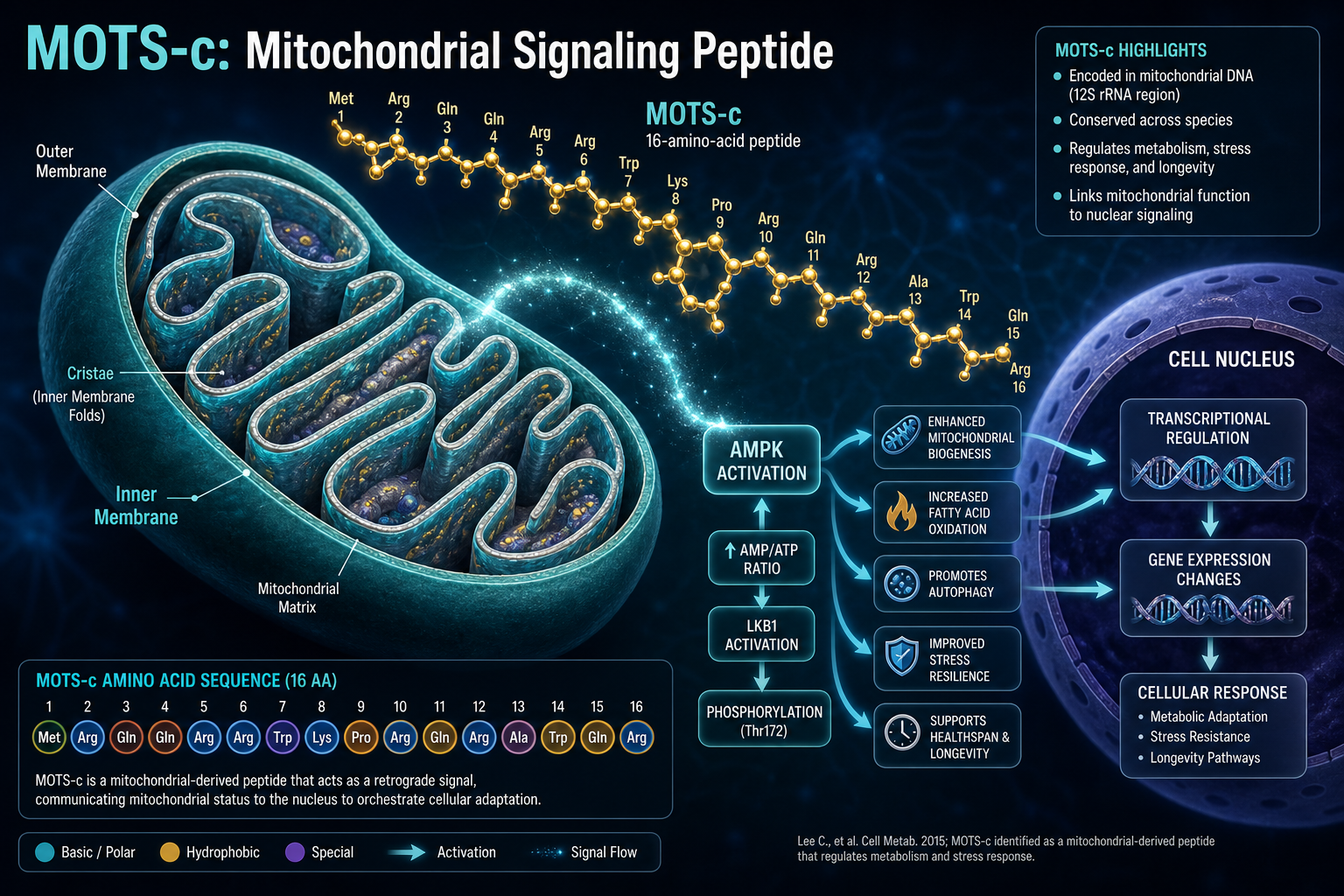
- MOTS-c is a 16-amino acid mitochondria-derived peptide that activates AMPK, improving glucose uptake and insulin sensitivity.
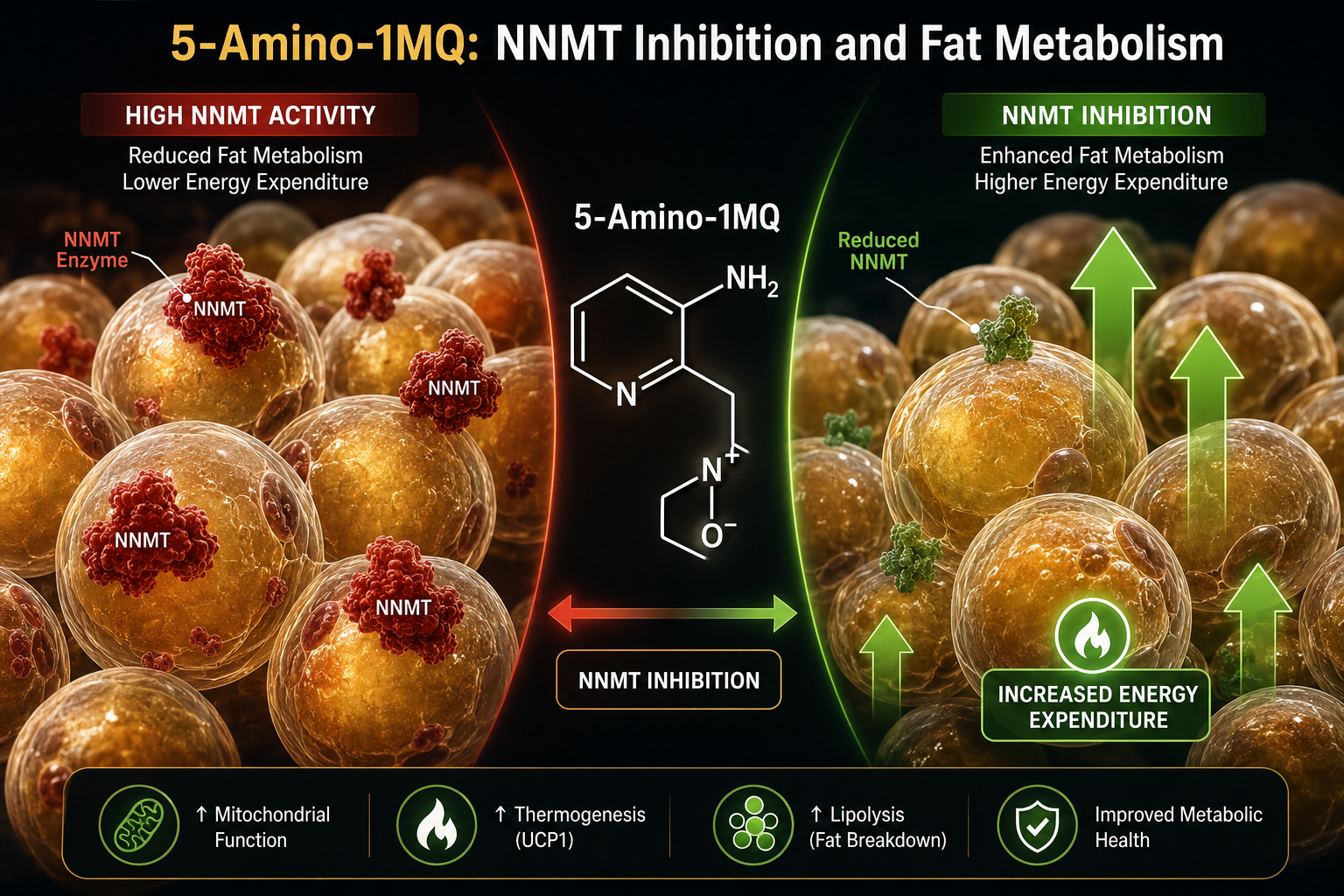
- 5-Amino-1MQ is a small-molecule inhibitor targeting NNMT, an enzyme overexpressed in obese adipose tissue, shifting fat cells toward energy expenditure.
- Both compounds target distinct metabolic pathways, making combined research protocols a logical area of investigation.
- MOTS-c behaves as a mitokine, released by muscle during exercise and capable of traveling to distant tissues and even the cell nucleus.
- Unlike classic metabolic drugs, these agents interface directly with mitochondrial and epigenetic signaling rather than simply blocking a receptor.
What Is MOTS-c and How Does It Interact with Mitochondrial Signaling
MOTS-c is a 16-amino acid peptide translated from a short open reading frame within mitochondrial DNA, an unusual origin that sets it apart from nuclear-encoded proteins. Its discovery confirmed that mitochondria are not merely ATP generators; they produce bioactive signals that govern whole-body metabolism.
The mechanism is precise. MOTS-c inhibits the folate-methionine cycle inside cells, which causes a buildup of AICAR, a naturally occurring AMPK activator. When AMPK switches on, cells increase glucose uptake, suppress fat synthesis, and shift toward oxidative metabolism. The result is improved insulin sensitivity and more efficient energy use across muscle, liver, and adipose tissue.
What makes MOTS-c especially compelling is its behavior under stress. During metabolic challenge, MOTS-c translocates to the nucleus, where it directly regulates adaptive stress-response genes. This retrograde signaling, from mitochondria back to the genome, represents a layer of metabolic control that classic small-molecule drugs do not replicate.
MOTS-c also qualifies as a mitokine: skeletal muscle releases it during exercise, after which it circulates to distant tissues and mimics aspects of exercise-induced metabolic benefit. Research in animal models shows that MOTS-c treatment significantly improves physical performance across young, middle-aged, and older subjects, suggesting a role in combating age-dependent decline.
For researchers exploring mitochondria-targeted compounds, the SS-31 mitochondrial research overview provides useful context on how different peptides approach mitochondrial membrane stabilization and energy efficiency.
MOTS-c at a glance:
| Parameter | Detail |
|---|---|
| Origin | Mitochondrial DNA |
| Length | 16 amino acids |
| Primary target | AMPK via AICAR accumulation |
| Half-life | Approximately 2 hours |
| Research dosage | 5-10 mg subcutaneously, 2-3x weekly |
5-Amino-1MQ: NNMT Inhibition and the Adipose Tissue Connection
Where MOTS-c acts through mitochondrial peptide signaling, 5-Amino-1MQ operates through a fundamentally different mechanism, making the two compounds complementary rather than redundant.
5-Amino-1MQ is a small-molecule inhibitor of nicotinamide N-methyltransferase (NNMT), an enzyme that is significantly overexpressed in the white adipose tissue of obese individuals. NNMT consumes methyl groups that would otherwise support NAD+ biosynthesis and healthy epigenetic regulation. By blocking NNMT, 5-Amino-1MQ frees up those methyl groups, shifts fat cell metabolism toward energy expenditure, and may reduce adipose tissue accumulation.
This is a meaningful distinction from classic metabolic drugs such as metformin or GLP-1 receptor agonists. Those agents primarily target receptor-level signaling or hepatic glucose output. 5-Amino-1MQ intervenes at the epigenetic and NAD+ metabolic level within the fat cell itself.
Researchers interested in NAD+ pathway modulation may also find value in reviewing the scientific evidence on NAD+ supplementation as a complementary framework.
Pharmacokinetic data for 5-Amino-1MQ suggest a half-life of roughly 12-16 hours, with research dosages typically ranging from 50-100 mg orally once or twice daily. Its oral bioavailability makes it logistically distinct from injectable peptides like MOTS-c.
Combining MOTS-c and 5-Amino-1MQ: Dual-Pathway Metabolic Research
The logic behind studying MOTS-c and 5-Amino-1MQ together rests on pathway complementarity. MOTS-c targets AMPK activation and mitochondrial stress signaling; 5-Amino-1MQ targets NNMT-driven epigenetic dysfunction in adipose tissue. Neither pathway fully overlaps, which is why combining them represents a rational research strategy for metabolic optimization.
"The shift from single-target metabolic drugs to multi-pathway peptide protocols reflects a broader understanding that energy dysregulation is never caused by one broken switch."
This dual approach also contrasts sharply with older pharmacological models. Classic drugs like statins or insulin sensitizers work downstream of the problem. MOTS-c and 5-Amino-1MQ work closer to the source, at the organelle and epigenome level, which is why researchers describe them as rewiring rather than merely adjusting cellular energy metabolism.
For broader context on how peptide combinations are being explored in research settings, the synergy of LL-37 and MOTS-c research overview offers a useful parallel example of multi-peptide protocol design.
Researchers working with mitochondria-targeted peptides may also consider reviewing SS-31 (elamipretide) research, which targets cardiolipin on the inner mitochondrial membrane, a third distinct mechanism that complements both MOTS-c and 5-Amino-1MQ approaches.
Additional resources on mitochondria-adjacent peptide research include:
Key differences between MOTS-c, 5-Amino-1MQ, and classic metabolic drugs:
| Feature | MOTS-c | 5-Amino-1MQ | Classic Drug (e.g., Metformin) |
|---|---|---|---|
| Origin | Mitochondrial peptide | Synthetic small molecule | Synthetic small molecule |
| Primary target | AMPK / nucleus | NNMT / adipose epigenome | Hepatic glucose output |
| Route | Subcutaneous | Oral | Oral |
| Metabolic layer | Organelle signaling | Epigenetic / NAD+ | Receptor / enzyme |
Conclusion
The science of Mitochondria, MOTS-c, and 5-Amino-1MQ: How Polypeptide Peptides Rewire Cellular Energy Metabolism represents a genuine shift in how researchers think about metabolic disease. Rather than patching downstream symptoms, these compounds address upstream dysfunction at the mitochondrial and epigenetic level.
Actionable next steps for researchers in 2026:
- Review the primary literature on MOTS-c's AMPK activation pathway and its nuclear translocation behavior under metabolic stress.
- Examine NNMT expression data in adipose tissue models before designing 5-Amino-1MQ protocols.
- Consider how mitochondria-targeted peptides like SS-31 might complement MOTS-c in multi-pathway research designs.
- Source research-grade compounds from verified, tested suppliers to ensure purity and traceability.
- Track both metabolic and physical performance markers across study timelines, given MOTS-c's documented effects on exercise capacity.
The mitochondrion is no longer just a powerhouse. It is a signaling organ, and the peptides it produces may be among the most important metabolic research targets of this decade.
Leave a Reply
Want to join the discussion?Feel free to contribute!