Call or Text 727-513-9780
  • Shopping Cart Shopping Cart
    0Shopping Cart
Pure Tested Peptides | America's most trusted Peptides for sale online
  • Peptides for sale
    • Oral Peptides for sale
      • Peptide Capsules for sale
      • BPC 157 Capsules 1000mcg
      • SLU-PP-332 Capsules | 1000 mcg
      • 5-Amino-1MQ 50mg Capsules
      • Tesofensine 500mcg
    • All Peptides for sale
    • Peptide Sprays
      • BPC 157 Nasal Spray Kit
      • BPC-157 TB500 Nasal Spray Kit
      • Semax Nasal Spray 10mg
      • Selank – Nasal Spray Kit – 10mg
      • Epithalon 50MG Nasal Spray Kit
      • Ipamorelin 10mg Nasal Spray
      • Klow Nasal Spray (BPC-157 + TB-500 + GHK-Cu + KPV) | 80mg
      • Hulk Nasal Spray Tesa / Ipa Blend 6/3 MG
      • Klow Nasal Spray
      • NAD + 500 mg Nasal Spray
      • PT-141 Nasal Spray Kit
    • GHRH Peptides
      • Ipa Peptides
      • CJC-1295 Peptides
        • CJC-1295 with DAC 5 mg
        • CJC-1295 without DAC 5 mg
        • CJC-1295 Ipa 10mg
      • Tesa Peptides
        • Tesa Peptide
        • Tesa 20 mg
    • GHK-Cu Peptides
      • All GHK-Cu Peptides
      • GHK-Cu 100mg
      • KLOW Peptide Blend – Buy KLOW blend online
    • BPC Peptides
      • All BPC Peptides
      • BPC-157
      • BPC-157 TB-500
      • BPC 157 capsules 1000mcg
    • SLU-PP-332 Peptides
      • All SLU-PP-332 Peptides
      • SLU-PP-332 5mg
    • GLP3 Peptides
      • GLP3-R
      • GLP3-R CAG 10mg
      • GLP3-R 20mg
    • PT-141 Peptides
      • PT-141 Peptides for sale
      • PT-141 10mg
      • PT-141 Nasal Spray
    • CAG Peptides
      • Lipo-C Peptide Blend
      • CAG 5mg
      • CAG 10mg
    • MOTS-C Peptides
      • MOTS-C Peptides for sale
      • MOTS-c peptide
      • MOTS-c 10mg *6 pack*
    • 5 Amino 1MQ Peptides
      • 5 Amino 1MQ Peptides for sale
      • 5-Amino-1MQ 50mg Capsules
      • 5-Amino-1MQ 5mg
    • Epithalon Peptides
      • Epithalon Peptides for sale
      • Epithalon 10mg
      • Epithalon 50mg
  • Shop
    • GLPs
      • 5-Amino-1MQ 50mg Capsules
      • 5-Amino-1MQ 5mg
      • GLP3-Reta
      • L-Carnitine 500mg/ml
      • Tesofensine 500mcg
      • SLU-PP-332 5mg
      • MOTS-c 10mg *6 pack*
    • Epithalon & BPC Peptides
      • Epithalon 10mg
      • Epithalon 50mg
      • BPC-157
      • BPC 157 capsules 1000mcg
      • BPC-157 TB-500
      • BPC-157 TB500 Nasal Spray Kit
      • BPC 157 Nasal Spray Kit
    • BPC TB-500 & NAD+ Peptides
      • NAD+ 500 mg
      • KLOW Peptide Blend – Buy KLOW blend online
      • GLOW Peptide Blend
      • TB 500 5mg
      • BPC 157 capsules 1000mcg – Supplement
      • BPC 157 Nasal Spray Kit
      • BPC-157
      • BPC-157 TB500 Nasal Spray Kit
      • BPC-157 TB-500
      • BPC 157 capsules 1000mcg
    • LL-37 Peptide
      • LL-37 10 mg
    • MOTS-C & Selank
      • MOTS-c peptide
      • Selank 10mg
    • GHK Peptides
      • GHK-Cu 100mg
      • GLOW Peptide Blend
      • KLOW Peptide Blend – Buy KLOW blend online
  • COAs
  • Wholesale
    • Wholesale Peptides for sale
  • PTP FAQ
  • Affiliates
    • Selank Peptide: Advanced Pharmacological Mechanisms Underlying Its Anxiolytic and Nootropic Effects in Research
      • 5-Amino-1MQ Peptide: Detailed Mechanisms of NNMT Inhibition and Its Impact on Cellular Metabolism Research
        • MOTS-C Peptide: Unraveling Its Role in Mitochondrial Dynamics and Energy Metabolism Research
          • Epithalon Peptide and Telomerase Regulation: Investigating Its Impact on Cellular Senescence and Lifespan Research Models
            • GLP2-T vs GLP2 Tirz Peptide: Understanding the Naming, Mechanistic Nuances, and Research Implications for Gut Health
      • Peptides and Polypeptides in Modern Pharmacology: What Research on Metoprolol, Prednisone, and Amlodipine Reveals
        • Polypeptide Peptides vs NSAIDs: What Naproxen and Diclofenac Teach Tissue-Repair Researchers About BPC‑157 and TB‑500
          • Peptides and Polypeptides in Endocrine Pharmacology: How GLP-1, GLP-2, and GLP-3 Retatrutide Differ From Classic Drugs Like Prednisone and Amlodipine
          • 5‑Amino‑1MQ Peptide and NNMT Inhibition: How It Compares With Statins Like Atorvastatin in Adipose and Lipid Metabolism Research
      • Enclomiphene, Estrogen Receptor Signaling, and Luteinizing Phase Biology: What Hormone Researchers Should Measure
        • Mesenchymal Stem Cells, BPC‑157, and GHK‑Cu: How Tissue Repair Peptides Compare With Classic NSAIDs Like Naproxen in Injury Models
          • Peptide Calculator Use Cases Beyond Growth Hormone: Working Through GLP‑3 Retatrutide, MOTS‑c, and BPC‑157 Research Dosing
        • Polypeptide Peptides in Endocrine and Metabolic Pharmacology: Lessons From Amlodipine, Prednisone, and Metoprolol
        • Peptides Calculator for Advanced Blends: Worked Examples for Tesamorelin, CJC‑1295, and Ipamorelin Stacks
          • Peptides and Polypeptides in Human Physiology: How Molecular Size Shapes Research Applications
            • Selank Peptide: Advanced Pharmacological Mechanisms Underlying Its Anxiolytic and Nootropic Effects in Research
          • 5-Amino-1MQ Peptide: Detailed Mechanisms of NNMT Inhibition and Its Impact on Cellular Metabolism Research
            • MOTS-C Peptide: Unraveling Its Role in Mitochondrial Dynamics and Energy Metabolism Research
              • Epithalon Peptide and Telomerase Regulation: Investigating Its Impact on Cellular Senescence and Lifespan Research Models
                • GLP2-T vs GLP2 Tirz Peptide: Understanding the Naming, Mechanistic Nuances, and Research Implications for Gut Health
                  • Peptides and Polypeptides in Endocrine Pharmacology: How GLP-1, GLP-2, and GLP-3 Retatrutide Differ From Classic Drugs Like Prednisone and Amlodipine
                    • Polypeptide Peptides vs NSAIDs: What Naproxen and Diclofenac Teach Tissue-Repair Researchers About BPC‑157 and TB‑500
                      • Peptides and Polypeptides in Modern Pharmacology: What Research on Metoprolol, Prednisone, and Amlodipine Reveals
                        • 5‑Amino‑1MQ Peptide and NNMT Inhibition: How It Compares With Statins Like Atorvastatin in Adipose and Lipid Metabolism Research
                        • Enclomiphene, Estrogen Receptor Signaling, and Luteinizing Phase Biology: What Hormone Researchers Should Measure
                        • Mesenchymal Stem Cells, BPC‑157, and GHK‑Cu: How Tissue Repair Peptides Compare With Classic NSAIDs Like Naproxen in Injury Models
                        • Peptide Calculator Use Cases Beyond Growth Hormone: Working Through GLP‑3 Retatrutide, MOTS‑c, and BPC‑157 Research Dosing
                        • Polypeptide Peptides in Endocrine and Metabolic Pharmacology: Lessons From Amlodipine, Prednisone, and Metoprolol
                        • Peptides Calculator for Advanced Blends: Worked Examples for Tesamorelin, CJC‑1295, and Ipamorelin Stacks
                        • Peptides and Polypeptides in Human Physiology: How Molecular Size Shapes Research Applications
                        • Selank Peptide: Advanced Pharmacological Mechanisms Underlying Its Anxiolytic and Nootropic Effects in Research
                        • MOTS-C Peptide: Unraveling Its Role in Mitochondrial Dynamics and Energy Metabolism Research
                        • Peptides and Polypeptides in Modern Pharmacology: What Research on Metoprolol, Prednisone, and Amlodipine Reveals
                        • Peptides and Polypeptides in Endocrine Pharmacology: How GLP-1, GLP-2, and GLP-3 Retatrutide Differ From Classic Drugs Like Prednisone and Amlodipine
                        • 5-Amino-1MQ Peptide: Detailed Mechanisms of NNMT Inhibition and Its Impact on Cellular Metabolism Research
                        • Mesenchymal Stem Cells, BPC‑157, and GHK‑Cu: How Tissue Repair Peptides Compare With Classic NSAIDs Like Naproxen in Injury Models
                        • Peptide Calculator Use Cases Beyond Growth Hormone: Working Through GLP‑3 Retatrutide, MOTS‑c, and BPC‑157 Research Dosing
                        • GLP2-T vs GLP2 Tirz Peptide: Understanding the Naming, Mechanistic Nuances, and Research Implications for Gut Health
                        • Polypeptide Peptides in Endocrine and Metabolic Pharmacology: Lessons From Amlodipine, Prednisone, and Metoprolol
                        • Polypeptide Peptides vs NSAIDs: What Naproxen and Diclofenac Teach Tissue-Repair Researchers About BPC‑157 and TB‑500
                        • Peptides and Polypeptides in Human Physiology: How Molecular Size Shapes Research Applications
                        • Peptides Calculator for Advanced Blends: Worked Examples for Tesamorelin, CJC‑1295, and Ipamorelin Stacks
                        • 5‑Amino‑1MQ Peptide and NNMT Inhibition: How It Compares With Statins Like Atorvastatin in Adipose and Lipid Metabolism Research
                        • Enclomiphene, Estrogen Receptor Signaling, and Luteinizing Phase Biology: What Hormone Researchers Should Measure
                        • Epithalon Peptide and Telomerase Regulation: Investigating Its Impact on Cellular Senescence and Lifespan Research Models
                        • Best research protocol Klow blend
                        • best time to take BPC-157
                        • best time to take DSIP (Delta Sleep Inducing Peptide)
                        • best time to take CJC-1295
                        • best time to take AOD-9604
                        • best time to take Follistatin 344
                        • best time to take Ipamorelin
                        • best time to take MK-677 (Ibutamoren)
                        • best time to take Ligandrol (LGD-4033) — research compound
                        • best time to take Ostarine (MK-2866) — research compound
                        • best time to take GHK-CU
                        • best time to take TB-500
                        • best time to take MOTS-c
                        • best time to take Semax
                        • best time to take RAD-140 (Testolone) — research compound
                        • best time to take Thymosin Alpha-1
                        • best time to take PEG-MGF
                        • Biolife Plasma, Octapharma Plasma, and Research Peptides: How Plasma Donation Labs Differ From Peptide Suppliers
                        • best time to take YK-11 — research compound
                        • best time to take PT-141 (Bremelanotide)
                        • Best research protocol Klow blend
  • Contact
    • Contact Customer Service
    • Text Customer Support
  • About US
  • Shop all peptides
  • Affiliate Program
    • Affiliate Signup
  • Login / Register Login / Register Page Link Login / Register Page Link
  • Click to open the search input field Click to open the search input field Search
  • Menu Menu

Tag Archive for: growth hormone pulsatility

Tesamorelin and Ipamorelin Peptides: Complementary Mechanisms for GH Secretagogue Research

Tesamorelin and Ipamorelin Peptides: Complementary Mechanisms for GH Secretagogue Research

June 5, 2026/0 Comments/by Pure Tested

}

Professional () hero image with : 'Tesamorelin & Ipamorelin: Complementary GH Secretagogue Research' in extra large white

Growth hormone secretion is not a single-switch event — it is a finely tuned pulse controlled by at least two distinct receptor systems. Understanding how those systems differ, and how they interact, is precisely why research into Tesamorelin and Ipamorelin Peptides: Complementary Mechanisms for GH Secretagogue Research has attracted sustained scientific interest in 2026.

Key Takeaways

  • Tesamorelin is a GHRH analog acting on the GHRH receptor; Ipamorelin is a ghrelin mimetic acting on GHS-R1a — two separate pathways.
  • Combining both peptides produces a synergistic GH pulse that exceeds what either compound achieves alone.
  • Tesamorelin holds FDA approval for HIV-associated lipodystrophy; Ipamorelin remains a research compound only.
  • Ipamorelin's receptor selectivity means it does not significantly raise cortisol, prolactin, or ACTH — a notable safety distinction.
  • Both compounds are prohibited under WADA's S2 category and are strictly for licensed research use.

Distinct Receptor Targets: The Foundation of Synergy
Distinct Receptor Targets: The Foundation of Synergy

The core science behind Tesamorelin and Ipamorelin Peptides: Complementary Mechanisms for GH Secretagogue Research begins at the receptor level.

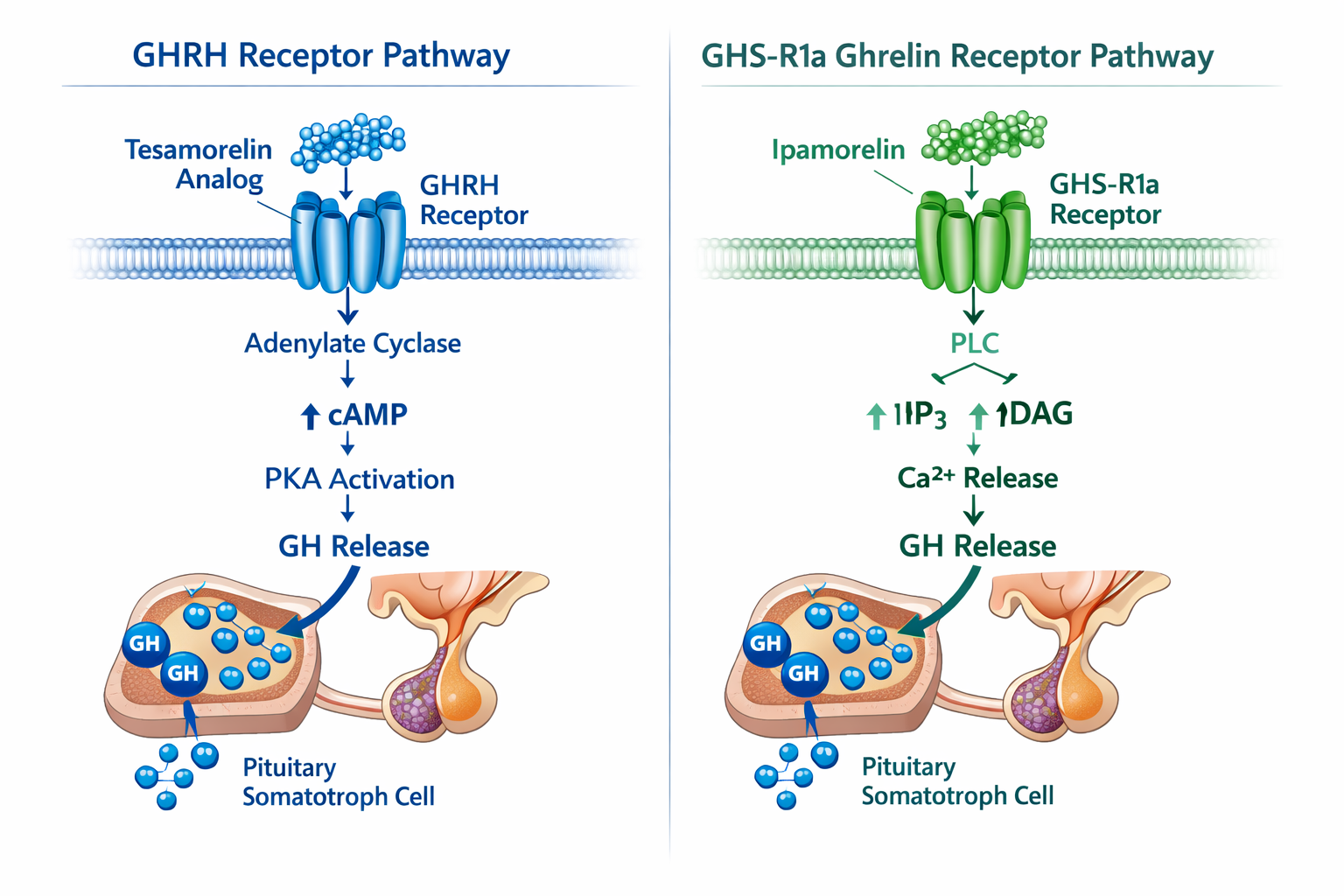
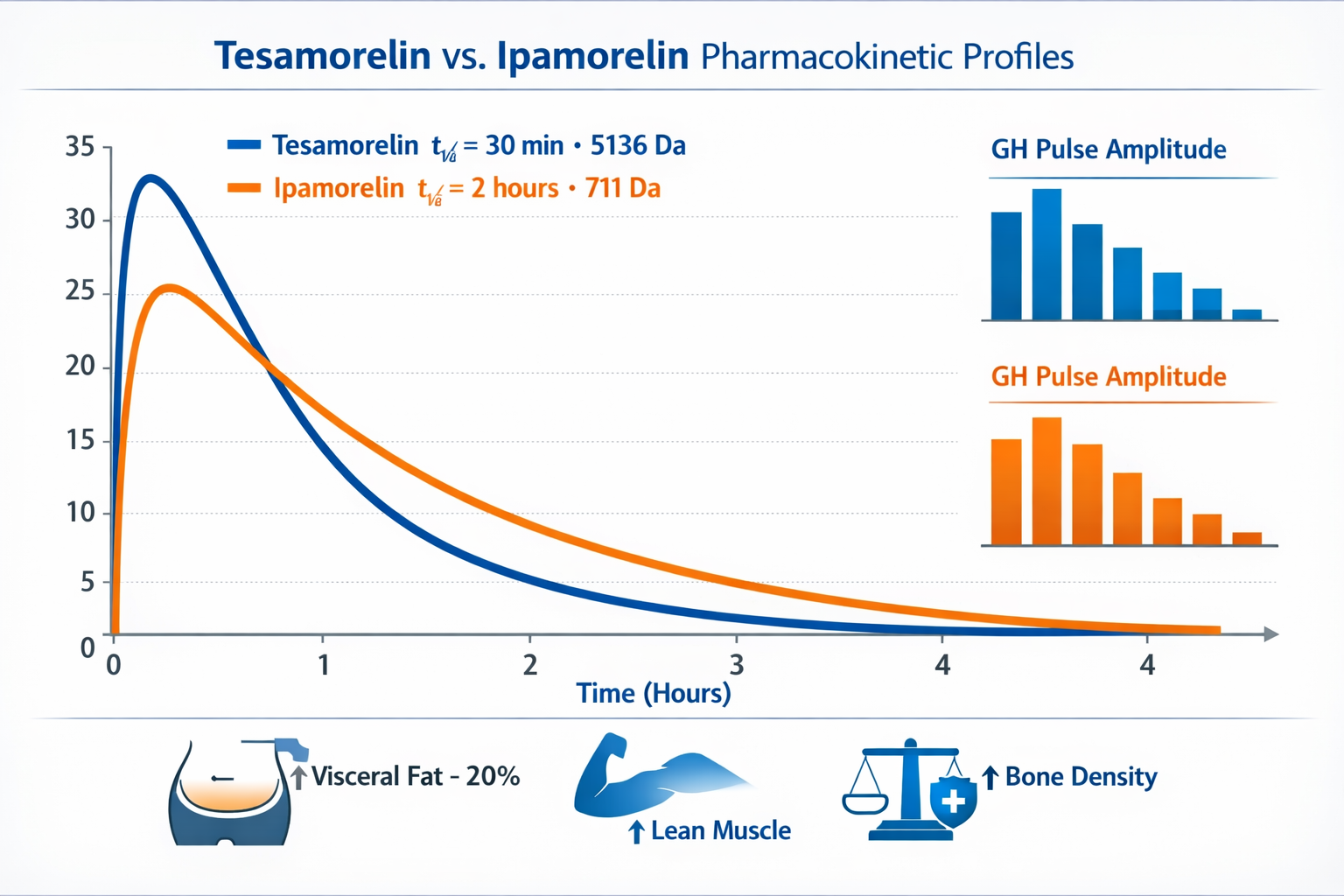
Tesamorelin is a stabilized analog of endogenous growth hormone-releasing hormone (GHRH). It binds the GHRH receptor on pituitary somatotroph cells and activates the cAMP/PKA signaling cascade, triggering GH synthesis and release. Its molecular weight is approximately 5,136 Da and its plasma half-life ranges from 25 to 40 minutes — short enough to preserve natural pulsatility while still delivering a measurable GH signal. Researchers interested in the science behind this compound can review detailed background on where to buy Tesamorelin and the science behind it.

Ipamorelin, by contrast, is a selective ghrelin receptor agonist that targets GHS-R1a. Its downstream signaling runs through the phospholipase C / IP3 / DAG pathway — entirely separate from the cAMP route used by Tesamorelin. At roughly 711 Da with a half-life near two hours, Ipamorelin is structurally compact and pharmacokinetically distinct. Critically, its receptor selectivity means it does not meaningfully elevate cortisol, ACTH, or prolactin, setting it apart from older GH secretagogues. More on Ipamorelin's muscle and fat research applications can be found at Ipamorelin muscle and fat research themes.

"Two separate locks, two separate keys — but both open the same door to GH release."

Because the two peptides operate on non-overlapping intracellular pathways, co-administration produces an additive — and in some models, synergistic — GH secretory response. This is the mechanistic rationale behind multi-peptide research protocols.


Pharmacokinetics, Clinical Evidence, and Regulatory Status
Pharmacokinetics, Clinical Evidence, and Regulatory Status

The regulatory histories of these two compounds diverge sharply.

Tesamorelin is the only FDA-approved GHRH analog, indicated for HIV-associated lipodystrophy. Phase 3 trials demonstrated a 15–18% reduction in visceral adipose tissue over 26 weeks — a clinically meaningful outcome supported by robust human data. Ipamorelin, while it advanced through Phase II trials for post-operative ileus, did not meet its primary endpoints in that indication and remains unapproved for any clinical use.

Feature Tesamorelin Ipamorelin
Receptor target GHRH-R GHS-R1a
Molecular weight ~5,136 Da ~711 Da
Half-life 25–40 min ~2 hours
FDA approval Yes (lipodystrophy) No
Cortisol elevation Minimal Minimal
WADA status Prohibited (S2) Prohibited (S2)

Both compounds are prohibited under WADA's S2 category, which restricts their use in competitive sport. Researchers should also note that CJC-1295 without DAC is another GHRH-family peptide often studied alongside these compounds for comparative GH pulsatility data.


Designing Combination Protocols for GH Pulsatility Research
Designing Combination Protocols for GH Pulsatility Research

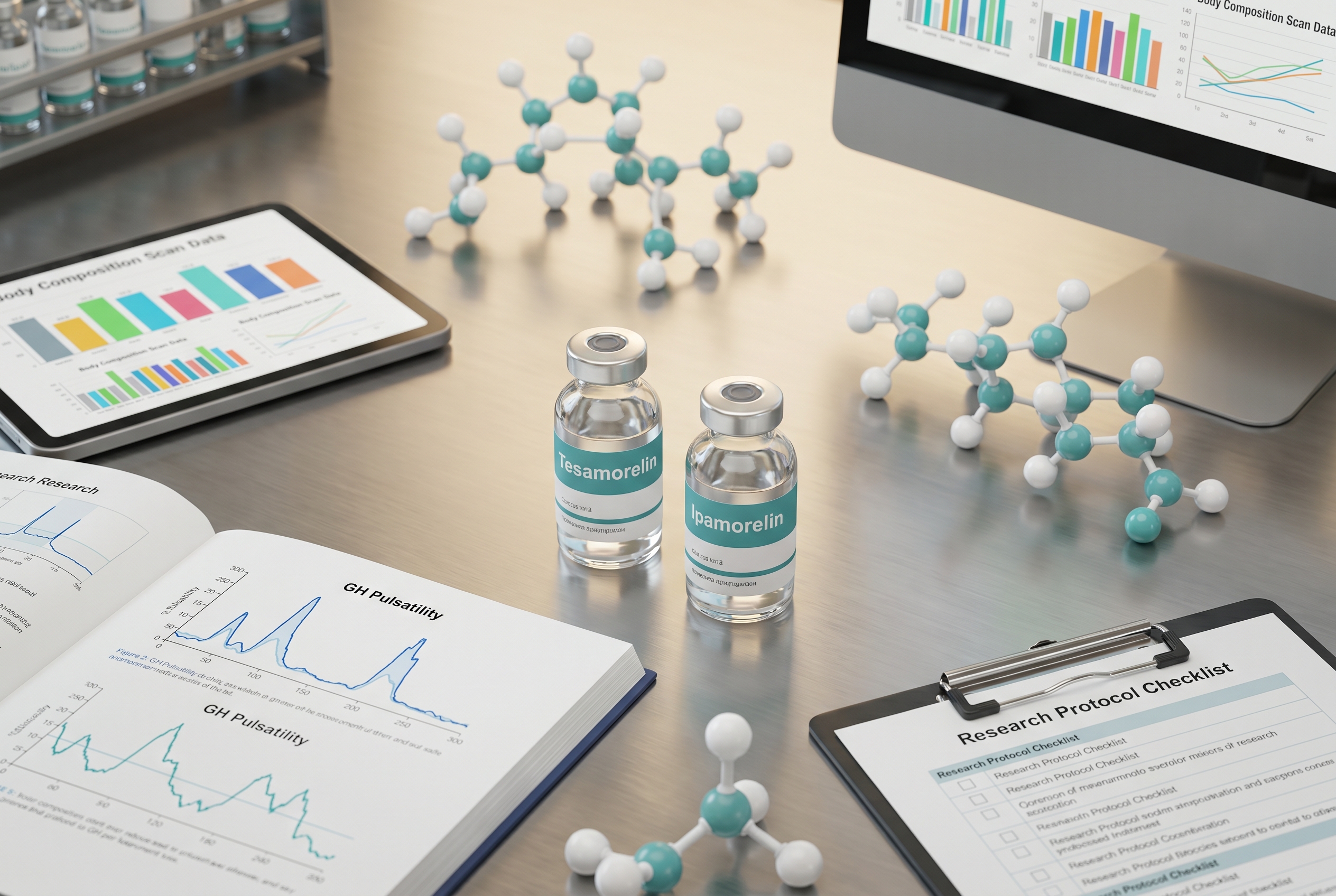
The practical application of Tesamorelin and Ipamorelin Peptides: Complementary Mechanisms for GH Secretagogue Research lies in protocol design. Because the two peptides hit different receptors, researchers can time their administration to amplify a single GH pulse or to study how dual-pathway stimulation affects downstream IGF-1 levels and body-composition markers.

Pre-formulated research blends that combine Tesamorelin, CJC-1295, and Ipamorelin — such as the Tesamorelin / CJC-1295 / Ipamorelin 12mg blend — allow investigators to study multi-secretagogue interactions without compounding separate solutions. For protocols that also incorporate AOD-9604, the Tesamorelin / AOD-9604 / CJC-1295 / Ipamorelin blend extends the metabolic research scope further.

Researchers studying the broader peptide landscape often pair GH secretagogue work with complementary compounds. For example, CJC-1295 with DAC research findings provide a useful reference point for understanding how DAC modification changes GH pulse kinetics relative to the shorter-acting analogs.

Key variables in combination protocol design include:

  • Timing offset — administering Ipamorelin 15–30 minutes before or after Tesamorelin to observe pulse shape differences
  • Dose titration — adjusting each compound independently to isolate receptor-specific contributions
  • Biomarker selection — tracking GH, IGF-1, visceral fat volume, and lean mass as primary endpoints
  • Washout periods — accounting for Ipamorelin's longer half-life when designing crossover studies

One important limitation: no direct human clinical trial has yet evaluated the Tesamorelin-Ipamorelin combination as a co-administered protocol. All synergy data to date comes from preclinical or mechanistic modeling work, meaning researchers must interpret findings with appropriate caution.


Conclusion

The mechanistic complementarity of Tesamorelin and Ipamorelin makes them a compelling pairing for GH secretagogue research. Their non-overlapping receptor targets — GHRH-R and GHS-R1a respectively — provide a rational basis for combination protocols aimed at studying GH pulsatility, visceral fat reduction, and body-composition dynamics.

Actionable next steps for researchers:

  1. Review the pharmacokinetic profiles of both compounds before designing dosing windows.
  2. Select validated biomarkers (GH, IGF-1, visceral adipose tissue) as primary endpoints.
  3. Source peptides from suppliers that provide third-party purity verification — see the peptide purity testing guide for sourcing standards.
  4. Consult the Ipamorelin GHRH/GRF research overview for additional mechanistic context before finalizing protocols.
  5. Maintain strict compliance with institutional research regulations and WADA prohibitions.

Rigorous, well-designed preclinical studies remain the essential next step before any broader conclusions about this peptide combination can be drawn.

https://www.puretestedpeptides.com/wp-content/uploads/2026/06/Tesamorelin-and-Ipamorelin-Peptides-Complementary-Mechanisms-for-GH-Secretagogue-Research.jpg 1696 2528 Pure Tested https://www.puretestedpeptides.com/wp-content/uploads/2026/01/buy-peptides-online.jpg Pure Tested2026-06-05 13:36:412026-07-20 15:03:54Tesamorelin and Ipamorelin Peptides: Complementary Mechanisms for GH Secretagogue Research
×

Helpful Links

  • My account
  • Cart
  • Checkout
  • Refund and Returns Policy
  • Privacy Policy
  • SMS Privacy Policy
  • Login
  • My Account
  • Logout

USA Made Lab Tested Peptides

All products are sold for research, laboratory, or analytical purposes only, and are not for human consumption


Pure Tested Peptides is a chemical supplier. Pure Tested Peptides is not a compounding / chemical compounding facility as defined under 503A of the Federal Food, Drug, and Cosmetic act. Pure Tested Peptides is not an outsourcing facility as defined under 503B of the Federal Food, Drug, and Cosmetic act.

The statements made within this website have not been evaluated by the US Food and Drug Administration. The products we offer are not intended to diagnose, treat, cure or prevent any disease.

Human/Animal Consumption Prohibited. Laboratory/In-Vitro Experimental Use Only

Scroll to top Scroll to top Scroll to top