Call or Text 727-513-9780
  • Shopping Cart Shopping Cart
    0Shopping Cart
Pure Tested Peptides | America's most trusted Peptides for sale online
  • Peptides for sale
    • Oral Peptides for sale
      • Peptide Capsules for sale
      • BPC 157 Capsules 1000mcg
      • SLU-PP-332 Capsules | 1000 mcg
      • 5-Amino-1MQ 50mg Capsules
      • Tesofensine 500mcg
    • All Peptides for sale
    • Peptide Sprays
      • BPC 157 Nasal Spray Kit
      • BPC-157 TB500 Nasal Spray Kit
      • Semax Nasal Spray 10mg
      • Selank – Nasal Spray Kit – 10mg
      • Epithalon 50MG Nasal Spray Kit
      • Ipamorelin 10mg Nasal Spray
      • Klow Nasal Spray (BPC-157 + TB-500 + GHK-Cu + KPV) | 80mg
      • Hulk Nasal Spray Tesa / Ipa Blend 6/3 MG
      • Klow Nasal Spray
      • NAD + 500 mg Nasal Spray
      • PT-141 Nasal Spray Kit
    • GHRH Peptides
      • Ipa Peptides
      • CJC-1295 Peptides
        • CJC-1295 with DAC 5 mg
        • CJC-1295 without DAC 5 mg
        • CJC-1295 Ipa 10mg
      • Tesa Peptides
        • Tesa Peptide
        • Tesa 20 mg
    • GHK-Cu Peptides
      • All GHK-Cu Peptides
      • GHK-Cu 100mg
      • KLOW Peptide Blend – Buy KLOW blend online
    • BPC Peptides
      • All BPC Peptides
      • BPC-157
      • BPC-157 TB-500
      • BPC 157 capsules 1000mcg
    • SLU-PP-332 Peptides
      • All SLU-PP-332 Peptides
      • SLU-PP-332 5mg
    • GLP3 Peptides
      • GLP3-R
      • GLP3-R CAG 10mg
      • GLP3-R 20mg
    • PT-141 Peptides
      • PT-141 Peptides for sale
      • PT-141 10mg
      • PT-141 Nasal Spray
    • CAG Peptides
      • Lipo-C Peptide Blend
      • CAG 5mg
      • CAG 10mg
    • MOTS-C Peptides
      • MOTS-C Peptides for sale
      • MOTS-c peptide
      • MOTS-c 10mg *6 pack*
    • 5 Amino 1MQ Peptides
      • 5 Amino 1MQ Peptides for sale
      • 5-Amino-1MQ 50mg Capsules
      • 5-Amino-1MQ 5mg
    • Epithalon Peptides
      • Epithalon Peptides for sale
      • Epithalon 10mg
      • Epithalon 50mg
  • Shop
    • GLPs
      • 5-Amino-1MQ 50mg Capsules
      • 5-Amino-1MQ 5mg
      • GLP3-Reta
      • L-Carnitine 500mg/ml
      • Tesofensine 500mcg
      • SLU-PP-332 5mg
      • MOTS-c 10mg *6 pack*
    • Epithalon & BPC Peptides
      • Epithalon 10mg
      • Epithalon 50mg
      • BPC-157
      • BPC 157 capsules 1000mcg
      • BPC-157 TB-500
      • BPC-157 TB500 Nasal Spray Kit
      • BPC 157 Nasal Spray Kit
    • BPC TB-500 & NAD+ Peptides
      • NAD+ 500 mg
      • KLOW Peptide Blend – Buy KLOW blend online
      • GLOW Peptide Blend
      • TB 500 5mg
      • BPC 157 capsules 1000mcg – Supplement
      • BPC 157 Nasal Spray Kit
      • BPC-157
      • BPC-157 TB500 Nasal Spray Kit
      • BPC-157 TB-500
      • BPC 157 capsules 1000mcg
    • LL-37 Peptide
      • LL-37 10 mg
    • MOTS-C & Selank
      • MOTS-c peptide
      • Selank 10mg
    • GHK Peptides
      • GHK-Cu 100mg
      • GLOW Peptide Blend
      • KLOW Peptide Blend – Buy KLOW blend online
  • COAs
  • Wholesale
    • Wholesale Peptides for sale
  • PTP FAQ
  • Affiliates
    • Selank Peptide: Advanced Pharmacological Mechanisms Underlying Its Anxiolytic and Nootropic Effects in Research
      • 5-Amino-1MQ Peptide: Detailed Mechanisms of NNMT Inhibition and Its Impact on Cellular Metabolism Research
        • MOTS-C Peptide: Unraveling Its Role in Mitochondrial Dynamics and Energy Metabolism Research
          • Epithalon Peptide and Telomerase Regulation: Investigating Its Impact on Cellular Senescence and Lifespan Research Models
            • GLP2-T vs GLP2 Tirz Peptide: Understanding the Naming, Mechanistic Nuances, and Research Implications for Gut Health
      • Peptides and Polypeptides in Modern Pharmacology: What Research on Metoprolol, Prednisone, and Amlodipine Reveals
        • Polypeptide Peptides vs NSAIDs: What Naproxen and Diclofenac Teach Tissue-Repair Researchers About BPC‑157 and TB‑500
          • Peptides and Polypeptides in Endocrine Pharmacology: How GLP-1, GLP-2, and GLP-3 Retatrutide Differ From Classic Drugs Like Prednisone and Amlodipine
          • 5‑Amino‑1MQ Peptide and NNMT Inhibition: How It Compares With Statins Like Atorvastatin in Adipose and Lipid Metabolism Research
      • Enclomiphene, Estrogen Receptor Signaling, and Luteinizing Phase Biology: What Hormone Researchers Should Measure
        • Mesenchymal Stem Cells, BPC‑157, and GHK‑Cu: How Tissue Repair Peptides Compare With Classic NSAIDs Like Naproxen in Injury Models
          • Peptide Calculator Use Cases Beyond Growth Hormone: Working Through GLP‑3 Retatrutide, MOTS‑c, and BPC‑157 Research Dosing
        • Polypeptide Peptides in Endocrine and Metabolic Pharmacology: Lessons From Amlodipine, Prednisone, and Metoprolol
        • Peptides Calculator for Advanced Blends: Worked Examples for Tesamorelin, CJC‑1295, and Ipamorelin Stacks
          • Peptides and Polypeptides in Human Physiology: How Molecular Size Shapes Research Applications
            • Selank Peptide: Advanced Pharmacological Mechanisms Underlying Its Anxiolytic and Nootropic Effects in Research
          • 5-Amino-1MQ Peptide: Detailed Mechanisms of NNMT Inhibition and Its Impact on Cellular Metabolism Research
            • MOTS-C Peptide: Unraveling Its Role in Mitochondrial Dynamics and Energy Metabolism Research
              • Epithalon Peptide and Telomerase Regulation: Investigating Its Impact on Cellular Senescence and Lifespan Research Models
                • GLP2-T vs GLP2 Tirz Peptide: Understanding the Naming, Mechanistic Nuances, and Research Implications for Gut Health
                  • Peptides and Polypeptides in Endocrine Pharmacology: How GLP-1, GLP-2, and GLP-3 Retatrutide Differ From Classic Drugs Like Prednisone and Amlodipine
                    • Polypeptide Peptides vs NSAIDs: What Naproxen and Diclofenac Teach Tissue-Repair Researchers About BPC‑157 and TB‑500
                      • Peptides and Polypeptides in Modern Pharmacology: What Research on Metoprolol, Prednisone, and Amlodipine Reveals
                        • 5‑Amino‑1MQ Peptide and NNMT Inhibition: How It Compares With Statins Like Atorvastatin in Adipose and Lipid Metabolism Research
                        • Enclomiphene, Estrogen Receptor Signaling, and Luteinizing Phase Biology: What Hormone Researchers Should Measure
                        • Mesenchymal Stem Cells, BPC‑157, and GHK‑Cu: How Tissue Repair Peptides Compare With Classic NSAIDs Like Naproxen in Injury Models
                        • Peptide Calculator Use Cases Beyond Growth Hormone: Working Through GLP‑3 Retatrutide, MOTS‑c, and BPC‑157 Research Dosing
                        • Polypeptide Peptides in Endocrine and Metabolic Pharmacology: Lessons From Amlodipine, Prednisone, and Metoprolol
                        • Peptides Calculator for Advanced Blends: Worked Examples for Tesamorelin, CJC‑1295, and Ipamorelin Stacks
                        • Peptides and Polypeptides in Human Physiology: How Molecular Size Shapes Research Applications
                        • Selank Peptide: Advanced Pharmacological Mechanisms Underlying Its Anxiolytic and Nootropic Effects in Research
                        • MOTS-C Peptide: Unraveling Its Role in Mitochondrial Dynamics and Energy Metabolism Research
                        • Peptides and Polypeptides in Modern Pharmacology: What Research on Metoprolol, Prednisone, and Amlodipine Reveals
                        • Peptides and Polypeptides in Endocrine Pharmacology: How GLP-1, GLP-2, and GLP-3 Retatrutide Differ From Classic Drugs Like Prednisone and Amlodipine
                        • 5-Amino-1MQ Peptide: Detailed Mechanisms of NNMT Inhibition and Its Impact on Cellular Metabolism Research
                        • Mesenchymal Stem Cells, BPC‑157, and GHK‑Cu: How Tissue Repair Peptides Compare With Classic NSAIDs Like Naproxen in Injury Models
                        • Peptide Calculator Use Cases Beyond Growth Hormone: Working Through GLP‑3 Retatrutide, MOTS‑c, and BPC‑157 Research Dosing
                        • GLP2-T vs GLP2 Tirz Peptide: Understanding the Naming, Mechanistic Nuances, and Research Implications for Gut Health
                        • Polypeptide Peptides in Endocrine and Metabolic Pharmacology: Lessons From Amlodipine, Prednisone, and Metoprolol
                        • Polypeptide Peptides vs NSAIDs: What Naproxen and Diclofenac Teach Tissue-Repair Researchers About BPC‑157 and TB‑500
                        • Peptides and Polypeptides in Human Physiology: How Molecular Size Shapes Research Applications
                        • Peptides Calculator for Advanced Blends: Worked Examples for Tesamorelin, CJC‑1295, and Ipamorelin Stacks
                        • 5‑Amino‑1MQ Peptide and NNMT Inhibition: How It Compares With Statins Like Atorvastatin in Adipose and Lipid Metabolism Research
                        • Enclomiphene, Estrogen Receptor Signaling, and Luteinizing Phase Biology: What Hormone Researchers Should Measure
                        • Epithalon Peptide and Telomerase Regulation: Investigating Its Impact on Cellular Senescence and Lifespan Research Models
                        • Best research protocol Klow blend
                        • best time to take BPC-157
                        • best time to take DSIP (Delta Sleep Inducing Peptide)
                        • best time to take CJC-1295
                        • best time to take AOD-9604
                        • best time to take Follistatin 344
                        • best time to take Ipamorelin
                        • best time to take MK-677 (Ibutamoren)
                        • best time to take Ligandrol (LGD-4033) — research compound
                        • best time to take Ostarine (MK-2866) — research compound
                        • best time to take GHK-CU
                        • best time to take TB-500
                        • best time to take MOTS-c
                        • best time to take Semax
                        • best time to take RAD-140 (Testolone) — research compound
                        • best time to take Thymosin Alpha-1
                        • best time to take PEG-MGF
                        • Biolife Plasma, Octapharma Plasma, and Research Peptides: How Plasma Donation Labs Differ From Peptide Suppliers
                        • best time to take YK-11 — research compound
                        • best time to take PT-141 (Bremelanotide)
                        • Best research protocol Klow blend
  • Contact
    • Contact Customer Service
    • Text Customer Support
  • About US
  • Shop all peptides
  • Affiliate Program
    • Affiliate Signup
  • Login / Register Login / Register Page Link Login / Register Page Link
  • Click to open the search input field Click to open the search input field Search
  • Menu Menu

Tag Archive for: genetic aging research

DNA, Telomeres, and Longevity Peptides: Positioning Epithalon and MOTS‑c in Genetic Aging Research

DNA, Telomeres, and Longevity Peptides: Positioning Epithalon and MOTS‑c in Genetic Aging Research

July 21, 2026/0 Comments/in Uncategorized/by

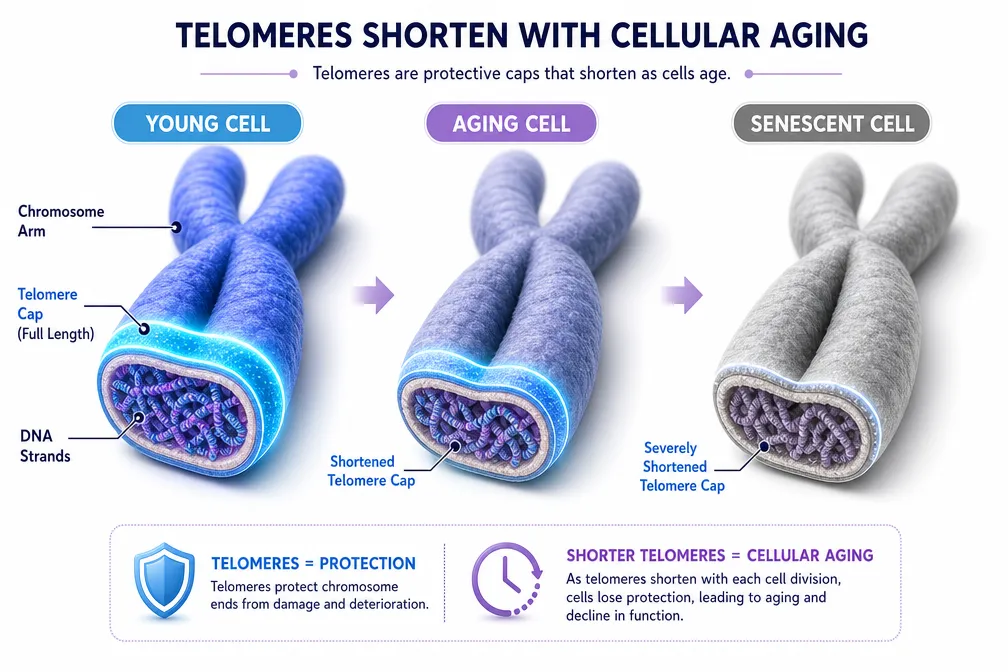
Every time a human cell divides, its chromosomes lose a small fragment of protective DNA from their ends. After roughly 50 to 70 divisions, those ends become critically short, and the cell stops functioning normally. This biological countdown, encoded directly in the genome, sits at the center of aging science in 2026, and two peptides, Epithalon and MOTS-c, are drawing serious preclinical attention for their roles in this process.

The intersection of DNA, Telomeres, and Longevity Peptides: Positioning Epithalon and MOTS-c in Genetic Aging Research is no longer a fringe topic. It now represents one of the most active frontiers in geroscience, connecting chromosome biology, mitochondrial signaling, and peptide pharmacology in ways that were not possible to study even a decade ago.

Key Takeaways

  • Telomere shortening is a measurable, genetically encoded driver of cellular aging and senescence.
  • Epithalon, a synthetic tetrapeptide, has shown telomerase-activating properties in multiple preclinical models.
  • MOTS-c is a mitochondria-derived peptide that regulates nuclear gene expression and metabolic stress responses.
  • Both peptides are studied in the context of senescence, not as cures, but as research tools to probe aging mechanisms.
  • Understanding their distinct mechanisms helps clarify how genetic and mitochondrial aging pathways interact.
Key Takeaways

Telomere Biology: The Genetic Clock Inside Every Cell

Telomeres are repetitive DNA sequences (TTAGGG in humans) that cap the ends of chromosomes like plastic tips on shoelaces. Their primary job is structural: they prevent chromosomes from fusing together or being recognized as damaged DNA.

Why do telomeres shorten?

The enzyme responsible for copying DNA, DNA polymerase, cannot fully replicate the very end of a linear chromosome. This is called the "end-replication problem." Each cell division leaves the telomere slightly shorter. When telomeres reach a critical minimum length, the cell enters one of three states:

Cellular Outcome Description
Replicative Senescence Cell stops dividing but remains metabolically active
Apoptosis Programmed cell death is triggered
Genomic Instability Cell continues dividing with errors, linked to cancer risk

The enzyme telomerase can rebuild telomere length by adding new TTAGGG repeats. It is highly active in germ cells and stem cells but largely silenced in most adult somatic cells. Reactivating telomerase in aged tissues, without triggering uncontrolled proliferation, is one of the central challenges in longevity research.

Researchers studying related longevity-focused peptide compounds, including those covered in the Vesugen, Vilon, and Chonluten longevity peptide overview, have noted that short regulatory peptides can modulate gene expression in aging tissues through epigenetic mechanisms that overlap with telomere maintenance pathways.

Epithalon: A Tetrapeptide With Telomerase-Activating Properties

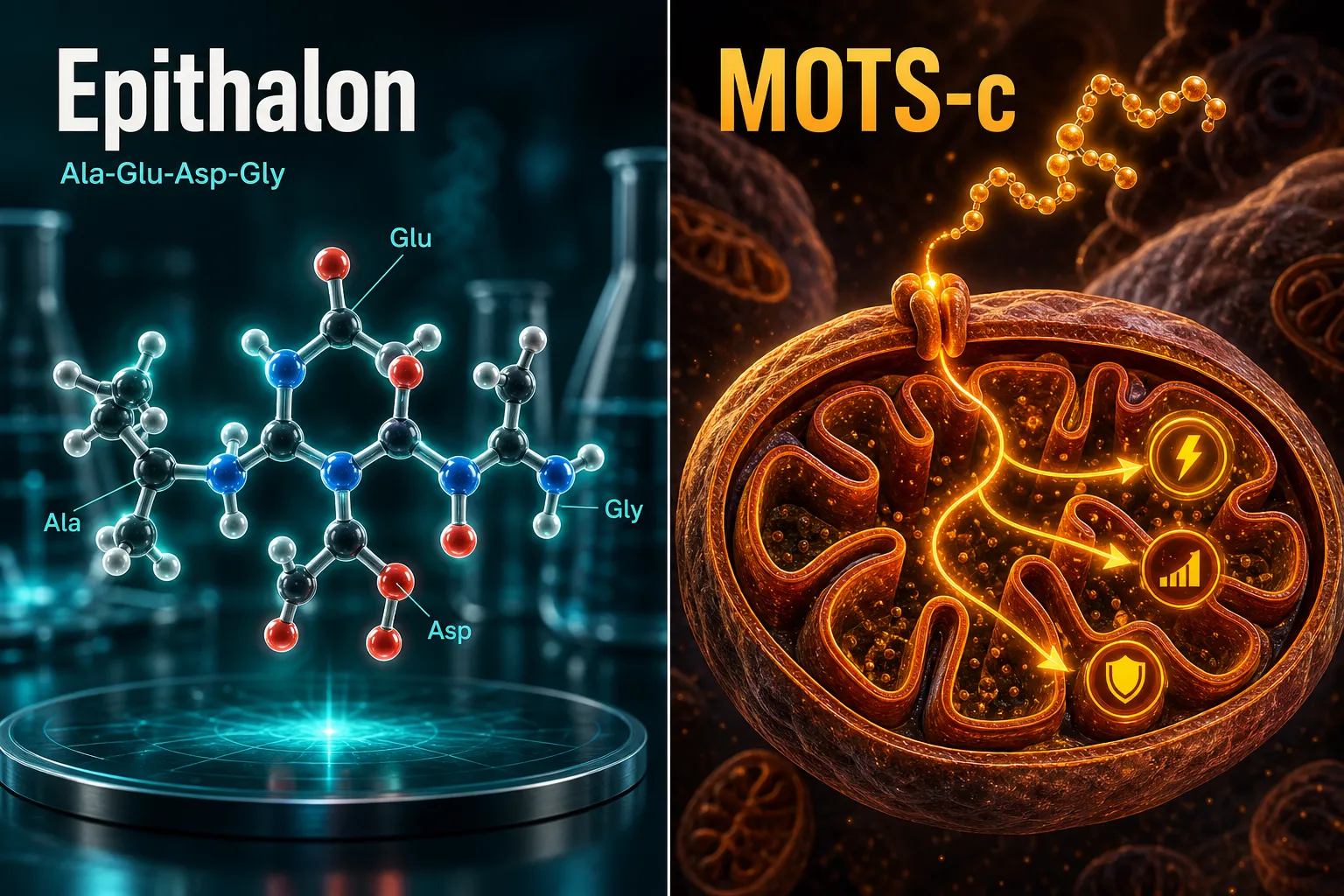
Epithalon (Ala-Glu-Asp-Gly) is a synthetic four-amino-acid peptide derived from the natural polypeptide Epithalamin, originally isolated from the pineal gland. It has been studied extensively in Russian gerontology research since the 1980s, with a growing body of preclinical data examining its effects on telomere dynamics.

Documented preclinical findings include:

  • Activation of telomerase in human somatic cells in vitro, leading to telomere elongation
  • Normalization of melatonin secretion patterns in aged animal models
  • Reduction of oxidative stress markers in aging tissues
  • Modulation of p53-dependent senescence pathways

A landmark study by Khavinson et al. demonstrated that Epithalon could elongate telomeres in cultured human fetal fibroblasts and extend the replicative lifespan of those cells beyond the normal Hayflick limit. This was a significant finding because it suggested that a short exogenous peptide could influence a core genetic aging mechanism.

"Telomerase activation without oncogenic transformation remains the key safety question in all telomere-extension research, and it is precisely the question that Epithalon preclinical models are designed to probe."

The peptide's mechanism appears to involve upregulation of the TERT gene (the catalytic subunit of telomerase), though the full upstream signaling pathway is still being characterized. For researchers exploring the broader landscape of peptide delivery and formulation science, innovative peptide delivery systems represent an important parallel area of development that affects how compounds like Epithalon are studied in vivo.
Epithalon: A Tetrapeptide With Telomerase-Activating Properties

MOTS-c: Mitochondrial DNA as a Source of Longevity Signals

While Epithalon targets nuclear telomere biology, MOTS-c operates from an entirely different genetic compartment: mitochondrial DNA (mtDNA). MOTS-c (Mitochondrial Open Reading Frame of the 12S rRNA Type-c) is a 16-amino-acid peptide encoded within the 12S ribosomal RNA gene of the mitochondrial genome.

This discovery, published in 2015, fundamentally changed how researchers think about mitochondria. Rather than being passive energy factories, mitochondria actively communicate with the nucleus through peptide signals, a process called retrograde signaling.

MOTS-c research highlights:

  • Translocates to the nucleus under metabolic stress conditions
  • Activates AMPK (AMP-activated protein kinase), a master regulator of cellular energy homeostasis
  • Reduces age-related insulin resistance in mouse models
  • Modulates the integrated stress response (ISR) to promote cellular resilience

The MOTS-c metabolic flexibility research overview provides additional context on how this peptide influences glucose metabolism and mitochondrial efficiency, both of which decline measurably with age. Separately, MOTS-c mitochondrial dynamics research examines how the peptide affects mitochondrial network architecture in aging models.

Critically, MOTS-c levels decline naturally with age in both rodents and humans, suggesting it may function as an endogenous longevity signal whose loss contributes to metabolic aging.

Positioning Both Peptides Within DNA, Telomeres, and Longevity Peptides Research

Understanding DNA, Telomeres, and Longevity Peptides: Positioning Epithalon and MOTS-c in Genetic Aging Research requires recognizing that these two compounds target different but complementary aging mechanisms:

Feature Epithalon MOTS-c
Origin Synthetic pineal-derived tetrapeptide Mitochondrial DNA-encoded peptide
Primary Target Nuclear telomerase / TERT gene AMPK / nuclear stress response
Aging Mechanism Telomere shortening, replicative senescence Metabolic decline, mitochondrial signaling
Research Model Cell culture, rodent lifespan studies Rodent metabolic aging, exercise models

Neither peptide is approved for human therapeutic use. Both are research-grade compounds studied in preclinical settings to map the genetic and metabolic architecture of aging.

Researchers interested in the mitochondrial protection angle may also find value in reviewing SS-31 peptide research, which targets mitochondrial membrane integrity through a distinct cardiolipin-binding mechanism, offering a third angle on mitochondrial aging biology.

For those exploring how peptide combinations are being studied, peptide blends research covers multi-compound preclinical approaches that are increasingly common in longevity-focused research designs.

Positioning Both Peptides Within DNA, Telomeres, and Longevity Peptides Research

Conclusion

The science connecting DNA, Telomeres, and Longevity Peptides: Positioning Epithalon and MOTS-c in Genetic Aging Research is still maturing, but the foundational mechanisms are well-supported by preclinical evidence. Telomere attrition and mitochondrial signaling decline are two of the most reproducible molecular hallmarks of aging, and both Epithalon and MOTS-c offer research tools to probe these systems with specificity.

Actionable next steps for researchers and science-minded readers:

  1. Review primary literature on Epithalon's TERT upregulation studies before drawing conclusions about telomerase safety profiles.
  2. Examine MOTS-c research in the context of AMPK biology to understand its metabolic aging relevance.
  3. Explore complementary mitochondrial peptides such as SS-31 to build a more complete picture of mitochondrial aging mechanisms.
  4. Consult peer-reviewed geroscience journals for the latest updates on telomere-targeted interventions entering early-phase human studies.
  5. Source any research-grade peptides only from suppliers providing third-party purity verification and full documentation.

The genetic architecture of aging is not a single pathway, it is a network. Epithalon and MOTS-c represent two well-characterized entry points into that network, and understanding both deepens the overall framework for longevity research in 2026 and beyond.

https://www.puretestedpeptides.com/wp-content/uploads/2026/07/dna-telomeres-and-longevity-peptides-positioning-epithalon-and-mots-c-in-genetic.webp 1024 1536 https://www.puretestedpeptides.com/wp-content/uploads/2026/01/buy-peptides-online.jpg 2026-07-21 13:40:102026-07-21 13:40:12DNA, Telomeres, and Longevity Peptides: Positioning Epithalon and MOTS‑c in Genetic Aging Research
×

Helpful Links

  • My account
  • Cart
  • Checkout
  • Refund and Returns Policy
  • Privacy Policy
  • SMS Privacy Policy
  • Login
  • My Account
  • Logout

USA Made Lab Tested Peptides

All products are sold for research, laboratory, or analytical purposes only, and are not for human consumption


Pure Tested Peptides is a chemical supplier. Pure Tested Peptides is not a compounding / chemical compounding facility as defined under 503A of the Federal Food, Drug, and Cosmetic act. Pure Tested Peptides is not an outsourcing facility as defined under 503B of the Federal Food, Drug, and Cosmetic act.

The statements made within this website have not been evaluated by the US Food and Drug Administration. The products we offer are not intended to diagnose, treat, cure or prevent any disease.

Human/Animal Consumption Prohibited. Laboratory/In-Vitro Experimental Use Only

Scroll to top Scroll to top Scroll to top