Call or Text 727-513-9780
  • Shopping Cart Shopping Cart
    0Shopping Cart
Pure Tested Peptides | America's most trusted Peptides for sale online
  • Peptides for sale
    • Oral Peptides for sale
      • Peptide Capsules for sale
      • BPC 157 Capsules 1000mcg
      • SLU-PP-332 Capsules | 1000 mcg
      • 5-Amino-1MQ 50mg Capsules
      • Tesofensine 500mcg
    • All Peptides for sale
    • Peptide Sprays
      • BPC 157 Nasal Spray Kit
      • BPC-157 TB500 Nasal Spray Kit
      • Semax Nasal Spray 10mg
      • Selank – Nasal Spray Kit – 10mg
      • Epithalon 50MG Nasal Spray Kit
      • Ipamorelin 10mg Nasal Spray
      • Klow Nasal Spray (BPC-157 + TB-500 + GHK-Cu + KPV) | 80mg
      • Hulk Nasal Spray Tesa / Ipa Blend 6/3 MG
      • Klow Nasal Spray
      • NAD + 500 mg Nasal Spray
      • PT-141 Nasal Spray Kit
    • GHRH Peptides
      • Ipa Peptides
      • CJC-1295 Peptides
        • CJC-1295 with DAC 5 mg
        • CJC-1295 without DAC 5 mg
        • CJC-1295 Ipa 10mg
      • Tesa Peptides
        • Tesa Peptide
        • Tesa 20 mg
    • GHK-Cu Peptides
      • All GHK-Cu Peptides
      • GHK-Cu 100mg
      • KLOW Peptide Blend – Buy KLOW blend online
    • BPC Peptides
      • All BPC Peptides
      • BPC-157
      • BPC-157 TB-500
      • BPC 157 capsules 1000mcg
    • SLU-PP-332 Peptides
      • All SLU-PP-332 Peptides
      • SLU-PP-332 5mg
    • GLP3 Peptides
      • GLP3-R
      • GLP3-R CAG 10mg
      • GLP3-R 20mg
    • PT-141 Peptides
      • PT-141 Peptides for sale
      • PT-141 10mg
      • PT-141 Nasal Spray
    • CAG Peptides
      • Lipo-C Peptide Blend
      • CAG 5mg
      • CAG 10mg
    • MOTS-C Peptides
      • MOTS-C Peptides for sale
      • MOTS-c peptide
      • MOTS-c 10mg *6 pack*
    • 5 Amino 1MQ Peptides
      • 5 Amino 1MQ Peptides for sale
      • 5-Amino-1MQ 50mg Capsules
      • 5-Amino-1MQ 5mg
    • Epithalon Peptides
      • Epithalon Peptides for sale
      • Epithalon 10mg
      • Epithalon 50mg
  • Shop
    • GLPs
      • 5-Amino-1MQ 50mg Capsules
      • 5-Amino-1MQ 5mg
      • GLP3-Reta
      • L-Carnitine 500mg/ml
      • Tesofensine 500mcg
      • SLU-PP-332 5mg
      • MOTS-c 10mg *6 pack*
    • Epithalon & BPC Peptides
      • Epithalon 10mg
      • Epithalon 50mg
      • BPC-157
      • BPC 157 capsules 1000mcg
      • BPC-157 TB-500
      • BPC-157 TB500 Nasal Spray Kit
      • BPC 157 Nasal Spray Kit
    • BPC TB-500 & NAD+ Peptides
      • NAD+ 500 mg
      • KLOW Peptide Blend – Buy KLOW blend online
      • GLOW Peptide Blend
      • TB 500 5mg
      • BPC 157 capsules 1000mcg – Supplement
      • BPC 157 Nasal Spray Kit
      • BPC-157
      • BPC-157 TB500 Nasal Spray Kit
      • BPC-157 TB-500
      • BPC 157 capsules 1000mcg
    • LL-37 Peptide
      • LL-37 10 mg
    • MOTS-C & Selank
      • MOTS-c peptide
      • Selank 10mg
    • GHK Peptides
      • GHK-Cu 100mg
      • GLOW Peptide Blend
      • KLOW Peptide Blend – Buy KLOW blend online
  • COAs
  • Wholesale
    • Wholesale Peptides for sale
  • PTP FAQ
  • Affiliates
    • Selank Peptide: Advanced Pharmacological Mechanisms Underlying Its Anxiolytic and Nootropic Effects in Research
      • 5-Amino-1MQ Peptide: Detailed Mechanisms of NNMT Inhibition and Its Impact on Cellular Metabolism Research
        • MOTS-C Peptide: Unraveling Its Role in Mitochondrial Dynamics and Energy Metabolism Research
          • Epithalon Peptide and Telomerase Regulation: Investigating Its Impact on Cellular Senescence and Lifespan Research Models
            • GLP2-T vs GLP2 Tirz Peptide: Understanding the Naming, Mechanistic Nuances, and Research Implications for Gut Health
      • Peptides and Polypeptides in Modern Pharmacology: What Research on Metoprolol, Prednisone, and Amlodipine Reveals
        • Polypeptide Peptides vs NSAIDs: What Naproxen and Diclofenac Teach Tissue-Repair Researchers About BPC‑157 and TB‑500
          • Peptides and Polypeptides in Endocrine Pharmacology: How GLP-1, GLP-2, and GLP-3 Retatrutide Differ From Classic Drugs Like Prednisone and Amlodipine
          • 5‑Amino‑1MQ Peptide and NNMT Inhibition: How It Compares With Statins Like Atorvastatin in Adipose and Lipid Metabolism Research
      • Enclomiphene, Estrogen Receptor Signaling, and Luteinizing Phase Biology: What Hormone Researchers Should Measure
        • Mesenchymal Stem Cells, BPC‑157, and GHK‑Cu: How Tissue Repair Peptides Compare With Classic NSAIDs Like Naproxen in Injury Models
          • Peptide Calculator Use Cases Beyond Growth Hormone: Working Through GLP‑3 Retatrutide, MOTS‑c, and BPC‑157 Research Dosing
        • Polypeptide Peptides in Endocrine and Metabolic Pharmacology: Lessons From Amlodipine, Prednisone, and Metoprolol
        • Peptides Calculator for Advanced Blends: Worked Examples for Tesamorelin, CJC‑1295, and Ipamorelin Stacks
          • Peptides and Polypeptides in Human Physiology: How Molecular Size Shapes Research Applications
            • Selank Peptide: Advanced Pharmacological Mechanisms Underlying Its Anxiolytic and Nootropic Effects in Research
          • 5-Amino-1MQ Peptide: Detailed Mechanisms of NNMT Inhibition and Its Impact on Cellular Metabolism Research
            • MOTS-C Peptide: Unraveling Its Role in Mitochondrial Dynamics and Energy Metabolism Research
              • Epithalon Peptide and Telomerase Regulation: Investigating Its Impact on Cellular Senescence and Lifespan Research Models
                • GLP2-T vs GLP2 Tirz Peptide: Understanding the Naming, Mechanistic Nuances, and Research Implications for Gut Health
                  • Peptides and Polypeptides in Endocrine Pharmacology: How GLP-1, GLP-2, and GLP-3 Retatrutide Differ From Classic Drugs Like Prednisone and Amlodipine
                    • Polypeptide Peptides vs NSAIDs: What Naproxen and Diclofenac Teach Tissue-Repair Researchers About BPC‑157 and TB‑500
                      • Peptides and Polypeptides in Modern Pharmacology: What Research on Metoprolol, Prednisone, and Amlodipine Reveals
                        • 5‑Amino‑1MQ Peptide and NNMT Inhibition: How It Compares With Statins Like Atorvastatin in Adipose and Lipid Metabolism Research
                        • Enclomiphene, Estrogen Receptor Signaling, and Luteinizing Phase Biology: What Hormone Researchers Should Measure
                        • Mesenchymal Stem Cells, BPC‑157, and GHK‑Cu: How Tissue Repair Peptides Compare With Classic NSAIDs Like Naproxen in Injury Models
                        • Peptide Calculator Use Cases Beyond Growth Hormone: Working Through GLP‑3 Retatrutide, MOTS‑c, and BPC‑157 Research Dosing
                        • Polypeptide Peptides in Endocrine and Metabolic Pharmacology: Lessons From Amlodipine, Prednisone, and Metoprolol
                        • Peptides Calculator for Advanced Blends: Worked Examples for Tesamorelin, CJC‑1295, and Ipamorelin Stacks
                        • Peptides and Polypeptides in Human Physiology: How Molecular Size Shapes Research Applications
                        • Selank Peptide: Advanced Pharmacological Mechanisms Underlying Its Anxiolytic and Nootropic Effects in Research
                        • MOTS-C Peptide: Unraveling Its Role in Mitochondrial Dynamics and Energy Metabolism Research
                        • Peptides and Polypeptides in Modern Pharmacology: What Research on Metoprolol, Prednisone, and Amlodipine Reveals
                        • Peptides and Polypeptides in Endocrine Pharmacology: How GLP-1, GLP-2, and GLP-3 Retatrutide Differ From Classic Drugs Like Prednisone and Amlodipine
                        • 5-Amino-1MQ Peptide: Detailed Mechanisms of NNMT Inhibition and Its Impact on Cellular Metabolism Research
                        • Mesenchymal Stem Cells, BPC‑157, and GHK‑Cu: How Tissue Repair Peptides Compare With Classic NSAIDs Like Naproxen in Injury Models
                        • Peptide Calculator Use Cases Beyond Growth Hormone: Working Through GLP‑3 Retatrutide, MOTS‑c, and BPC‑157 Research Dosing
                        • GLP2-T vs GLP2 Tirz Peptide: Understanding the Naming, Mechanistic Nuances, and Research Implications for Gut Health
                        • Polypeptide Peptides in Endocrine and Metabolic Pharmacology: Lessons From Amlodipine, Prednisone, and Metoprolol
                        • Polypeptide Peptides vs NSAIDs: What Naproxen and Diclofenac Teach Tissue-Repair Researchers About BPC‑157 and TB‑500
                        • Peptides and Polypeptides in Human Physiology: How Molecular Size Shapes Research Applications
                        • Peptides Calculator for Advanced Blends: Worked Examples for Tesamorelin, CJC‑1295, and Ipamorelin Stacks
                        • 5‑Amino‑1MQ Peptide and NNMT Inhibition: How It Compares With Statins Like Atorvastatin in Adipose and Lipid Metabolism Research
                        • Enclomiphene, Estrogen Receptor Signaling, and Luteinizing Phase Biology: What Hormone Researchers Should Measure
                        • Epithalon Peptide and Telomerase Regulation: Investigating Its Impact on Cellular Senescence and Lifespan Research Models
                        • Best research protocol Klow blend
                        • best time to take BPC-157
                        • best time to take DSIP (Delta Sleep Inducing Peptide)
                        • best time to take CJC-1295
                        • best time to take AOD-9604
                        • best time to take Follistatin 344
                        • best time to take Ipamorelin
                        • best time to take MK-677 (Ibutamoren)
                        • best time to take Ligandrol (LGD-4033) — research compound
                        • best time to take Ostarine (MK-2866) — research compound
                        • best time to take GHK-CU
                        • best time to take TB-500
                        • best time to take MOTS-c
                        • best time to take Semax
                        • best time to take RAD-140 (Testolone) — research compound
                        • best time to take Thymosin Alpha-1
                        • best time to take PEG-MGF
                        • Biolife Plasma, Octapharma Plasma, and Research Peptides: How Plasma Donation Labs Differ From Peptide Suppliers
                        • best time to take YK-11 — research compound
                        • best time to take PT-141 (Bremelanotide)
                        • Best research protocol Klow blend
  • Contact
    • Contact Customer Service
    • Text Customer Support
  • About US
  • Shop all peptides
  • Affiliate Program
    • Affiliate Signup
  • Login / Register Login / Register Page Link Login / Register Page Link
  • Click to open the search input field Click to open the search input field Search
  • Menu Menu

Tag Archive for: peptide stack compatibility

Enclomiphene Citrate: serm Mechanism, Testosterone Research, and Stack Compatibility

Enclomiphene Citrate: serm Mechanism, Testosterone Research, and Stack Compatibility

July 26, 2026/0 Comments/in Uncategorized/by

Low testosterone affects an estimated 2.1% of men under 40 and rises sharply with age, yet the clinical tools for restoring endogenous hormone production without suppressing fertility remain limited. Enclomiphene citrate has emerged as a focused research candidate in this gap. As a selective estrogen receptor modulator (serm), enclomiphene citrate offers a mechanistically distinct approach to endocrine support, and understanding its serm mechanism, testosterone research profile, and stack compatibility is essential for any researcher designing rigorous experimental protocols in 2026.

Key Takeaways

  • Enclomiphene citrate is the trans-isomer of clomiphene and acts as an estrogen receptor antagonist at the hypothalamic-pituitary axis.
  • By blocking negative estrogen feedback, it stimulates LH and FSH release, which drives endogenous testosterone production.
  • Clinical trials show meaningful testosterone elevation without the suppressive effects associated with exogenous androgen replacement.
  • Researchers frequently examine enclomiphene alongside peptide-based compounds to build multi-target experimental stacks.
  • Purity verification and sourcing documentation are critical before any laboratory use.

How Enclomiphene Citrate Works as a serm

The Hypothalamic-Pituitary-Gonadal Axis

To understand enclomiphene citrate's serm mechanism, one must first understand the feedback loop it targets. The hypothalamic-pituitary-gonadal (HPG) axis regulates testosterone through a tightly controlled signaling chain:

  1. The hypothalamus releases gonadotropin-releasing hormone (GnRH).
  2. GnRH prompts the pituitary to secrete luteinizing hormone (LH) and follicle-stimulating hormone (FSH).
  3. LH signals the Leydig cells in the testes to produce testosterone.
  4. Rising testosterone and estradiol feed back to the hypothalamus and pituitary, suppressing further GnRH and LH release.

Enclomiphene citrate blocks estrogen receptors at the hypothalamus and pituitary. This prevents estradiol from delivering its suppressive feedback signal. The result is sustained or elevated GnRH pulsatility, higher LH output, and increased endogenous testosterone synthesis.
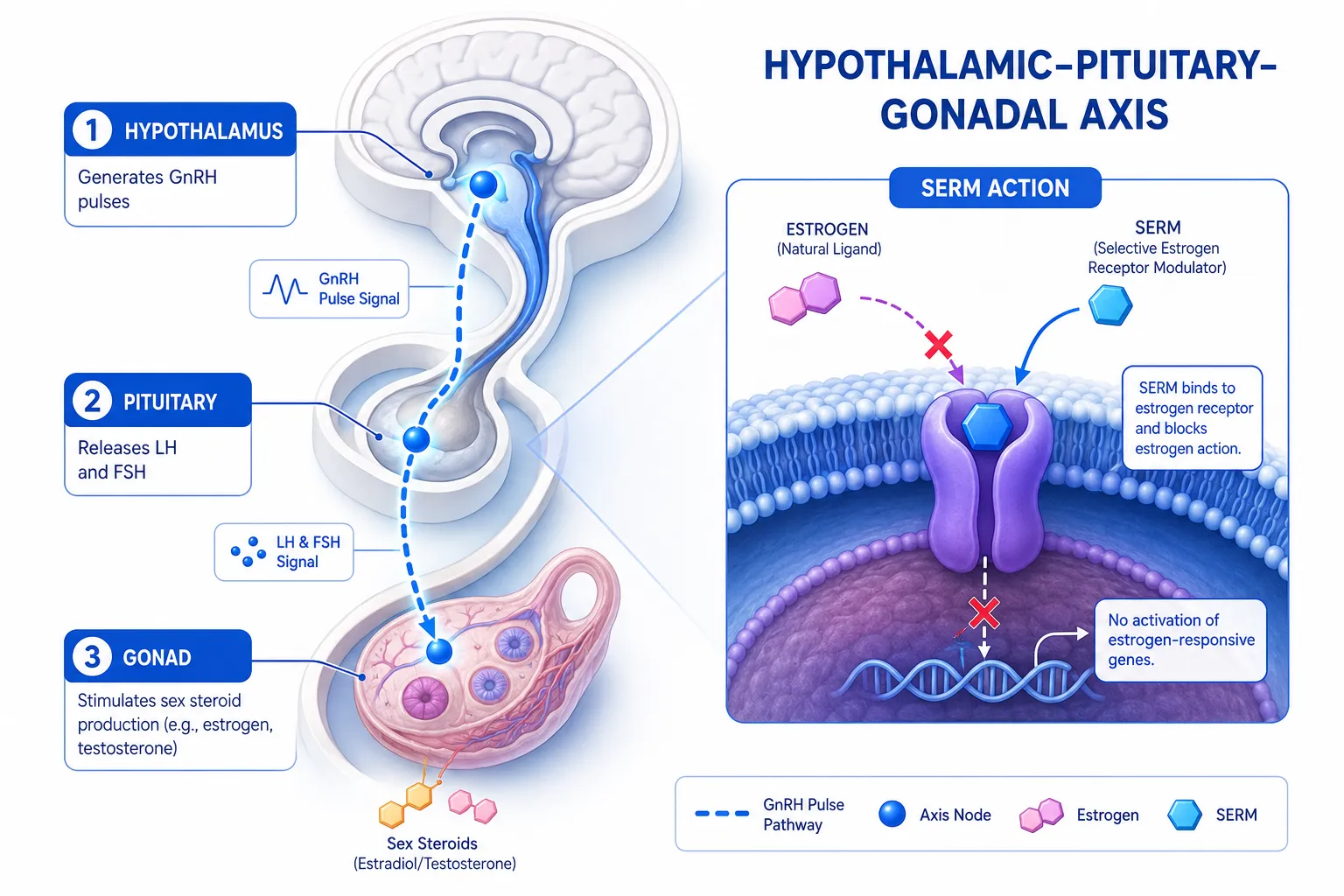
The Hypothalamic-Pituitary-Gonadal Axis

Enclomiphene vs. Zuclomiphene: Why Isomer Separation Matters

Clomiphene citrate is a 50/50 mixture of two geometric isomers: enclomiphene (trans) and zuclomiphene (cis). Research has clarified that these isomers behave very differently:

Property Enclomiphene (trans) Zuclomiphene (cis)
Receptor activity Antagonist Partial agonist
Half-life Short (~10 hours) Long (~30 days)
HPG stimulation Strong Weak or counterproductive
Accumulation risk Low High

Zuclomiphene's long half-life allows it to accumulate and act as a partial estrogen agonist, potentially blunting the very HPG stimulation researchers seek. Isolating the enclomiphene isomer removes this confounding variable and produces cleaner experimental data. For researchers exploring biochemistry-focused endocrine protocols, this mechanistic clarity is a significant advantage.

Testosterone Research: What the Evidence Shows

Clinical Trial Findings

Several Phase II and Phase III trials have examined enclomiphene citrate in men with secondary hypogonadism. Key findings include:

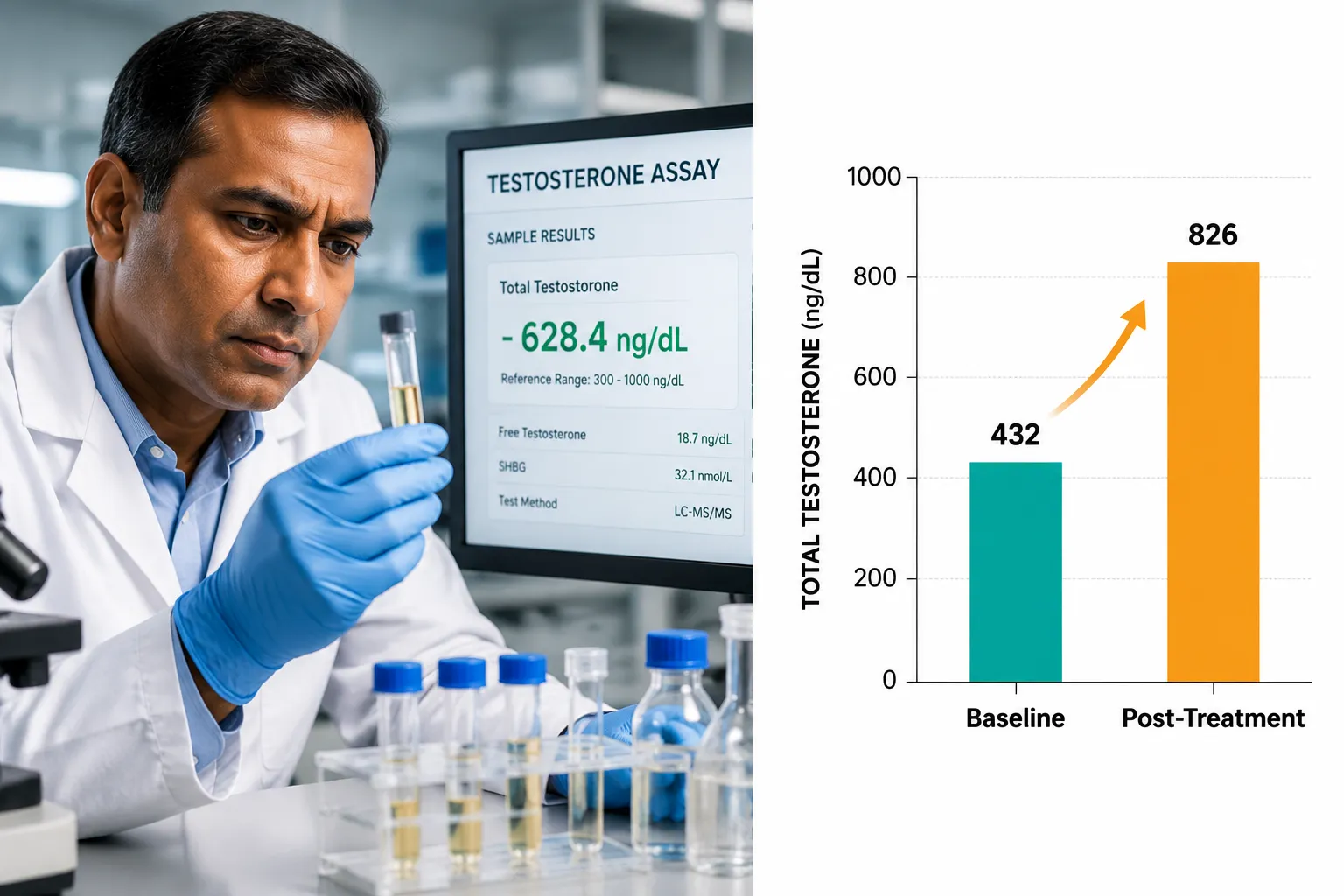
  • Testosterone normalization: Enclomiphene consistently raised serum total testosterone into the normal adult male range (400-700 ng/dL) in men who began with deficient levels.
  • LH and FSH preservation: Unlike exogenous testosterone, enclomiphene maintained or elevated gonadotropin levels, preserving testicular function and sperm parameters.
  • Estradiol management: Because enclomiphene blocks estrogen receptors rather than suppressing aromatase, estradiol levels in trials remained within acceptable ranges for most subjects, though individual variation was noted.

"Enclomiphene citrate restored testosterone without the gonadotropin suppression that defines conventional androgen replacement, a mechanistically important distinction for fertility-conscious research models."

Research Gaps and Limitations

Despite promising data, several areas remain under-studied:

  • Long-term safety data beyond 12 months is sparse.
  • Effects in women and in non-reproductive endocrine contexts are not well characterized.
  • Interactions with aromatase inhibitors and other endocrine-active compounds require further controlled investigation.

Researchers should treat available findings as hypothesis-generating rather than definitive. Protocols should include appropriate controls and validated assay methods.
Research Gaps and Limitations

Stack Compatibility: Enclomiphene Citrate in Multi-Compound Research Protocols

Why Researchers Combine Enclomiphene with Peptides

Research interest in enclomiphene citrate has grown alongside broader multi-target experimental design. Because enclomiphene acts upstream at the HPG axis rather than directly on androgen receptors, it is mechanistically compatible with several peptide classes that operate through entirely different pathways.

Common research combinations include:

  • Growth hormone secretagogues: Compounds like those in serm and Ipamorelin/CJC-1295 research blends are studied alongside serms to evaluate whether GH axis support and HPG axis normalization produce additive or independent effects on body composition and metabolic markers.
  • Tissue repair peptides: Researchers examining recovery contexts may pair enclomiphene with compounds like BPC-157 to study whether hormonal normalization affects tissue repair endpoints.
  • Metabolic peptides: Some protocols incorporate AOD-9604 alongside serms when the research question involves fat metabolism and hormonal context simultaneously.

Designing a Rigorous Stack Protocol

Before combining enclomiphene with any additional compound, researchers should address the following:

  1. Define independent variables clearly. Each compound should have a documented rationale tied to a specific mechanistic pathway.
  2. Establish washout periods. Enclomiphene's short half-life simplifies washout design compared to zuclomiphene, but co-administered peptides may have different clearance timelines.
  3. Use validated biomarkers. LH, FSH, total testosterone, free testosterone, estradiol, and SHBG are the minimum assay panel for HPG-focused research. Peptide-specific markers should be added based on the secondary compound.
  4. Source verified materials. Purity documentation is non-negotiable. Researchers sourcing lab-tested peptides for combination studies should require certificates of analysis for every compound in the stack.

For researchers exploring growth hormone axis interactions specifically, reviewing Sermorelin and Ipamorelin/CJC-1295 combination research provides useful context on how multi-peptide stacks are structured and documented.
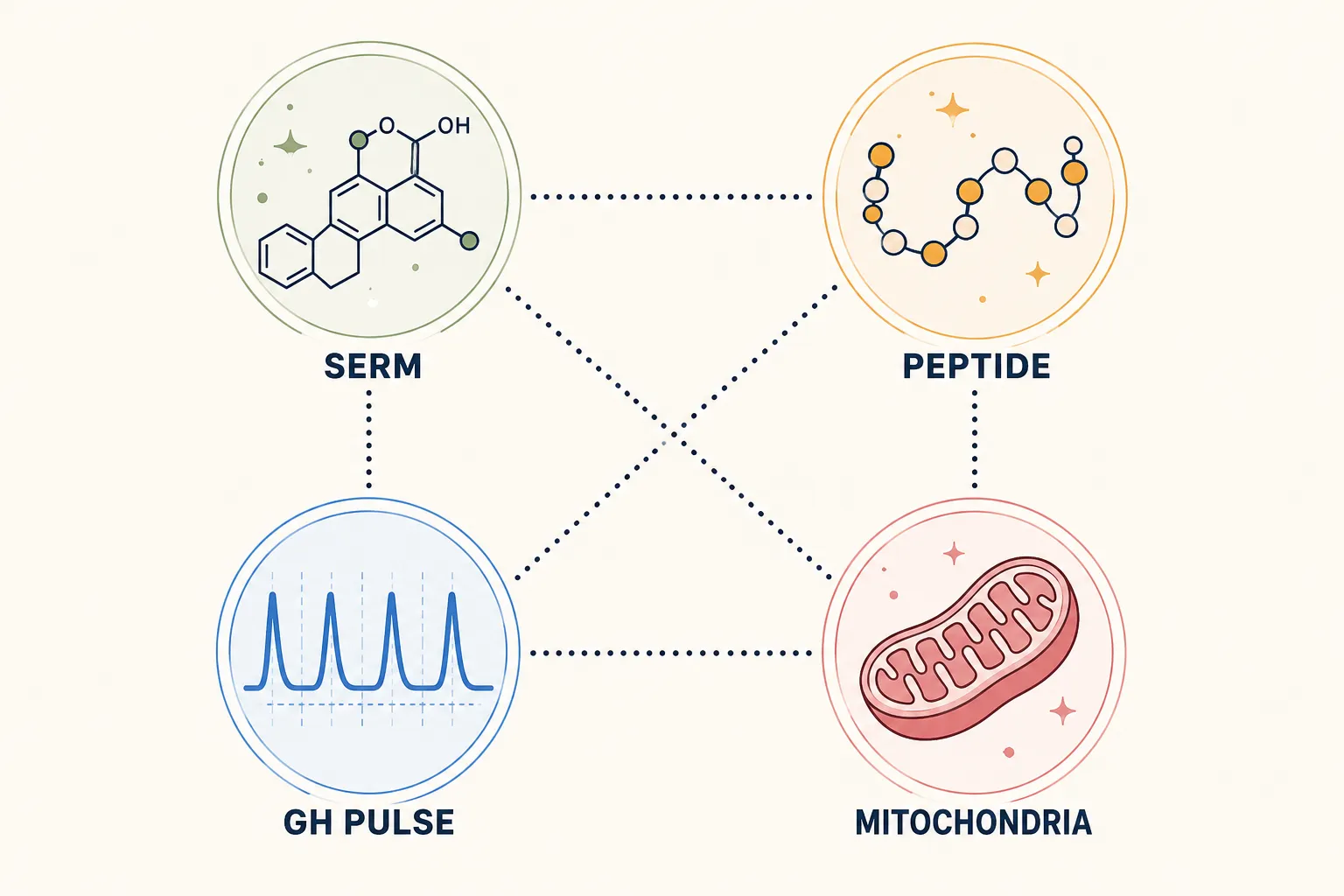
Designing a Rigorous Stack Protocol

Conclusion

Enclomiphene citrate represents one of the more mechanistically coherent tools available for HPG axis research in 2026. Its selective estrogen receptor antagonism at the hypothalamic-pituitary level drives endogenous LH and FSH output, producing testosterone elevation without the suppressive profile of exogenous androgen therapy. The isomeric separation from zuclomiphene removes a significant confounding variable that has historically complicated clomiphene-based research.

Actionable next steps for researchers:

  • Review published Phase II/III trial data to establish baseline expectations for LH, FSH, and testosterone response curves.
  • Design stack protocols with clear mechanistic rationale for each co-administered compound, using enclomiphene's short half-life as a timing anchor.
  • Source enclomiphene and any co-administered peptides from suppliers providing full purity documentation and third-party testing.
  • Consult the serm 10mg research product documentation for sourcing and traceability standards applicable to experimental use.

Rigorous experimental design, verified sourcing, and mechanistic clarity remain the foundation of credible enclomiphene citrate research.

References

  • Kim ED, Crosnoe L, Bar-Chama N, Khera M, Lipshultz LI. The treatment of hypogonadism in men of reproductive age. Fertility and Sterility. 2013;99(3):718-724.
  • Wiehle R, Cunningham GR, Pitteloud N, et al. Testosterone Restoration by Enclomiphene Citrate in Men with Secondary Hypogonadism. BJU International. 2013;112(8):1188-1200.
  • Krzastek SC, Smith RP. Non-testosterone management of male hypogonadism: an examination of the existing literature. Translational Andrology and Urology. 2020;9(Suppl 2):S160-S170.
  • Shabsigh R, Katz M, Yan G, Makhsida N. Cardiovascular issues in hypogonadism and testosterone therapy. The American Journal of Cardiology. 2005;96(12B):67M-72M.
  • Helo S, Ellen J, Mechlin C, et al. A randomized prospective double-blind comparison trial of clomiphene citrate and anastrozole in raising testosterone in hypogonadal infertile men. Journal of Sexual Medicine. 2015;12(8):1761-1769.
https://www.puretestedpeptides.com/wp-content/uploads/2026/07/enclomiphene-citrate-serm-mechanism-testosterone-research-and-stack-compatibilit.webp 1024 1536 https://www.puretestedpeptides.com/wp-content/uploads/2026/01/buy-peptides-online.jpg 2026-07-26 13:05:192026-07-26 13:05:19Enclomiphene Citrate: serm Mechanism, Testosterone Research, and Stack Compatibility
×

Helpful Links

  • My account
  • Cart
  • Checkout
  • Refund and Returns Policy
  • Privacy Policy
  • SMS Privacy Policy
  • Login
  • My Account
  • Logout

USA Made Lab Tested Peptides

All products are sold for research, laboratory, or analytical purposes only, and are not for human consumption


Pure Tested Peptides is a chemical supplier. Pure Tested Peptides is not a compounding / chemical compounding facility as defined under 503A of the Federal Food, Drug, and Cosmetic act. Pure Tested Peptides is not an outsourcing facility as defined under 503B of the Federal Food, Drug, and Cosmetic act.

The statements made within this website have not been evaluated by the US Food and Drug Administration. The products we offer are not intended to diagnose, treat, cure or prevent any disease.

Human/Animal Consumption Prohibited. Laboratory/In-Vitro Experimental Use Only

Scroll to top Scroll to top Scroll to top