

PT-141 Peptide Research in Female Sexual Function and Desire Models: What the Preclinical Evidence Actually Suggests
Nearly one in ten premenopausal women meets diagnostic criteria for hypoactive sexual desire disorder (HSDD), yet for decades the pharmacological toolkit for this condition remained nearly empty. PT-141 peptide research in female sexual function and desire models changed that conversation — not by improving blood flow, but by targeting the brain itself. Understanding what the preclinical evidence actually suggests requires a close look at melanocortin signaling, the receptor biology that drives it, and how animal model data translated into a regulatory approval.
Key Takeaways
- PT-141 (bremelanotide) acts on central melanocortin receptors, particularly MC4R, to modulate sexual desire rather than peripheral vascular tone.
- Preclinical studies in rats and nonhuman primates demonstrated measurable increases in pro-sexual behavior following PT-141 administration.
- A clear dose-response relationship was identified, with 1.75 mg subcutaneous emerging as the optimal research dose.
- Effects typically begin within 30 to 60 minutes and last 2 to 6 hours, consistent with the compound's pharmacokinetic profile.
- The FDA approved bremelanotide for HSDD in premenopausal women in 2019, backed by two Phase 3 randomized controlled trials.
The Melanocortin System: Why Central Signaling Matters for Female Desire
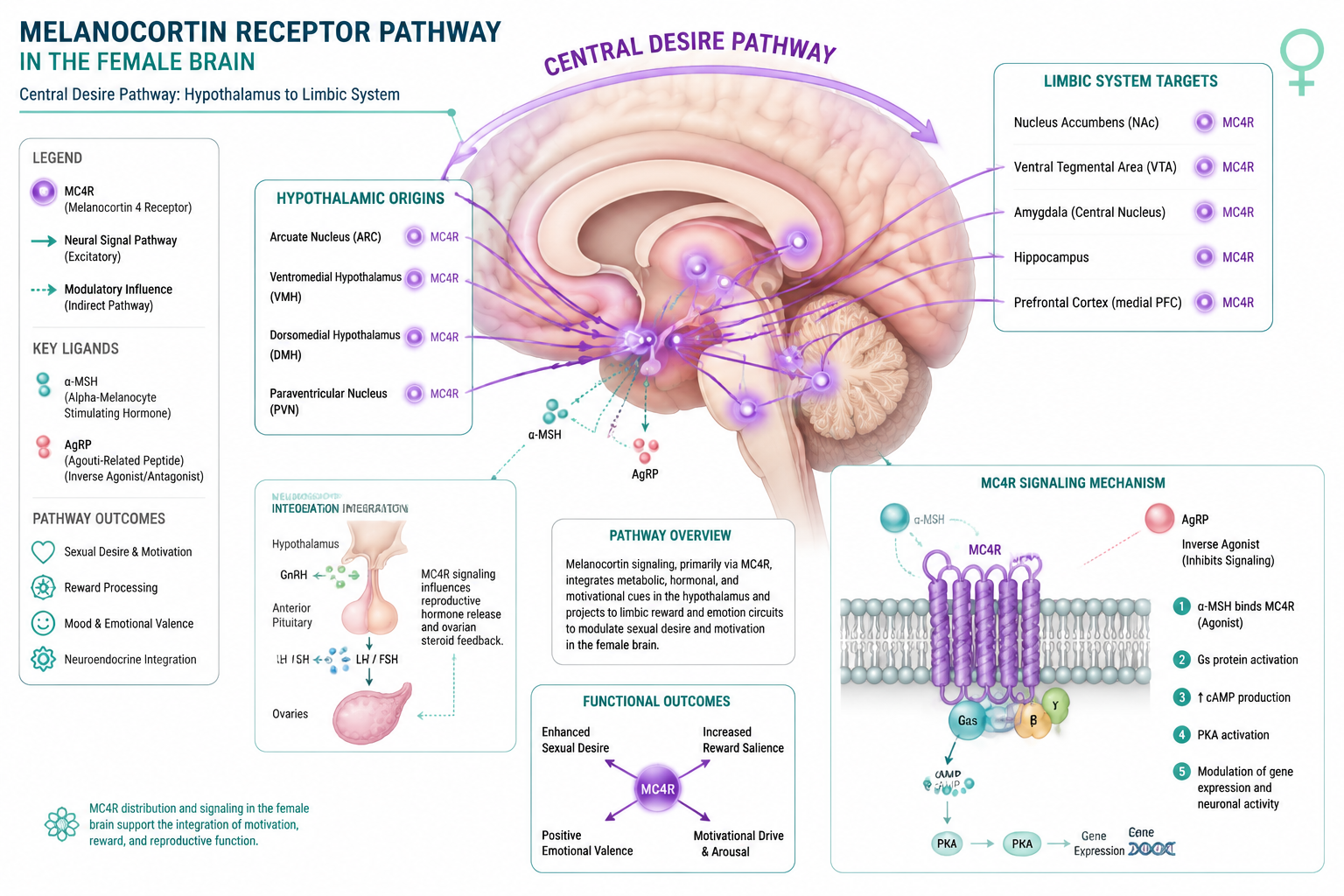
Sexual desire in women is not primarily a vascular event. It is a neurological one. The melanocortin system — a network of receptors distributed across the hypothalamus, limbic system, and brainstem — plays a documented role in regulating appetite, energy balance, and sexual motivation. Among the five known melanocortin receptor subtypes, MC4R has attracted the most attention in desire research.
PT-141 (bremelanotide) is a cyclic heptapeptide and metabolite of the tanning peptide Melanotan II. It binds MC3R and MC4R with high affinity. When MC4R is activated in the medial preoptic area and paraventricular nucleus, downstream signaling cascades influence dopaminergic and oxytocinergic pathways — both of which are strongly linked to motivated sexual behavior.
This mechanism is fundamentally different from approaches that target genital blood flow. Researchers studying PT-141 neural and metabolic research themes have noted that the compound's central action explains why its effects manifest as subjective desire rather than purely physical arousal.
"The melanocortin pathway represents one of the few tractable central targets for desire modulation identified through rigorous preclinical screening."
What Preclinical Models Reveal About PT-141 Peptide Research in Female Sexual Function and Desire Models
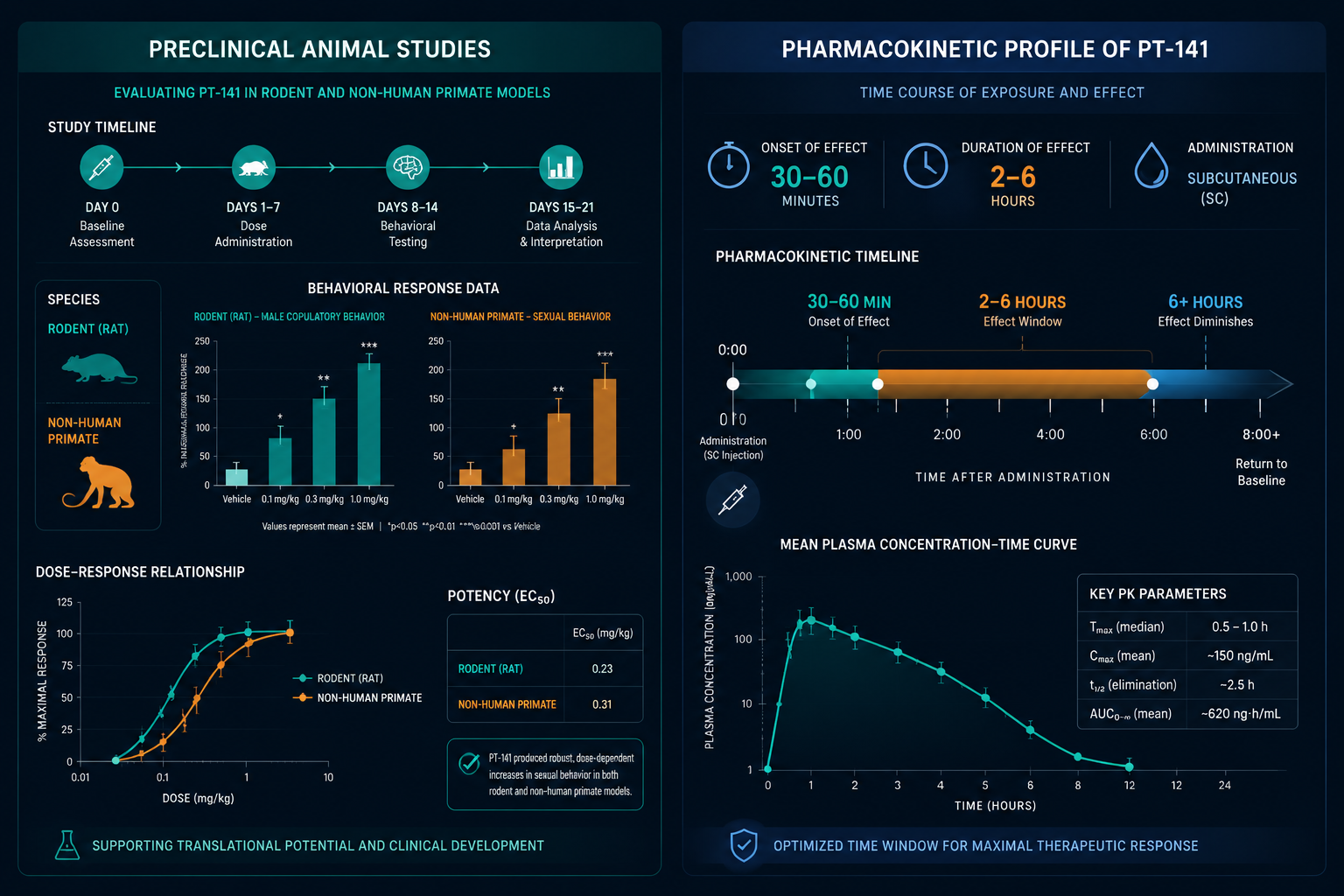
Animal models were essential in establishing the biological plausibility of MC4R agonism for sexual function. In ovariectomized rats — a standard model for studying hormone-independent desire — PT-141 administration produced significant increases in solicitation behaviors, lordosis quotients, and approach frequency toward male conspecifics. These are well-validated behavioral endpoints in rodent sexual function research.
Studies in nonhuman primates extended these findings. Female primates showed increased proceptive behaviors and reduced rejection behaviors following PT-141 exposure, suggesting the effect generalizes across mammalian species with more complex social and hormonal contexts.
Key preclinical findings at a glance:
| Model | Endpoint Measured | Observed Effect |
|---|---|---|
| Ovariectomized rat | Lordosis quotient | Significant increase |
| Intact female rat | Solicitation behavior | Dose-dependent increase |
| Nonhuman primate | Proceptive behavior | Increased frequency |
A linear dose-response relationship was confirmed up to the 1.75 mg subcutaneous threshold. Beyond this point, tolerability concerns — primarily nausea and transient hyperpigmentation — outweighed incremental efficacy gains. This finding directly shaped Phase 2 dose-finding protocols.
Pharmacokinetically, PT-141 reaches peak plasma concentration at approximately 1.2 hours post-injection. Pro-sexual effects in models align with this Tmax, with behavioral changes emerging at 30 to 60 minutes and persisting for 2 to 6 hours.
Researchers interested in how peptide purity affects preclinical reproducibility can explore Bachem and reference standards for peptide benchmarking, which directly affects the reliability of animal model data.
From Animal Data to Clinical Evidence: PT-141 Peptide Research in Female Sexual Function and Desire Models
The translational arc from rodent behavioral endpoints to human clinical outcomes is rarely clean. For PT-141, however, the melanocortin hypothesis held. The RECONNECT Phase 3 program enrolled 1,247 premenopausal women with HSDD across two randomized, double-blind, placebo-controlled trials. Both trials demonstrated statistically significant improvements in satisfying sexual events and reductions in desire-related distress.
The FDA approved bremelanotide (Vyleesi) in June 2019 — the second approved pharmacological treatment for HSDD in premenopausal women. An open-label 52-week extension confirmed sustained efficacy, with approximately 65% of participants continuing treatment.
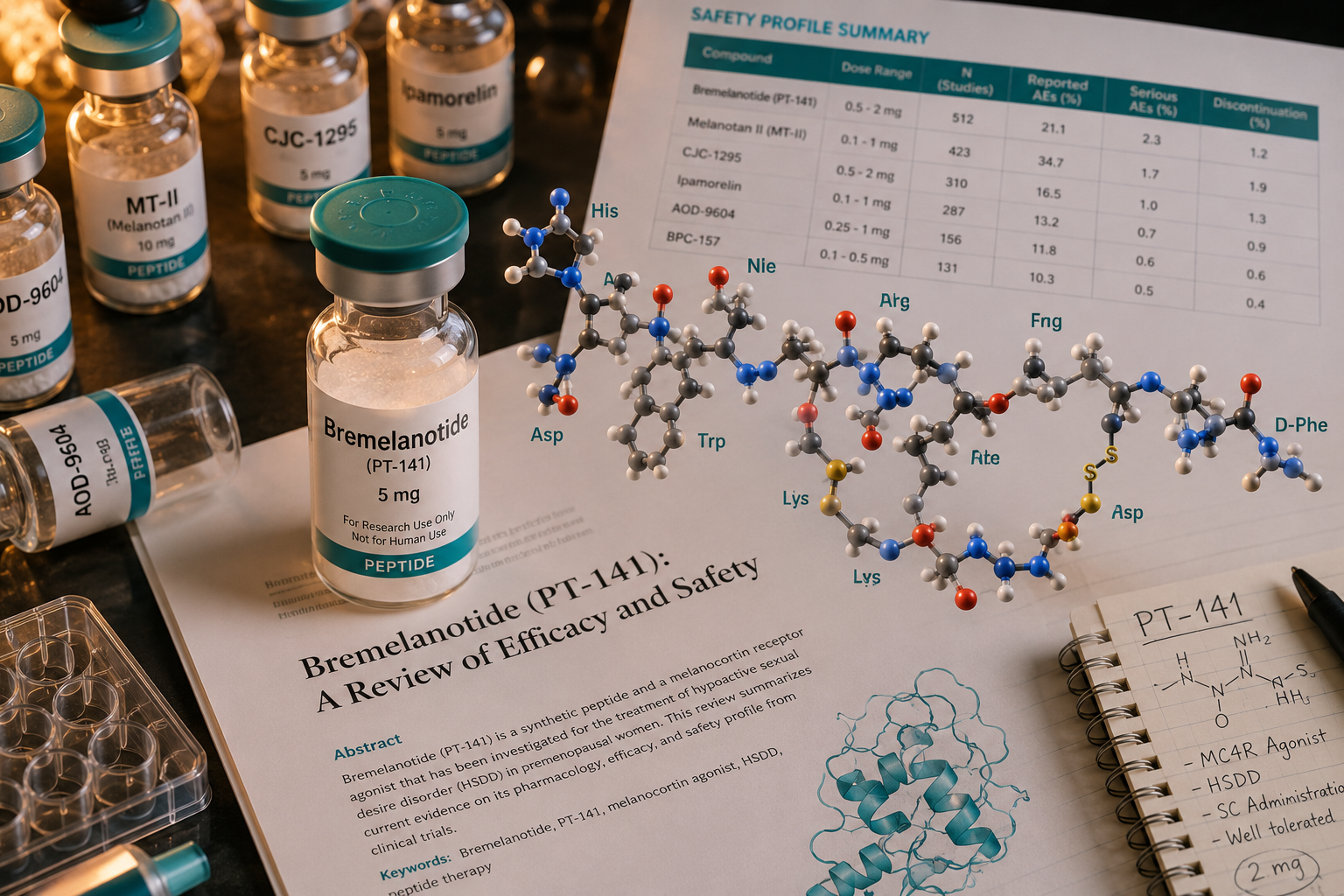
Safety profile summary:
- Nausea: reported in approximately 40% of participants
- Flushing and headache: common but transient
- Transient skin hyperpigmentation: noted with repeated use
- Recommended limit: no more than one dose per 24 hours, eight doses per month
The compound's safety and tolerability profile is important context for researchers reviewing PT-141 for sale for preclinical study purposes. Researchers comparing peptide classes may also find value in reviewing CJC-1295 research findings and ipamorelin research themes to contextualize how different receptor targets produce distinct physiological outcomes.
Exploratory research has also examined PT-141's MC receptor activity in metabolic and renal contexts, though these remain early-stage. For comparison, researchers studying mitochondrial peptide mechanisms may find the MOTS-c mitochondrial research overview a useful parallel for understanding receptor-mediated systemic effects.
Conclusion
PT-141 peptide research in female sexual function and desire models offers one of the clearest examples of successful central nervous system target validation in sexual medicine. The preclinical evidence — spanning rodent behavioral models, primate studies, and dose-response characterization — provided a mechanistically coherent foundation that translated into a Phase 3 approval.
Actionable next steps for researchers and informed readers:
- Review the MC4R agonism literature before designing desire-related preclinical protocols.
- Prioritize verified peptide purity when sourcing compounds for animal model studies.
- Use the 1.75 mg subcutaneous dose as the established reference point for efficacy-tolerability balance.
- Monitor the emerging literature on melanocortin receptor activity in metabolic and renal models for broader mechanistic insights.
- Consult the full simple peptides research resource for foundational peptide science context.
The melanocortin pathway is not a peripheral footnote in female sexual health research — it is the central mechanism. The preclinical evidence makes that case clearly.