

A peptide with a 30-minute half-life may sound like a limitation. In growth hormone research, it is often the point. CJC-1295 Without DAC: Why Half-Life Matters in Growth Hormone Research is a question that cuts to the core of how researchers design protocols that respect the body's natural hormonal rhythms rather than override them.
Also known as Modified GRF 1-29, CJC-1295 without DAC is a synthetic analog of growth hormone-releasing hormone (GHRH). Its short active window is not a flaw in the design — it is the design.
Key Takeaways
- CJC-1295 without DAC has a half-life of approximately 30 minutes, supporting pulsatile GH release
- The absence of the Drug Affinity Complex (DAC) distinguishes it from the longer-acting DAC variant
- Pulsatile GH secretion more closely mirrors natural physiology and may reduce receptor desensitization
- It is frequently paired with ipamorelin to target complementary GH-release pathways
- CJC-1295 without DAC is not FDA-approved and is intended strictly for research purposes
Understanding the Half-Life Difference in CJC-1295 Without DAC Research
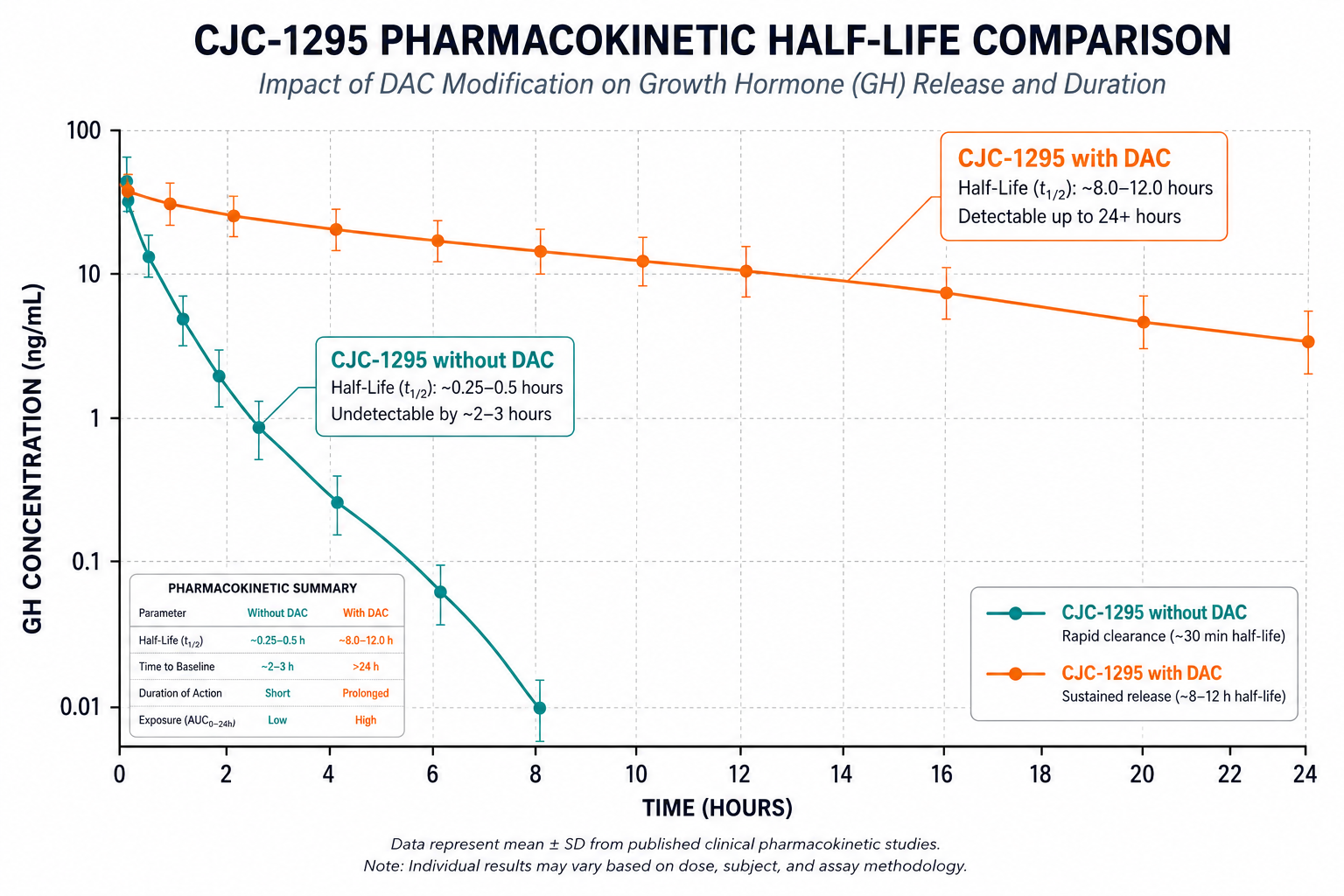
Half-life determines how long a compound remains active in a biological system. For CJC-1295 without DAC, that window is roughly 30 minutes. For the DAC version, the half-life stretches to approximately 5.8 to 8.1 days.
That difference is not trivial. It changes everything about how GH is released.
| Variant | Half-Life | GH Release Pattern |
|---|---|---|
| CJC-1295 without DAC | ~30 minutes | Pulsatile, physiological |
| CJC-1295 with DAC | ~5.8–8.1 days | Sustained, continuous |
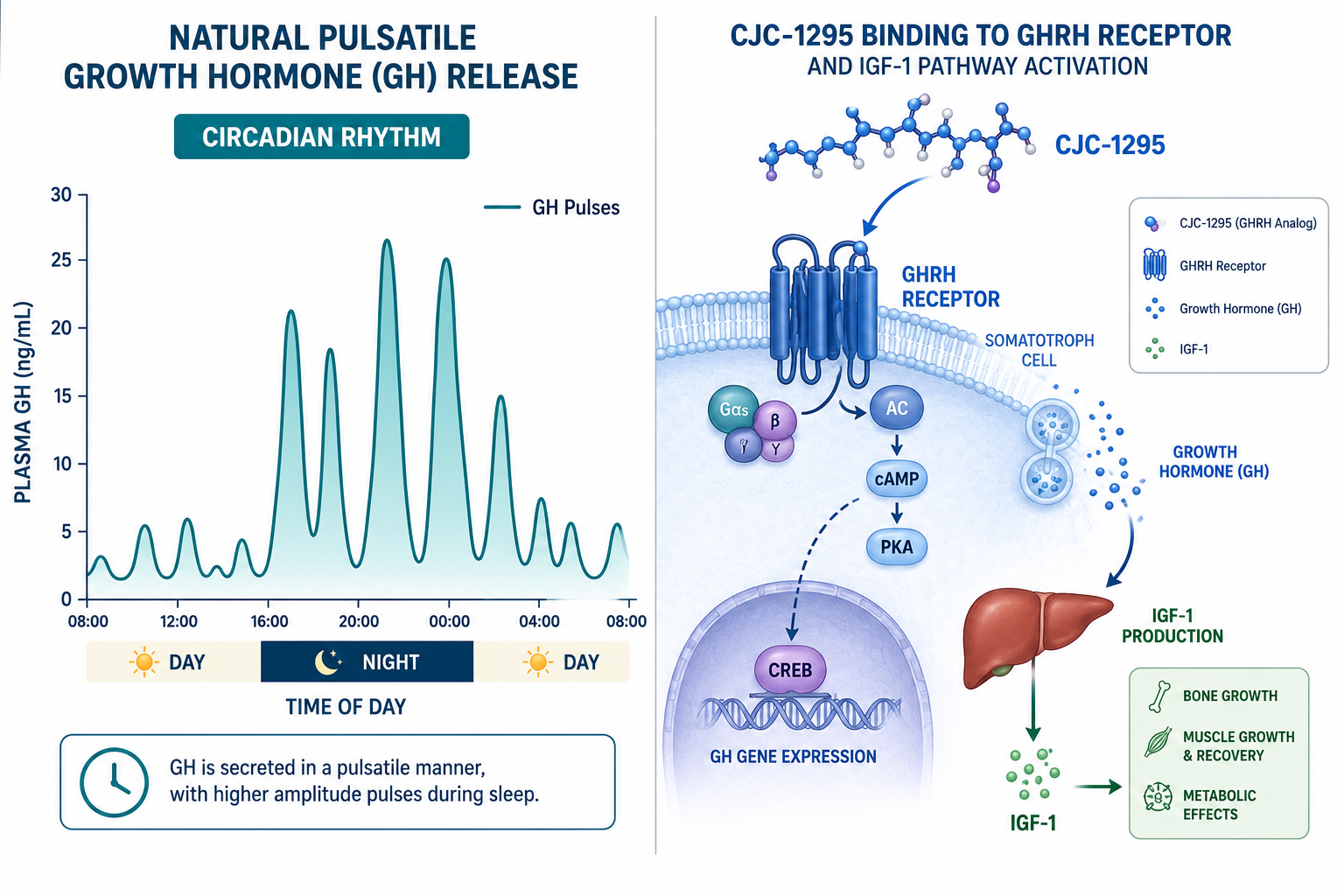
The body does not release GH in a steady stream. It releases it in pulses — sharp peaks followed by quiet troughs. This rhythm is tied to sleep cycles, metabolic signaling, and feedback loops involving IGF-1. A compound that mimics this pattern is considered more physiologically aligned than one that maintains constant elevation.
"The short half-life of the no-DAC variant allows researchers to time GH pulses with precision, which is central to protocols designed around natural secretion windows."
For a deeper look at how the DAC modification changes the pharmacological profile, the CJC-1295 with DAC deeper dive offers a useful comparison.
Mechanism of Action: How the No-DAC Version Triggers GH Pulses
CJC-1295 without DAC binds to GHRH receptors on pituitary somatotroph cells. This binding stimulates the release of GH, which in turn drives IGF-1 production in the liver. The cascade is well-characterized in the scientific literature.
What makes the no-DAC version distinct is its rapid clearance. Because it leaves the system quickly, GH levels rise sharply and then return to baseline — closely matching the body's endogenous pattern.
Why this matters in research:
- Avoids prolonged receptor activation that can lead to desensitization
- Allows multiple dosing windows within a single day
- Enables researchers to observe GH pulse responses in controlled intervals
Typical research protocols use doses of 100–300 mcg administered two to three times daily, often timed around sleep onset and morning windows when natural GH secretion is highest. Cycles in research settings commonly run 12 to 16 weeks.
The CJC-1295 product page provides additional catalog context for researchers sourcing this compound.
CJC-1295 Without DAC and Ipamorelin: A Common Research Pairing
One of the most studied combinations in GH research pairs CJC-1295 without DAC with ipamorelin. These two compounds work through different but complementary pathways.
- CJC-1295 without DAC activates the GHRH receptor, amplifying the GH pulse
- Ipamorelin activates the growth hormone secretagogue receptor (GHSR), independently triggering GH release
Together, they produce a stronger, more synchronized GH response than either compound alone. Researchers value this pairing because it targets two separate mechanisms while still producing a pulsatile, time-limited GH spike.
Pre-formulated blends are available for research use, including the CJC-1295 and ipamorelin combination and the CJC-1295 plus IPA research blend.
For researchers exploring broader GH-axis protocols, the tesa vs ipamorelin comparison provides useful context on how different GHRH analogs differ in their pharmacological profiles.
Storage, Safety, and Research Considerations
Lyophilized CJC-1295 without DAC should be stored at 2–8°C. Once reconstituted, it remains stable under refrigeration for up to 30 days.
The available safety data — drawn from studies on the parent CJC-1295 compound — suggest reasonable tolerability at research doses, with no serious adverse reactions reported at doses of 30 or 60 mcg/kg. However, long-term safety data remain limited, and the compound is not FDA-approved for human or veterinary use.
The evidence base includes 18 human studies, 126 animal studies, and over 56 published reviews — a substantial foundation, though researchers should note that studies specific to the no-DAC variant are less numerous than those on the DAC form.
Researchers interested in broader peptide research contexts may also find value in reviewing BPC-157 research documentation and TB-500 and BPC-157 regeneration research as complementary areas of study.
Conclusion
CJC-1295 Without DAC: Why Half-Life Matters in Growth Hormone Research comes down to one core principle: shorter is sometimes smarter. A 30-minute half-life is not a compromise — it is a tool that allows researchers to replicate pulsatile GH dynamics with precision.
Actionable next steps for researchers in 2026:
- Review the pharmacokinetic literature on Modified GRF 1-29 before designing protocols
- Consider the ipamorelin pairing to target complementary GH-release pathways
- Source compounds from verified suppliers with documented purity testing
- Align dosing windows with natural GH secretion peaks (sleep onset, morning)
- Monitor IGF-1 markers as a downstream indicator of GH pulse activity
Understanding half-life is not a detail — it is the foundation of responsible, reproducible growth hormone research.
Leave a Reply
Want to join the discussion?Feel free to contribute!