

Secondary hypogonadism affects an estimated 2–4% of adult men, yet a large portion of cases remain undertreated or managed with therapies that compromise fertility. The role of peptides in regulating estrogen receptor activity: a focus on enclomiphene research offers a compelling alternative pathway — one that works with the body's own hormonal architecture rather than bypassing it.
Key Takeaways
- Enclomiphene is the trans-isomer of clomiphene citrate and acts as a pure estrogen receptor antagonist in the hypothalamus and pituitary.
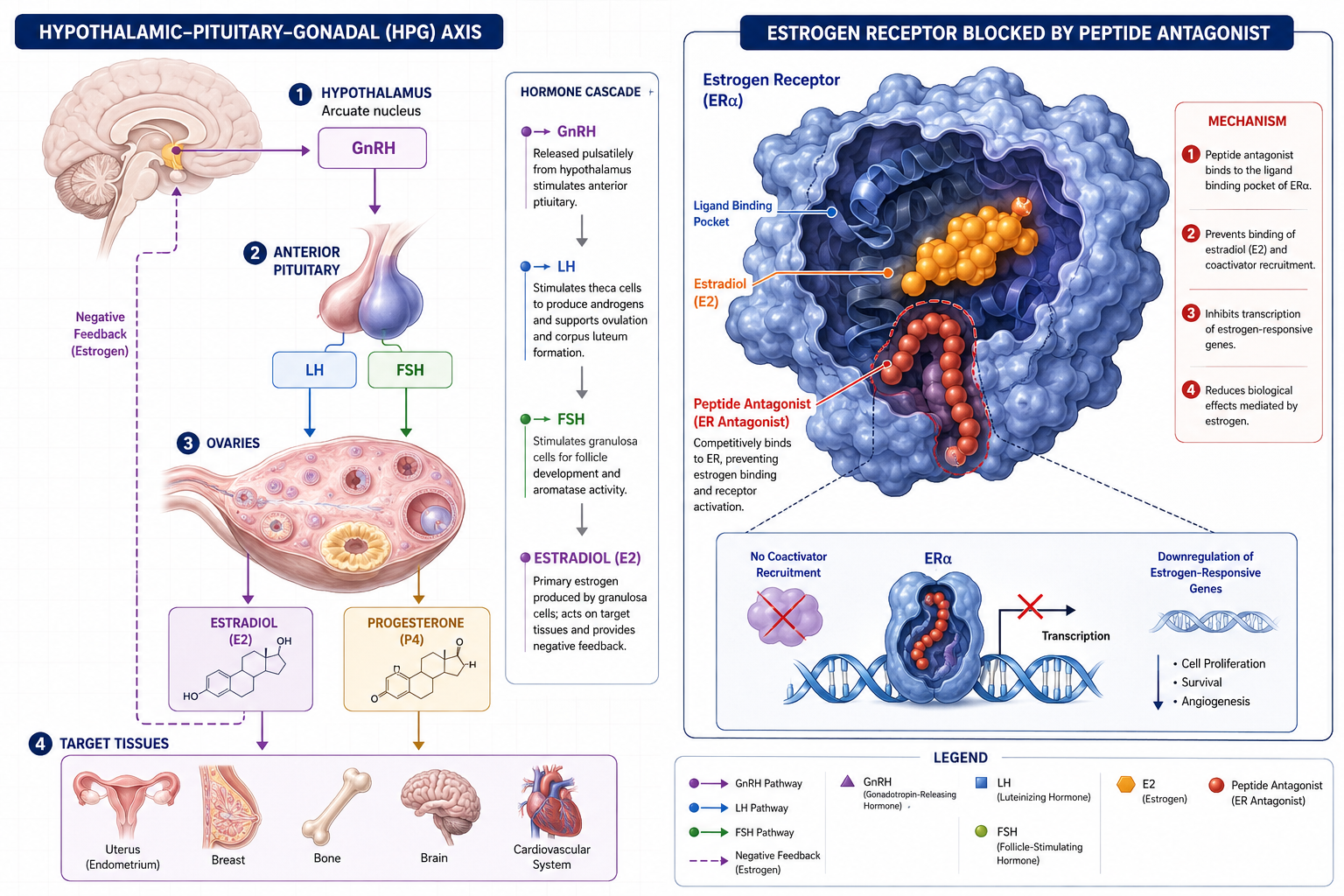
- By blocking estradiol's negative feedback signal, enclomiphene triggers a natural cascade that raises GnRH, LH, FSH, and ultimately testosterone.
- Unlike traditional testosterone replacement therapy (TRT), enclomiphene preserves sperm counts and testicular function.
- Early research suggests favorable effects on fasting plasma glucose, pointing to potential metabolic benefits.
- Enclomiphene is currently available through compounding pharmacies and is not FDA-approved as a standalone compound as of 2026.
How Enclomiphene Interacts with Estrogen Receptors
Enclomiphene belongs to a class of compounds called selective estrogen receptor modulators, or serms. Its molecular formula is C26H28ClNO, with a molecular weight of 406.0 g/mol. As the trans-isomer of clomiphene citrate, it functions as a pure estrogen receptor antagonist specifically in the hypothalamus and pituitary gland.
Here is how the mechanism unfolds:
- Circulating estradiol normally binds to estrogen receptors in the hypothalamus, sending a negative feedback signal that suppresses GnRH release.
- Enclomiphene occupies those same receptors, blocking estradiol from binding.
- With the negative feedback removed, the hypothalamus increases GnRH secretion.
- Elevated GnRH drives the pituitary to release more luteinizing hormone (LH) and follicle-stimulating hormone (FSH).
- Higher LH levels signal the testes to produce more endogenous testosterone.
"Enclomiphene stimulates natural testosterone production while preserving fertility — a key distinction from exogenous testosterone therapies." — Dr. Joe S. Lancaster, MD, board-certified OB-GYN and hormone specialist.
This cascade is precisely why the role of peptides in regulating estrogen receptor activity: a focus on enclomiphene research has gained traction among endocrinology researchers. Researchers exploring related peptide mechanisms, such as those studying epithalon and NAD-based hormonal pathways, have noted similar upstream signaling dynamics worth comparing.
Clinical Evidence and Comparison with Traditional TRT
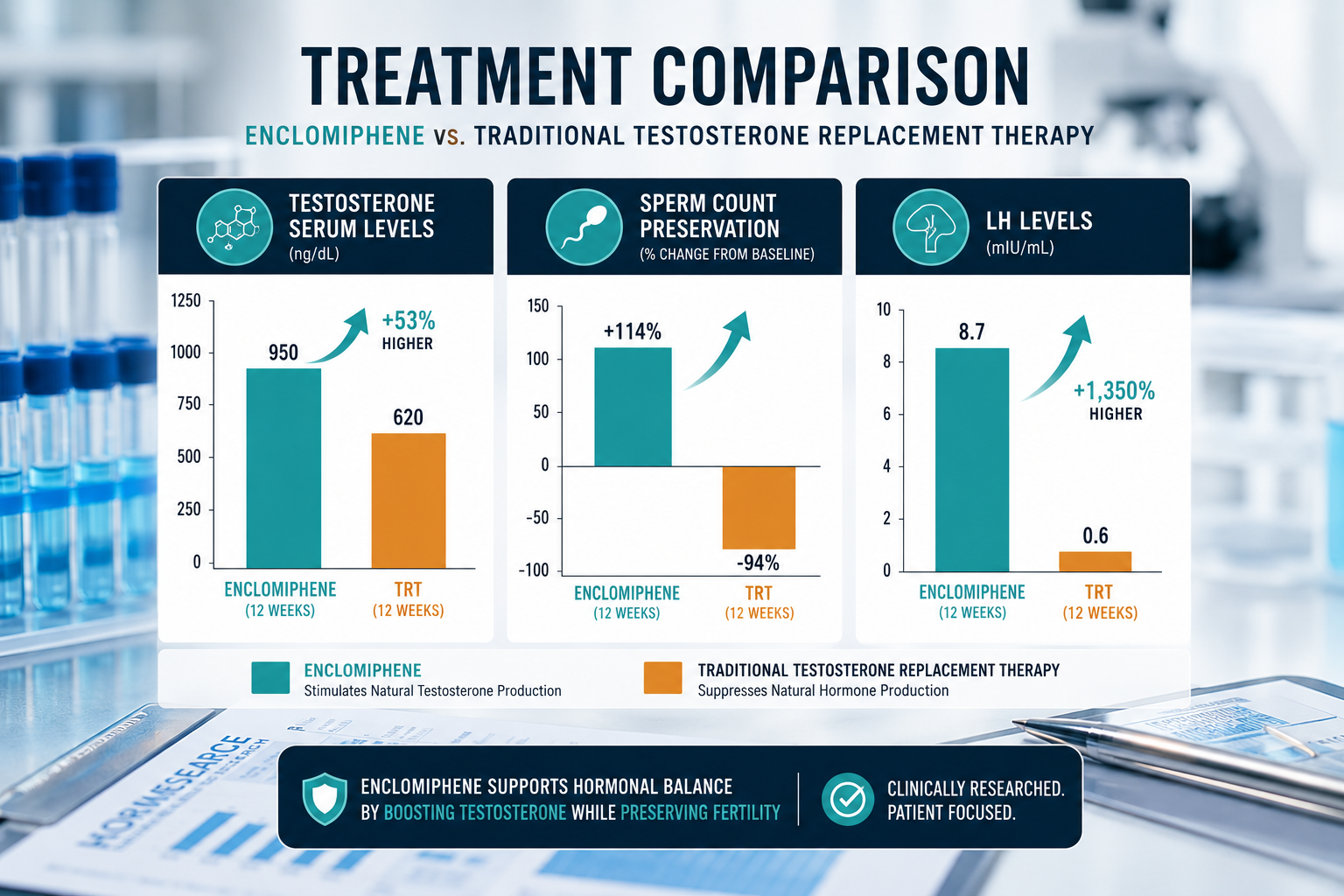
A randomized phase II clinical trial demonstrated that enclomiphene citrate successfully raised morning serum testosterone and LH levels in men with secondary hypogonadism — results comparable to those achieved with topical testosterone gel. Critically, participants maintained normal sperm counts throughout the study period.
Enclomiphene vs. Traditional Testosterone Replacement
| Parameter | Enclomiphene | Exogenous TRT |
|---|---|---|
| Endogenous testosterone | Increased | Suppressed |
| Sperm count | Preserved | Often reduced |
| Testicular function | Maintained | Risk of atrophy |
| HPG axis activity | Stimulated | Suppressed |
| Metabolic effect | Favorable glucose data | Variable |
Traditional TRT introduces testosterone from an external source, which suppresses the hypothalamic-pituitary-gonadal (HPG) axis. This can result in testicular atrophy and oligospermia — a significant concern for men who wish to maintain fertility. Enclomiphene sidesteps this problem entirely.
Short-term safety data for enclomiphene have been satisfactory and broadly comparable to testosterone gels and placebo groups. Additionally, early data showed improved fasting plasma glucose levels, suggesting potential utility in men with secondary hypogonadism linked to obesity or metabolic syndrome.
For researchers exploring related hormonal optimization compounds, resources on MOTS-C peptide research and the IPA-Sermorelin research stack provide useful context on how peptide-based approaches can complement endocrine modulation strategies.
Dosage, Regulatory Status, and Research Outlook

The standard oral dosage studied in research protocols ranges from 12.5 to 25 mg per day. Enclomiphene's half-life of approximately 10 hours supports once-daily dosing, making it practically convenient for research administration.
As of 2026, enclomiphene is not FDA-approved as a standalone drug. It remains accessible through compounding pharmacies. Clomiphene citrate — which contains both the enclomiphene (trans) and zuclomiphene (cis) isomers — holds FDA approval for female ovulatory dysfunction.
Ongoing research is investigating enclomiphene's potential across several areas:
- Secondary hypogonadism associated with obesity
- Metabolic syndrome management in men
- Male infertility where HPG axis preservation is essential
Researchers interested in the broader landscape of serm-adjacent compounds can review the serm 10mg product research page for additional context. Those exploring recovery-oriented peptides may also find value in reviewing top healing peptides and their mechanisms as complementary reading.
For quality benchmarking in peptide research, understanding Bachem reference standards and peptide benchmarks is essential when evaluating compound purity and study reliability.
Conclusion
The role of peptides in regulating estrogen receptor activity: a focus on enclomiphene research represents one of the more nuanced intersections of endocrinology and peptide science available for study in 2026. Enclomiphene's ability to block estrogen receptor activity at the hypothalamic-pituitary level — triggering a natural hormonal cascade without suppressing the HPG axis — sets it apart from conventional testosterone replacement approaches.
Actionable next steps for researchers:
- Review phase II clinical trial data on enclomiphene citrate and secondary hypogonadism before designing new protocols.
- Compare enclomiphene's receptor-binding profile against other serms when assessing research scope.
- Consult compounding pharmacy documentation and current regulatory guidance before sourcing.
- Explore synergistic peptide research areas, including metabolic and recovery pathways, to build a more complete endocrine research framework.
Leave a Reply
Want to join the discussion?Feel free to contribute!