

{"cover":"Professional landscape format (1536×1024) hero image with bold text overlay: 'DNA, Epithalon & MOTS-c: Peptide-Based Longevity Models' in extra large 72pt white bold sans-serif font with dark semi-transparent overlay box, centered upper third. Background shows a dramatic close-up of a glowing DNA double helix with telomere caps rendered in deep blue and gold, surrounded by floating molecular peptide chain structures. Color palette: deep navy, electric blue, gold accents. Magazine cover aesthetic, editorial quality, high contrast, cinematic lighting.","content":["Detailed landscape format (1536×1024) scientific illustration showing a split-panel composition: left side features a magnified telomere cap on a chromosome strand glowing in teal-blue light with telomerase enzyme molecules binding to the end; right side shows a vial labeled 'Epithalon' with molecular structure diagram overlaid. Laboratory bench setting with microscope in soft background bokeh. Color palette: cool teal, white, charcoal. Clean editorial scientific aesthetic, high detail, photorealistic rendering.","Landscape format (1536×1024) top-down aerial view of a mitochondrion cross-section rendered in warm amber and orange tones with MOTS-c peptide chains illustrated as glowing golden ribbons traveling from the mitochondrial matrix outward toward a cell nucleus in the background. AMPK activation nodes shown as bright spark points along metabolic pathway arrows. Dark cellular background with bioluminescent accents. Highly detailed scientific infographic style, editorial quality.","Landscape format (1536×1024) side-by-side comparison infographic showing two research protocol timelines on a dark slate background: left column labeled 'Epithalon — Telomerase Pathway' with chromosome diagrams and gene expression bar charts; right column labeled 'MOTS-c — AMPK Metabolic Pathway' with NAD+ level graphs and mitochondrial icons. Data visualization style with clean white typography, teal and amber color coding, laboratory notebook aesthetic, editorial quality."]
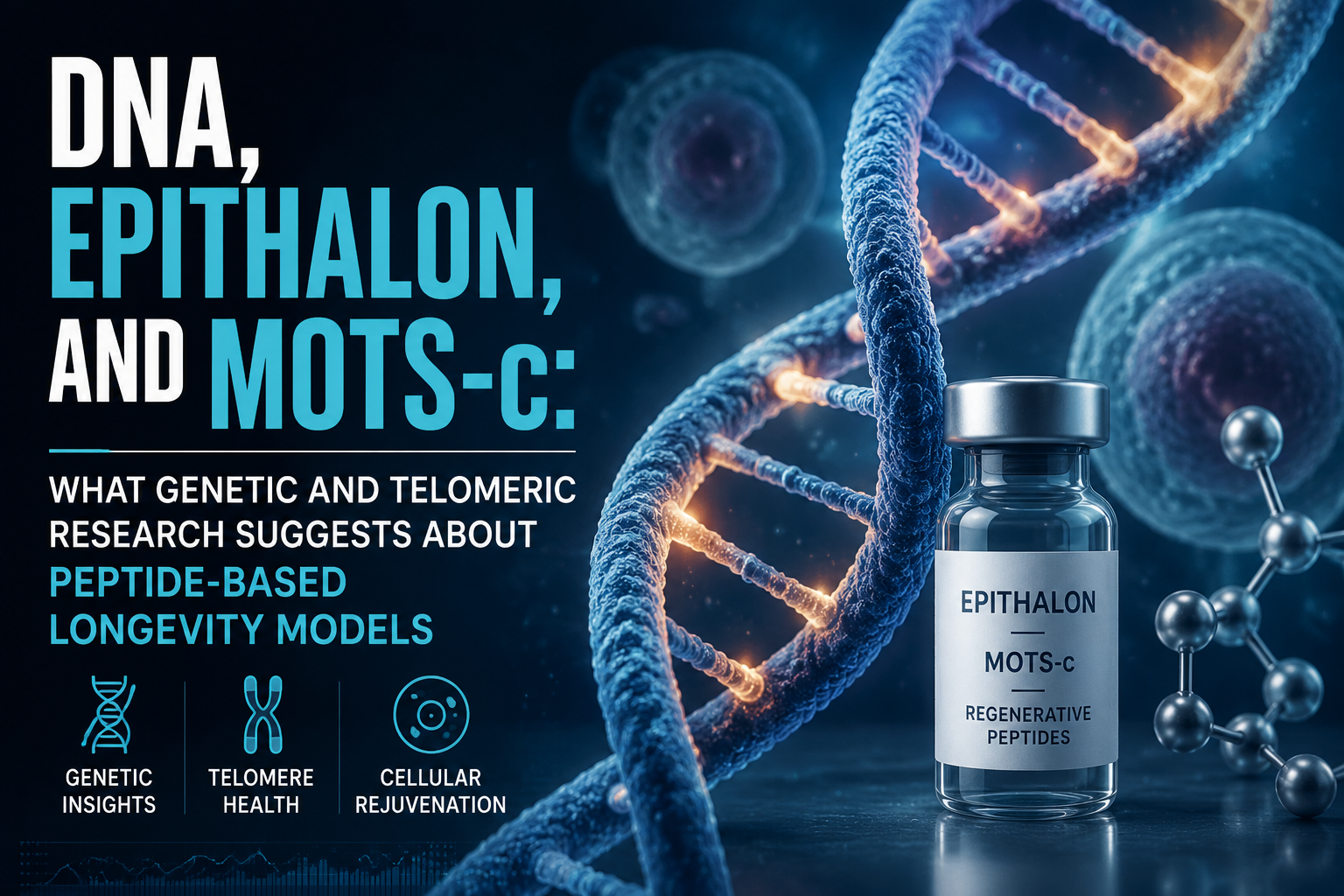
Telomeres shorten by roughly 25–200 base pairs with every cell division — a biological clock that researchers have spent decades trying to slow or reverse. That measurable, molecular countdown is precisely why the study of DNA, Epithalon, and MOTS-c: What Genetic and Telomeric Research Suggests About Peptide-Based Longevity Models has attracted serious attention in preclinical science. Two peptides — Epithalon and MOTS-c — have emerged from this field with distinct but potentially complementary mechanisms, offering researchers a framework for studying multiple aging hallmarks at the genetic level.
Key Takeaways
- Epithalon is a synthetic tetrapeptide studied for its ability to activate telomerase and extend telomere length in cell and animal models.
- MOTS-c is a mitochondrial-derived peptide that travels to the cell nucleus and regulates metabolism through AMPK activation and NAD+ modulation.
- MOTS-c plasma levels decline by nearly 21% between young adulthood and ages 70-81, making it a quantifiable aging biomarker.
- Both peptides target different hallmarks of aging, suggesting complementary use in multi-endpoint research protocols.
- Current evidence is largely preclinical; independent replication and large-scale trials remain limited.
How Epithalon Interacts With Telomeric DNA
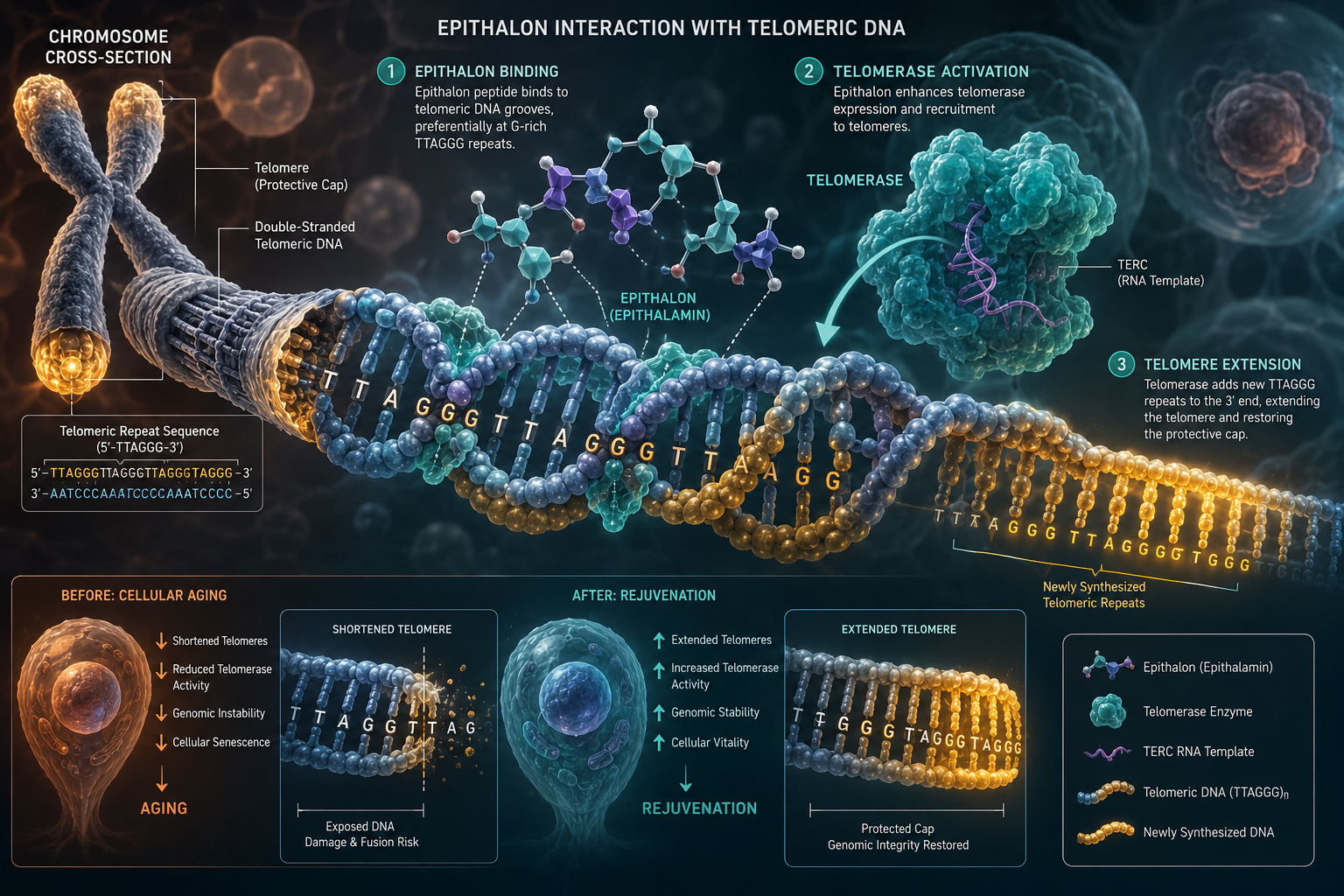
Epithalon (Ala-Glu-Asp-Gly) is a four-amino-acid peptide first synthesized from the pineal gland extract Epithalamin. In laboratory models, it activates telomerase — the enzyme responsible for adding protective nucleotide sequences to chromosome ends. When human fetal fibroblasts were exposed to Epithalon, researchers observed measurable telomere elongation alongside continued cell division beyond typical senescence thresholds.
In animal studies, lifespan extensions of 11-25% were recorded in mice, with approximately 16% extensions observed in fruit fly models. These are striking figures in longevity research. However, a critical limitation must be noted: the majority of these findings originate from a single research group, and independent replication remains sparse. No large-scale, double-blind, placebo-controlled trials have been conducted by outside investigators.
Common lab endpoints when studying Epithalon include:
- Telomere length measurement via quantitative PCR or Southern blot
- Telomerase reverse transcriptase (TERT) gene expression levels
- Circadian gene normalization (Epithalon has been shown to restore nocturnal melatonin peaks in aged rats)
- Cell division count beyond the Hayflick limit
Researchers interested in Epithalon peptides for experimental models should also account for its pharmacokinetics: plasma half-life is under 30 minutes, yet downstream gene-regulatory effects may persist 24-72 hours post-administration.
A note on safety in research models: Short-term animal studies showed no significant toxicity. However, because elevated telomerase activity is also a feature of cancer cells, long-term oncogenic risk remains a theoretical concern that researchers must factor into study design.
MOTS-c, Mitochondrial DNA, and Nuclear Gene Regulation
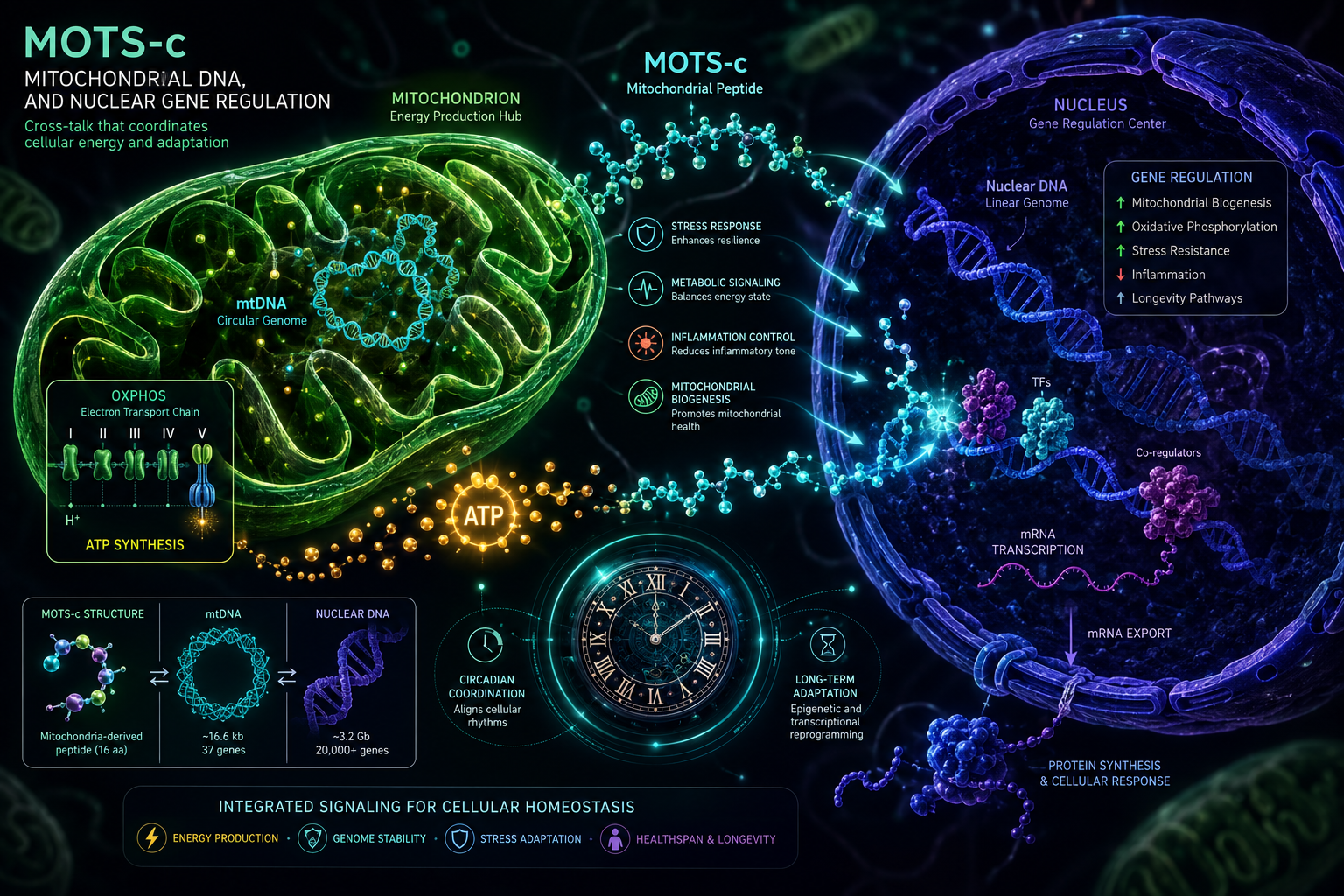
MOTS-c (Mitochondrial Open Reading Frame of the Twelve S rRNA-c) is encoded not in nuclear DNA but in mitochondrial DNA — a distinction that makes it biologically unique. Under metabolic stress, MOTS-c translocates from the mitochondria to the cell nucleus, where it directly influences gene expression related to metabolism and stress response.
Its primary mechanism involves AMPK activation, a master energy-sensing pathway. This leads to improved glucose clearance, enhanced insulin sensitivity, and elevated NAD+ levels — all biomarkers that decline measurably with age. Research on the MOTS-c mitochondrial peptide highlights that circulating MOTS-c levels drop by nearly 21% in individuals aged 70-81 compared to those aged 18-30, establishing it as a quantifiable aging biomarker.
Documented research endpoints for MOTS-c studies:
| Endpoint | Observed Effect |
|---|---|
| AMPK phosphorylation | Increased in skeletal muscle |
| NAD+ levels | Elevated following administration |
| Glucose clearance | Improved insulin sensitivity |
| Physical performance | Enhanced in aged mouse models over 2 weeks |
| Skin collagen | Increased via IL-6 reduction |
For researchers exploring MOTS-c and mitochondrial dynamics, the skin collagen finding is particularly notable: MOTS-c reduced IL-6, a key inflammatory mediator of collagen degradation, in 6-week-old mouse models.
Research Protocols Combining DNA, Epithalon, and MOTS-c: What Genetic and Telomeric Research Suggests About Peptide-Based Longevity Models
Because Epithalon and MOTS-c operate through separate mechanisms — telomerase activation versus AMPK-driven metabolic regulation — combining them in a single protocol allows researchers to probe multiple aging hallmarks simultaneously. This multi-target approach reflects a broader shift in longevity science away from single-pathway models.
"Aging is not a single-gene problem. Studying peptides that address telomeric integrity and mitochondrial signaling together reflects the biological complexity of cellular senescence."
Researchers working within this framework often pair these peptides with complementary agents. The SS-31 mechanism and mitochondrial protection research provides additional context for mitochondrial-targeted protocols. Similarly, GHK-Cu longevity research themes offer a parallel track focused on extracellular matrix remodeling and gene expression.
For a broader view of mitochondrial aging research, the mitochondrial longevity focus resource outlines how MOTS-c fits within a larger experimental landscape that includes compounds like NAD+ precursors and related metabolic modulators.
Standard dual-protocol design considerations:
- Establish baseline telomere length, TERT expression, and AMPK activity before intervention
- Use age-matched control groups with verified MOTS-c plasma levels
- Measure NAD+, glucose tolerance, and inflammatory markers (IL-6, TNF-alpha) at defined intervals
- Include circadian rhythm assessments when Epithalon is part of the protocol
Researchers exploring broader peptide longevity stacks may also find value in reviewing Vesugen, Vilon, and Chonluten longevity peptide research for comparative gene-regulatory data.
Conclusion
The intersection of DNA, Epithalon, and MOTS-c: What Genetic and Telomeric Research Suggests About Peptide-Based Longevity Models represents one of the more scientifically grounded areas of peptide research in 2026. Epithalon's telomerase-activating properties and MOTS-c's mitochondrial-to-nuclear signaling offer complementary tools for studying cellular aging at the genetic level.
Actionable next steps for researchers:
- Review existing telomerase activation literature before designing Epithalon endpoints to avoid replicating single-source data without controls.
- Measure baseline MOTS-c plasma levels as a quantifiable aging biomarker in any metabolic aging study.
- Incorporate NAD+ and AMPK assays as standard endpoints when MOTS-c is part of the protocol.
- Design studies with independent verification methods to address the reproducibility gap in current Epithalon literature.
- Consult the MOTS-c and SLU-PP-332 research overview for emerging data on AMPK-pathway synergies.
The science is promising but still maturing. Rigorous, independently replicated research remains the highest priority for advancing peptide-based longevity models from preclinical observation to validated biological insight.
Leave a Reply
Want to join the discussion?Feel free to contribute!