Call or Text 727-513-9780
  • Shopping Cart Shopping Cart
    0Shopping Cart
Pure Tested Peptides | America's most trusted Peptides for sale online
  • Peptides for sale
    • Oral Peptides for sale
      • Peptide Capsules for sale
      • BPC 157 Capsules 1000mcg
      • SLU-PP-332 Capsules | 1000 mcg
      • 5-Amino-1MQ 50mg Capsules
      • Tesofensine 500mcg
    • All Peptides for sale
    • Peptide Sprays
      • BPC 157 Nasal Spray Kit
      • BPC-157 TB500 Nasal Spray Kit
      • Semax Nasal Spray 10mg
      • Selank – Nasal Spray Kit – 10mg
      • Epithalon 50MG Nasal Spray Kit
      • Ipamorelin 10mg Nasal Spray
      • Klow Nasal Spray (BPC-157 + TB-500 + GHK-Cu + KPV) | 80mg
      • Hulk Nasal Spray Tesa / Ipa Blend 6/3 MG
      • Klow Nasal Spray
      • NAD + 500 mg Nasal Spray
      • PT-141 Nasal Spray Kit
    • GHRH Peptides
      • Ipa Peptides
      • CJC-1295 Peptides
        • CJC-1295 with DAC 5 mg
        • CJC-1295 without DAC 5 mg
        • CJC-1295 Ipa 10mg
      • Tesa Peptides
        • Tesa Peptide
        • Tesa 20 mg
    • GHK-Cu Peptides
      • All GHK-Cu Peptides
      • GHK-Cu 100mg
      • KLOW Peptide Blend – Buy KLOW blend online
    • BPC Peptides
      • All BPC Peptides
      • BPC-157
      • BPC-157 TB-500
      • BPC 157 capsules 1000mcg
    • SLU-PP-332 Peptides
      • All SLU-PP-332 Peptides
      • SLU-PP-332 5mg
    • GLP3 Peptides
      • GLP3-R
      • GLP3-R CAG 10mg
      • GLP3-R 20mg
    • PT-141 Peptides
      • PT-141 Peptides for sale
      • PT-141 10mg
      • PT-141 Nasal Spray
    • CAG Peptides
      • Lipo-C Peptide Blend
      • CAG 5mg
      • CAG 10mg
    • MOTS-C Peptides
      • MOTS-C Peptides for sale
      • MOTS-c peptide
      • MOTS-c 10mg *6 pack*
    • 5 Amino 1MQ Peptides
      • 5 Amino 1MQ Peptides for sale
      • 5-Amino-1MQ 50mg Capsules
      • 5-Amino-1MQ 5mg
    • Epithalon Peptides
      • Epithalon Peptides for sale
      • Epithalon 10mg
      • Epithalon 50mg
  • Shop
    • GLPs
      • 5-Amino-1MQ 50mg Capsules
      • 5-Amino-1MQ 5mg
      • GLP3-Reta
      • L-Carnitine 500mg/ml
      • Tesofensine 500mcg
      • SLU-PP-332 5mg
      • MOTS-c 10mg *6 pack*
    • Epithalon & BPC Peptides
      • Epithalon 10mg
      • Epithalon 50mg
      • BPC-157
      • BPC 157 capsules 1000mcg
      • BPC-157 TB-500
      • BPC-157 TB500 Nasal Spray Kit
      • BPC 157 Nasal Spray Kit
    • BPC TB-500 & NAD+ Peptides
      • NAD+ 500 mg
      • KLOW Peptide Blend – Buy KLOW blend online
      • GLOW Peptide Blend
      • TB 500 5mg
      • BPC 157 capsules 1000mcg – Supplement
      • BPC 157 Nasal Spray Kit
      • BPC-157
      • BPC-157 TB500 Nasal Spray Kit
      • BPC-157 TB-500
      • BPC 157 capsules 1000mcg
    • LL-37 Peptide
      • LL-37 10 mg
    • MOTS-C & Selank
      • MOTS-c peptide
      • Selank 10mg
    • GHK Peptides
      • GHK-Cu 100mg
      • GLOW Peptide Blend
      • KLOW Peptide Blend – Buy KLOW blend online
  • COAs
  • Wholesale
    • Wholesale Peptides for sale
  • PTP FAQ
  • Affiliates
    • Selank Peptide: Advanced Pharmacological Mechanisms Underlying Its Anxiolytic and Nootropic Effects in Research
      • 5-Amino-1MQ Peptide: Detailed Mechanisms of NNMT Inhibition and Its Impact on Cellular Metabolism Research
        • MOTS-C Peptide: Unraveling Its Role in Mitochondrial Dynamics and Energy Metabolism Research
          • Epithalon Peptide and Telomerase Regulation: Investigating Its Impact on Cellular Senescence and Lifespan Research Models
            • GLP2-T vs GLP2 Tirz Peptide: Understanding the Naming, Mechanistic Nuances, and Research Implications for Gut Health
      • Peptides and Polypeptides in Modern Pharmacology: What Research on Metoprolol, Prednisone, and Amlodipine Reveals
        • Polypeptide Peptides vs NSAIDs: What Naproxen and Diclofenac Teach Tissue-Repair Researchers About BPC‑157 and TB‑500
          • Peptides and Polypeptides in Endocrine Pharmacology: How GLP-1, GLP-2, and GLP-3 Retatrutide Differ From Classic Drugs Like Prednisone and Amlodipine
          • 5‑Amino‑1MQ Peptide and NNMT Inhibition: How It Compares With Statins Like Atorvastatin in Adipose and Lipid Metabolism Research
      • Enclomiphene, Estrogen Receptor Signaling, and Luteinizing Phase Biology: What Hormone Researchers Should Measure
        • Mesenchymal Stem Cells, BPC‑157, and GHK‑Cu: How Tissue Repair Peptides Compare With Classic NSAIDs Like Naproxen in Injury Models
          • Peptide Calculator Use Cases Beyond Growth Hormone: Working Through GLP‑3 Retatrutide, MOTS‑c, and BPC‑157 Research Dosing
        • Polypeptide Peptides in Endocrine and Metabolic Pharmacology: Lessons From Amlodipine, Prednisone, and Metoprolol
        • Peptides Calculator for Advanced Blends: Worked Examples for Tesamorelin, CJC‑1295, and Ipamorelin Stacks
          • Peptides and Polypeptides in Human Physiology: How Molecular Size Shapes Research Applications
            • Selank Peptide: Advanced Pharmacological Mechanisms Underlying Its Anxiolytic and Nootropic Effects in Research
          • 5-Amino-1MQ Peptide: Detailed Mechanisms of NNMT Inhibition and Its Impact on Cellular Metabolism Research
            • MOTS-C Peptide: Unraveling Its Role in Mitochondrial Dynamics and Energy Metabolism Research
              • Epithalon Peptide and Telomerase Regulation: Investigating Its Impact on Cellular Senescence and Lifespan Research Models
                • GLP2-T vs GLP2 Tirz Peptide: Understanding the Naming, Mechanistic Nuances, and Research Implications for Gut Health
                  • Peptides and Polypeptides in Endocrine Pharmacology: How GLP-1, GLP-2, and GLP-3 Retatrutide Differ From Classic Drugs Like Prednisone and Amlodipine
                    • Polypeptide Peptides vs NSAIDs: What Naproxen and Diclofenac Teach Tissue-Repair Researchers About BPC‑157 and TB‑500
                      • Peptides and Polypeptides in Modern Pharmacology: What Research on Metoprolol, Prednisone, and Amlodipine Reveals
                        • 5‑Amino‑1MQ Peptide and NNMT Inhibition: How It Compares With Statins Like Atorvastatin in Adipose and Lipid Metabolism Research
                        • Enclomiphene, Estrogen Receptor Signaling, and Luteinizing Phase Biology: What Hormone Researchers Should Measure
                        • Mesenchymal Stem Cells, BPC‑157, and GHK‑Cu: How Tissue Repair Peptides Compare With Classic NSAIDs Like Naproxen in Injury Models
                        • Peptide Calculator Use Cases Beyond Growth Hormone: Working Through GLP‑3 Retatrutide, MOTS‑c, and BPC‑157 Research Dosing
                        • Polypeptide Peptides in Endocrine and Metabolic Pharmacology: Lessons From Amlodipine, Prednisone, and Metoprolol
                        • Peptides Calculator for Advanced Blends: Worked Examples for Tesamorelin, CJC‑1295, and Ipamorelin Stacks
                        • Peptides and Polypeptides in Human Physiology: How Molecular Size Shapes Research Applications
                        • Selank Peptide: Advanced Pharmacological Mechanisms Underlying Its Anxiolytic and Nootropic Effects in Research
                        • MOTS-C Peptide: Unraveling Its Role in Mitochondrial Dynamics and Energy Metabolism Research
                        • Peptides and Polypeptides in Modern Pharmacology: What Research on Metoprolol, Prednisone, and Amlodipine Reveals
                        • Peptides and Polypeptides in Endocrine Pharmacology: How GLP-1, GLP-2, and GLP-3 Retatrutide Differ From Classic Drugs Like Prednisone and Amlodipine
                        • 5-Amino-1MQ Peptide: Detailed Mechanisms of NNMT Inhibition and Its Impact on Cellular Metabolism Research
                        • Mesenchymal Stem Cells, BPC‑157, and GHK‑Cu: How Tissue Repair Peptides Compare With Classic NSAIDs Like Naproxen in Injury Models
                        • Peptide Calculator Use Cases Beyond Growth Hormone: Working Through GLP‑3 Retatrutide, MOTS‑c, and BPC‑157 Research Dosing
                        • GLP2-T vs GLP2 Tirz Peptide: Understanding the Naming, Mechanistic Nuances, and Research Implications for Gut Health
                        • Polypeptide Peptides in Endocrine and Metabolic Pharmacology: Lessons From Amlodipine, Prednisone, and Metoprolol
                        • Polypeptide Peptides vs NSAIDs: What Naproxen and Diclofenac Teach Tissue-Repair Researchers About BPC‑157 and TB‑500
                        • Peptides and Polypeptides in Human Physiology: How Molecular Size Shapes Research Applications
                        • Peptides Calculator for Advanced Blends: Worked Examples for Tesamorelin, CJC‑1295, and Ipamorelin Stacks
                        • 5‑Amino‑1MQ Peptide and NNMT Inhibition: How It Compares With Statins Like Atorvastatin in Adipose and Lipid Metabolism Research
                        • Enclomiphene, Estrogen Receptor Signaling, and Luteinizing Phase Biology: What Hormone Researchers Should Measure
                        • Epithalon Peptide and Telomerase Regulation: Investigating Its Impact on Cellular Senescence and Lifespan Research Models
                        • Best research protocol Klow blend
                        • best time to take BPC-157
                        • best time to take DSIP (Delta Sleep Inducing Peptide)
                        • best time to take CJC-1295
                        • best time to take AOD-9604
                        • best time to take Follistatin 344
                        • best time to take Ipamorelin
                        • best time to take MK-677 (Ibutamoren)
                        • best time to take Ligandrol (LGD-4033) — research compound
                        • best time to take Ostarine (MK-2866) — research compound
                        • best time to take GHK-CU
                        • best time to take TB-500
                        • best time to take MOTS-c
                        • best time to take Semax
                        • best time to take RAD-140 (Testolone) — research compound
                        • best time to take Thymosin Alpha-1
                        • best time to take PEG-MGF
                        • Biolife Plasma, Octapharma Plasma, and Research Peptides: How Plasma Donation Labs Differ From Peptide Suppliers
                        • best time to take YK-11 — research compound
                        • best time to take PT-141 (Bremelanotide)
                        • Best research protocol Klow blend
  • Contact
    • Contact Customer Service
    • Text Customer Support
  • About US
  • Shop all peptides
  • Affiliate Program
    • Affiliate Signup
  • Login / Register Login / Register Page Link Login / Register Page Link
  • Click to open the search input field Click to open the search input field Search
  • Menu Menu

Tag Archive for: triumph-4 trial

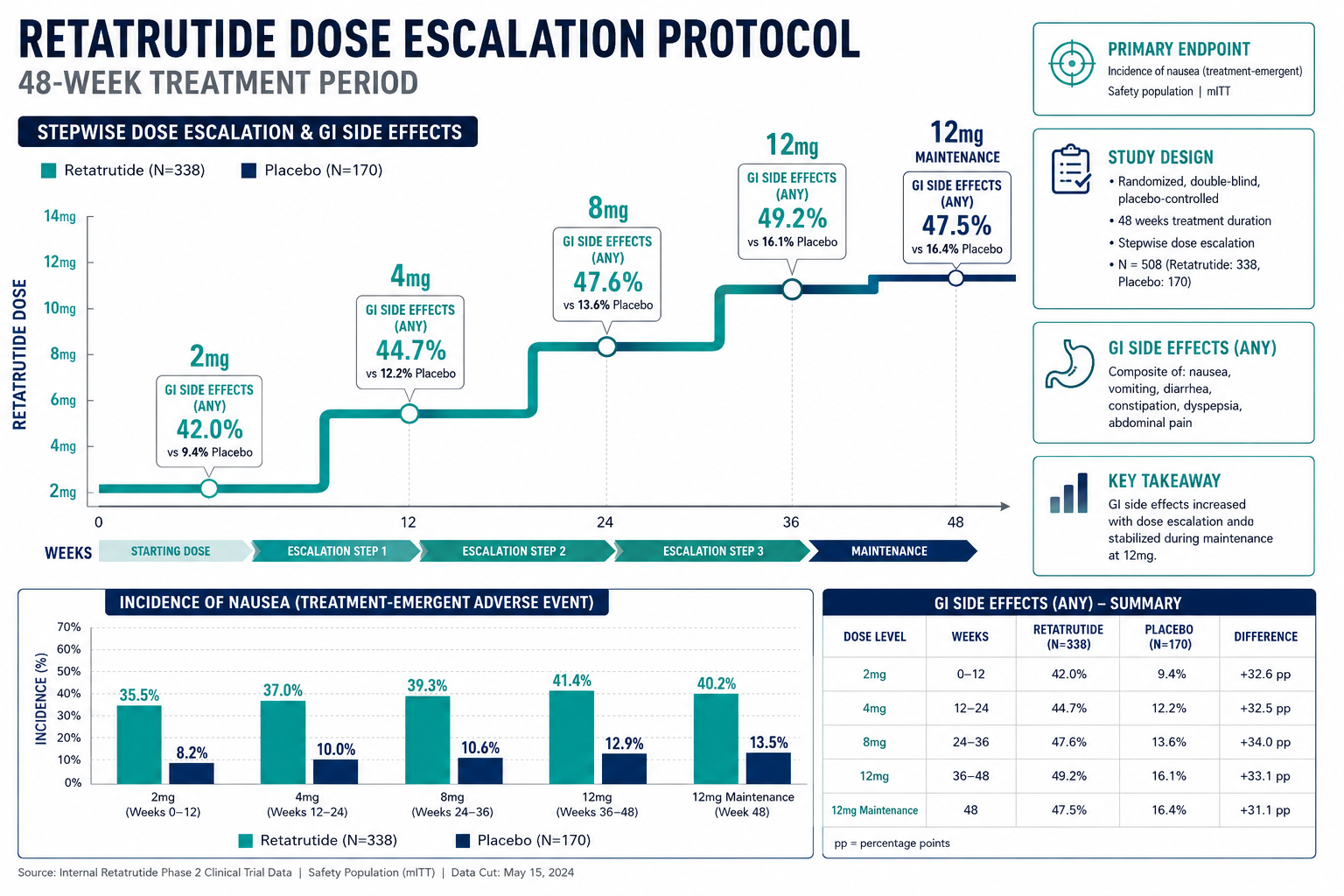
GLP-3 Retatrutide Dose Escalation: Understanding Tolerability and Side Effects in Research Studies

GLP-3 Retatrutide Dose Escalation: Understanding Tolerability and Side Effects in Research Studies

July 3, 2026/0 Comments/by Pure Tested

Discontinuation rates in Retatrutide research groups reached as high as 16% due to adverse events, compared to 0% in placebo groups. That single data point frames the central challenge researchers face when designing protocols around GLP-3 Retatrutide dose escalation: understanding tolerability and side effects in research studies is not optional; it is foundational to sound experimental design.

Key Takeaways

  • Gastrointestinal side effects are the most common adverse events and are strongly dose-dependent, peaking during escalation phases.
  • Gradual four-week dose escalation intervals significantly improve tolerability compared to rapid titration.
  • A unique dysesthesia signal, abnormal tingling or burning, affects up to 20.9% of participants at the highest doses.
  • Modest heart rate increases averaging 5 to 10 BPM have been observed, peaking around week 24.
  • Approximately 25 to 40% of total weight lost may come from lean mass, making resistance training and protein intake critical protocol considerations.
Key Takeaways

Dose Escalation Protocol and the Tolerability Framework

The core principle guiding GLP-3 Retatrutide dose escalation in research settings is gradual titration. Starting at 2 mg and increasing in four-week intervals allows biological systems to adapt before advancing to higher dose tiers. This approach directly reduces the frequency and intensity of adverse events.

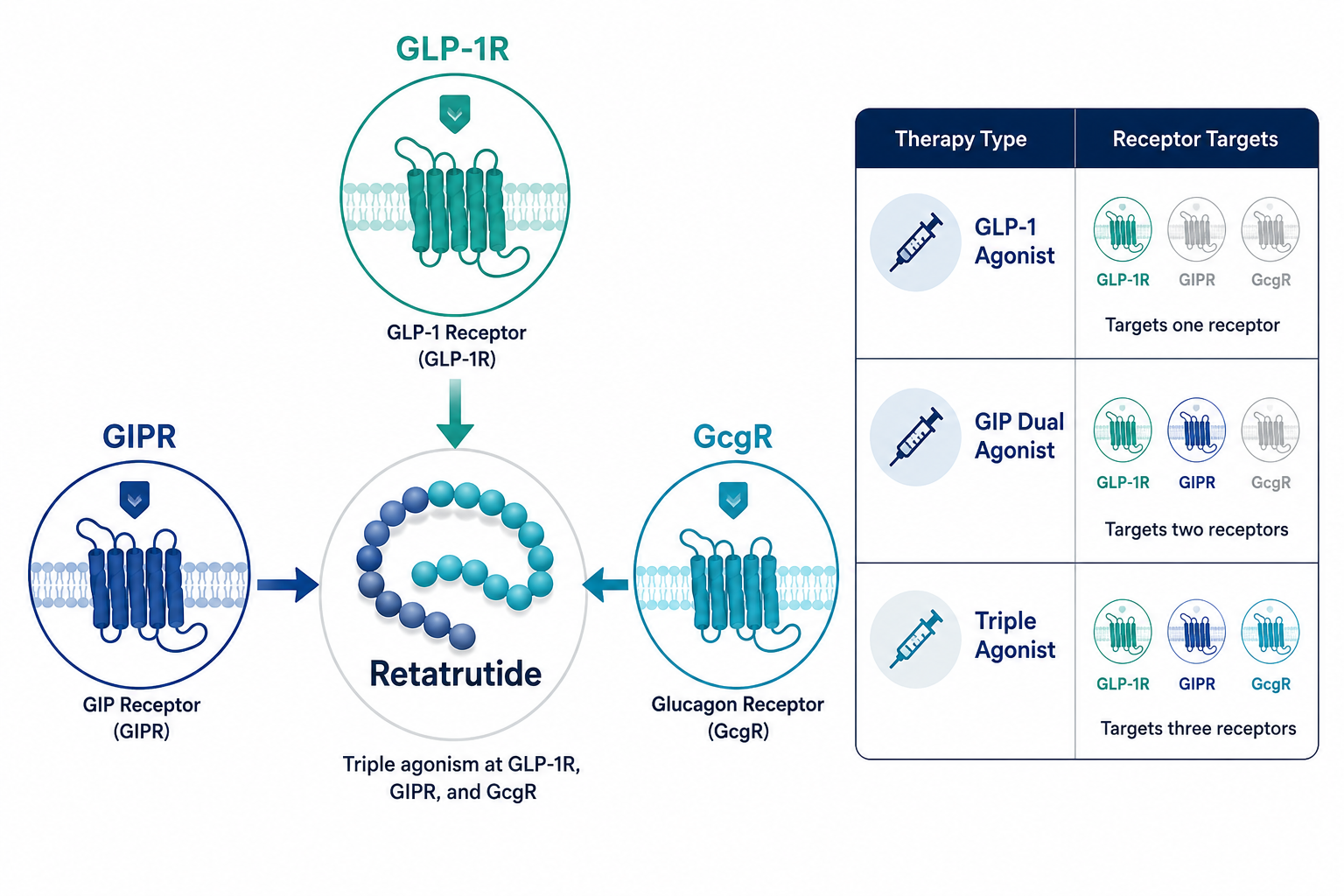
Retatrutide is a triple agonist acting on GLP-1, GIP, and glucagon receptors simultaneously. This multi-receptor activity drives its potent metabolic effects, but it also broadens the side effect profile compared to single-target GLP-1 agents. Researchers exploring GLP-1 and incretin research themes will recognize the GI tolerability pattern, but Retatrutide introduces additional signals not seen with earlier-generation compounds.

In the 48-week Phase 2 obesity trial, weight loss outcomes were clearly dose-dependent, reinforcing that higher doses carry both greater efficacy and greater tolerability burden. The 68-week TRIUMPH-4 Phase 3 trial further confirmed this relationship, with nausea rates of 38.1% at 9 mg and 43.2% at 12 mg, versus 10.7% in the placebo group.

Practical protocol guidance:

Dose Tier Approximate Duration Primary Tolerability Risk
2 mg Weeks 1-4 Minimal GI symptoms
4 mg Weeks 5-8 Mild nausea onset
8 mg Weeks 9-16 Moderate GI events peak
12 mg Weeks 17+ Highest GI and dysesthesia risk

Researchers sourcing material for metabolic studies can review the GLP-3 triple agonist research planning catalog for further context on compound availability and protocol scaffolding.


Side Effect Profile: What Research Data Reveals

Side Effect Profile: What Research Data Reveals

Understanding the full tolerability and side effects in research studies requires examining each adverse event category individually.

Gastrointestinal Events

Nausea, vomiting, diarrhea, and constipation are the dominant adverse events. These are mild to moderate in most cases and cluster heavily during the escalation window rather than persisting at maintenance doses. Comparing Retatrutide to tirzepatide, GI event rates are measurably higher, a distinction researchers should factor into study design and participant selection criteria.

The Dysesthesia Signal

"Up to 20.9% of participants at the 12 mg dose reported dysesthesia, abnormal tingling or burning sensations, compared to just 0.7% in the placebo group."

This signal is notably absent from standard GLP-1 agonist profiles. The glucagon receptor component of Retatrutide is the suspected driver. Researchers designing longer-duration studies should include dysesthesia monitoring checkpoints, particularly at higher dose tiers. This distinguishes Retatrutide's side effect map from compounds like tesa, which carries its own distinct tolerability considerations.

Cardiovascular Signal: Heart Rate

Resting heart rate increases averaging 5 to 10 BPM have been documented, peaking near week 24 before partially attenuating. While modest, this elevation warrants baseline cardiovascular assessment in research subjects and ongoing monitoring throughout the protocol. Researchers interested in broader metabolic modulation research will find this cardiovascular signal relevant to multi-compound study design.

Lean Mass Considerations

Roughly 25 to 40% of total weight lost during Retatrutide studies is lean mass, a finding consistent across the broader GLP-1 drug class. Research protocols that do not account for this risk may produce confounded body composition data. Resistance exercise protocols and elevated protein intake are the primary mitigation strategies supported by current evidence.

For researchers examining complementary compounds that may address lean mass preservation, ipamorelin muscle and fat research themes offer relevant parallel data.


Designing Safer Research Protocols Around Retatrutide

Designing Safer Research Protocols Around Retatrutide

Translating the GLP-3 Retatrutide dose escalation tolerability and side effects data into actionable protocol design requires structured decision-making.

Key protocol design checkpoints:

  • Baseline screening: Cardiovascular status, GI history, and neurological baselines before initiating escalation.
  • Escalation pacing: Strict four-week minimum intervals between dose increases; do not accelerate based on early tolerance.
  • Adverse event monitoring windows: Heightened observation during weeks 5 through 20, when GI and dysesthesia events peak.
  • Discontinuation thresholds: Pre-define stopping criteria; trial data shows 6 to 16% discontinuation rates, and researchers should plan for this range.
  • Body composition tracking: Dual-energy X-ray absorptiometry (DEXA) or equivalent methods to monitor lean mass changes.

Long-term cardiovascular, renal, and oncological safety data remain incomplete pending results from the ongoing TRIUMPH-5 multi-year trial. This gap is a meaningful limitation for researchers planning extended protocols. Researchers interested in renal-adjacent peptide safety profiles may find value in reviewing SS-31 kidney health research as a comparative reference point.

Those sourcing Retatrutide for research can explore the Reta 10mg product tag for catalog options, while researchers building broader metabolic panels may also reference GLP-1 peptide product options for complementary compounds.


Conclusion

GLP-3 Retatrutide dose escalation: understanding tolerability and side effects in research studies is not a peripheral concern, it is the operational core of any well-designed Retatrutide protocol. The data from Phase 2 and TRIUMPH-4 trials provide a clear roadmap: GI events dominate the escalation window, dysesthesia is a unique and dose-dependent signal, heart rate elevations require cardiovascular monitoring, and lean mass loss demands proactive mitigation strategies.

Actionable next steps for researchers in 2026:

  1. Build four-week escalation intervals into every protocol from the outset.
  2. Include dysesthesia and cardiovascular monitoring checkpoints at weeks 12, 24, and 48.
  3. Define discontinuation criteria before the study begins, accounting for the 6 to 16% adverse-event dropout range.
  4. Pair Retatrutide protocols with body composition tracking to capture lean mass data.
  5. Monitor TRIUMPH-5 trial publications for emerging long-term safety data before extending protocol durations.

Researchers who treat the tolerability profile as a design input, not an afterthought, will produce more reliable, reproducible, and ethically sound data from their Retatrutide studies.

https://www.puretestedpeptides.com/wp-content/uploads/2026/07/GLP-3-Retatrutide-Dose-Escalation-Understanding-Tolerability-and-Side-Effects-in-Research-Studies.png 1024 1536 Pure Tested https://www.puretestedpeptides.com/wp-content/uploads/2026/01/buy-peptides-online.jpg Pure Tested2026-07-03 13:04:132026-07-20 15:01:12GLP-3 Retatrutide Dose Escalation: Understanding Tolerability and Side Effects in Research Studies
Retatrutide vs GLP3 Peptide: How to Interpret the Naming Difference in Research Context

Retatrutide vs GLP3 Peptide: How to Interpret the Naming Difference in Research Context

July 1, 2026/0 Comments/by Pure Tested

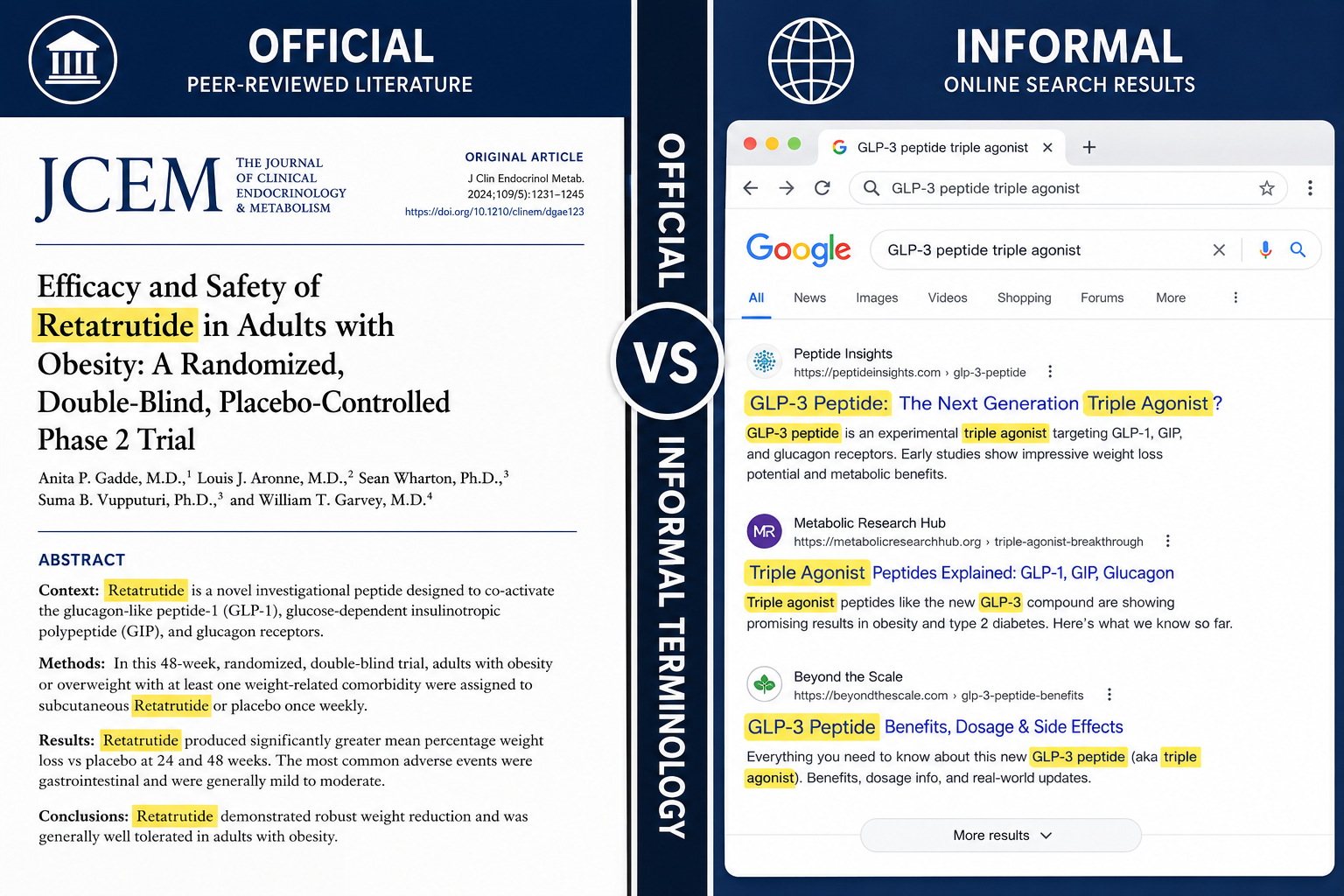
Researchers and informed readers searching metabolic peptide literature in 2026 frequently encounter two terms side by side — "retatrutide" and "GLP-3 peptide" — and assume they are comparing two separate compounds. They are not. Understanding this naming gap is essential for reading clinical data accurately and avoiding confusion when evaluating research outcomes.

This article on Retatrutide vs GLP3 Peptide: How to Interpret the Naming Difference in Research Context explains where the informal label came from, what the science actually says, and how to navigate terminology when reviewing preclinical or clinical literature.

Key Takeaways

  • "GLP-3 peptide" is an informal shorthand, not an official scientific or regulatory term.
  • Retatrutide is the INN (International Nonproprietary Name) for a triple receptor agonist targeting GLP-1R, GIPR, and GcgR.
  • The "GLP-3" label emerged from a logical but unofficial progression: GLP-1 agonist, then dual GLP-1/GIP agonist, then "triple" or "GLP-3."
  • Phase 3 TRIUMPH-4 trial data showed up to 28.7% body weight reduction at 68 weeks with a 12 mg dose.
  • In formal research contexts, always use "retatrutide" or "triple receptor agonist" to ensure accurate source retrieval.

Where the "GLP-3" Label Comes From

Where the "GLP-3" Label Comes From

The naming logic follows a simple pattern that the research community informally adopted. GLP-1 receptor agonists — such as semaglutide — target a single receptor. Dual agonists like tirzepatide activate both the GLP-1 receptor and the GIP receptor. When retatrutide arrived as a compound activating three receptors simultaneously — GLP-1R, GIPR, and the glucagon receptor (GcgR) — some writers and online communities began calling it a "GLP-3" to signal that it goes one step further than a dual agonist.

This is a shorthand label, not a pharmacological classification. No regulatory body, no peer-reviewed journal, and no drug developer has officially designated retatrutide as a "GLP-3 receptor agonist." The glucagon receptor is not a third GLP receptor in any biological sense. GLP-1 and GLP-2 are the two glucagon-like peptides identified in the literature, and neither is the same as the glucagon receptor that retatrutide activates.

Term Type Official?
Retatrutide INN / clinical name Yes
Triple receptor agonist Mechanistic descriptor Yes
GLP-3 peptide Community shorthand No
GLP-1/GIP/GcgR agonist Pharmacological label Yes

For those already familiar with the broader landscape of incretin-based compounds, the GLP-1 incretin research themes article provides useful background on how these receptor classes differ.


What Retatrutide Actually Does in Research

What Retatrutide Actually Does in Research

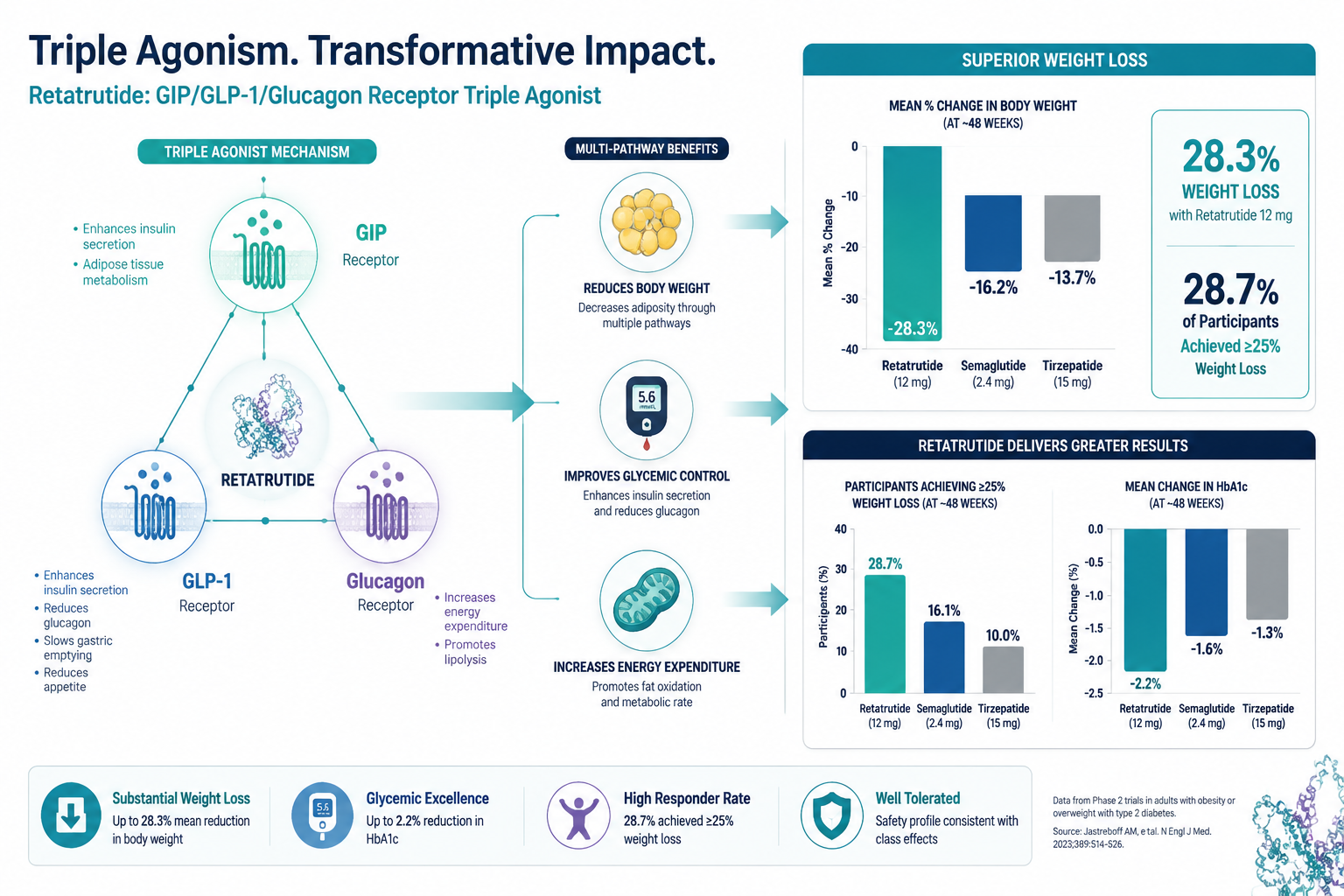
Retatrutide works by co-activating three distinct receptor pathways that each influence energy balance, appetite signaling, and glucose metabolism. The GLP-1 receptor component slows gastric emptying and reduces appetite. The GIP receptor component modulates insulin secretion and fat storage. The glucagon receptor component increases energy expenditure and promotes fat oxidation.

This triple mechanism is why Phase 2 trial data reported up to 24.2% body weight loss at 48 weeks with a 12 mg dose — a figure that exceeded what single or dual agonists had achieved at comparable timepoints. Phase 3 TRIUMPH-4 trial data extended that finding further, showing up to 28.7% body weight loss at 68 weeks with the same 12 mg dose.

"Triple agonism is not simply additive — the glucagon receptor component introduces an energy expenditure pathway that single and dual agonists do not access."

For researchers comparing incretin-based mechanisms, the dual receptor agonism research breakdown and the generations of GLP-1 differences articles offer relevant context. Researchers interested in complementary metabolic compounds may also find value in reviewing cagrilintide synergy with GLP-1 as a related area of investigation.


How to Interpret the Naming Difference in Research Context

How to Interpret the Naming Difference in Research Context

When evaluating Retatrutide vs GLP3 Peptide: How to Interpret the Naming Difference in Research Context, the practical rule is straightforward: use "retatrutide" for database searches on PubMed, ClinicalTrials.gov, or any regulatory archive. Searching "GLP-3 peptide" will return inconsistent results and may surface unrelated compounds or speculative content.

The informal "GLP-3" label is most common in:

  • Fitness and biohacking communities
  • Non-peer-reviewed blog content
  • Social media discussions comparing weight-loss peptides

It is rarely, if ever, used in:

  • Clinical trial registrations
  • Peer-reviewed pharmacology journals
  • FDA or EMA regulatory filings

Researchers studying adjacent compounds — such as tesofensine peptide overview or TESA body composition research themes — will notice the same pattern: informal community labels often diverge from official nomenclature. Maintaining terminological precision protects the integrity of literature reviews and prevents citation errors.


Conclusion

The core answer to Retatrutide vs GLP3 Peptide: How to Interpret the Naming Difference in Research Context is that no meaningful distinction exists between the two terms — they refer to the same compound, but one name is scientifically valid and one is not. Retatrutide is the correct, searchable, regulatory-recognized name for the triple GLP-1R/GIPR/GcgR agonist under active Phase 3 investigation.

Actionable next steps for researchers and informed readers:

  • Use "retatrutide" exclusively when searching clinical databases or citing literature.
  • Treat "GLP-3 peptide" as a community shorthand that signals triple agonism, not a distinct compound class.
  • Cross-reference mechanism descriptions against the three receptor targets (GLP-1R, GIPR, GcgR) to verify you are reading about the correct compound.
  • Follow TRIUMPH-4 and related Phase 3 trial updates for the most current efficacy and safety data.

Precision in terminology is not pedantic — it is the foundation of reliable research interpretation.

https://www.puretestedpeptides.com/wp-content/uploads/2026/07/Retatrutide-vs-GLP3-Peptide-How-to-Interpret-the-Naming-Difference-in-Research-Context.png 1024 1536 Pure Tested https://www.puretestedpeptides.com/wp-content/uploads/2026/01/buy-peptides-online.jpg Pure Tested2026-07-01 13:04:142026-07-20 15:01:17Retatrutide vs GLP3 Peptide: How to Interpret the Naming Difference in Research Context
Retatrutide Phase 3 Results: What the New GLP-3 Data Mean for Obesity and Glycemic Research

Retatrutide Phase 3 Results: What the New GLP-3 Data Mean for Obesity and Glycemic Research

June 24, 2026/0 Comments/by Pure Tested

A single drug producing nearly 30% average body-weight loss in a randomized Phase 3 trial would have seemed implausible a decade ago. In 2026, that is exactly what the latest retatrutide Phase 3 results are showing — and the implications for obesity and glycemic research extend well beyond the scale.

Wide-angle infographic-style illustration showing three interconnected receptor icons labeled GIP, GLP-1, and Glucagon

Key Takeaways

  • Retatrutide is a first-in-class GIP/GLP-1/glucagon triple agonist being developed by Eli Lilly for obesity and related metabolic conditions.
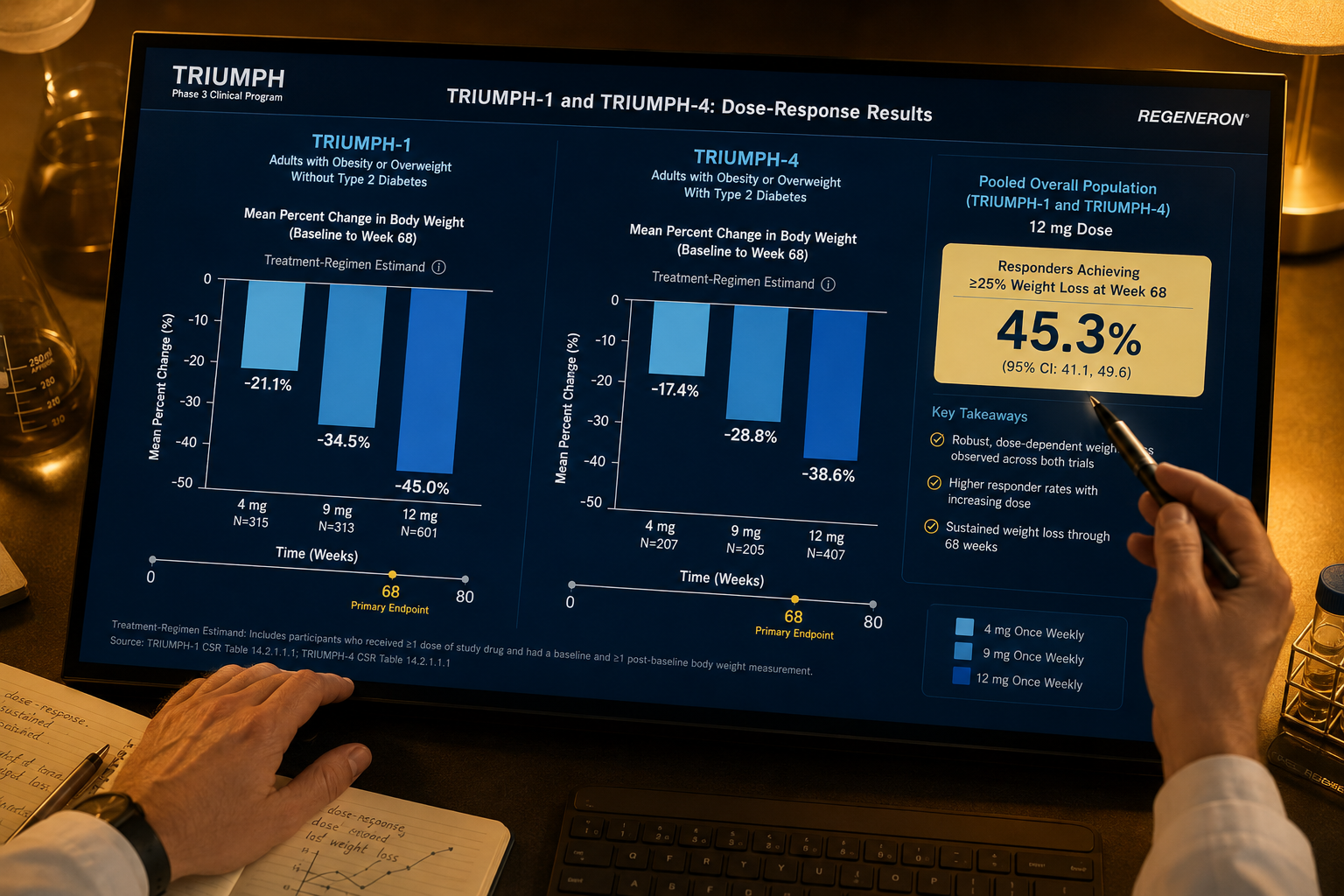
  • The TRIUMPH-1 Phase 3 trial showed mean weight loss of 28.3% at 80 weeks on the 12 mg dose, with 45.3% of participants losing 30% or more of body weight.
  • TRIUMPH-4 reported 28.7% mean weight loss at 68 weeks — the largest Phase 3 weight-loss signal ever recorded for a GLP-1-class compound.
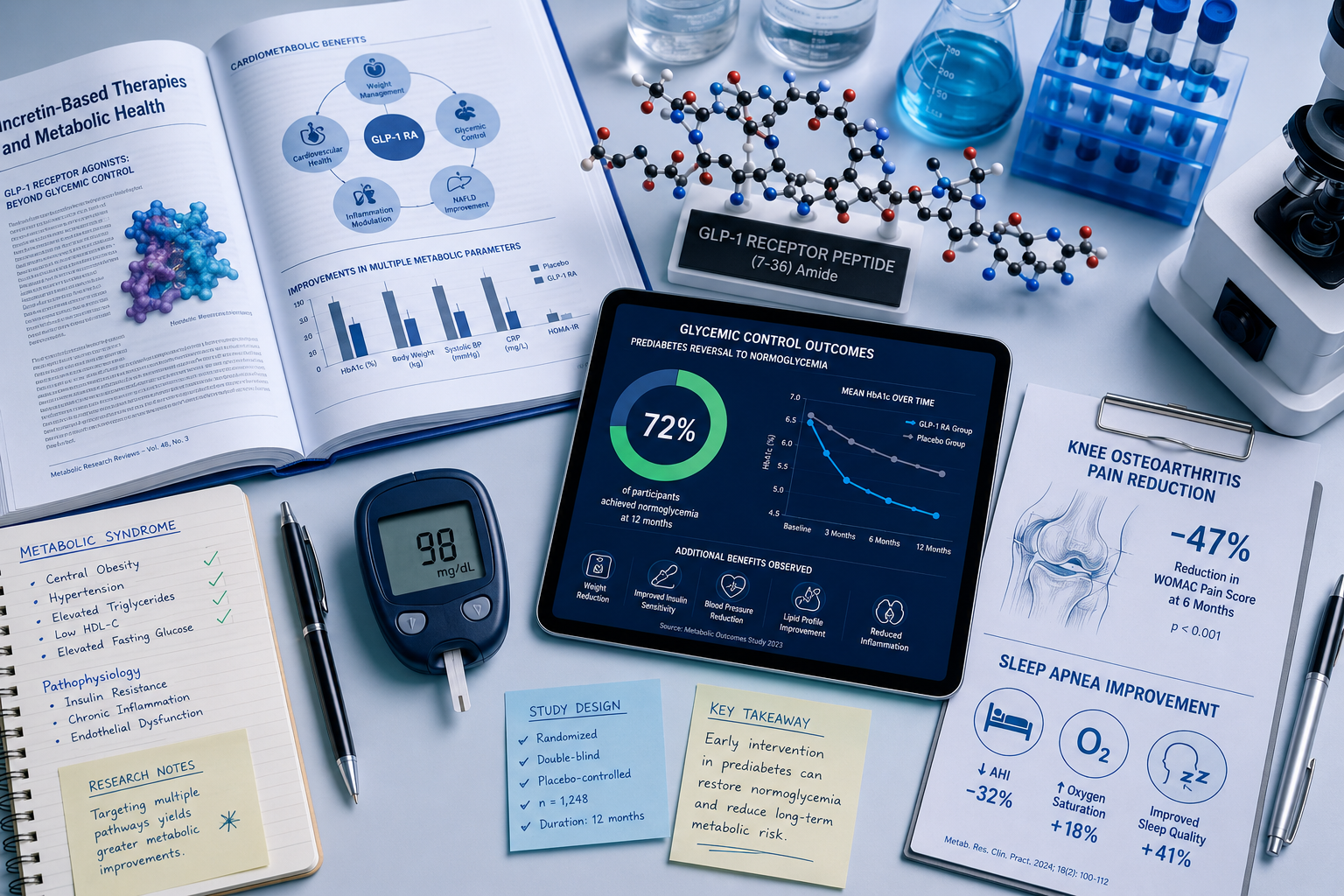
  • Secondary endpoints include a 72% reversion of prediabetes to normoglycemia and a 75.8% reduction in knee osteoarthritis pain.
  • June 2026 Lilly data confirm consistent benefits across multiple obesity-related conditions, including sleep apnea and type 2 diabetes.

What Makes Retatrutide Different From Earlier GLP-1 Agents

Most researchers familiar with GLP-1 peptide research and generational differences know that each successive agent in this class has pushed weight-loss benchmarks higher. Semaglutide averaged roughly 15% weight loss in Phase 3. Tirzepatide, a dual GIP/GLP-1 agonist, reached approximately 22%. Retatrutide adds a third target — the glucagon receptor — creating a triple-agonist profile that amplifies energy expenditure alongside appetite suppression and insulin sensitization.

This triple mechanism is central to understanding the retatrutide Phase 3 results. By activating glucagon receptors, retatrutide increases hepatic glucose output and thermogenesis, effects that single and dual agonists do not fully capture. Researchers studying GLP-3 and retatrutide compound data have noted that this added axis may explain why the efficacy ceiling appears higher than with prior agents.


TRIUMPH-1 and TRIUMPH-4: Breaking Down the Phase 3 Data

The TRIUMPH-1 trial enrolled 2,339 adults with obesity or overweight with at least one weight-related complication. At 80 weeks, mean weight loss was dose-dependent:

Dose Mean Weight Loss
4 mg 19.0%
9 mg 25.9%
12 mg 28.3% (~70 lb)
Placebo 2.2%

Notably, 45.3% of participants on 12 mg achieved 30% or greater weight loss — a threshold that previously required bariatric surgery. In a prespecified extension of participants with a baseline BMI of 35 or higher, continued 12 mg treatment to 104 weeks produced approximately 30.3% mean weight loss, equivalent to roughly 85 lb over two years.

"A 30% reduction in body weight through a once-weekly injectable represents a fundamental shift in what pharmacotherapy can achieve."

TRIUMPH-4, reported in December 2025 and now widely cited in 2026 analyses, reinforced these findings. Mean body-weight reduction reached 28.7% at 68 weeks on 12 mg once weekly, versus 2.1% on placebo. This figure is described as the largest weight-loss signal ever reported in a randomized Phase 3 trial of any GLP-1-class compound, exceeding the Phase 3 performance of both semaglutide and tirzepatide.

Secondary outcomes from TRIUMPH-4 are equally striking:

  • 75.8% reduction in knee osteoarthritis pain scores
  • ~20% reduction in LDL cholesterol
  • ~72% reversion of prediabetes to normoglycemia

For researchers already exploring metabolic peptides such as MOTS-c and its mitochondrial metabolic signaling, these multi-system effects align with a broader understanding that adiposity drives dysfunction across multiple organ systems simultaneously.

TRIUMPH-1 and TRIUMPH-4: Breaking Down the Phase 3 Data


Glycemic Research Implications and the June 2026 Lilly Update

On June 6, 2026, Eli Lilly released additional Phase 3 data confirming that retatrutide produced substantial weight loss alongside meaningful improvements in knee osteoarthritis pain, moderate-to-severe obstructive sleep apnea, and type 2 diabetes. The TRANSCEND-T2D-1 trial arm demonstrated strong glycemic control paired with double-digit weight loss in patients with established type 2 diabetes — a combination that positions retatrutide as a potential platform therapy rather than a single-indication drug.

This breadth of effect is relevant to researchers studying body composition and metabolic research themes or SLU-PP-332 metabolic modulation, because it highlights how upstream energy-balance interventions can cascade into downstream glycemic, inflammatory, and structural improvements.

The 72% prediabetes reversion rate is particularly significant. It suggests that weight loss of sufficient magnitude may normalize glucose regulation in a large proportion of at-risk individuals, reducing the pipeline burden on diabetes-specific interventions.

Researchers also tracking NAD+ energetics and longevity research may find the mitochondrial and thermogenic components of glucagon receptor activation worth examining in parallel, as both pathways converge on cellular energy efficiency.

Glycemic Research Implications and the June 2026 Lilly Update


Conclusion

The retatrutide Phase 3 results represent a meaningful advance in obesity and glycemic research. TRIUMPH-1 and TRIUMPH-4 together establish a new efficacy benchmark — approximately 28 to 30% body-weight reduction — that no prior pharmacological agent has achieved in randomized controlled trials. The secondary endpoints, particularly the 72% prediabetes reversion rate and the reductions in osteoarthritis pain and LDL cholesterol, indicate that the benefits extend well beyond the scale.

Actionable next steps for researchers and clinicians:

  • Review the full TRIUMPH-1 and TRIUMPH-4 datasets as they become available in peer-reviewed journals in 2026.
  • Monitor the TRANSCEND-T2D-1 readouts for glycemic-specific endpoints relevant to type 2 diabetes management protocols.
  • Consider how triple-agonist mechanisms intersect with other metabolic research areas, including GLP-1 peptide sourcing and research concepts and growth hormone axis compounds like tesa.
  • Track Eli Lilly's regulatory submission timeline, as approval decisions will shape clinical access and research availability throughout 2026 and beyond.

The retatrutide Phase 3 results confirm that the next generation of metabolic pharmacotherapy has arrived — and the data demand serious attention from anyone working at the intersection of obesity and glycemic research.

https://www.puretestedpeptides.com/wp-content/uploads/2026/06/Retatrutide-Phase-3-Results-What-the-New-GLP-3-Data-Mean-for-Obesity-and-Glycemic-Research.png 1024 1536 Pure Tested https://www.puretestedpeptides.com/wp-content/uploads/2026/01/buy-peptides-online.jpg Pure Tested2026-06-24 13:07:172026-07-20 15:02:20Retatrutide Phase 3 Results: What the New GLP-3 Data Mean for Obesity and Glycemic Research
Retatrutide Side Effects, Tolerability, and Dose Escalation: What the Clinical Literature Shows

Retatrutide Side Effects, Tolerability, and Dose Escalation: What the Clinical Literature Shows

June 14, 2026/0 Comments/by Pure Tested

Sixty percent of participants on the highest retatrutide dose reported nausea in Phase 2 trials. That single data point tells you more about managing this triple-receptor agonist than any headline about weight loss ever could. For clinicians, researchers, and informed readers, understanding Retatrutide Side Effects, Tolerability, and Dose Escalation: What the Clinical Literature Shows is the essential starting point before any other conversation about this compound.

Key Takeaways

  • Gastrointestinal adverse events are the most common side effects and are strongly dose-dependent.
  • Dysesthesia (abnormal skin sensation) is a unique side effect not seen with semaglutide or tirzepatide.
  • Slow, structured dose escalation is the primary strategy for improving tolerability.
  • Most adverse events are mild to moderate and tend to decrease after the titration phase.
  • Understanding the adverse-event profile helps set realistic expectations for any research or clinical context.

Key Takeaways

The Gastrointestinal Adverse Event Profile

The dominant safety signal across all retatrutide trials is gastrointestinal (GI) in nature. In the TRIUMPH-4 Phase 3 trial, participants receiving the 12 mg dose reported the following rates compared to placebo:

Adverse Event Retatrutide 12 mg Placebo
Nausea 43.2% 10.7%
Diarrhea 33.1% 13.4%
Constipation 25.0% 8.7%
Vomiting 20.9% 0.0%
Decreased appetite 18.2% 9.4%

These numbers are significant but not unexpected. Retatrutide activates three receptors simultaneously: GLP-1, GIP, and glucagon. This triple-agonist mechanism, which you can explore further through the GLP-3 retatrutide research overview, amplifies both efficacy and GI burden compared to single or dual-receptor agents.

It is also worth noting how retatrutide compares within the broader evolution of incretin-based therapies. The generations of GLP-1 receptor agonists page provides useful context for how each new class has shifted the tolerability landscape.

"The GI side effect profile of retatrutide is consistent with its mechanism but is meaningfully more pronounced at higher doses than what is observed with dual agonists."


The Gastrointestinal Adverse Event Profile

Dose-Dependent Tolerability: What the Phase 2 Data Reveals

One of the clearest findings from the TRIUMPH-1 Phase 2 trial is that side effects scale with dose. The nausea data across dose groups tells a direct story:

  • 1 mg dose: 14% reported nausea
  • 4 mg dose: 36% reported nausea
  • 8 mg dose: 44% reported nausea
  • 12 mg dose: 60% reported nausea

Diarrhea followed a less linear pattern, peaking at the 4 mg and 8 mg doses (both at 20%) before dropping slightly at 12 mg (15%), which may reflect GI adaptation over time.

This dose-response relationship is the primary reason that structured titration protocols exist. Gradual escalation allows the body to adapt to receptor activation before reaching therapeutic doses. Researchers interested in how similar peptide compounds handle titration can review CJC-1295 with DAC research findings for comparative context on incremental dosing strategies.

Understanding the GIP receptor and its importance also helps explain why the GI burden of retatrutide differs from GLP-1-only agents. GIP receptor co-activation affects gastric emptying and gut motility in ways that compound the nausea signal.


Dose-Dependent Tolerability: What the Phase 2 Data Reveals

Dysesthesia and Other Notable Findings in Retatrutide Side Effects, Tolerability, and Dose Escalation

Beyond GI effects, dysesthesia stands out as a clinically distinctive finding. In TRIUMPH-4, 20.9% of participants on the 12 mg dose reported this abnormal skin sensation, compared to just 0.7% in the placebo group. This side effect has not been observed with semaglutide or tirzepatide, making it a potential marker of retatrutide's unique glucagon receptor activity.

The mechanism behind dysesthesia is not fully characterized, but it is thought to relate to the glucagon receptor's role in peripheral nervous system signaling. Most reported cases were mild and did not lead to discontinuation.

For those studying peptide compounds with overlapping metabolic and neurological effects, the metabolic modulation research lines resource offers broader context on how receptor cross-talk can produce unexpected systemic signals.

Additional findings from the clinical literature on Retatrutide Side Effects, Tolerability, and Dose Escalation: What the Clinical Literature Shows include:

  • Injection site reactions (mild, consistent with subcutaneous peptide administration)
  • Heart rate increases at higher doses, consistent with glucagon receptor activity
  • No new cardiovascular safety signals identified in Phase 2 or Phase 3 data to date

Researchers exploring synergistic incretin mechanisms may also find the cagrilintide synergy with GLP-1 article relevant, as it addresses how combination receptor strategies influence tolerability profiles.


Conclusion

The clinical picture of Retatrutide Side Effects, Tolerability, and Dose Escalation: What the Clinical Literature Shows is one of manageable but meaningful adverse events, primarily GI in nature and clearly dose-dependent. Dysesthesia remains the most pharmacologically interesting finding, given its absence in comparable drug classes.

Actionable next steps for researchers and clinicians:

  1. Prioritize slow dose escalation protocols to reduce peak GI burden.
  2. Monitor for dysesthesia specifically, as it may be under-recognized without active questioning.
  3. Assess individual GI tolerance at each dose step before advancing.
  4. Review the full product research catalog for related metabolic peptide compounds with established tolerability data.
  5. Cross-reference the metabolic modulation research lines for mechanistic context when interpreting adverse event patterns.

The efficacy data for retatrutide is compelling. But sound research and clinical decision-making begins with a clear-eyed view of the safety profile, not the weight-loss headline.

https://www.puretestedpeptides.com/wp-content/uploads/2026/06/Retatrutide-Side-Effects-Tolerability-and-Dose-Escalation-What-the-Clinical-Literature-Shows.png 1024 1536 Pure Tested https://www.puretestedpeptides.com/wp-content/uploads/2026/01/buy-peptides-online.jpg Pure Tested2026-06-14 16:48:432026-07-20 15:03:13Retatrutide Side Effects, Tolerability, and Dose Escalation: What the Clinical Literature Shows
How Retatrutide Compares With GLP-1 and GLP-2 Research Peptides in Obesity Models

How Retatrutide Compares With GLP-1 and GLP-2 Research Peptides in Obesity Models

June 4, 2026/0 Comments/by Pure Tested

Triple agonism has quietly shifted the center of gravity in metabolic peptide research. While single-receptor approaches dominated the conversation for years, a 39-amino acid compound called retatrutide now sits at the intersection of three distinct signaling pathways — and the weight-loss data from preclinical and clinical obesity models is unlike anything seen before in this class.

Understanding how retatrutide compares with GLP-1 and GLP-2 research peptides in obesity models requires a clear look at receptor biology, efficacy endpoints, and the structural differences that separate these compounds at the molecular level.

Key Takeaways

  • Retatrutide is a triple agonist activating GLP-1, GIP, and glucagon receptors simultaneously, producing greater metabolic effects than single or dual agonists.
  • Phase 3 TRIUMPH-4 data showed 28.7% average weight loss at 68 weeks — the highest recorded in any obesity trial to date.
  • GLP-2 peptides act primarily on intestinal repair and growth, not on adipose tissue or appetite suppression, making them functionally distinct from GLP-1 class agents.
  • Retatrutide's glucagon receptor component raises resting metabolic rate and promotes lipolysis, a mechanism absent in GLP-1-only agents.
  • As of 2026, retatrutide remains in Phase 3 trials, with a New Drug Application filing anticipated in late 2026 or early 2027.

Retatrutide triple receptor agonist mechanism diagram

The Receptor Architecture Behind Triple Agonism

How retatrutide compares with GLP-1 and GLP-2 research peptides in obesity models starts with a fundamental structural distinction. Retatrutide is built on a GIP backbone, modified to resist DPP-4 enzymatic degradation, and conjugated to a C20 fatty diacid moiety that extends its half-life. This architecture allows it to engage three receptors simultaneously:

Receptor Primary Effect
GLP-1R Insulin secretion, appetite suppression
GIPR Enhanced insulin response, fat metabolism
GCG-R Increased resting metabolic rate, lipolysis

GLP-1 agonists like semaglutide activate only the GLP-1 receptor. This reduces appetite and improves glycemic control but leaves energy expenditure largely unchanged. Dual agonists such as tirzepatide add GIP receptor activation, improving insulin sensitivity and fat metabolism. Retatrutide layers glucagon receptor agonism on top of both, actively raising the rate at which the body burns stored fat.

GLP-2 peptides occupy a completely different functional space. Their primary role is intestinal epithelial growth, mucosal repair, and nutrient absorption regulation. In obesity models, GLP-2 analogs show minimal direct impact on body weight or adipose tissue reduction. Researchers studying gut-barrier integrity or inflammatory bowel conditions find GLP-2 highly relevant, but it does not compete with GLP-1 class agents on weight-loss endpoints.

For those exploring the broader landscape of incretin-related research, the GLP-3 and retatrutide incretin research themes page provides useful context on how these receptor classes are being studied in parallel.


Weight loss comparison bar chart: Retatrutide vs GLP-1 agents

Efficacy Data Across Obesity Models: Where the Numbers Diverge

The clinical weight-loss data illustrates the gap between these approaches with precision.

  • Semaglutide (GLP-1 only): approximately 14.9% body weight reduction over 68 weeks
  • Tirzepatide (GLP-1 + GIP): approximately 22.5% over 72 weeks
  • Retatrutide 12 mg (GLP-1 + GIP + GCG): 28.7% over 68 weeks in the TRIUMPH-4 Phase 3 trial

"Retatrutide's triple-agonist approach may redefine obesity treatment by offering weight loss results approaching those of bariatric surgery."

In Phase 2 trials, participants at the 12 mg dose also showed a 2.2% reduction in HbA1c from a baseline of approximately 8.3%, with 82% reaching HbA1c levels at or below 6.5%. This dual impact on both body weight and glycemic control strengthens retatrutide's research profile considerably.

The glucagon receptor component deserves particular attention. By increasing resting metabolic rate and driving lipolysis, it creates an energy-expenditure advantage that neither GLP-1 nor GLP-2 agents can replicate. This is why researchers tracking AOD-9604 metabolic research and lipolytic peptide mechanisms are increasingly interested in how glucagon co-agonism fits into broader fat-loss models.

For context on how GLP-1 peptides are currently categorized and studied, that resource outlines the foundational receptor class from which retatrutide diverges.


Researcher reviewing peptide molecular data in laboratory

How Retatrutide Compares With GLP-1 and GLP-2 Research Peptides in Obesity Models: Safety and Research Outlook

The side-effect profile of retatrutide largely mirrors that of other GLP-1 class agents. Nausea, diarrhea, vomiting, and constipation are the most commonly reported issues. One notable distinction is dysesthesia — tingling or burning sensations — reported in approximately 20.9% of participants at the 12 mg dose in TRIUMPH-4. This is not commonly observed with GLP-1-only or GLP-2 agents and likely reflects glucagon receptor activity.

As of 2026, retatrutide remains in Phase 3 trials. An NDA filing is anticipated in late 2026 or early 2027. Researchers sourcing compounds for preclinical work can review the GLP-3 Retatrutide 10mg research product for current availability.

Those building a broader metabolic research framework may also find value in exploring what is new in peptide research to understand how retatrutide fits alongside other emerging compounds, or reviewing NAD research and GLP-3 online resources for complementary metabolic pathways under investigation.

For researchers studying peptide blends in research contexts, the triple-agonist design of retatrutide also raises questions about whether combination approaches in preclinical models could replicate or extend its receptor-engagement profile.


Conclusion

How retatrutide compares with GLP-1 and GLP-2 research peptides in obesity models comes down to receptor breadth and metabolic reach. GLP-1 agents suppress appetite and improve insulin response. GLP-2 agents repair intestinal tissue. Retatrutide does something categorically different: it activates three complementary pathways at once, producing weight-loss outcomes that exceed all prior pharmacological benchmarks and approach the efficacy of surgical intervention.

Actionable next steps for researchers:

  • Review Phase 2 and TRIUMPH-4 Phase 3 trial data to understand dose-response relationships at the 4 mg, 8 mg, and 12 mg levels.
  • Distinguish GLP-2 research models (gut repair, nutrient absorption) from GLP-1/GCG co-agonism models before designing obesity endpoints.
  • Monitor NDA filing timelines in late 2026 and early 2027 for regulatory developments that may affect research access.
  • Evaluate glucagon receptor co-agonism as a distinct variable when comparing metabolic outcomes across peptide classes.

The research conversation around obesity pharmacology has changed. Triple agonism is no longer a theoretical advantage — the data has made it a measurable one.


https://www.puretestedpeptides.com/wp-content/uploads/2026/06/How-Retatrutide-Compares-With-GLP-1-and-GLP-2-Research-Peptides-in-Obesity-Models-1.png 672 1024 Pure Tested https://www.puretestedpeptides.com/wp-content/uploads/2026/01/buy-peptides-online.jpg Pure Tested2026-06-04 13:18:082026-07-20 15:03:56How Retatrutide Compares With GLP-1 and GLP-2 Research Peptides in Obesity Models
How Retatrutide Compares With GLP-1 and GLP-2 Research Peptides in Obesity Models

How Retatrutide Compares With GLP-1 and GLP-2 Research Peptides in Obesity Models

June 4, 2026/0 Comments/by Pure Tested

Triple agonism has quietly shifted the center of gravity in metabolic peptide research. While single-receptor approaches dominated the conversation for years, a 39-amino acid compound called retatrutide now sits at the intersection of three distinct signaling pathways — and the weight-loss data from preclinical and clinical obesity models is unlike anything seen before in this class.

Understanding how retatrutide compares with GLP-1 and GLP-2 research peptides in obesity models requires a clear look at receptor biology, efficacy endpoints, and the structural differences that separate these compounds at the molecular level.

Key Takeaways

  • Retatrutide is a triple agonist activating GLP-1, GIP, and glucagon receptors simultaneously, producing greater metabolic effects than single or dual agonists.
  • Phase 3 TRIUMPH-4 data showed 28.7% average weight loss at 68 weeks — the highest recorded in any obesity trial to date.
  • GLP-2 peptides act primarily on intestinal repair and growth, not on adipose tissue or appetite suppression, making them functionally distinct from GLP-1 class agents.
  • Retatrutide's glucagon receptor component raises resting metabolic rate and promotes lipolysis, a mechanism absent in GLP-1-only agents.
  • As of 2026, retatrutide remains in Phase 3 trials, with a New Drug Application filing anticipated in late 2026 or early 2027.

Retatrutide triple receptor agonist mechanism diagram

The Receptor Architecture Behind Triple Agonism

How retatrutide compares with GLP-1 and GLP-2 research peptides in obesity models starts with a fundamental structural distinction. Retatrutide is built on a GIP backbone, modified to resist DPP-4 enzymatic degradation, and conjugated to a C20 fatty diacid moiety that extends its half-life. This architecture allows it to engage three receptors simultaneously:

Receptor Primary Effect
GLP-1R Insulin secretion, appetite suppression
GIPR Enhanced insulin response, fat metabolism
GCG-R Increased resting metabolic rate, lipolysis

GLP-1 agonists like semaglutide activate only the GLP-1 receptor. This reduces appetite and improves glycemic control but leaves energy expenditure largely unchanged. Dual agonists such as tirzepatide add GIP receptor activation, improving insulin sensitivity and fat metabolism. Retatrutide layers glucagon receptor agonism on top of both, actively raising the rate at which the body burns stored fat.

GLP-2 peptides occupy a completely different functional space. Their primary role is intestinal epithelial growth, mucosal repair, and nutrient absorption regulation. In obesity models, GLP-2 analogs show minimal direct impact on body weight or adipose tissue reduction. Researchers studying gut-barrier integrity or inflammatory bowel conditions find GLP-2 highly relevant, but it does not compete with GLP-1 class agents on weight-loss endpoints.

For those exploring the broader landscape of incretin-related research, the GLP-3 and retatrutide incretin research themes page provides useful context on how these receptor classes are being studied in parallel.


Weight loss comparison bar chart: Retatrutide vs GLP-1 agents

Efficacy Data Across Obesity Models: Where the Numbers Diverge

The clinical weight-loss data illustrates the gap between these approaches with precision.

  • Semaglutide (GLP-1 only): approximately 14.9% body weight reduction over 68 weeks
  • Tirzepatide (GLP-1 + GIP): approximately 22.5% over 72 weeks
  • Retatrutide 12 mg (GLP-1 + GIP + GCG): 28.7% over 68 weeks in the TRIUMPH-4 Phase 3 trial

"Retatrutide's triple-agonist approach may redefine obesity treatment by offering weight loss results approaching those of bariatric surgery."

In Phase 2 trials, participants at the 12 mg dose also showed a 2.2% reduction in HbA1c from a baseline of approximately 8.3%, with 82% reaching HbA1c levels at or below 6.5%. This dual impact on both body weight and glycemic control strengthens retatrutide's research profile considerably.

The glucagon receptor component deserves particular attention. By increasing resting metabolic rate and driving lipolysis, it creates an energy-expenditure advantage that neither GLP-1 nor GLP-2 agents can replicate. This is why researchers tracking AOD-9604 metabolic research and lipolytic peptide mechanisms are increasingly interested in how glucagon co-agonism fits into broader fat-loss models.

For context on how GLP-1 peptides are currently categorized and studied, that resource outlines the foundational receptor class from which retatrutide diverges.


Researcher reviewing peptide molecular data in laboratory

How Retatrutide Compares With GLP-1 and GLP-2 Research Peptides in Obesity Models: Safety and Research Outlook

The side-effect profile of retatrutide largely mirrors that of other GLP-1 class agents. Nausea, diarrhea, vomiting, and constipation are the most commonly reported issues. One notable distinction is dysesthesia — tingling or burning sensations — reported in approximately 20.9% of participants at the 12 mg dose in TRIUMPH-4. This is not commonly observed with GLP-1-only or GLP-2 agents and likely reflects glucagon receptor activity.

As of 2026, retatrutide remains in Phase 3 trials. An NDA filing is anticipated in late 2026 or early 2027. Researchers sourcing compounds for preclinical work can review the GLP-3 Retatrutide 10mg research product for current availability.

Those building a broader metabolic research framework may also find value in exploring what is new in peptide research to understand how retatrutide fits alongside other emerging compounds, or reviewing NAD research and GLP-3 online resources for complementary metabolic pathways under investigation.

For researchers studying peptide blends in research contexts, the triple-agonist design of retatrutide also raises questions about whether combination approaches in preclinical models could replicate or extend its receptor-engagement profile.


Conclusion

How retatrutide compares with GLP-1 and GLP-2 research peptides in obesity models comes down to receptor breadth and metabolic reach. GLP-1 agents suppress appetite and improve insulin response. GLP-2 agents repair intestinal tissue. Retatrutide does something categorically different: it activates three complementary pathways at once, producing weight-loss outcomes that exceed all prior pharmacological benchmarks and approach the efficacy of surgical intervention.

Actionable next steps for researchers:

  • Review Phase 2 and TRIUMPH-4 Phase 3 trial data to understand dose-response relationships at the 4 mg, 8 mg, and 12 mg levels.
  • Distinguish GLP-2 research models (gut repair, nutrient absorption) from GLP-1/GCG co-agonism models before designing obesity endpoints.
  • Monitor NDA filing timelines in late 2026 and early 2027 for regulatory developments that may affect research access.
  • Evaluate glucagon receptor co-agonism as a distinct variable when comparing metabolic outcomes across peptide classes.

The research conversation around obesity pharmacology has changed. Triple agonism is no longer a theoretical advantage — the data has made it a measurable one.


https://www.puretestedpeptides.com/wp-content/uploads/2026/06/How-Retatrutide-Compares-With-GLP-1-and-GLP-2-Research-Peptides-in-Obesity-Models.png 672 1024 Pure Tested https://www.puretestedpeptides.com/wp-content/uploads/2026/01/buy-peptides-online.jpg Pure Tested2026-06-04 13:18:082026-07-20 15:03:57How Retatrutide Compares With GLP-1 and GLP-2 Research Peptides in Obesity Models
How Retatrutide Compares With GLP-1 and GLP-2 Research Peptides in Obesity Models

How Retatrutide Compares With GLP-1 and GLP-2 Research Peptides in Obesity Models

June 4, 2026/0 Comments/by Pure Tested

Triple agonism has quietly shifted the center of gravity in metabolic peptide research. While single-receptor approaches dominated the conversation for years, a 39-amino acid compound called retatrutide now sits at the intersection of three distinct signaling pathways — and the weight-loss data from preclinical and clinical obesity models is unlike anything seen before in this class.

Understanding how retatrutide compares with GLP-1 and GLP-2 research peptides in obesity models requires a clear look at receptor biology, efficacy endpoints, and the structural differences that separate these compounds at the molecular level.

Key Takeaways

  • Retatrutide is a triple agonist activating GLP-1, GIP, and glucagon receptors simultaneously, producing greater metabolic effects than single or dual agonists.
  • Phase 3 TRIUMPH-4 data showed 28.7% average weight loss at 68 weeks — the highest recorded in any obesity trial to date.
  • GLP-2 peptides act primarily on intestinal repair and growth, not on adipose tissue or appetite suppression, making them functionally distinct from GLP-1 class agents.
  • Retatrutide's glucagon receptor component raises resting metabolic rate and promotes lipolysis, a mechanism absent in GLP-1-only agents.
  • As of 2026, retatrutide remains in Phase 3 trials, with a New Drug Application filing anticipated in late 2026 or early 2027.

Retatrutide triple receptor agonist mechanism diagram

The Receptor Architecture Behind Triple Agonism

How retatrutide compares with GLP-1 and GLP-2 research peptides in obesity models starts with a fundamental structural distinction. Retatrutide is built on a GIP backbone, modified to resist DPP-4 enzymatic degradation, and conjugated to a C20 fatty diacid moiety that extends its half-life. This architecture allows it to engage three receptors simultaneously:

Receptor Primary Effect
GLP-1R Insulin secretion, appetite suppression
GIPR Enhanced insulin response, fat metabolism
GCG-R Increased resting metabolic rate, lipolysis

GLP-1 agonists like semaglutide activate only the GLP-1 receptor. This reduces appetite and improves glycemic control but leaves energy expenditure largely unchanged. Dual agonists such as tirzepatide add GIP receptor activation, improving insulin sensitivity and fat metabolism. Retatrutide layers glucagon receptor agonism on top of both, actively raising the rate at which the body burns stored fat.

GLP-2 peptides occupy a completely different functional space. Their primary role is intestinal epithelial growth, mucosal repair, and nutrient absorption regulation. In obesity models, GLP-2 analogs show minimal direct impact on body weight or adipose tissue reduction. Researchers studying gut-barrier integrity or inflammatory bowel conditions find GLP-2 highly relevant, but it does not compete with GLP-1 class agents on weight-loss endpoints.

For those exploring the broader landscape of incretin-related research, the GLP-3 and retatrutide incretin research themes page provides useful context on how these receptor classes are being studied in parallel.


Weight loss comparison bar chart: Retatrutide vs GLP-1 agents

Efficacy Data Across Obesity Models: Where the Numbers Diverge

The clinical weight-loss data illustrates the gap between these approaches with precision.

  • Semaglutide (GLP-1 only): approximately 14.9% body weight reduction over 68 weeks
  • Tirzepatide (GLP-1 + GIP): approximately 22.5% over 72 weeks
  • Retatrutide 12 mg (GLP-1 + GIP + GCG): 28.7% over 68 weeks in the TRIUMPH-4 Phase 3 trial

"Retatrutide's triple-agonist approach may redefine obesity treatment by offering weight loss results approaching those of bariatric surgery."

In Phase 2 trials, participants at the 12 mg dose also showed a 2.2% reduction in HbA1c from a baseline of approximately 8.3%, with 82% reaching HbA1c levels at or below 6.5%. This dual impact on both body weight and glycemic control strengthens retatrutide's research profile considerably.

The glucagon receptor component deserves particular attention. By increasing resting metabolic rate and driving lipolysis, it creates an energy-expenditure advantage that neither GLP-1 nor GLP-2 agents can replicate. This is why researchers tracking AOD-9604 metabolic research and lipolytic peptide mechanisms are increasingly interested in how glucagon co-agonism fits into broader fat-loss models.

For context on how GLP-1 peptides are currently categorized and studied, that resource outlines the foundational receptor class from which retatrutide diverges.


Researcher reviewing peptide molecular data in laboratory

How Retatrutide Compares With GLP-1 and GLP-2 Research Peptides in Obesity Models: Safety and Research Outlook

The side-effect profile of retatrutide largely mirrors that of other GLP-1 class agents. Nausea, diarrhea, vomiting, and constipation are the most commonly reported issues. One notable distinction is dysesthesia — tingling or burning sensations — reported in approximately 20.9% of participants at the 12 mg dose in TRIUMPH-4. This is not commonly observed with GLP-1-only or GLP-2 agents and likely reflects glucagon receptor activity.

As of 2026, retatrutide remains in Phase 3 trials. An NDA filing is anticipated in late 2026 or early 2027. Researchers sourcing compounds for preclinical work can review the GLP-3 Retatrutide 10mg research product for current availability.

Those building a broader metabolic research framework may also find value in exploring what is new in peptide research to understand how retatrutide fits alongside other emerging compounds, or reviewing NAD research and GLP-3 online resources for complementary metabolic pathways under investigation.

For researchers studying peptide blends in research contexts, the triple-agonist design of retatrutide also raises questions about whether combination approaches in preclinical models could replicate or extend its receptor-engagement profile.


Conclusion

How retatrutide compares with GLP-1 and GLP-2 research peptides in obesity models comes down to receptor breadth and metabolic reach. GLP-1 agents suppress appetite and improve insulin response. GLP-2 agents repair intestinal tissue. Retatrutide does something categorically different: it activates three complementary pathways at once, producing weight-loss outcomes that exceed all prior pharmacological benchmarks and approach the efficacy of surgical intervention.

Actionable next steps for researchers:

  • Review Phase 2 and TRIUMPH-4 Phase 3 trial data to understand dose-response relationships at the 4 mg, 8 mg, and 12 mg levels.
  • Distinguish GLP-2 research models (gut repair, nutrient absorption) from GLP-1/GCG co-agonism models before designing obesity endpoints.
  • Monitor NDA filing timelines in late 2026 and early 2027 for regulatory developments that may affect research access.
  • Evaluate glucagon receptor co-agonism as a distinct variable when comparing metabolic outcomes across peptide classes.

The research conversation around obesity pharmacology has changed. Triple agonism is no longer a theoretical advantage — the data has made it a measurable one.


https://www.puretestedpeptides.com/wp-content/uploads/2026/06/How-Retatrutide-Compares-With-GLP-1-and-GLP-2-Research-Peptides-in-Obesity-Models.png 672 1024 Pure Tested https://www.puretestedpeptides.com/wp-content/uploads/2026/01/buy-peptides-online.jpg Pure Tested2026-06-04 13:18:082026-07-20 15:04:06How Retatrutide Compares With GLP-1 and GLP-2 Research Peptides in Obesity Models
How Retatrutide Compares With GLP-1 and GLP-2 Research Peptides in Obesity Models

How Retatrutide Compares With GLP-1 and GLP-2 Research Peptides in Obesity Models

June 4, 2026/0 Comments/by Pure Tested

Triple agonism has quietly shifted the center of gravity in metabolic peptide research. While single-receptor approaches dominated the conversation for years, a 39-amino acid compound called retatrutide now sits at the intersection of three distinct signaling pathways — and the weight-loss data from preclinical and clinical obesity models is unlike anything seen before in this class.

Understanding how retatrutide compares with GLP-1 and GLP-2 research peptides in obesity models requires a clear look at receptor biology, efficacy endpoints, and the structural differences that separate these compounds at the molecular level.

Key Takeaways

  • Retatrutide is a triple agonist activating GLP-1, GIP, and glucagon receptors simultaneously, producing greater metabolic effects than single or dual agonists.
  • Phase 3 TRIUMPH-4 data showed 28.7% average weight loss at 68 weeks — the highest recorded in any obesity trial to date.
  • GLP-2 peptides act primarily on intestinal repair and growth, not on adipose tissue or appetite suppression, making them functionally distinct from GLP-1 class agents.
  • Retatrutide's glucagon receptor component raises resting metabolic rate and promotes lipolysis, a mechanism absent in GLP-1-only agents.
  • As of 2026, retatrutide remains in Phase 3 trials, with a New Drug Application filing anticipated in late 2026 or early 2027.

Retatrutide triple receptor agonist mechanism diagram

The Receptor Architecture Behind Triple Agonism

How retatrutide compares with GLP-1 and GLP-2 research peptides in obesity models starts with a fundamental structural distinction. Retatrutide is built on a GIP backbone, modified to resist DPP-4 enzymatic degradation, and conjugated to a C20 fatty diacid moiety that extends its half-life. This architecture allows it to engage three receptors simultaneously:

Receptor Primary Effect
GLP-1R Insulin secretion, appetite suppression
GIPR Enhanced insulin response, fat metabolism
GCG-R Increased resting metabolic rate, lipolysis

GLP-1 agonists like semaglutide activate only the GLP-1 receptor. This reduces appetite and improves glycemic control but leaves energy expenditure largely unchanged. Dual agonists such as tirzepatide add GIP receptor activation, improving insulin sensitivity and fat metabolism. Retatrutide layers glucagon receptor agonism on top of both, actively raising the rate at which the body burns stored fat.

GLP-2 peptides occupy a completely different functional space. Their primary role is intestinal epithelial growth, mucosal repair, and nutrient absorption regulation. In obesity models, GLP-2 analogs show minimal direct impact on body weight or adipose tissue reduction. Researchers studying gut-barrier integrity or inflammatory bowel conditions find GLP-2 highly relevant, but it does not compete with GLP-1 class agents on weight-loss endpoints.

For those exploring the broader landscape of incretin-related research, the GLP-3 and retatrutide incretin research themes page provides useful context on how these receptor classes are being studied in parallel.


Weight loss comparison bar chart: Retatrutide vs GLP-1 agents

Efficacy Data Across Obesity Models: Where the Numbers Diverge

The clinical weight-loss data illustrates the gap between these approaches with precision.

  • Semaglutide (GLP-1 only): approximately 14.9% body weight reduction over 68 weeks
  • Tirzepatide (GLP-1 + GIP): approximately 22.5% over 72 weeks
  • Retatrutide 12 mg (GLP-1 + GIP + GCG): 28.7% over 68 weeks in the TRIUMPH-4 Phase 3 trial

"Retatrutide's triple-agonist approach may redefine obesity treatment by offering weight loss results approaching those of bariatric surgery."

In Phase 2 trials, participants at the 12 mg dose also showed a 2.2% reduction in HbA1c from a baseline of approximately 8.3%, with 82% reaching HbA1c levels at or below 6.5%. This dual impact on both body weight and glycemic control strengthens retatrutide's research profile considerably.

The glucagon receptor component deserves particular attention. By increasing resting metabolic rate and driving lipolysis, it creates an energy-expenditure advantage that neither GLP-1 nor GLP-2 agents can replicate. This is why researchers tracking AOD-9604 metabolic research and lipolytic peptide mechanisms are increasingly interested in how glucagon co-agonism fits into broader fat-loss models.

For context on how GLP-1 peptides are currently categorized and studied, that resource outlines the foundational receptor class from which retatrutide diverges.


Researcher reviewing peptide molecular data in laboratory

How Retatrutide Compares With GLP-1 and GLP-2 Research Peptides in Obesity Models: Safety and Research Outlook

The side-effect profile of retatrutide largely mirrors that of other GLP-1 class agents. Nausea, diarrhea, vomiting, and constipation are the most commonly reported issues. One notable distinction is dysesthesia — tingling or burning sensations — reported in approximately 20.9% of participants at the 12 mg dose in TRIUMPH-4. This is not commonly observed with GLP-1-only or GLP-2 agents and likely reflects glucagon receptor activity.

As of 2026, retatrutide remains in Phase 3 trials. An NDA filing is anticipated in late 2026 or early 2027. Researchers sourcing compounds for preclinical work can review the GLP-3 Retatrutide 10mg research product for current availability.

Those building a broader metabolic research framework may also find value in exploring what is new in peptide research to understand how retatrutide fits alongside other emerging compounds, or reviewing NAD research and GLP-3 online resources for complementary metabolic pathways under investigation.

For researchers studying peptide blends in research contexts, the triple-agonist design of retatrutide also raises questions about whether combination approaches in preclinical models could replicate or extend its receptor-engagement profile.


Conclusion

How retatrutide compares with GLP-1 and GLP-2 research peptides in obesity models comes down to receptor breadth and metabolic reach. GLP-1 agents suppress appetite and improve insulin response. GLP-2 agents repair intestinal tissue. Retatrutide does something categorically different: it activates three complementary pathways at once, producing weight-loss outcomes that exceed all prior pharmacological benchmarks and approach the efficacy of surgical intervention.

Actionable next steps for researchers:

  • Review Phase 2 and TRIUMPH-4 Phase 3 trial data to understand dose-response relationships at the 4 mg, 8 mg, and 12 mg levels.
  • Distinguish GLP-2 research models (gut repair, nutrient absorption) from GLP-1/GCG co-agonism models before designing obesity endpoints.
  • Monitor NDA filing timelines in late 2026 and early 2027 for regulatory developments that may affect research access.
  • Evaluate glucagon receptor co-agonism as a distinct variable when comparing metabolic outcomes across peptide classes.

The research conversation around obesity pharmacology has changed. Triple agonism is no longer a theoretical advantage — the data has made it a measurable one.


https://www.puretestedpeptides.com/wp-content/uploads/2026/06/How-Retatrutide-Compares-With-GLP-1-and-GLP-2-Research-Peptides-in-Obesity-Models.png 672 1024 Pure Tested https://www.puretestedpeptides.com/wp-content/uploads/2026/01/buy-peptides-online.jpg Pure Tested2026-06-04 13:18:082026-07-20 15:03:57How Retatrutide Compares With GLP-1 and GLP-2 Research Peptides in Obesity Models
How Retatrutide Compares With GLP-1 and GLP-2 Research Peptides in Obesity Models

How Retatrutide Compares With GLP-1 and GLP-2 Research Peptides in Obesity Models

June 4, 2026/0 Comments/by Pure Tested

Triple agonism has quietly shifted the center of gravity in metabolic peptide research. While single-receptor approaches dominated the conversation for years, a 39-amino acid compound called retatrutide now sits at the intersection of three distinct signaling pathways — and the weight-loss data from preclinical and clinical obesity models is unlike anything seen before in this class.

Understanding how retatrutide compares with GLP-1 and GLP-2 research peptides in obesity models requires a clear look at receptor biology, efficacy endpoints, and the structural differences that separate these compounds at the molecular level.

Key Takeaways

  • Retatrutide is a triple agonist activating GLP-1, GIP, and glucagon receptors simultaneously, producing greater metabolic effects than single or dual agonists.
  • Phase 3 TRIUMPH-4 data showed 28.7% average weight loss at 68 weeks — the highest recorded in any obesity trial to date.
  • GLP-2 peptides act primarily on intestinal repair and growth, not on adipose tissue or appetite suppression, making them functionally distinct from GLP-1 class agents.
  • Retatrutide's glucagon receptor component raises resting metabolic rate and promotes lipolysis, a mechanism absent in GLP-1-only agents.
  • As of 2026, retatrutide remains in Phase 3 trials, with a New Drug Application filing anticipated in late 2026 or early 2027.

Retatrutide triple receptor agonist mechanism diagram

The Receptor Architecture Behind Triple Agonism

How retatrutide compares with GLP-1 and GLP-2 research peptides in obesity models starts with a fundamental structural distinction. Retatrutide is built on a GIP backbone, modified to resist DPP-4 enzymatic degradation, and conjugated to a C20 fatty diacid moiety that extends its half-life. This architecture allows it to engage three receptors simultaneously:

Receptor Primary Effect
GLP-1R Insulin secretion, appetite suppression
GIPR Enhanced insulin response, fat metabolism
GCG-R Increased resting metabolic rate, lipolysis

GLP-1 agonists like semaglutide activate only the GLP-1 receptor. This reduces appetite and improves glycemic control but leaves energy expenditure largely unchanged. Dual agonists such as tirzepatide add GIP receptor activation, improving insulin sensitivity and fat metabolism. Retatrutide layers glucagon receptor agonism on top of both, actively raising the rate at which the body burns stored fat.

GLP-2 peptides occupy a completely different functional space. Their primary role is intestinal epithelial growth, mucosal repair, and nutrient absorption regulation. In obesity models, GLP-2 analogs show minimal direct impact on body weight or adipose tissue reduction. Researchers studying gut-barrier integrity or inflammatory bowel conditions find GLP-2 highly relevant, but it does not compete with GLP-1 class agents on weight-loss endpoints.

For those exploring the broader landscape of incretin-related research, the GLP-3 and retatrutide incretin research themes page provides useful context on how these receptor classes are being studied in parallel.


Weight loss comparison bar chart: Retatrutide vs GLP-1 agents

Efficacy Data Across Obesity Models: Where the Numbers Diverge

The clinical weight-loss data illustrates the gap between these approaches with precision.

  • Semaglutide (GLP-1 only): approximately 14.9% body weight reduction over 68 weeks
  • Tirzepatide (GLP-1 + GIP): approximately 22.5% over 72 weeks
  • Retatrutide 12 mg (GLP-1 + GIP + GCG): 28.7% over 68 weeks in the TRIUMPH-4 Phase 3 trial

"Retatrutide's triple-agonist approach may redefine obesity treatment by offering weight loss results approaching those of bariatric surgery."

In Phase 2 trials, participants at the 12 mg dose also showed a 2.2% reduction in HbA1c from a baseline of approximately 8.3%, with 82% reaching HbA1c levels at or below 6.5%. This dual impact on both body weight and glycemic control strengthens retatrutide's research profile considerably.

The glucagon receptor component deserves particular attention. By increasing resting metabolic rate and driving lipolysis, it creates an energy-expenditure advantage that neither GLP-1 nor GLP-2 agents can replicate. This is why researchers tracking AOD-9604 metabolic research and lipolytic peptide mechanisms are increasingly interested in how glucagon co-agonism fits into broader fat-loss models.

For context on how GLP-1 peptides are currently categorized and studied, that resource outlines the foundational receptor class from which retatrutide diverges.


Researcher reviewing peptide molecular data in laboratory

How Retatrutide Compares With GLP-1 and GLP-2 Research Peptides in Obesity Models: Safety and Research Outlook

The side-effect profile of retatrutide largely mirrors that of other GLP-1 class agents. Nausea, diarrhea, vomiting, and constipation are the most commonly reported issues. One notable distinction is dysesthesia — tingling or burning sensations — reported in approximately 20.9% of participants at the 12 mg dose in TRIUMPH-4. This is not commonly observed with GLP-1-only or GLP-2 agents and likely reflects glucagon receptor activity.

As of 2026, retatrutide remains in Phase 3 trials. An NDA filing is anticipated in late 2026 or early 2027. Researchers sourcing compounds for preclinical work can review the GLP-3 Retatrutide 10mg research product for current availability.

Those building a broader metabolic research framework may also find value in exploring what is new in peptide research to understand how retatrutide fits alongside other emerging compounds, or reviewing NAD research and GLP-3 online resources for complementary metabolic pathways under investigation.

For researchers studying peptide blends in research contexts, the triple-agonist design of retatrutide also raises questions about whether combination approaches in preclinical models could replicate or extend its receptor-engagement profile.


Conclusion

How retatrutide compares with GLP-1 and GLP-2 research peptides in obesity models comes down to receptor breadth and metabolic reach. GLP-1 agents suppress appetite and improve insulin response. GLP-2 agents repair intestinal tissue. Retatrutide does something categorically different: it activates three complementary pathways at once, producing weight-loss outcomes that exceed all prior pharmacological benchmarks and approach the efficacy of surgical intervention.

Actionable next steps for researchers:

  • Review Phase 2 and TRIUMPH-4 Phase 3 trial data to understand dose-response relationships at the 4 mg, 8 mg, and 12 mg levels.
  • Distinguish GLP-2 research models (gut repair, nutrient absorption) from GLP-1/GCG co-agonism models before designing obesity endpoints.
  • Monitor NDA filing timelines in late 2026 and early 2027 for regulatory developments that may affect research access.
  • Evaluate glucagon receptor co-agonism as a distinct variable when comparing metabolic outcomes across peptide classes.

The research conversation around obesity pharmacology has changed. Triple agonism is no longer a theoretical advantage — the data has made it a measurable one.


https://www.puretestedpeptides.com/wp-content/uploads/2026/06/How-Retatrutide-Compares-With-GLP-1-and-GLP-2-Research-Peptides-in-Obesity-Models.png 672 1024 Pure Tested https://www.puretestedpeptides.com/wp-content/uploads/2026/01/buy-peptides-online.jpg Pure Tested2026-06-04 13:18:082026-07-20 15:04:07How Retatrutide Compares With GLP-1 and GLP-2 Research Peptides in Obesity Models
×

Helpful Links

  • My account
  • Cart
  • Checkout
  • Refund and Returns Policy
  • Privacy Policy
  • SMS Privacy Policy
  • Login
  • My Account
  • Logout

USA Made Lab Tested Peptides

All products are sold for research, laboratory, or analytical purposes only, and are not for human consumption


Pure Tested Peptides is a chemical supplier. Pure Tested Peptides is not a compounding / chemical compounding facility as defined under 503A of the Federal Food, Drug, and Cosmetic act. Pure Tested Peptides is not an outsourcing facility as defined under 503B of the Federal Food, Drug, and Cosmetic act.

The statements made within this website have not been evaluated by the US Food and Drug Administration. The products we offer are not intended to diagnose, treat, cure or prevent any disease.

Human/Animal Consumption Prohibited. Laboratory/In-Vitro Experimental Use Only

Scroll to top Scroll to top Scroll to top