
Ideal Dose and Dosing for VIP Peptide: A Comprehensive 2026 Guide
When it comes to peptide research and therapeutic applications, Vasoactive Intestinal Peptide (VIP) stands out as one of the most fascinating yet complex compounds in modern wellness protocols. Understanding the ideal dose and dosing for VIP peptide can mean the difference between achieving optimal research outcomes and experiencing suboptimal results. As peptide therapy continues to gain traction among fitness enthusiasts, medi-spa professionals, and research communities in 2026, the demand for evidence-based dosing information has never been higher. This comprehensive guide explores everything you need to know about VIP peptide dosing, from foundational principles to advanced protocols.
Key Takeaways
- VIP peptide dosing varies significantly based on administration route, with intranasal doses ranging from 25-200 mcg and subcutaneous doses typically between 50-300 mcg
- Frequency matters as much as dose, with most research protocols utilizing 1-3 administrations daily depending on therapeutic goals
- Individual response varies widely, making it essential to start with lower doses and adjust based on tolerance and desired outcomes
- Proper reconstitution and storage are critical for maintaining peptide stability and ensuring accurate dosing
- Working with qualified professionals and sourcing from reputable suppliers like Pure Tested Peptides ensures quality and safety
Understanding VIP Peptide: Foundation for Proper Dosing
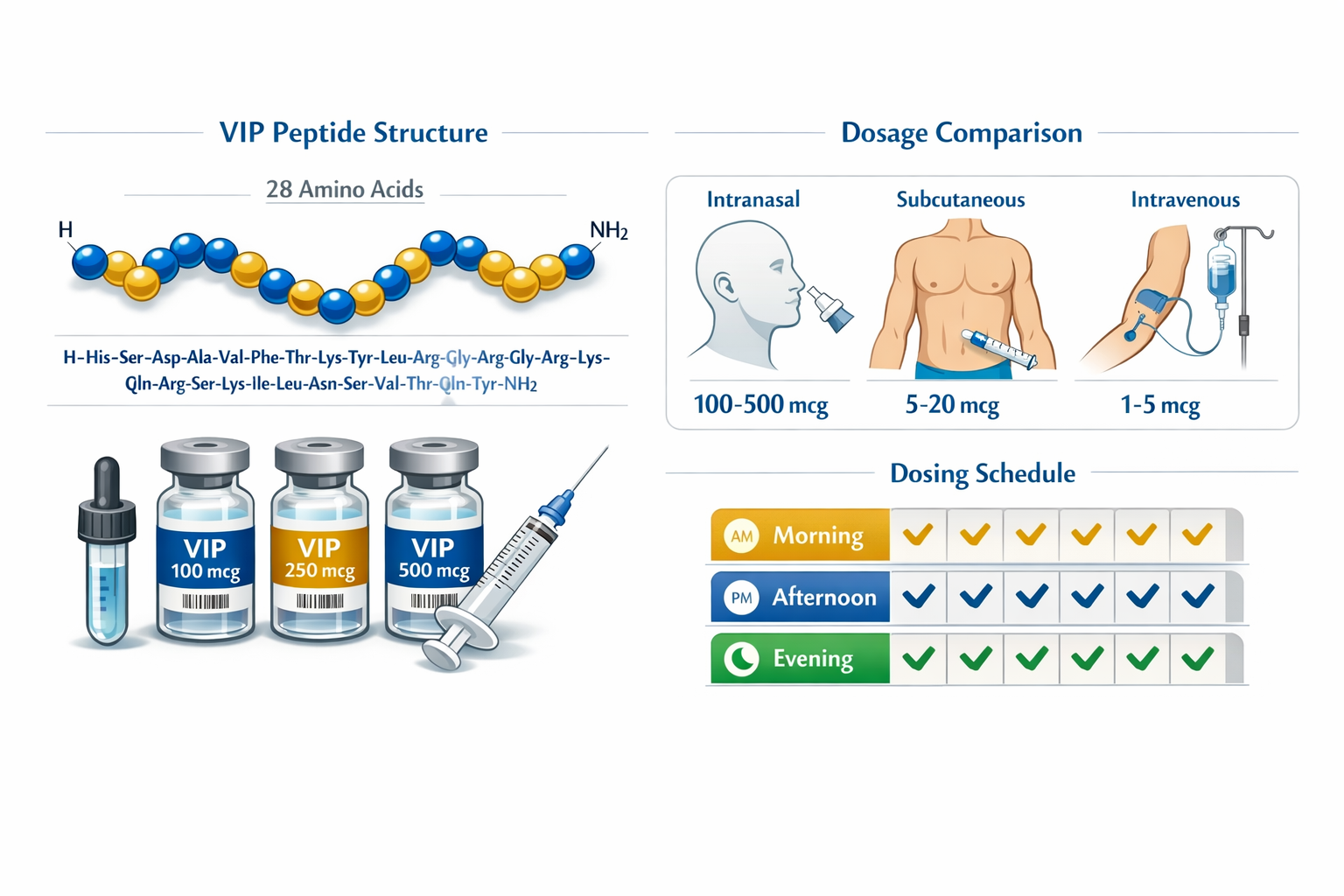
Vasoactive Intestinal Peptide (VIP) is a naturally occurring 28-amino acid neuropeptide that plays crucial roles in numerous physiological processes. First discovered in 1970, VIP functions as both a neurotransmitter and a hormone, influencing everything from immune function to circadian rhythms. The peptide's wide-ranging effects make it an attractive research compound, but this versatility also demands careful attention to dosing protocols.
The Science Behind VIP Peptide
VIP belongs to the secretin-glucagon peptide family and binds to two primary receptor types: VPAC1 and VPAC2. These receptors are distributed throughout the body, including the brain, gastrointestinal tract, lungs, and immune system. This widespread receptor distribution explains why VIP demonstrates such diverse biological activities.
Key biological functions of VIP include:
- 🧠 Neuroprotection and cognitive support
- 💪 Smooth muscle relaxation and vasodilation
- 🛡️ Immune system modulation
- 🫁 Respiratory function regulation
- 🔄 Circadian rhythm maintenance
The peptide's short half-life—approximately 1-2 minutes in circulation—significantly impacts dosing strategies. This rapid degradation necessitates specific administration routes and timing considerations that researchers must understand before establishing protocols.
When exploring peptide research options, understanding these foundational principles becomes essential for developing effective protocols.
Ideal Dose and Dosing for VIP Peptide: Administration Routes
The ideal dose and dosing for VIP peptide depends heavily on the chosen administration route. Each method offers distinct advantages, absorption rates, and bioavailability profiles that directly influence dosing requirements.
Intranasal Administration
Intranasal delivery represents the most common administration route for VIP peptide in research settings. This method offers several advantages, including non-invasive application, direct access to the central nervous system via the olfactory pathway, and relatively simple self-administration.
Typical intranasal dosing parameters:
| Dose Range | Frequency | Application |
|---|---|---|
| 25-50 mcg | 2-3x daily | Low-dose protocols |
| 50-100 mcg | 2-3x daily | Standard protocols |
| 100-200 mcg | 1-2x daily | High-dose protocols |
| 200+ mcg | 1x daily | Intensive research |
The intranasal route bypasses first-pass metabolism, allowing VIP to reach systemic circulation and cross the blood-brain barrier more effectively. Research suggests that approximately 10-15% of intranasally administered VIP reaches the bloodstream, with effects typically observed within 15-30 minutes.
Subcutaneous Injection
Subcutaneous (SC) administration provides more predictable pharmacokinetics compared to intranasal delivery. This route is particularly relevant for researchers requiring precise dosing control and sustained systemic exposure.
Subcutaneous dosing guidelines:
- Starting dose: 50-100 mcg once daily
- Standard dose: 100-200 mcg 1-2 times daily
- Advanced dose: 200-300 mcg 1-2 times daily
- Maximum researched dose: 400 mcg daily (divided doses)
SC injection sites typically include the abdomen, thigh, or upper arm. Proper injection technique and site rotation help minimize local reactions and ensure consistent absorption. Many researchers exploring peptide dosing protocols find subcutaneous administration offers the most reliable results.
Intravenous Administration
Intravenous (IV) delivery provides 100% bioavailability but requires clinical settings and professional administration. This route is primarily reserved for acute research applications or clinical studies.
IV dosing typically ranges from 25-100 mcg administered over 1-2 minutes, though some protocols utilize continuous infusions at rates of 10-30 mcg per hour. The immediate onset and precise control make IV administration valuable for specific research contexts, though practical limitations restrict its widespread use.
Determining Your Ideal Dose and Dosing for VIP Peptide
Establishing the ideal dose and dosing for VIP peptide requires careful consideration of multiple factors. Unlike one-size-fits-all approaches, effective VIP protocols demand individualization based on specific parameters and research objectives.
Factors Influencing Dosing Decisions
Body weight and composition play a role in peptide distribution and metabolism, though VIP dosing isn't strictly weight-based like some other compounds. A 150-pound individual might respond optimally to the same dose as someone weighing 200 pounds, depending on receptor sensitivity and metabolic factors.
Research objectives significantly impact dosing strategies:
- 🎯 Immune modulation: Typically requires 50-150 mcg 2-3x daily
- 🧠 Cognitive support: Often utilizes 25-100 mcg 2-3x daily (intranasal)
- 💪 Recovery protocols: May employ 100-200 mcg 1-2x daily
- 🫁 Respiratory research: Frequently uses 50-200 mcg as needed
Individual sensitivity varies considerably among research subjects. Some individuals demonstrate robust responses to lower doses, while others require higher amounts to achieve similar outcomes. This variability underscores the importance of starting conservatively and adjusting based on observed effects.
Starting Protocols and Titration
The recommended starting approach for VIP peptide research follows a conservative titration model:
Week 1-2: Begin with the lowest effective dose for your chosen route
- Intranasal: 25-50 mcg 1-2x daily
- Subcutaneous: 50-100 mcg once daily
Week 3-4: Assess response and consider modest increases
- Increase by 25-50 mcg if response is suboptimal
- Maintain current dose if achieving desired outcomes
- Reduce dose if experiencing adverse effects
Week 5+: Optimize dosing based on accumulated data
- Fine-tune frequency and amount
- Establish maintenance protocol
- Document outcomes for protocol refinement
This graduated approach minimizes potential side effects while allowing researchers to identify their optimal dosing window. Similar strategies are employed with other research peptides to ensure safety and efficacy.
Reconstitution and Preparation: Critical for Accurate Dosing
Proper reconstitution directly impacts the accuracy of your ideal dose and dosing for VIP peptide. Errors in preparation can lead to significant dosing inaccuracies, compromising research outcomes and potentially causing adverse effects.
Reconstitution Process
VIP peptide typically arrives as lyophilized (freeze-dried) powder requiring reconstitution before use. The standard process involves:
Materials needed:
- VIP peptide vial (typically 2-10 mg)
- Bacteriostatic water or sterile saline
- Insulin syringes (0.3-1.0 mL)
- Alcohol swabs
- Sterile work surface
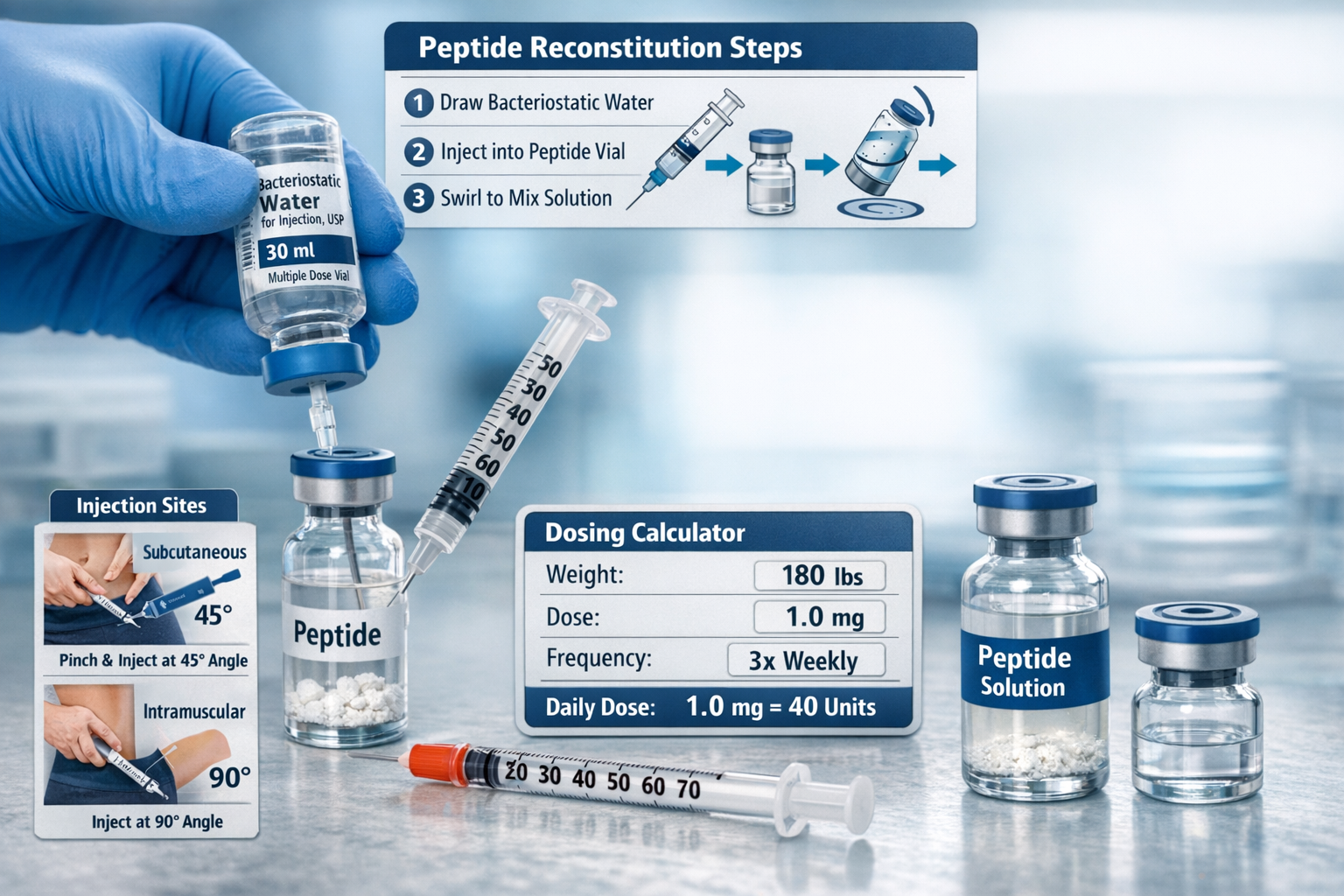
Step-by-step reconstitution:
- Calculate required volume: Determine how much bacteriostatic water to add based on desired concentration
- Prepare workspace: Clean surface with alcohol and gather all materials
- Add solvent slowly: Inject bacteriostatic water down the side of the vial, not directly onto the powder
- Gentle mixing: Swirl gently—never shake vigorously, as this can denature the peptide
- Visual inspection: Ensure complete dissolution; solution should be clear without particles
- Label vial: Include reconstitution date and concentration
Calculating Concentrations
Example calculation for a 5 mg VIP vial:
If you add 2.5 mL of bacteriostatic water to a 5 mg vial:
- 5 mg = 5,000 mcg
- 5,000 mcg ÷ 2.5 mL = 2,000 mcg/mL
- Each 0.1 mL (10 units on insulin syringe) = 200 mcg
Common concentration formulas:
| Vial Size | Water Added | Final Concentration | Dose per 0.1 mL |
|---|---|---|---|
| 2 mg | 2 mL | 1,000 mcg/mL | 100 mcg |
| 5 mg | 2.5 mL | 2,000 mcg/mL | 200 mcg |
| 5 mg | 5 mL | 1,000 mcg/mL | 100 mcg |
| 10 mg | 5 mL | 2,000 mcg/mL | 200 mcg |
Accurate calculations ensure you're administering the intended dose. Many researchers maintain detailed logs of their reconstitution protocols, similar to approaches used with 5-amino-1-mq peptide and other compounds.
Storage and Stability
Proper storage is essential for maintaining peptide integrity and ensuring consistent dosing:
Before reconstitution:
- Store at -20°C (freezer)
- Protect from light
- Shelf life: 12-24 months when properly stored
After reconstitution:
- Store at 2-8°C (refrigerator)
- Use within 30 days for optimal potency
- Protect from light and temperature fluctuations
- Never freeze reconstituted peptides
Temperature excursions can significantly degrade VIP peptide, leading to reduced potency and inaccurate effective dosing. When sourcing peptides from reputable suppliers, proper storage information should always be included with your order.
Frequency and Timing: Optimizing Your VIP Peptide Protocol
Beyond determining the ideal dose and dosing for VIP peptide per administration, frequency and timing significantly influence overall outcomes. VIP's short half-life necessitates strategic scheduling to maintain therapeutic levels.
Dosing Frequency Options
Once daily protocols:
- Suitable for: Maintenance research, convenience-focused approaches
- Typical dose: Higher end of range (150-300 mcg)
- Best timing: Morning or evening, consistently
- Advantages: Simple adherence, minimal disruption
- Considerations: May not maintain stable levels throughout day
Twice daily protocols:
- Suitable for: Standard research applications, balanced coverage
- Typical dose: 75-150 mcg per administration
- Best timing: Morning and evening (12 hours apart)
- Advantages: More stable levels, flexible dosing
- Considerations: Requires twice-daily commitment
Three times daily protocols:
- Suitable for: Intensive research, maximum coverage
- Typical dose: 50-100 mcg per administration
- Best timing: Morning, afternoon, evening (8 hours apart)
- Advantages: Most consistent levels, optimal receptor engagement
- Considerations: Demanding schedule, higher total daily dose
Timing Considerations
Circadian alignment may enhance VIP peptide effects, as the peptide naturally influences circadian rhythms. Some research suggests:
- 🌅 Morning doses: May support daytime energy and cognitive function
- 🌙 Evening doses: Could promote relaxation and sleep quality
- ⚖️ Divided doses: Provide balanced support throughout 24-hour period
Meal timing doesn't significantly impact VIP absorption for most administration routes, though some researchers prefer dosing on an empty stomach for consistency. Intranasal administration can be performed regardless of meal timing.
Exercise timing represents another consideration. Some protocols utilize VIP 30-60 minutes before physical activity to potentially support performance and recovery, while others prefer post-exercise administration to aid recuperation.
These timing strategies apply across various peptide research protocols and can be adapted based on individual schedules and objectives.
Safety Considerations and Side Effect Management
Understanding potential side effects is crucial when determining the ideal dose and dosing for VIP peptide. While VIP is generally well-tolerated at appropriate doses, awareness of possible reactions enables prompt recognition and management.
Common Side Effects
Mild side effects reported in research contexts include:
- 💧 Nasal irritation or dryness (intranasal route)
- 🔴 Injection site reactions (subcutaneous route)
- 🤢 Mild nausea (typically dose-dependent)
- 😴 Transient drowsiness or fatigue
- 🩸 Vasodilation effects (flushing, warmth)
These effects are usually temporary and resolve within 30-60 minutes. They often diminish with continued use as tolerance develops.
Dose-dependent reactions may include:
- Increased frequency of mild side effects at higher doses
- Headaches (particularly with intranasal administration)
- Dizziness or lightheadedness
- Gastrointestinal disturbances
Managing Adverse Effects
If side effects occur:
- Reduce dose by 25-50% and monitor response
- Adjust frequency (e.g., switch from 3x to 2x daily)
- Change administration route if appropriate
- Ensure proper hydration and electrolyte balance
- Discontinue use if severe reactions occur
Contraindications and cautions:
- ⚠️ Pregnancy and breastfeeding
- ⚠️ Active cardiovascular conditions
- ⚠️ Severe hypotension
- ⚠️ Known hypersensitivity to VIP or related peptides
Always consult with qualified healthcare professionals before beginning any peptide research protocol. This principle applies whether working with VIP or other research peptides available through specialized suppliers.
Advanced Dosing Strategies and Protocols
For experienced researchers, advanced approaches to the ideal dose and dosing for VIP peptide can optimize outcomes and address specific research objectives.
Cycling Protocols
Continuous administration maintains steady VIP levels but may lead to receptor downregulation over extended periods. Some researchers implement cycling strategies:
5 days on / 2 days off:
- Maintains receptor sensitivity
- Provides regular breaks
- Suitable for long-term protocols
3 weeks on / 1 week off:
- Allows for periodic assessment
- May prevent tolerance development
- Common in extended research periods
6 months on / 1 month off:
- Long-term maintenance approach
- Permits comprehensive evaluation
- Reduces potential for dependency
Combination Protocols
VIP peptide is sometimes researched alongside complementary compounds to achieve synergistic effects:
VIP + BPC-157/TB-500:
- Combined recovery and regeneration support
- VIP: 100-150 mcg 2x daily
- BPC-157: 250-500 mcg daily
- TB-500: 2-5 mg weekly
VIP + Epithalon:
- Comprehensive cellular health approach
- VIP: 50-100 mcg 2-3x daily
- Epithalon: 5-10 mg per cycle (10-20 days)
VIP + MOTS-C:
- Metabolic and mitochondrial optimization
- VIP: 100-200 mcg 2x daily
- MOTS-C: 5-15 mg weekly
When combining peptides, start with lower doses of each compound and monitor carefully for interactions. Many researchers source multiple peptides from comprehensive suppliers to ensure consistent quality across their protocols.
Pulsatile Dosing
Pulsatile administration mimics natural peptide release patterns and may enhance receptor response:
- Varying doses throughout the day (e.g., 50 mcg morning, 100 mcg afternoon, 75 mcg evening)
- Alternating higher and lower dose days
- Strategic timing around specific activities or research objectives
This approach requires more sophisticated protocol management but may offer advantages for certain research goals.
Monitoring and Adjusting Your VIP Peptide Protocol
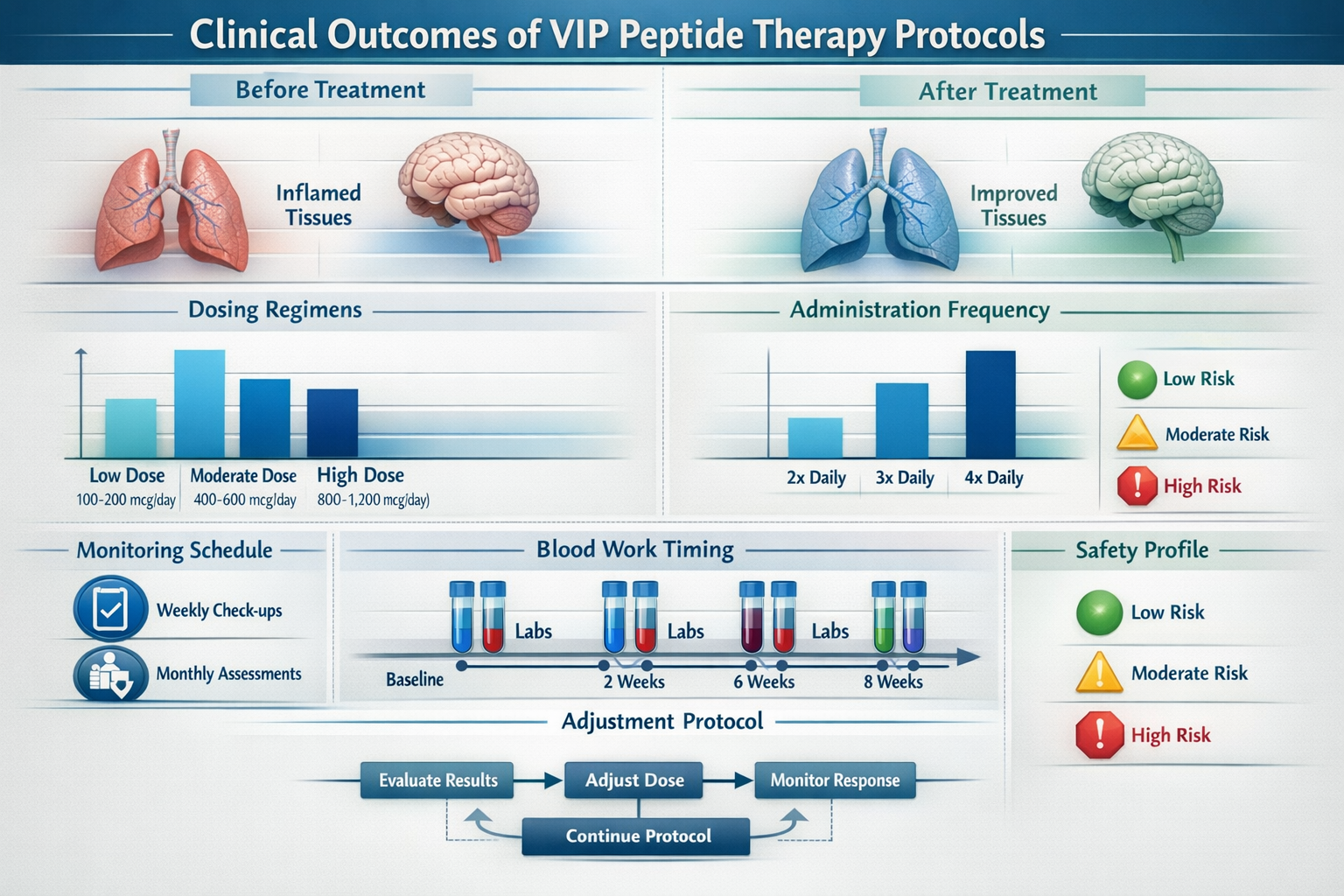
Effective implementation of the ideal dose and dosing for VIP peptide requires ongoing monitoring and willingness to adjust based on observed outcomes.
Tracking Parameters
Subjective measures to monitor:
- 📊 Energy levels and fatigue
- 🧠 Cognitive function and mental clarity
- 😴 Sleep quality and duration
- 💪 Physical performance and recovery
- 🎯 Overall sense of well-being
Objective measures when available:
- 🩺 Vital signs (blood pressure, heart rate)
- 🔬 Laboratory markers (inflammatory markers, immune function)
- ⚖️ Body composition changes
- 📈 Performance metrics (strength, endurance, etc.)
Maintaining a detailed research log helps identify patterns and optimize dosing over time. Similar tracking approaches are valuable across various peptide research applications.
Signs Your Dose Needs Adjustment
Indicators to increase dose:
- ✅ No observable effects at current dose after 2-3 weeks
- ✅ Initial positive effects have plateaued
- ✅ Well-tolerated with no side effects
- ✅ Research objectives not being met
Indicators to decrease dose:
- ⚠️ Persistent side effects
- ⚠️ Excessive fatigue or drowsiness
- ⚠️ Headaches or dizziness
- ⚠️ Any concerning symptoms
Indicators to maintain current dose:
- ✨ Achieving desired research outcomes
- ✨ Minimal to no side effects
- ✨ Consistent, predictable responses
- ✨ Sustainable long-term protocol
Quality and Sourcing: Foundation of Accurate Dosing
The most carefully calculated ideal dose and dosing for VIP peptide becomes meaningless if the peptide itself is of poor quality. Sourcing from reputable suppliers ensures you're actually receiving the compound and concentration you expect.
Quality Indicators
Reputable suppliers provide:
- 📜 Third-party testing certificates (COA)
- 🔬 Purity verification (typically ≥98%)
- 📦 Proper packaging and storage
- 📋 Detailed reconstitution instructions
- 🛡️ Quality guarantees and support
Red flags to avoid:
- ❌ No testing documentation
- ❌ Suspiciously low prices
- ❌ Poor packaging or labeling
- ❌ Lack of customer support
- ❌ No clear company information
When sourcing VIP peptide or other research compounds, prioritize suppliers with established reputations, transparent testing practices, and responsive customer service.
Verifying Peptide Authenticity
Visual inspection:
- Lyophilized peptide should appear as white to off-white powder
- Reconstituted solution should be clear and colorless
- No unusual odors or discoloration
Functional verification:
- Expected effects at documented doses
- Consistent results across batches
- Predictable stability and shelf life
Cost Considerations
While budget matters, the cheapest option rarely represents the best value in peptide research. Quality peptides justify their cost through:
- ✅ Accurate dosing (what's on the label matches what's in the vial)
- ✅ Consistent results across research periods
- ✅ Reduced waste from degraded or ineffective products
- ✅ Lower risk of contamination or adverse reactions
Investing in quality peptides from trusted sources ultimately proves more economical than repeatedly purchasing substandard products.
Practical Implementation: Putting It All Together
Translating knowledge about the ideal dose and dosing for VIP peptide into practical application requires systematic planning and execution.
Sample Beginner Protocol
Research objective: General wellness exploration
Administration route: Intranasal
Duration: 12-week initial trial
Weeks 1-2:
- Dose: 50 mcg
- Frequency: 2x daily (morning and evening)
- Total daily dose: 100 mcg
Weeks 3-4:
- Dose: 75 mcg
- Frequency: 2x daily
- Total daily dose: 150 mcg
Weeks 5-12:
- Dose: 100 mcg
- Frequency: 2x daily
- Total daily dose: 200 mcg
Monitoring: Daily logs of energy, sleep quality, and any side effects
Sample Intermediate Protocol
Research objective: Recovery and immune support
Administration route: Subcutaneous
Duration: 16-week protocol with cycling
Weeks 1-6:
- Dose: 150 mcg
- Frequency: 2x daily
- Total daily dose: 300 mcg
- Schedule: 5 days on, 2 days off
Week 7: Rest week (no administration)
Weeks 8-14:
- Dose: 200 mcg
- Frequency: 2x daily
- Total daily dose: 400 mcg
- Schedule: 5 days on, 2 days off
Weeks 15-16: Taper down to 100 mcg 2x daily
Monitoring: Weekly assessments of recovery markers, immune function indicators, and overall well-being
Sample Advanced Protocol
Research objective: Comprehensive wellness optimization
Administration route: Combination (intranasal + subcutaneous)
Duration: 24-week protocol with strategic cycling
Phase 1 (Weeks 1-8):
- Morning: 100 mcg intranasal
- Afternoon: 150 mcg subcutaneous
- Evening: 100 mcg intranasal
- Total daily dose: 350 mcg
Phase 2 (Weeks 9-16):
- Morning: 150 mcg subcutaneous
- Evening: 150 mcg intranasal
- Total daily dose: 300 mcg
- Schedule: 6 days on, 1 day off
Phase 3 (Weeks 17-20):
- Maintenance: 100 mcg intranasal 2x daily
- Total daily dose: 200 mcg
Weeks 21-24: Gradual taper and assessment period
This advanced approach requires significant experience with peptide research and careful monitoring throughout. Similar sophisticated protocols are employed with various research peptides to achieve specific objectives.
Common Mistakes and How to Avoid Them
Even with comprehensive knowledge of the ideal dose and dosing for VIP peptide, researchers frequently encounter pitfalls that compromise their protocols.
Dosing Errors
Mistake #1: Starting too high
- Problem: Increases side effect risk, makes it difficult to assess minimum effective dose
- Solution: Always begin at the lower end of the dosing range and titrate up gradually
Mistake #2: Inconsistent administration
- Problem: Creates unpredictable results, makes it impossible to assess true effects
- Solution: Establish a consistent schedule and stick to it for at least 2-3 weeks before making changes
Mistake #3: Ignoring half-life
- Problem: Dosing once daily when the compound requires more frequent administration
- Solution: Match dosing frequency to VIP's pharmacokinetics (typically 2-3x daily for optimal coverage)
Preparation Errors
Mistake #4: Improper reconstitution
- Problem: Inaccurate concentrations lead to dosing errors
- Solution: Calculate carefully, measure precisely, and verify calculations before administration
Mistake #5: Poor storage practices
- Problem: Degraded peptide leads to reduced potency and unpredictable effects
- Solution: Follow storage guidelines strictly—refrigerate after reconstitution, protect from light
Mistake #6: Reusing syringes or supplies
- Problem: Contamination risk, reduced sterility
- Solution: Always use fresh, sterile supplies for each administration
Protocol Errors
Mistake #7: Changing multiple variables simultaneously
- Problem: Impossible to determine which change caused observed effects
- Solution: Modify one variable at a time (dose OR frequency OR timing)
Mistake #8: Insufficient monitoring
- Problem: Missing important signals about effectiveness or side effects
- Solution: Maintain detailed logs and review them regularly
Mistake #9: Unrealistic expectations
- Problem: Disappointment and premature protocol abandonment
- Solution: Set realistic timelines (most protocols require 4-6 weeks for full assessment)
Learning from these common errors helps researchers optimize their approach to VIP peptide and other research compounds.
Future Directions in VIP Peptide Research
As we progress through 2026, research into the ideal dose and dosing for VIP peptide continues to evolve, with emerging studies refining our understanding of optimal protocols.
Emerging Administration Technologies
Novel delivery systems under investigation include:
- 💊 Oral formulations: Encapsulation technologies that protect VIP from digestive degradation
- 🩹 Transdermal patches: Sustained-release systems for continuous delivery
- 💨 Improved intranasal devices: Enhanced absorption and more precise dosing
- 💉 Extended-release injectable formulations: Reducing administration frequency
These innovations may significantly alter dosing recommendations as they become available to researchers.
Personalized Dosing Approaches
Precision medicine applications are beginning to influence VIP peptide protocols:
- 🧬 Genetic testing to predict individual response
- 📊 Biomarker-guided dose optimization
- 🤖 AI-assisted protocol development
- 📱 Real-time monitoring and adjustment systems
As these technologies mature, the concept of "ideal dose" may shift from general ranges to highly individualized prescriptions based on genetic, metabolic, and physiological factors.
Expanded Research Applications
New research areas exploring VIP peptide include:
- 🧠 Neurodegenerative condition research
- 🫁 Respiratory health optimization
- 💪 Athletic performance and recovery
- 🛡️ Autoimmune modulation
- 😴 Sleep quality enhancement
Each application may require distinct dosing strategies, further expanding our understanding of optimal VIP peptide protocols.
Conclusion: Mastering Your VIP Peptide Protocol
Understanding the ideal dose and dosing for VIP peptide represents both a science and an art. While research provides valuable guidelines—intranasal doses typically ranging from 25-200 mcg and subcutaneous doses from 50-300 mcg, administered 1-3 times daily—individual optimization requires careful attention to response, tolerance, and specific research objectives.
Key principles for success:
✅ Start conservatively with lower doses and gradually titrate upward based on response
✅ Maintain consistency in administration timing, preparation methods, and monitoring practices
✅ Source quality peptides from reputable suppliers with verified testing and purity
✅ Monitor systematically using both subjective and objective measures to guide adjustments
✅ Adjust thoughtfully by changing one variable at a time and allowing adequate assessment periods
✅ Prioritize safety by recognizing side effects early and adjusting protocols accordingly
The journey to finding your optimal VIP peptide protocol may require patience and experimentation, but the systematic approach outlined in this guide provides a solid foundation. Whether you're a fitness enthusiast exploring recovery optimization, a medi-spa professional developing client protocols, or a researcher investigating VIP's diverse applications, understanding proper dosing principles ensures you maximize the potential of this remarkable peptide.
Next Steps
Ready to begin your VIP peptide research? Consider these action items:
- Educate yourself further on VIP peptide mechanisms and applications
- Source quality peptides from verified suppliers
- Develop your protocol using the frameworks provided in this guide
- Establish monitoring systems to track your research outcomes
- Consult professionals when appropriate to ensure safe and effective implementation
- Join research communities to share experiences and learn from others
The field of peptide research continues to expand rapidly in 2026, offering exciting opportunities for those willing to approach it with diligence, respect for safety protocols, and commitment to evidence-based practices. Your journey with VIP peptide begins with understanding proper dosing—and continues with careful, systematic exploration of this fascinating compound's potential.
<!DOCTYPE html>
<html lang="en">
<head>
    <meta charset="UTF-8">
    <meta name="viewport" content="width=device-width, initial-scale=1.0">
    <title>VIP Peptide Dosing Calculator</title>
    <style>
        * {
            margin: 0;
            padding: 0;
            box-sizing: border-box;
        }

        .cg-element-calculator-container {
            max-width: 800px;
            margin: 20px auto;
            padding: 30px;
            background: linear-gradient(135deg, #667eea 0%, #764ba2 100%);
            border-radius: 15px;
            box-shadow: 0 10px 30px rgba(0,0,0,0.3);
            font-family: 'Segoe UI', Tahoma, Geneva, Verdana, sans-serif;
        }

        .cg-element-calculator-header {
            text-align: center;
            color: white;
            margin-bottom: 30px;
        }

        .cg-element-calculator-header h1 {
            font-size: 28px;
            margin-bottom: 10px;
            text-shadow: 2px 2px 4px rgba(0,0,0,0.3);
        }

        .cg-element-calculator-header p {
            font-size: 14px;
            opacity: 0.9;
        }

        .cg-element-calculator-content {
            background: white;
            padding: 30px;
            border-radius: 10px;
        }

        .cg-element-input-group {
            margin-bottom: 25px;
        }

        .cg-element-input-group label {
            display: block;
            font-weight: 600;
            color: #333;
            margin-bottom: 8px;
            font-size: 14px;
        }

        .cg-element-input-group select,
        .cg-element-input-group input {
            width: 100%;
            padding: 12px;
            border: 2px solid #e0e0e0;
            border-radius: 8px;
            font-size: 16px;
            transition: border-color 0.3s;
        }

        .cg-element-input-group select:focus,
        .cg-element-input-group input:focus {
            outline: none;
            border-color: #667eea;
        }

        .cg-element-input-row {
            display: grid;
            grid-template-columns: 1fr 1fr;
            gap: 15px;
        }

        .cg-element-calculate-btn {
            width: 100%;
            padding: 15px;
            background: linear-gradient(135deg, #667eea 0%, #764ba2 100%);
            color: white;
            border: none;
            border-radius: 8px;
            font-size: 18px;
            font-weight: 600;
            cursor: pointer;
            transition: transform 0.2s, box-shadow 0.2s;
            margin-top: 10px;
        }

        .cg-element-calculate-btn:hover {
            transform: translateY(-2px);
            box-shadow: 0 5px 15px rgba(102, 126, 234, 0.4);
        }

        .cg-element-calculate-btn:active {
            transform: translateY(0);
        }

        .cg-element-results {
            margin-top: 30px;
            padding: 25px;
            background: #f8f9fa;
            border-radius: 10px;
            border-left: 5px solid #667eea;
            display: none;
        }

        .cg-element-results.active {
            display: block;
            animation: slideIn 0.4s ease-out;
        }

        @keyframes slideIn {
            from {
                opacity: 0;
                transform: translateY(-10px);
            }
            to {
                opacity: 1;
                transform: translateY(0);
            }
        }

        .cg-element-results h3 {
            color: #667eea;
            margin-bottom: 20px;
            font-size: 20px;
        }

        .cg-element-result-item {
            display: flex;
            justify-content: space-between;
            padding: 12px 0;
            border-bottom: 1px solid #e0e0e0;
        }

        .cg-element-result-item:last-child {
            border-bottom: none;
        }

        .cg-element-result-label {
            font-weight: 600;
            color: #555;
        }

        .cg-element-result-value {
            color: #667eea;
            font-weight: 700;
            font-size: 16px;
        }

        .cg-element-info-box {
            margin-top: 20px;
            padding: 15px;
            background: #fff3cd;
            border-left: 4px solid #ffc107;
            border-radius: 5px;
            font-size: 13px;
            color: #856404;
        }

        .cg-element-dosing-schedule {
            margin-top: 20px;
            padding: 20px;
            background: white;
            border-radius: 8px;
            border: 2px solid #667eea;
        }

        .cg-element-dosing-schedule h4 {
            color: #667eea;
            margin-bottom: 15px;
            font-size: 16px;
        }

        .cg-element-schedule-item {
            padding: 10px;
            margin-bottom: 8px;
            background: #f8f9fa;
            border-radius: 5px;
            display: flex;
            align-items: center;
        }

        .cg-element-schedule-time {
            font-weight: 700;
            color: #667eea;
            margin-right: 15px;
            min-width: 80px;
        }

        .cg-element-schedule-dose {
            color: #333;
        }

        @media (max-width: 600px) {
            .cg-element-calculator-container {
                padding: 20px;
                margin: 10px;
            }

            .cg-element-input-row {
                grid-template-columns: 1fr;
            }

            .cg-element-calculator-header h1 {
                font-size: 22px;
            }

            .cg-element-calculator-content {
                padding: 20px;
            }
        }
    </style>
</head>
<body>
    <div class="cg-element-calculator-container">
        <div class="cg-element-calculator-header">
            <h1>💉 VIP Peptide Dosing Calculator</h1>
            <p>Calculate your ideal VIP peptide dose and reconstitution requirements</p>
        </div>

        <div class="cg-element-calculator-content">
            <div class="cg-element-input-group">
                <label for="cg-vial-size">Vial Size (mg)</label>
                <select id="cg-vial-size">
                    <option value="2">2 mg</option>
                    <option value="5" selected>5 mg</option>
                    <option value="10">10 mg</option>
                </select>
            </div>

            <div class="cg-element-input-group">
                <label for="cg-water-volume">Bacteriostatic Water to Add (mL)</label>
                <input type="number" id="cg-water-volume" value="2.5" step="0.1" min="0.5" max="10">
            </div>

            <div class="cg-element-input-row">
                <div class="cg-element-input-group">
                    <label for="cg-dose-amount">Desired Dose per Administration (mcg)</label>
                    <input type="number" id="cg-dose-amount" value="100" step="25" min="25" max="400">
                </div>

                <div class="cg-element-input-group">
                    <label for="cg-frequency">Doses per Day</label>
                    <select id="cg-frequency">
                        <option value="1">1x daily</option>
                        <option value="2" selected>2x daily</option>
                        <option value="3">3x daily</option>
                    </select>
                </div>
            </div>

            <div class="cg-element-input-group">
                <label for="cg-admin-route">Administration Route</label>
                <select id="cg-admin-route">
                    <option value="intranasal" selected>Intranasal</option>
                    <option value="subcutaneous">Subcutaneous</option>
                    <option value="intravenous">Intravenous</option>
                </select>
            </div>

            <button class="cg-element-calculate-btn" onclick="calculateDosing()">Calculate Dosing Protocol</button>

            <div class="cg-element-results" id="cg-results">
                <h3>📊 Your Personalized Dosing Protocol</h3>

                <div class="cg-element-result-item">
                    <span class="cg-element-result-label">Final Concentration:</span>
                    <span class="cg-element-result-value" id="cg-concentration">-</span>
                </div>

                <div class="cg-element-result-item">
                    <span class="cg-element-result-label">Volume per Dose:</span>
                    <span class="cg-element-result-value" id="cg-volume-per-dose">-</span>
                </div>

                <div class="cg-element-result-item">
                    <span class="cg-element-result-label">Units on Insulin Syringe:</span>
                    <span class="cg-element-result-value" id="cg-syringe-units">-</span>
                </div>

                <div class="cg-element-result-item">
                    <span class="cg-element-result-label">Total Daily Dose:</span>
                    <span class="cg-element-result-value" id="cg-daily-dose">-</span>
                </div>

                <div class="cg-element-result-item">
                    <span class="cg-element-result-label">Vial Duration:</span>
                    <span class="cg-element-result-value" id="cg-vial-duration">-</span>
                </div>

                <div class="cg-element-dosing-schedule" id="cg-schedule">
                    <h4>⏰ Suggested Dosing Schedule</h4>
                    <div id="cg-schedule-items"></div>
                </div>

                <div class="cg-element-info-box">
                    <strong>⚠️ Important Reminders:</strong><br>
                    • Store reconstituted peptide at 2-8°C (refrigerator)<br>
                    • Use within 30 days of reconstitution<br>
                    • Always use sterile technique and fresh supplies<br>
                    • Start with lower doses if new to VIP peptide<br>
                    • Consult healthcare professionals for guidance
                </div>
            </div>
        </div>
    </div>

    <script>
        function calculateDosing() {
            // Get input values
            const vialSize = parseFloat(document.getElementById('cg-vial-size').value);
            const waterVolume = parseFloat(document.getElementById('cg-water-volume').value);
            const doseAmount = parseFloat(document.getElementById('cg-dose-amount').value);
            const frequency = parseInt(document.getElementById('cg-frequency').value);
            const adminRoute = document.getElementById('cg-admin-route').value;

            // Calculate concentration
            const vialSizeMcg = vialSize * 1000; // Convert mg to mcg
            const concentrationPerMl = vialSizeMcg / waterVolume;

            // Calculate volume per dose
            const volumePerDose = doseAmount / concentrationPerMl;

            // Calculate syringe units (0.01 mL = 1 unit on insulin syringe)
            const syringeUnits = volumePerDose * 100;

            // Calculate total daily dose
            const dailyDose = doseAmount * frequency;

            // Calculate vial duration
            const totalDoses = vialSizeMcg / doseAmount;
            const durationDays = Math.floor(totalDoses / frequency);

            // Update results
            document.getElementById('cg-concentration').textContent = concentrationPerMl.toFixed(0) + ' mcg/mL';
            document.getElementById('cg-volume-per-dose').textContent = volumePerDose.toFixed(3) + ' mL';
            document.getElementById('cg-syringe-units').textContent = syringeUnits.toFixed(1) + ' units';
            document.getElementById('cg-daily-dose').textContent = dailyDose + ' mcg';
            document.getElementById('cg-vial-duration').textContent = durationDays + ' days';

            // Generate dosing schedule
            generateSchedule(frequency, doseAmount, adminRoute);

            // Show results
            document.getElementById('cg-results').classList.add('active');

            // Scroll to results
            document.getElementById('cg-results').scrollIntoView({ behavior: 'smooth', block: 'nearest' });
        }

        function generateSchedule(frequency, dose, route) {
            const scheduleContainer = document.getElementById('cg-schedule-items');
            scheduleContainer.innerHTML = '';

            let times = [];
            if (frequency === 1) {
                times = ['8:00 AM'];
            } else if (frequency === 2) {
                times = ['8:00 AM', '8:00 PM'];
            } else if (frequency === 3) {
                times = ['8:00 AM', '4:00 PM', '12:00 AM'];
            }

            const routeText = {
                'intranasal': 'intranasal spray',
                'subcutaneous': 'subcutaneous injection',
                'intravenous': 'intravenous administration'
            };

            times.forEach(time => {
                const scheduleItem = document.createElement('div');
                scheduleItem.className = 'cg-element-schedule-item';
                scheduleItem.innerHTML = `
                    <span class="cg-element-schedule-time">${time}</span>
                    <span class="cg-element-schedule-dose">${dose} mcg via ${routeText[route]}</span>
                `;
                scheduleContainer.appendChild(scheduleItem);
            });
        }
    </script>
</body>
</html>
SEO Meta Information
Meta Title: VIP Peptide Dosing Guide 2026 | Ideal Doses & Protocols
Meta Description: Complete guide to ideal VIP peptide dosing. Learn proper doses (25-300mcg), administration routes, reconstitution, and protocols for optimal research outcomes in 2026.
Target Keywords: Ideal dose and dosing for VIP peptide, VIP peptide dosage, VIP peptide protocol, VIP peptide administration, peptide dosing guide
Related Keywords: vasoactive intestinal peptide, VIP peptide reconstitution, intranasal peptide dosing, subcutaneous peptide injection, peptide research protocols, peptide sourcing, peptide quality testing