Call or Text 727-513-9780
  • Shopping Cart Shopping Cart
    0Shopping Cart
Pure Tested Peptides | America's most trusted Peptides for sale online
  • Peptides for sale
    • Oral Peptides for sale
      • Peptide Capsules for sale
      • BPC 157 Capsules 1000mcg
      • SLU-PP-332 Capsules | 1000 mcg
      • 5-Amino-1MQ 50mg Capsules
      • Tesofensine 500mcg
    • All Peptides for sale
    • Peptide Sprays
      • BPC 157 Nasal Spray Kit
      • BPC-157 TB500 Nasal Spray Kit
      • Semax Nasal Spray 10mg
      • Selank – Nasal Spray Kit – 10mg
      • Epithalon 50MG Nasal Spray Kit
      • Ipamorelin 10mg Nasal Spray
      • Klow Nasal Spray (BPC-157 + TB-500 + GHK-Cu + KPV) | 80mg
      • Hulk Nasal Spray Tesa / Ipa Blend 6/3 MG
      • Klow Nasal Spray
      • NAD + 500 mg Nasal Spray
      • PT-141 Nasal Spray Kit
    • GHRH Peptides
      • Ipa Peptides
      • CJC-1295 Peptides
        • CJC-1295 with DAC 5 mg
        • CJC-1295 without DAC 5 mg
        • CJC-1295 Ipa 10mg
      • Tesa Peptides
        • Tesa Peptide
        • Tesa 20 mg
    • GHK-Cu Peptides
      • All GHK-Cu Peptides
      • GHK-Cu 100mg
      • KLOW Peptide Blend – Buy KLOW blend online
    • BPC Peptides
      • All BPC Peptides
      • BPC-157
      • BPC-157 TB-500
      • BPC 157 capsules 1000mcg
    • SLU-PP-332 Peptides
      • All SLU-PP-332 Peptides
      • SLU-PP-332 5mg
    • GLP3 Peptides
      • GLP3-R
      • GLP3-R CAG 10mg
      • GLP3-R 20mg
    • PT-141 Peptides
      • PT-141 Peptides for sale
      • PT-141 10mg
      • PT-141 Nasal Spray
    • CAG Peptides
      • Lipo-C Peptide Blend
      • CAG 5mg
      • CAG 10mg
    • MOTS-C Peptides
      • MOTS-C Peptides for sale
      • MOTS-c peptide
      • MOTS-c 10mg *6 pack*
    • 5 Amino 1MQ Peptides
      • 5 Amino 1MQ Peptides for sale
      • 5-Amino-1MQ 50mg Capsules
      • 5-Amino-1MQ 5mg
    • Epithalon Peptides
      • Epithalon Peptides for sale
      • Epithalon 10mg
      • Epithalon 50mg
  • Shop
    • GLPs
      • 5-Amino-1MQ 50mg Capsules
      • 5-Amino-1MQ 5mg
      • GLP3-Reta
      • L-Carnitine 500mg/ml
      • Tesofensine 500mcg
      • SLU-PP-332 5mg
      • MOTS-c 10mg *6 pack*
    • Epithalon & BPC Peptides
      • Epithalon 10mg
      • Epithalon 50mg
      • BPC-157
      • BPC 157 capsules 1000mcg
      • BPC-157 TB-500
      • BPC-157 TB500 Nasal Spray Kit
      • BPC 157 Nasal Spray Kit
    • BPC TB-500 & NAD+ Peptides
      • NAD+ 500 mg
      • KLOW Peptide Blend – Buy KLOW blend online
      • GLOW Peptide Blend
      • TB 500 5mg
      • BPC 157 capsules 1000mcg – Supplement
      • BPC 157 Nasal Spray Kit
      • BPC-157
      • BPC-157 TB500 Nasal Spray Kit
      • BPC-157 TB-500
      • BPC 157 capsules 1000mcg
    • LL-37 Peptide
      • LL-37 10 mg
    • MOTS-C & Selank
      • MOTS-c peptide
      • Selank 10mg
    • GHK Peptides
      • GHK-Cu 100mg
      • GLOW Peptide Blend
      • KLOW Peptide Blend – Buy KLOW blend online
  • COAs
  • Wholesale
    • Wholesale Peptides for sale
  • PTP FAQ
  • Affiliates
    • Affiliate Program
    • Affiliate Signup
  • Contact
    • Contact Customer Service
    • Text Customer Support
  • About US
  • Shop all peptides
  • Login / Register Login / Register Page Link Login / Register Page Link
  • Click to open the search input field Click to open the search input field Search
  • Menu Menu
Best Research Peptides for Tissue Repair: Comparing BPC‑157, TB‑500, GHK‑Cu, and Glow/Klow Blends for In‑Vitro and Animal Models

Best Research Peptides for Tissue Repair: Comparing BPC‑157, TB‑500, GHK‑Cu, and Glow/Klow Blends for In‑Vitro and Animal Models

June 8, 2026/0 Comments/in Uncategorized/by

Fewer than 30 human subjects have been enrolled across all published pilot studies on BPC‑157 combined — yet preclinical data on this and related peptides continues to accelerate at a striking pace. For researchers selecting compounds for tissue repair models in 2026, that gap between animal evidence and human data is the central challenge. This article examines the best research peptides for tissue repair: comparing BPC‑157, TB‑500, GHK‑Cu, and Glow/Klow blends for in‑vitro and animal models, covering mechanisms, model selection, reconstitution ranges, and purity considerations.

Key Takeaways

  • BPC‑157, TB‑500, and GHK‑Cu each target a distinct phase of tissue repair, making them complementary rather than redundant.
  • GLOW blends combine all three peptides; KLOW adds the anti-inflammatory tripeptide KPV for a broader repair profile.
  • Preclinical evidence is robust, but human clinical data remains extremely limited — these compounds are for research use only.
  • Purity verification and proper reconstitution are non-negotiable for reproducible in-vitro and animal model results.
  • None of these peptides are FDA-approved for medical use in tissue repair contexts as of 2026.
Key Takeaways


Mechanisms of Action: What Each Peptide Does

Understanding why these peptides are considered among the best research peptides for tissue repair starts with their distinct biological pathways.

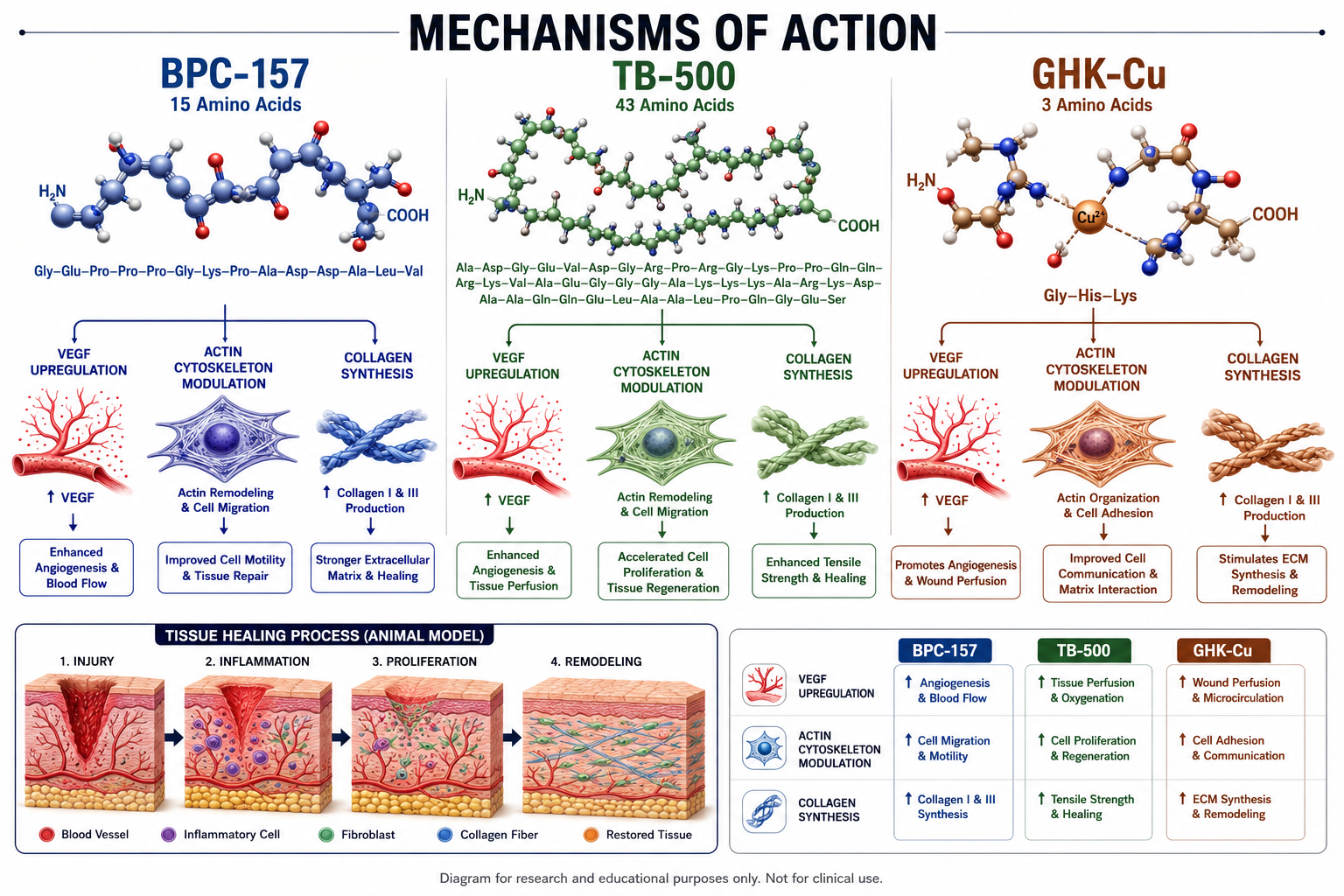
BPC‑157 (Body Protection Compound 157) is a 15-amino-acid synthetic peptide derived from a gastric protein. Its primary mechanism involves upregulating vascular endothelial growth factor (VEGF), which drives angiogenesis — the formation of new blood vessels. In animal models, this translates to accelerated healing across tendons, muscles, ligaments, bones, and gut mucosa. Researchers can explore the BPC-157 research overview for detailed preclinical data summaries.

TB‑500 (Thymosin Beta‑4 fragment) works differently. It modulates the actin cytoskeleton, facilitating cell migration and differentiation. This makes it particularly relevant in wound-closure and muscle-repair models where cellular mobility is rate-limiting.

GHK‑Cu (Glycine-Histidine-Lysine copper complex) focuses on the reconstruction phase. It stimulates collagen synthesis and extracellular matrix remodeling. Researchers studying dermal and connective tissue models will find the GHK-Cu extracellular matrix research a useful reference. The copper chelation component also appears to modulate gene expression related to tissue remodeling.

Peptide Primary Mechanism Key Repair Phase
BPC‑157 VEGF upregulation, angiogenesis Vascularization
TB‑500 Actin modulation, cell migration Proliferation
GHK‑Cu Collagen synthesis, ECM remodeling Reconstruction

Comparing GLOW and KLOW Blends for Research Models
Comparing GLOW and KLOW Blends for Research Models

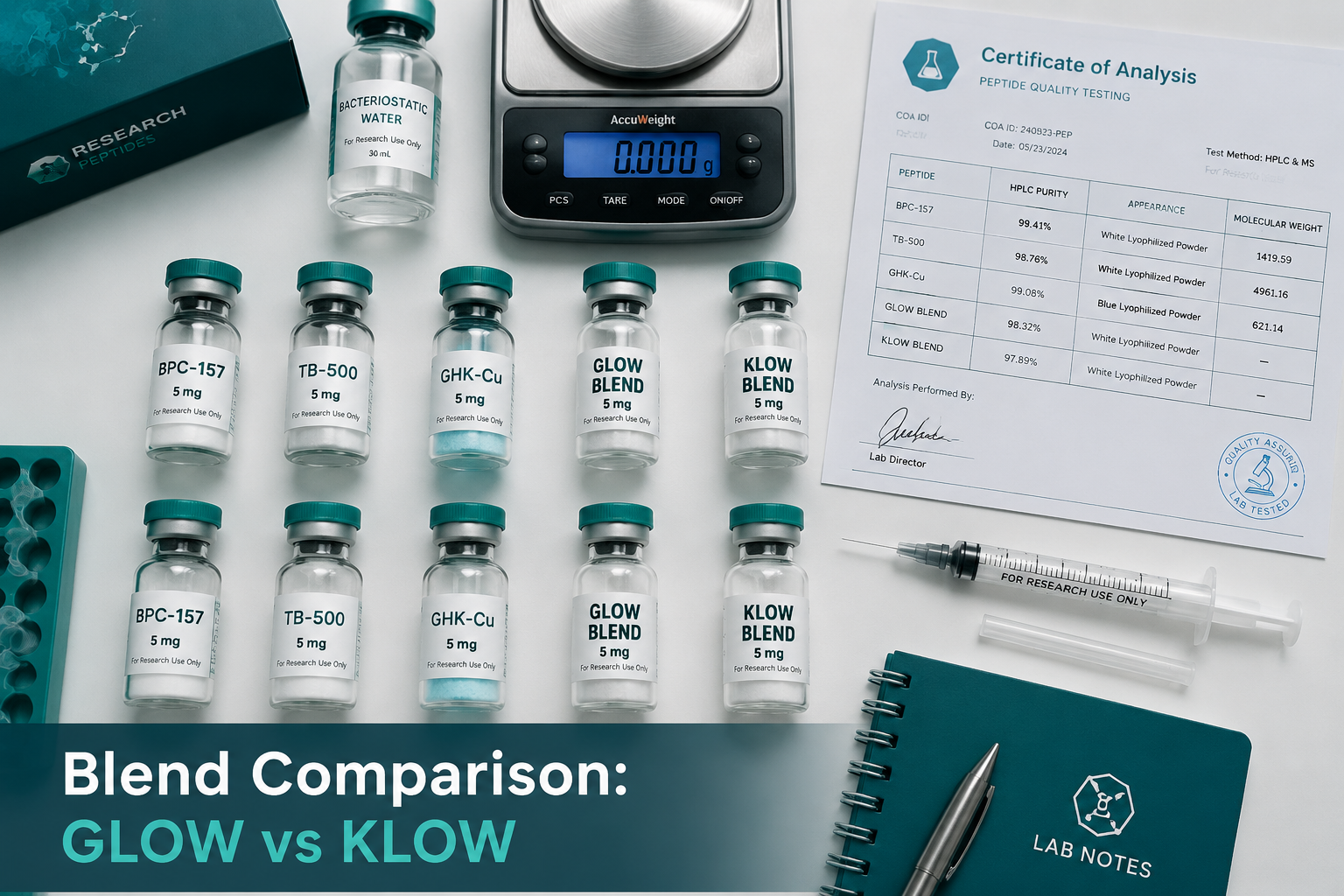
The GLOW blend combines BPC‑157, TB‑500, and GHK‑Cu in a single formulation, targeting all three stages of the repair cascade sequentially. This multi-phase approach is the core rationale behind proprietary blends — rather than isolating one mechanism, researchers can observe how overlapping pathways interact. The GLOW and KLOW peptide blend overview provides composition details relevant to experimental design.

The KLOW blend extends GLOW by adding KPV, a tripeptide (Lysine-Proline-Valine) with documented anti-inflammatory properties. In models where inflammation is a confounding variable — such as inflammatory bowel or skin wound models — KLOW may offer a more controlled environment for observing net repair outcomes.

Important note: No published clinical trials have evaluated GLOW or KLOW blends in human subjects. Both are marketed strictly for in-vitro research purposes and are not intended for human or veterinary use.

For researchers interested in longevity-adjacent tissue repair themes, the GLOW blend longevity research themes page outlines how these compounds intersect with broader aging biology questions.


Model Selection, Reconstitution, and Purity Considerations
Model Selection, Reconstitution, and Purity Considerations

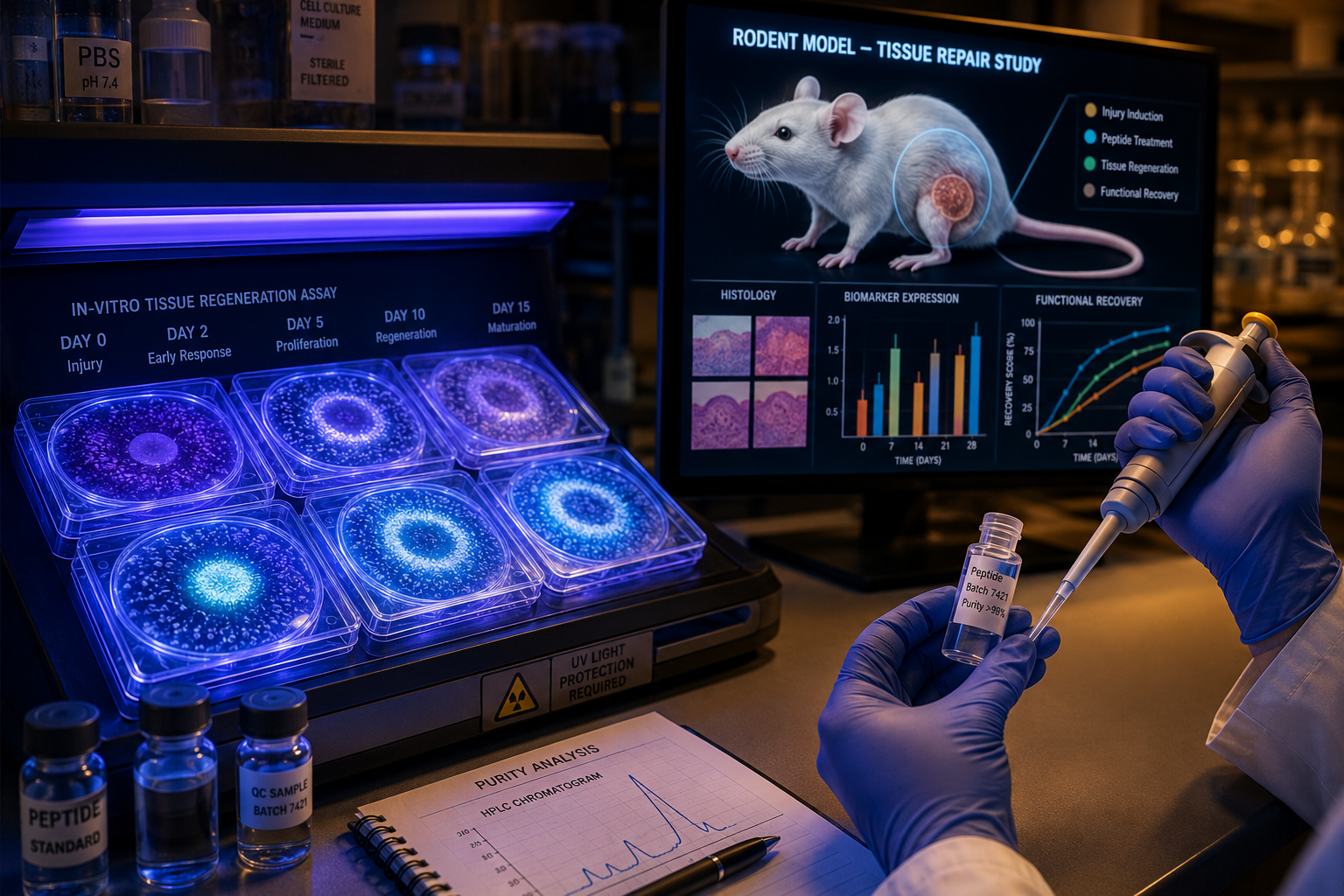
Selecting the right model is as critical as selecting the peptide. For in-vitro work, cell migration assays (scratch assays), tube formation assays for angiogenesis, and collagen gel contraction models are the most common formats aligned with BPC‑157, TB‑500, and GHK‑Cu mechanisms respectively.

For animal models, rodent tendon transection, excisional wound, and colitis models dominate the published literature on BPC‑157. TB‑500 has shown relevance in cardiac and skeletal muscle injury models. GHK‑Cu is frequently evaluated in dermal punch-biopsy models.

Reconstitution guidance (for research use only):

  • Peptides should be reconstituted with bacteriostatic water or sterile saline.
  • Typical working concentrations in cell culture range from 1 nM to 1 µM depending on the assay.
  • Avoid repeated freeze-thaw cycles; aliquot prior to storage at -20°C.

Purity is the most overlooked variable in peptide research reproducibility. Researchers should require certificates of analysis (CoA) confirming HPLC purity of at least 98% and mass spectrometry confirmation. The quality testing protocols page outlines what rigorous third-party verification looks like in practice. For broader peptide sourcing context, peptide blend research options can help orient purchasing decisions.

Researchers exploring adjacent repair-related compounds may also find the TB-500 and BPC-157 regeneration research page useful for comparative study design.


Conclusion

The best research peptides for tissue repair — BPC‑157, TB‑500, GHK‑Cu, and Glow/Klow blends for in‑vitro and animal models — each bring distinct, well-characterized mechanisms to the repair cascade. BPC‑157 drives vascularization, TB‑500 enables cell migration, and GHK‑Cu rebuilds the extracellular matrix. GLOW and KLOW blends combine these actions, with KLOW adding anti-inflammatory KPV for more complex inflammatory models.

Actionable next steps for researchers:

  • Match peptide selection to the specific repair phase your model targets.
  • Demand third-party CoA documentation with HPLC and mass spec data before ordering.
  • Design controls that isolate individual peptide contributions when using blends.
  • Remain current on regulatory status — none of these compounds are approved for human use as of 2026.

Rigorous experimental design, verified purity, and clear model alignment remain the foundation of reproducible tissue repair research.

Tags: angiogenesis research, animal models, bpc-157, collagen synthesis, ghk-cu, glow peptide blend, in-vitro models, klow peptide blend, peptide research, research peptides, tb-500, tissue repair peptides
https://www.puretestedpeptides.com/wp-content/uploads/2026/06/Best-Research-Peptides-for-Tissue-Repair-Comparing-BPC‑157-TB‑500-GHK‑Cu-and-GlowKlow-Blends-for-In‑Vitro-and-Animal-Models.png 1024 1536 https://www.puretestedpeptides.com/wp-content/uploads/2026/01/buy-peptides-online.jpg 2026-06-08 13:04:002026-06-08 13:04:00Best Research Peptides for Tissue Repair: Comparing BPC‑157, TB‑500, GHK‑Cu, and Glow/Klow Blends for In‑Vitro and Animal Models
You might also like
PT-141 Peptide: Melanocortin Receptor Agonism and Its Role in Sexual Function Research PT-141 Peptide: Melanocortin Receptor Agonism and Its Role in Sexual Function Research
Selank vs Semax: Neuroimmune, Anxiolytic, and Cognitive Pathways Compared for Research Use Selank vs Semax: Neuroimmune, Anxiolytic, and Cognitive Pathways Compared for Research Use
CJC-1295 With Ipamorelin: Why Researchers Pair Them, What Pulsatile GH Signaling Looks Like, and What to Measure CJC-1295 With Ipamorelin: Why Researchers Pair Them, What Pulsatile GH Signaling Looks Like, and What to Measure
GHK-Cu Peptide in Tissue Remodeling Research: Collagen Signaling, Copper Biology, and Experimental Readouts GHK-Cu Peptide in Tissue Remodeling Research: Collagen Signaling, Copper Biology, and Experimental Readouts
Mesenchymal Stem Cells and Peptides: How BPC‑157, TB‑500, GHK‑Cu, and Glow Blend Are Used in Regeneration Research Mesenchymal Stem Cells and Peptides: How BPC‑157, TB‑500, GHK‑Cu, and Glow Blend Are Used in Regeneration Research
Retatrutide vs GLP-1 and GLP-2 Pathways: How Triple Agonism Changes the Research Conversation Retatrutide vs GLP-1 and GLP-2 Pathways: How Triple Agonism Changes the Research Conversation
Polypeptide Peptides in Modern Lab Research: From Structure to Synthesis Workflows Polypeptide Peptides in Modern Lab Research: From Structure to Synthesis Workflows
GHK-Cu for Collagen, Copper Biology, and Skin-Regeneration Research: A Mechanism-First Overview GHK-Cu for Collagen, Copper Biology, and Skin-Regeneration Research: A Mechanism-First Overview
0 replies

Leave a Reply

Want to join the discussion?
Feel free to contribute!

Leave a Reply Cancel reply

Your email address will not be published. Required fields are marked *

×

Helpful Links

  • My account
  • Cart
  • Checkout
  • Refund and Returns Policy
  • Privacy Policy
  • SMS Privacy Policy
  • Login
  • My Account
  • Logout

USA Made Lab Tested Peptides

All products are sold for research, laboratory, or analytical purposes only, and are not for human consumption


Pure Tested Peptides is a chemical supplier. Pure Tested Peptides is not a compounding / chemical compounding facility as defined under 503A of the Federal Food, Drug, and Cosmetic act. Pure Tested Peptides is not an outsourcing facility as defined under 503B of the Federal Food, Drug, and Cosmetic act.

The statements made within this website have not been evaluated by the US Food and Drug Administration. The products we offer are not intended to diagnose, treat, cure or prevent any disease.

Human/Animal Consumption Prohibited. Laboratory/In-Vitro Experimental Use Only

Link to: GHK-Cu Peptide Mechanism: Copper Binding, Extracellular Matrix Signaling, and Tissue-Repair Research Link to: GHK-Cu Peptide Mechanism: Copper Binding, Extracellular Matrix Signaling, and Tissue-Repair Research GHK-Cu Peptide Mechanism: Copper Binding, Extracellular Matrix Signaling, and...GHK-Cu Peptide Mechanism: Copper Binding, Extracellular Matrix Signaling, and Tissue-Repair Research Link to: What Is GLP-3 Retatrutide? Triple-Agonist Biology, Receptor Targets, and Why It Is Different From GLP-1 Link to: What Is GLP-3 Retatrutide? Triple-Agonist Biology, Receptor Targets, and Why It Is Different From GLP-1 What Is GLP-3 Retatrutide? Triple-Agonist Biology, Receptor Targets, and Why It Is Different From GLP-1What Is GLP-3 Retatrutide? Triple-Agonist Biology, Receptor Targets, and Why...
Scroll to top Scroll to top Scroll to top