Call or Text 727-513-9780
  • Shopping Cart Shopping Cart
    0Shopping Cart
Pure Tested Peptides | America's most trusted Peptides for sale online
  • Peptides for sale
    • Oral Peptides for sale
      • Peptide Capsules for sale
      • BPC 157 Capsules 1000mcg
      • SLU-PP-332 Capsules | 1000 mcg
      • 5-Amino-1MQ 50mg Capsules
      • Tesofensine 500mcg
    • All Peptides for sale
    • Peptide Sprays
      • BPC 157 Nasal Spray Kit
      • BPC-157 TB500 Nasal Spray Kit
      • Semax Nasal Spray 10mg
      • Selank – Nasal Spray Kit – 10mg
      • Epithalon 50MG Nasal Spray Kit
      • Ipamorelin 10mg Nasal Spray
      • Klow Nasal Spray (BPC-157 + TB-500 + GHK-Cu + KPV) | 80mg
      • Hulk Nasal Spray Tesa / Ipa Blend 6/3 MG
      • Klow Nasal Spray
      • NAD + 500 mg Nasal Spray
      • PT-141 Nasal Spray Kit
    • GHRH Peptides
      • Ipa Peptides
      • CJC-1295 Peptides
        • CJC-1295 with DAC 5 mg
        • CJC-1295 without DAC 5 mg
        • CJC-1295 Ipa 10mg
      • Tesa Peptides
        • Tesa Peptide
        • Tesa 20 mg
    • GHK-Cu Peptides
      • All GHK-Cu Peptides
      • GHK-Cu 100mg
      • KLOW Peptide Blend – Buy KLOW blend online
    • BPC Peptides
      • All BPC Peptides
      • BPC-157
      • BPC-157 TB-500
      • BPC 157 capsules 1000mcg
    • SLU-PP-332 Peptides
      • All SLU-PP-332 Peptides
      • SLU-PP-332 5mg
    • GLP3 Peptides
      • GLP3-R
      • GLP3-R CAG 10mg
      • GLP3-R 20mg
    • PT-141 Peptides
      • PT-141 Peptides for sale
      • PT-141 10mg
      • PT-141 Nasal Spray
    • CAG Peptides
      • Lipo-C Peptide Blend
      • CAG 5mg
      • CAG 10mg
    • MOTS-C Peptides
      • MOTS-C Peptides for sale
      • MOTS-c peptide
      • MOTS-c 10mg *6 pack*
    • 5 Amino 1MQ Peptides
      • 5 Amino 1MQ Peptides for sale
      • 5-Amino-1MQ 50mg Capsules
      • 5-Amino-1MQ 5mg
    • Epithalon Peptides
      • Epithalon Peptides for sale
      • Epithalon 10mg
      • Epithalon 50mg
  • Shop
    • GLPs
      • 5-Amino-1MQ 50mg Capsules
      • 5-Amino-1MQ 5mg
      • GLP3-Reta
      • L-Carnitine 500mg/ml
      • Tesofensine 500mcg
      • SLU-PP-332 5mg
      • MOTS-c 10mg *6 pack*
    • Epithalon & BPC Peptides
      • Epithalon 10mg
      • Epithalon 50mg
      • BPC-157
      • BPC 157 capsules 1000mcg
      • BPC-157 TB-500
      • BPC-157 TB500 Nasal Spray Kit
      • BPC 157 Nasal Spray Kit
    • BPC TB-500 & NAD+ Peptides
      • NAD+ 500 mg
      • KLOW Peptide Blend – Buy KLOW blend online
      • GLOW Peptide Blend
      • TB 500 5mg
      • BPC 157 capsules 1000mcg – Supplement
      • BPC 157 Nasal Spray Kit
      • BPC-157
      • BPC-157 TB500 Nasal Spray Kit
      • BPC-157 TB-500
      • BPC 157 capsules 1000mcg
    • LL-37 Peptide
      • LL-37 10 mg
    • MOTS-C & Selank
      • MOTS-c peptide
      • Selank 10mg
    • GHK Peptides
      • GHK-Cu 100mg
      • GLOW Peptide Blend
      • KLOW Peptide Blend – Buy KLOW blend online
  • COAs
  • Wholesale
    • Wholesale Peptides for sale
  • PTP FAQ
  • Affiliates
    • Affiliate Program
    • Affiliate Signup
  • Contact
    • Contact Customer Service
    • Text Customer Support
  • About US
  • Shop all peptides
  • Login / Register Login / Register Page Link Login / Register Page Link
  • Click to open the search input field Click to open the search input field Search
  • Menu Menu
How to Choose a Peptide Supplier for Research Use Only: Purity, COAs, and Red Flags Explained

How to Choose a Peptide Supplier for Research Use Only: Purity, COAs, and Red Flags Explained

June 9, 2026/0 Comments/in Uncategorized/by

Roughly 30% of research compounds purchased online fail independent purity verification — a sobering figure for any scientist whose experimental outcomes depend on what is actually inside the vial. Understanding how to choose a peptide supplier for research use only: purity, COAs, and red flags explained is not a bureaucratic exercise; it is the foundation of reproducible science.

Key Takeaways

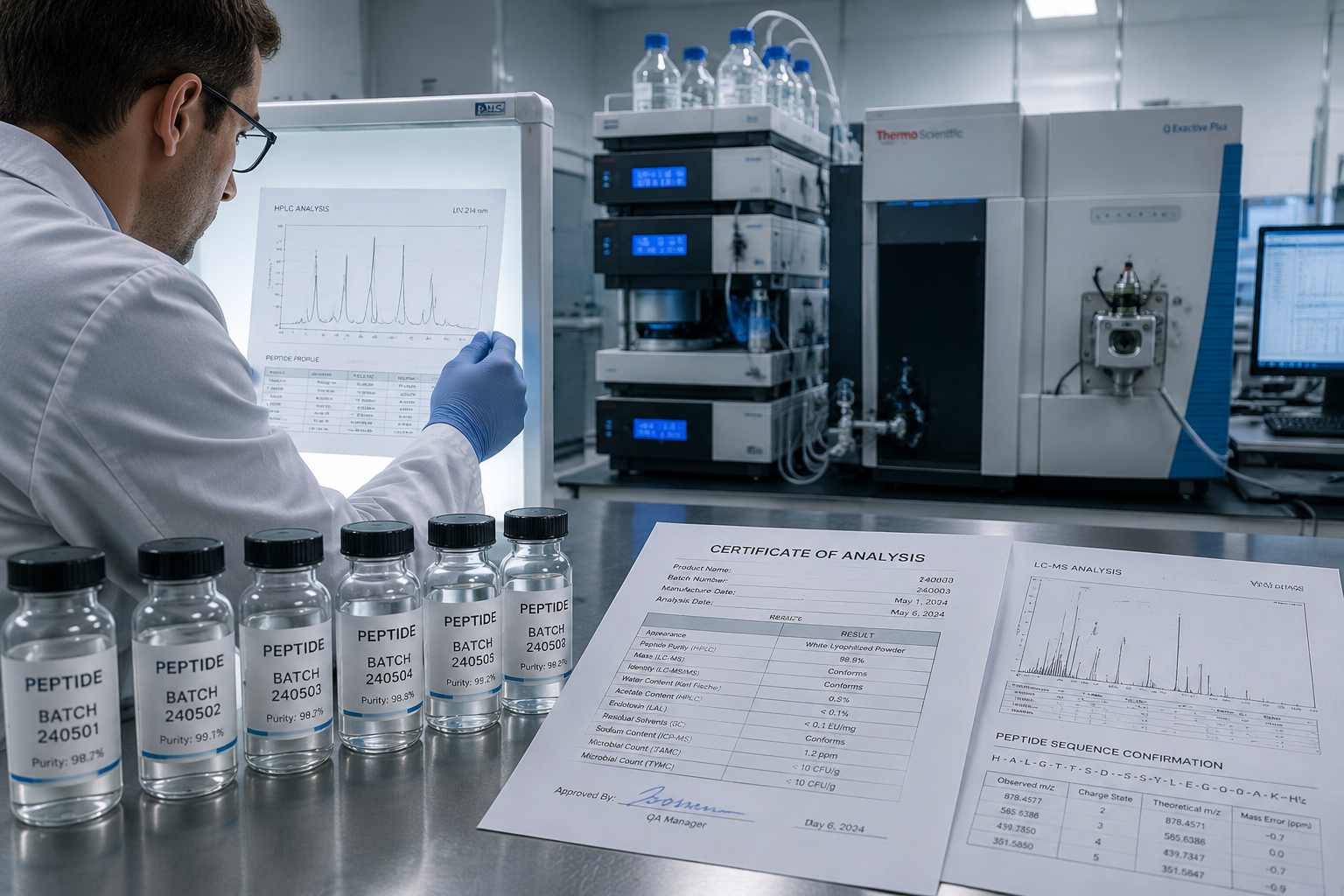
  • Research-grade peptides should carry a minimum purity of 98% confirmed by HPLC analysis from an independent, accredited laboratory.
  • Every batch needs its own unique Certificate of Analysis (COA) with a matching lot number — generic, reused COAs are a serious red flag.
  • Legitimate COAs include both HPLC chromatograms and mass spectrometry data confirming peptide identity.
  • Suppliers must label products "Research Use Only" and must not make therapeutic or clinical claims.
  • Price, community reputation, and supplier transparency are secondary filters that help narrow down trustworthy vendors.
Key Takeaways

Purity Standards: Why 98% Is the Baseline, Not a Bonus

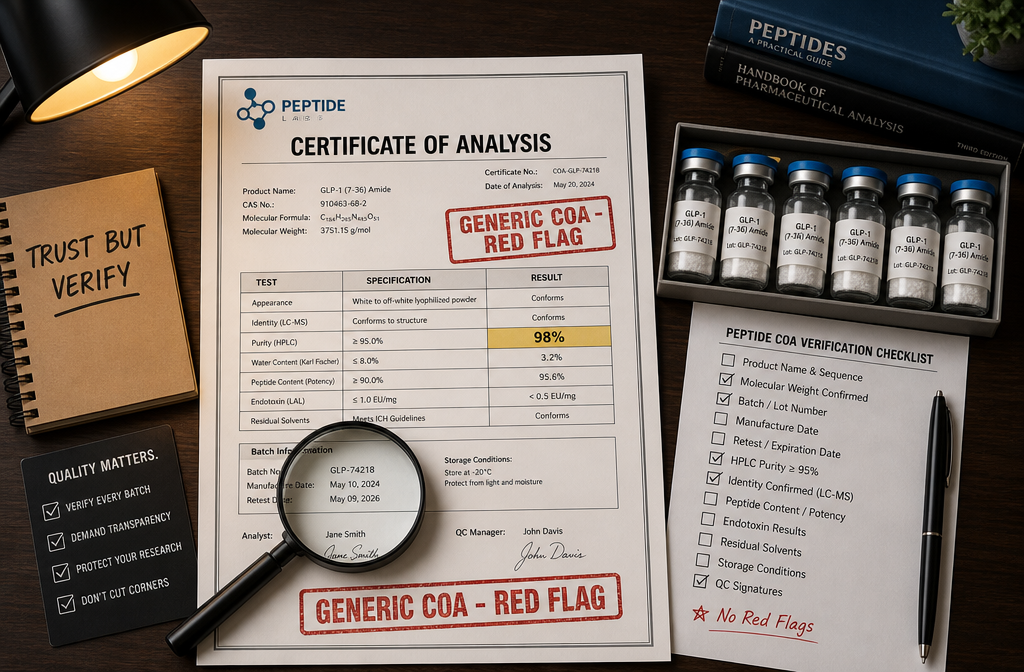
When evaluating any research peptide vendor, purity is the first non-negotiable metric. Research-grade peptides should achieve a minimum purity of 98% as measured by High-Performance Liquid Chromatography (HPLC). Any product falling below this threshold introduces impurities — truncated sequences, oxidized residues, or synthesis byproducts — that can skew binding assays, cell viability studies, and animal model outcomes in ways that are difficult to detect and nearly impossible to correct retroactively.

HPLC alone, however, is not sufficient. A credible supplier pairs HPLC data with mass spectrometry (LC-MS or MALDI-TOF) to confirm that the molecular weight of the compound matches the theoretical sequence. Together, these two analytical methods answer two distinct questions:

Test What It Confirms
HPLC Purity percentage and absence of major impurities
Mass Spectrometry Correct molecular identity and sequence integrity

For in vivo research models, a third data point becomes critical: endotoxin testing. Bacterial endotoxins — lipopolysaccharides shed from gram-negative bacteria during synthesis — can trigger severe immune responses in animal subjects, completely confounding experimental results. Any supplier serving researchers running in vivo protocols should include endotoxin levels on the COA.

Researchers studying compounds like SS-31 peptides or BPC-157 should specifically verify that purity documentation covers the exact batch received, not a representative sample from a prior production run.

Purity Standards: Why 98% Is the Baseline, Not a Bonus

How to Read a COA: Batch Numbers, Chromatograms, and What Legitimate Documentation Looks Like

A Certificate of Analysis is only as useful as the information it contains. Knowing how to choose a peptide supplier for research use only means knowing how to interrogate this document critically.

Four elements every legitimate COA must include:

  1. Batch or lot number that matches the number printed on the product label — if these do not align, the COA may not apply to the vial in hand.
  2. HPLC chromatogram showing the actual peak profile, not just a reported percentage. A supplier providing only a number without the underlying chromatogram is offering an unverifiable claim.
  3. Mass spectrometry spectrum confirming molecular weight, ideally with the observed versus theoretical mass comparison clearly stated.
  4. Name of the third-party testing laboratory — independent accredited labs carry far more credibility than in-house testing, which cannot be independently audited.

"A COA that cannot be traced to a specific batch and a named independent laboratory is not a certificate of analysis — it is a marketing document."

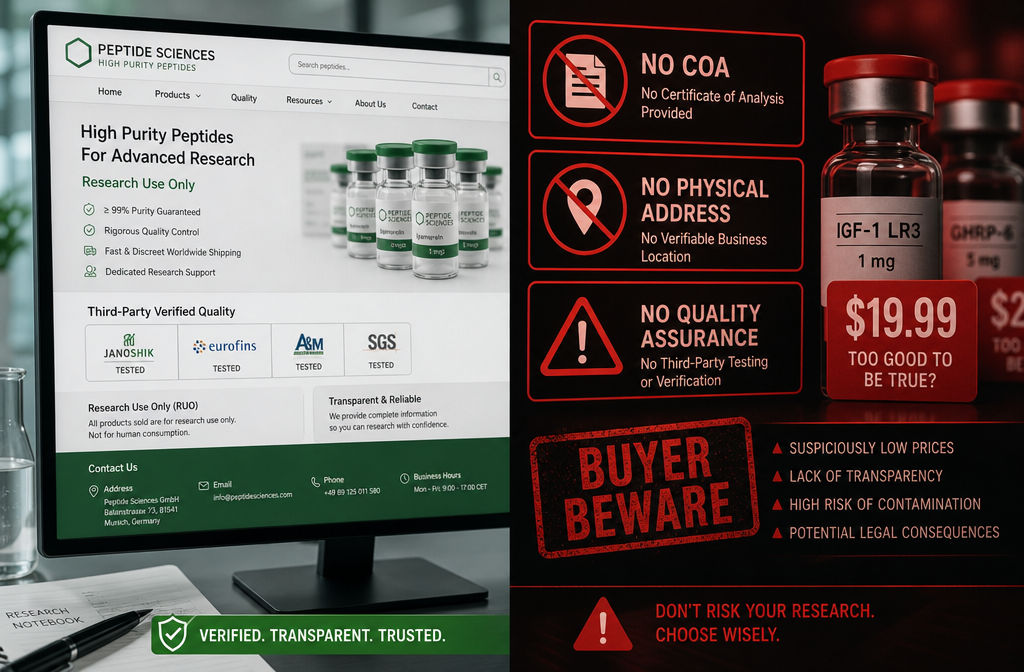
Generic COAs reused across multiple products or batches are among the most common red flags in the peptide research supply market. Suppliers offering compounds such as Epithalon or Thymosin Alpha-1 should provide batch-specific documentation for every order. Reviewing a supplier's published COA library before purchasing is a practical first step.

How to Read a COA: Batch Numbers, Chromatograms, and What Legitimate Documentation Looks Like

Red Flags, Regulatory Language, and Supplier Transparency

The final layer of due diligence in how to choose a peptide supplier for research use only: purity, COAs, and red flags explained involves evaluating the supplier's conduct, not just their paperwork.

Red flags to watch for:

  • No physical address or verifiable contact information on the website
  • Therapeutic or clinical claims about peptide effects (e.g., "treats," "cures," "prescribed for")
  • Pricing dramatically below market average — underdosed or impure products are the most common explanation
  • Identical COAs across multiple different peptides or batches
  • No visible third-party lab affiliation

What legitimate suppliers do differently:

  • Label every product clearly as "Research Use Only" with no implied human-use endorsement
  • Publish transparent quality control processes and are willing to discuss testing methodology directly
  • Maintain an active, verifiable community reputation through documented reviews and scientific forums

Pricing deserves a direct note: suspiciously low prices are not a value proposition. They are a signal. Peptide synthesis at research-grade purity is resource-intensive. A vendor offering MOTS-c or PT-141 at a fraction of market rate has almost certainly cut corners somewhere in synthesis, purification, or testing.

Regulatory compliance is equally non-negotiable. In 2026, regulatory scrutiny of research peptide vendors continues to increase. Suppliers making health claims or marketing peptides for human use are operating outside compliance boundaries — and purchasing from them exposes researchers to both scientific and legal risk. Reviewing a supplier's full product catalog and FAQ documentation before committing to a vendor relationship is a sound practice.


Conclusion

Choosing a research peptide supplier is a scientific decision, not a shopping decision. The checklist is straightforward: demand 98%+ HPLC-confirmed purity, require batch-specific COAs from named independent laboratories, verify mass spectrometry data, and confirm endotoxin testing for any in vivo application. Walk away from any vendor missing these elements, making therapeutic claims, or offering prices that defy the economics of quality synthesis.

Actionable next steps for 2026:

  • Before ordering, request the COA for the specific batch you will receive and cross-reference the lot number.
  • Verify the named testing laboratory is accredited and independently searchable.
  • Search the supplier's name in scientific community forums and documented review sources.
  • Confirm all product pages carry "Research Use Only" language with no clinical claims.
  • Consult the supplier's FAQ section and documentation resources to assess transparency before purchase.

Rigorous vendor selection is the first experiment in any research protocol — and it deserves the same analytical rigor as every experiment that follows.

Tags: buy peptides online, certificate of analysis, endotoxin testing, hplc purity, mass spectrometry peptides, peptide coa, peptide purity standards, peptide quality control, peptide supplier, peptide vendor red flags, research grade peptides, research use only peptides
https://www.puretestedpeptides.com/wp-content/uploads/2026/06/How-to-Choose-a-Peptide-Supplier-for-Research-Use-Only-Purity-COAs-and-Red-Flags-Explained.png 672 1024 https://www.puretestedpeptides.com/wp-content/uploads/2026/01/buy-peptides-online.jpg 2026-06-09 13:05:422026-06-09 13:05:42How to Choose a Peptide Supplier for Research Use Only: Purity, COAs, and Red Flags Explained
You might also like
How Safe Are Mail‑Order Research Peptides? Evidence Gaps, Regulatory Gray Zones, and Risk‑Mitigation for Labs How Safe Are Mail‑Order Research Peptides? Evidence Gaps, Regulatory Gray Zones, and Risk‑Mitigation for Labs
PT-141 Peptide: Melanocortin Receptor Agonist Research and its Mechanism of Action PT-141 Peptide: Melanocortin Receptor Agonist Research and its Mechanism of Action
Where to Buy Nootropic Peptides Like Semax and Selank for Research: What Labs Should Look For in a Supplier Where to Buy Nootropic Peptides Like Semax and Selank for Research: What Labs Should Look For in a Supplier
Where to Buy GLP-3 Retatrutide for Research: A Guide to Sourcing High-Purity Peptides Where to Buy GLP-3 Retatrutide for Research: A Guide to Sourcing High-Purity Peptides
Glow Blend and Klow Blend Peptides: Example Stacks for Skin, Hair, and ‘Aging Support’ Research Only Glow Blend and Klow Blend Peptides: Example Stacks for Skin, Hair, and ‘Aging Support’ Research Only
Retatrutide Clinical Trial Timeline: What TRIUMPH-1 and Phase 3 Results Mean for Research Use Only Buyers Retatrutide Clinical Trial Timeline: What TRIUMPH-1 and Phase 3 Results Mean for Research Use Only Buyers
How Online Communities Evaluate Research Peptide Vendors: Lessons from Reddit, YouTube, and Lab Forums How Online Communities Evaluate Research Peptide Vendors: Lessons from Reddit, YouTube, and Lab Forums
PT-141 Peptide and Melanocortin Signaling: What Researchers Should Know Beyond Erectile-Function Headlines PT-141 Peptide and Melanocortin Signaling: What Researchers Should Know Beyond Erectile-Function Headlines
0 replies

Leave a Reply

Want to join the discussion?
Feel free to contribute!

Leave a Reply Cancel reply

Your email address will not be published. Required fields are marked *

×

Helpful Links

  • My account
  • Cart
  • Checkout
  • Refund and Returns Policy
  • Privacy Policy
  • SMS Privacy Policy
  • Login
  • My Account
  • Logout

USA Made Lab Tested Peptides

All products are sold for research, laboratory, or analytical purposes only, and are not for human consumption


Pure Tested Peptides is a chemical supplier. Pure Tested Peptides is not a compounding / chemical compounding facility as defined under 503A of the Federal Food, Drug, and Cosmetic act. Pure Tested Peptides is not an outsourcing facility as defined under 503B of the Federal Food, Drug, and Cosmetic act.

The statements made within this website have not been evaluated by the US Food and Drug Administration. The products we offer are not intended to diagnose, treat, cure or prevent any disease.

Human/Animal Consumption Prohibited. Laboratory/In-Vitro Experimental Use Only

Link to: Tesamorelin, CJC‑1295, and Ipamorelin Stacks: How Researchers Compare Multi‑Peptide Blends to Single‑Peptide Protocols Link to: Tesamorelin, CJC‑1295, and Ipamorelin Stacks: How Researchers Compare Multi‑Peptide Blends to Single‑Peptide Protocols Tesamorelin, CJC‑1295, and Ipamorelin Stacks: How Researchers Compare Multi‑Peptide...Tesamorelin, CJC‑1295, and Ipamorelin Stacks: How Researchers Compare Multi‑Peptide Blends to Single‑Peptide Protocols Link to: Enclomiphene in Male Endocrine Research: Mechanism vs Clomiphene and Overlaps With Luteinizing Phase Physiology Link to: Enclomiphene in Male Endocrine Research: Mechanism vs Clomiphene and Overlaps With Luteinizing Phase Physiology Enclomiphene in Male Endocrine Research: Mechanism vs Clomiphene and Overlaps With Luteinizing Phase PhysiologyEnclomiphene in Male Endocrine Research: Mechanism vs Clomiphene and Overlaps...
Scroll to top Scroll to top Scroll to top