Call or Text 727-513-9780
  • Shopping Cart Shopping Cart
    0Shopping Cart
Pure Tested Peptides | America's most trusted Peptides for sale online
  • Peptides for sale
    • Oral Peptides for sale
      • Peptide Capsules for sale
      • BPC 157 Capsules 1000mcg
      • SLU-PP-332 Capsules | 1000 mcg
      • 5-Amino-1MQ 50mg Capsules
      • Tesofensine 500mcg
    • All Peptides for sale
    • Peptide Sprays
      • BPC 157 Nasal Spray Kit
      • BPC-157 TB500 Nasal Spray Kit
      • Semax Nasal Spray 10mg
      • Selank – Nasal Spray Kit – 10mg
      • Epithalon 50MG Nasal Spray Kit
      • Ipamorelin 10mg Nasal Spray
      • Klow Nasal Spray (BPC-157 + TB-500 + GHK-Cu + KPV) | 80mg
      • Hulk Nasal Spray Tesa / Ipa Blend 6/3 MG
      • Klow Nasal Spray
      • NAD + 500 mg Nasal Spray
      • PT-141 Nasal Spray Kit
    • GHRH Peptides
      • Ipa Peptides
      • CJC-1295 Peptides
        • CJC-1295 with DAC 5 mg
        • CJC-1295 without DAC 5 mg
        • CJC-1295 Ipa 10mg
      • Tesa Peptides
        • Tesa Peptide
        • Tesa 20 mg
    • GHK-Cu Peptides
      • All GHK-Cu Peptides
      • GHK-Cu 100mg
      • KLOW Peptide Blend – Buy KLOW blend online
    • BPC Peptides
      • All BPC Peptides
      • BPC-157
      • BPC-157 TB-500
      • BPC 157 capsules 1000mcg
    • SLU-PP-332 Peptides
      • All SLU-PP-332 Peptides
      • SLU-PP-332 5mg
    • GLP3 Peptides
      • GLP3-R
      • GLP3-R CAG 10mg
      • GLP3-R 20mg
    • PT-141 Peptides
      • PT-141 Peptides for sale
      • PT-141 10mg
      • PT-141 Nasal Spray
    • CAG Peptides
      • Lipo-C Peptide Blend
      • CAG 5mg
      • CAG 10mg
    • MOTS-C Peptides
      • MOTS-C Peptides for sale
      • MOTS-c peptide
      • MOTS-c 10mg *6 pack*
    • 5 Amino 1MQ Peptides
      • 5 Amino 1MQ Peptides for sale
      • 5-Amino-1MQ 50mg Capsules
      • 5-Amino-1MQ 5mg
    • Epithalon Peptides
      • Epithalon Peptides for sale
      • Epithalon 10mg
      • Epithalon 50mg
  • Shop
    • GLPs
      • 5-Amino-1MQ 50mg Capsules
      • 5-Amino-1MQ 5mg
      • GLP3-Reta
      • L-Carnitine 500mg/ml
      • Tesofensine 500mcg
      • SLU-PP-332 5mg
      • MOTS-c 10mg *6 pack*
    • Epithalon & BPC Peptides
      • Epithalon 10mg
      • Epithalon 50mg
      • BPC-157
      • BPC 157 capsules 1000mcg
      • BPC-157 TB-500
      • BPC-157 TB500 Nasal Spray Kit
      • BPC 157 Nasal Spray Kit
    • BPC TB-500 & NAD+ Peptides
      • NAD+ 500 mg
      • KLOW Peptide Blend – Buy KLOW blend online
      • GLOW Peptide Blend
      • TB 500 5mg
      • BPC 157 capsules 1000mcg – Supplement
      • BPC 157 Nasal Spray Kit
      • BPC-157
      • BPC-157 TB500 Nasal Spray Kit
      • BPC-157 TB-500
      • BPC 157 capsules 1000mcg
    • LL-37 Peptide
      • LL-37 10 mg
    • MOTS-C & Selank
      • MOTS-c peptide
      • Selank 10mg
    • GHK Peptides
      • GHK-Cu 100mg
      • GLOW Peptide Blend
      • KLOW Peptide Blend – Buy KLOW blend online
  • COAs
  • Wholesale
    • Wholesale Peptides for sale
  • PTP FAQ
  • Affiliates
    • Affiliate Program
    • Affiliate Signup
  • Contact
    • Contact Customer Service
    • Text Customer Support
  • About US
  • Shop all peptides
  • Login / Register Login / Register Page Link Login / Register Page Link
  • Click to open the search input field Click to open the search input field Search
  • Menu Menu
GLP-3 Retatrutide vs. GLP-1 and GLP-2: Understanding Receptor Specificity and Research Models

GLP-3 Retatrutide vs. GLP-1 and GLP-2: Understanding Receptor Specificity and Research Models

June 21, 2026/0 Comments/in Uncategorized/by

A 39-amino acid peptide achieving 28.7% body weight reduction in preliminary Phase 3 data is not a minor incremental advance — it signals a fundamental shift in how researchers think about metabolic receptor targeting. At the center of this shift is retatrutide, often labeled "GLP-3" in research shorthand, and understanding GLP-3 Retatrutide vs. GLP-1 and GLP-2: Understanding Receptor Specificity and Research Models is now essential for anyone following the metabolic peptide research landscape in 2026.

Key Takeaways

  • Retatrutide simultaneously activates three receptors: GLP-1, GIP, and glucagon — unlike GLP-1 or GLP-2 single-agonist peptides.
  • Its receptor potency profile is uneven by design, with the GIP receptor showing the highest binding affinity.
  • Triple-receptor activation addresses both sides of energy balance: reducing caloric intake and increasing energy expenditure.
  • Retatrutide remains investigational as of 2026, with Phase 3 trials ongoing and FDA filing projected for 2026-2027.
  • Structural modifications including a C20 fatty diacid moiety enable once-weekly dosing through extended half-life.

How Receptor Specificity Defines the GLP-3 Retatrutide vs. GLP-1 and GLP-2 Distinction
How Receptor Specificity Defines the GLP-3 Retatrutide vs. GLP-1 and GLP-2 Distinction

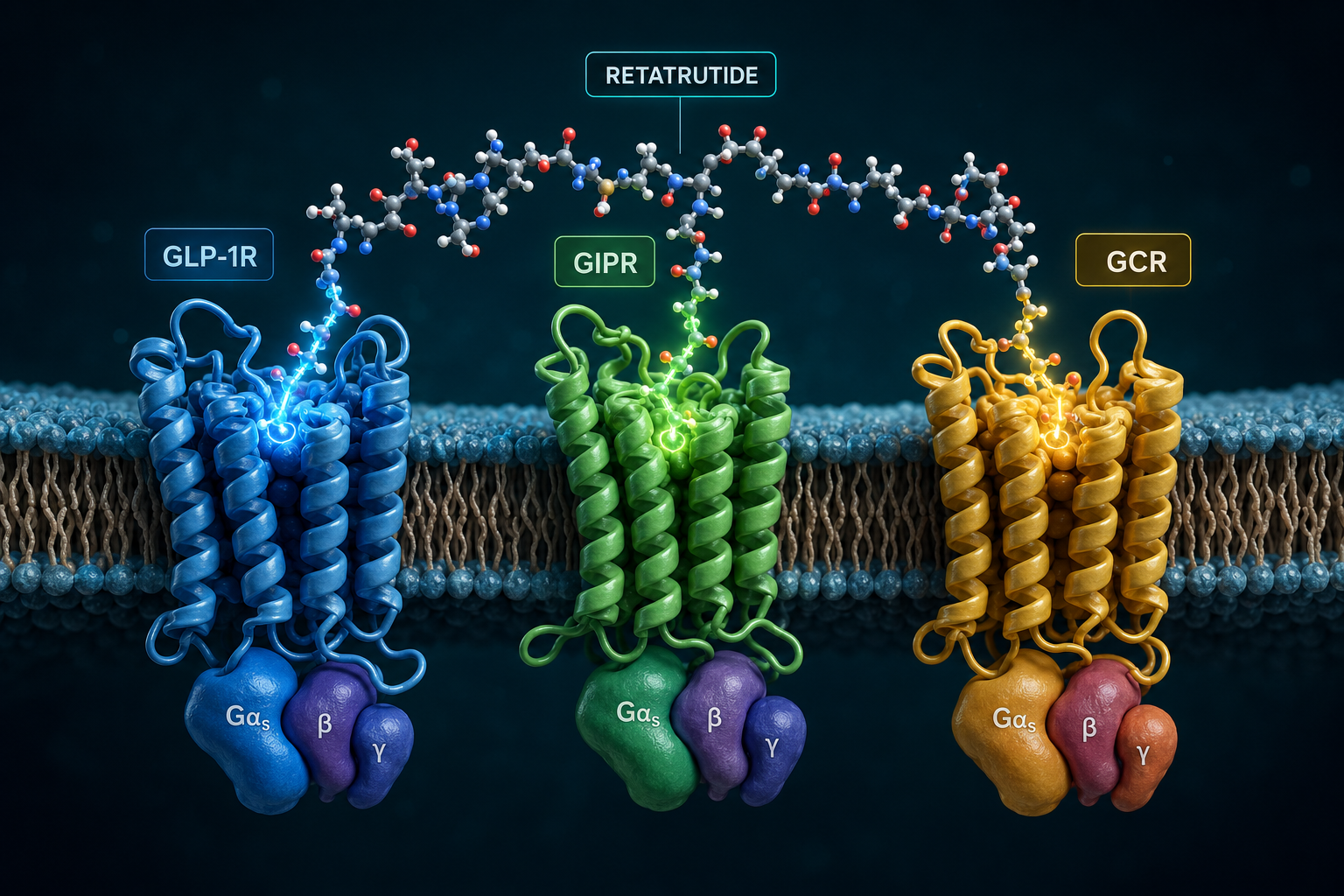
The term "GLP-3" is a colloquial label used in research communities to distinguish retatrutide from earlier incretin-based compounds. Formally, retatrutide is a triple agonist — it binds and activates the GLP-1 receptor, the GIP receptor, and the glucagon receptor. This is categorically different from GLP-1 receptor agonists like semaglutide, which target a single receptor, and from GLP-2, a peptide primarily involved in intestinal growth and repair through its own dedicated receptor.

Understanding the receptor specificity comparison requires looking at potency data:

Receptor EC50 Value Relative Potency vs. Native Peptide
GIP Receptor 0.0643 nM ~8.9x more potent than native GIP
GLP-1 Receptor 0.775 nM ~0.4x potency of native GLP-1
Glucagon Receptor 5.79 nM ~0.3x potency of native glucagon

This asymmetric potency profile is intentional. The GIP receptor is activated most strongly, while glucagon receptor engagement is kept moderate — enough to drive thermogenesis and fat mobilization without triggering hyperglycemia. GLP-1 receptor activation suppresses appetite and enhances insulin secretion, while GLP-2 operates on an entirely separate pathway focused on gut mucosal integrity, making it functionally distinct from retatrutide's mechanism.

For researchers exploring incretin biology, the GLP-3 incretin research themes page provides a useful foundation for understanding how this triple-agonist model differs from classic GLP-1 frameworks.


Downstream Signaling Pathways: Where GLP-3 Retatrutide vs. GLP-1 and GLP-2 Research Models Diverge
Downstream Signaling Pathways: Where GLP-3 Retatrutide vs. GLP-1 and GLP-2 Research Models Diverge

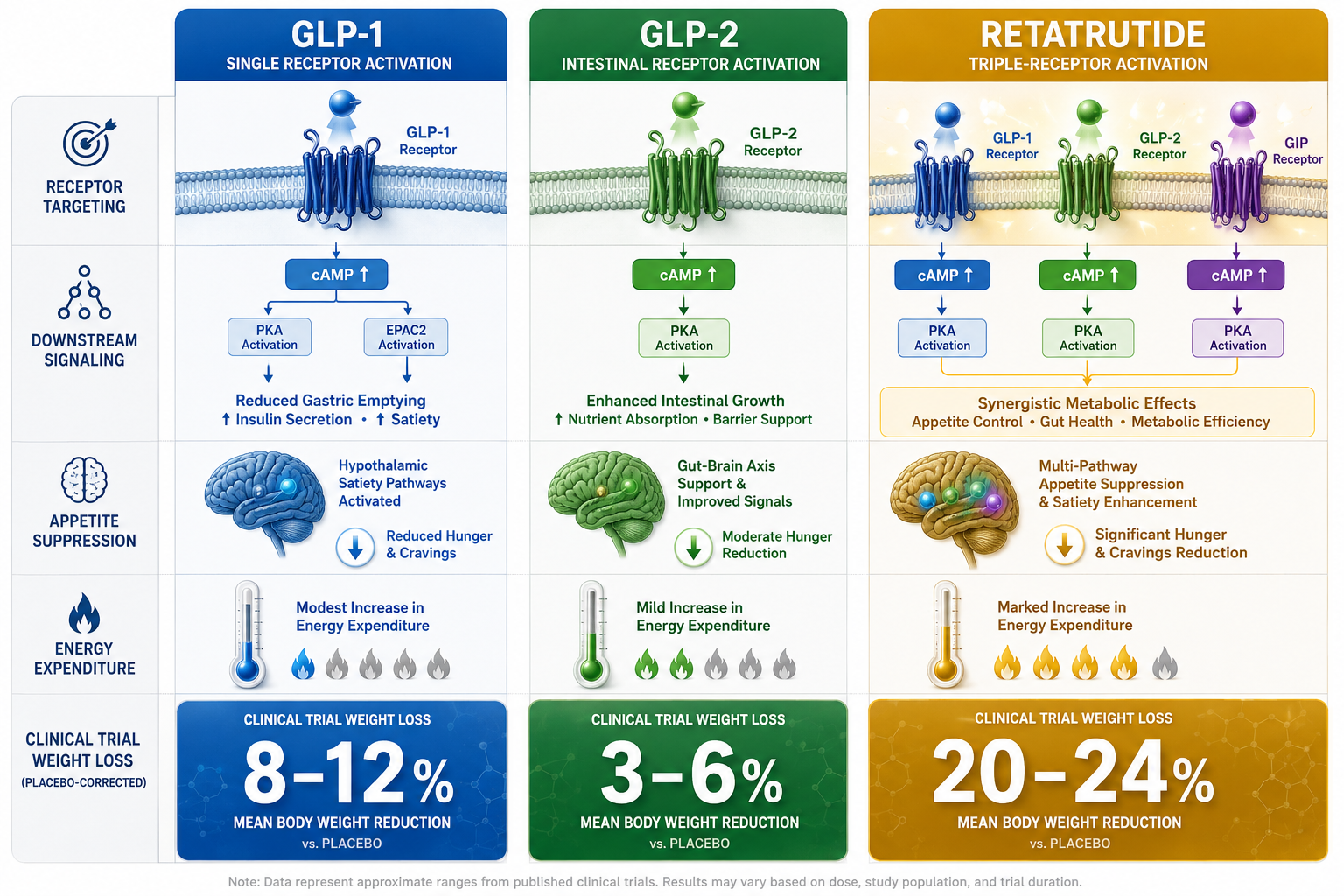
The downstream effects of receptor activation explain why retatrutide produces outcomes that single-agonist peptides cannot replicate. Each receptor pathway contributes a distinct physiological signal:

  • GLP-1 receptor activation: Slows gastric emptying, reduces appetite via central nervous system signaling, and stimulates glucose-dependent insulin release.
  • GIP receptor activation: Enhances insulin secretion, may improve insulin sensitivity, and contributes to adipose tissue regulation.
  • Glucagon receptor activation: Increases hepatic glucose output at low levels, but more critically at therapeutic doses, drives thermogenesis and promotes lipolysis.

GLP-2, by contrast, signals primarily through receptors in the intestinal epithelium, stimulating mucosal growth and nutrient absorption. Its downstream effects are largely confined to the gut, with no meaningful overlap with the metabolic energy-balance pathways that retatrutide engages.

This divergence has significant implications for research model design. Studies examining retatrutide must account for simultaneous multi-receptor crosstalk, whereas GLP-1 or GLP-2 models involve cleaner, more isolated signaling environments. Researchers interested in how GIP receptor dynamics fit into this picture can explore the GIP receptor and its importance for additional context.

Those comparing generational differences in GLP-1 compounds may also find value in reviewing generations of GLP-1 differences to place retatrutide's design within a broader evolutionary framework of incretin drug development.


Clinical Research Outcomes and the Triple-Agonist Advantage
Clinical Research Outcomes and the Triple-Agonist Advantage

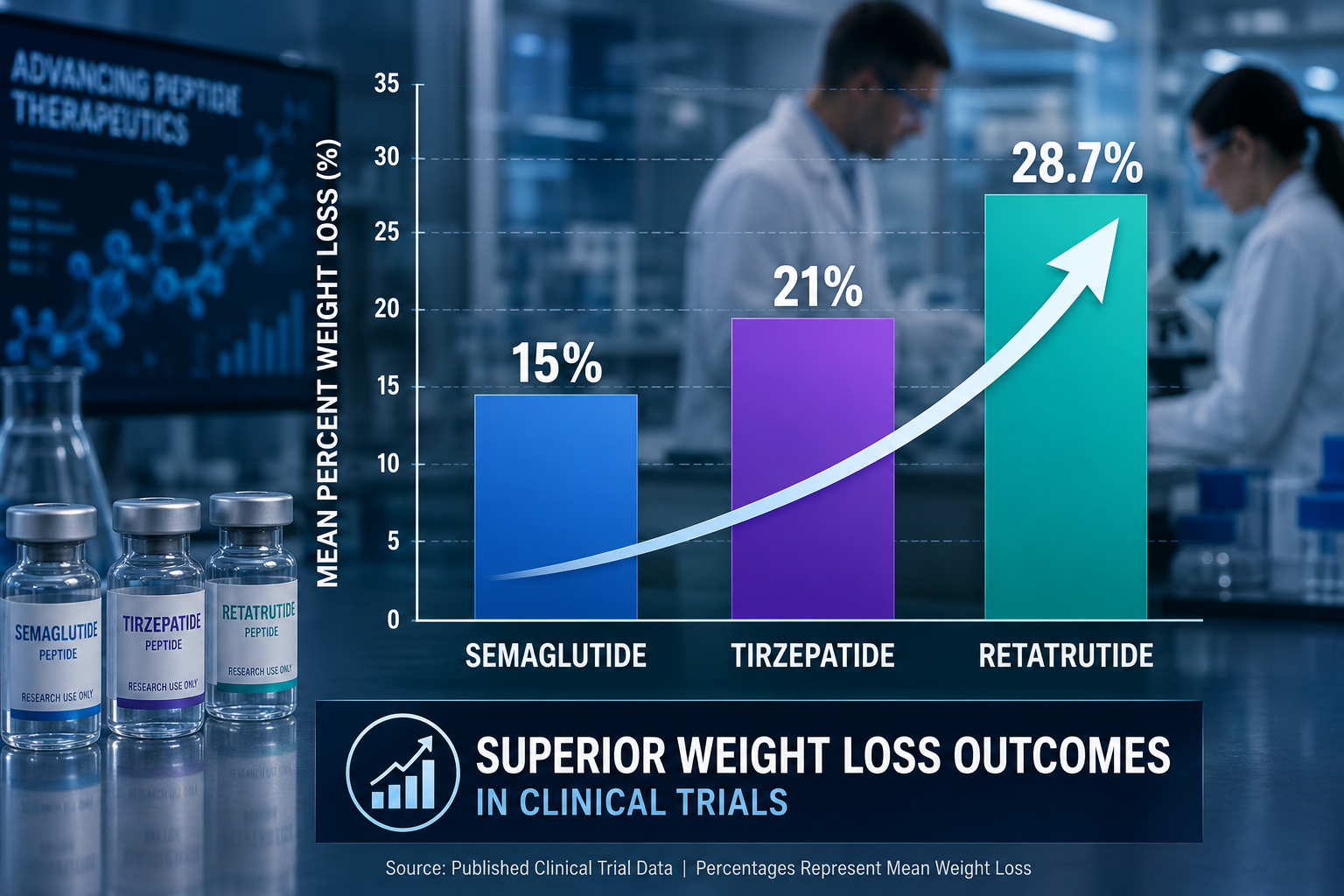
The clinical data emerging from retatrutide trials reflects the compounded benefit of triple-receptor engagement. Phase 2 results showed up to 24.2% body weight reduction over 48 weeks. Preliminary Phase 3 data pushes that figure to 28.7% at 68 weeks — a result that exceeds outcomes from both semaglutide and tirzepatide in comparable timeframes.

Structurally, retatrutide is built on a GIP peptide backbone, modified with 2-aminoisobutyric acid (Aib) residues and a C20 fatty diacid moiety. These modifications resist enzymatic degradation and extend the half-life to approximately six days, making once-weekly subcutaneous dosing feasible. Steady-state plasma concentrations are typically reached within four to five weeks of consistent administration.

As of 2026, retatrutide remains investigational. It has not received FDA approval and is available only in research and clinical trial contexts. An FDA filing is projected for 2026-2027 pending Phase 3 completion.

Researchers building multi-pathway metabolic models may also find it useful to examine how other compounds interact with energy regulation. The SLU-PP-332 metabolic modulation research themes page outlines complementary pathways that some researchers study alongside incretin-based models. Similarly, the GLP-1 peptide generational research concepts resource provides sourcing and conceptual context for GLP-1 receptor research.

For those specifically focused on retatrutide as a research compound, the GLP-3 triple agonist research planning page offers catalog navigation and planning guidance.


Conclusion

The comparison of GLP-3 Retatrutide vs. GLP-1 and GLP-2: Understanding Receptor Specificity and Research Models reveals a clear hierarchy of mechanistic complexity. GLP-2 operates in a gut-specific domain. GLP-1 agonists provide meaningful but single-pathway metabolic control. Retatrutide, through its calibrated triple-receptor engagement, addresses energy balance from multiple angles simultaneously — a design that its clinical outcomes appear to validate.

Actionable next steps for researchers:

  • Review published Phase 2 and Phase 3 trial protocols to understand retatrutide's dosing and endpoint design before building research models.
  • Map receptor crosstalk carefully when designing in vitro or preclinical studies involving triple agonists.
  • Compare GIP receptor potency data against GLP-1 receptor data to understand which pathway dominates at different dose levels.
  • Monitor FDA filing updates projected for 2026-2027 to track regulatory trajectory.
  • Consult the GLP-3 newest triple agonist overview for updated research framing as new data emerges.
Tags: gip receptor, glp-1 receptor agonist, glp-2, glp-3, incretin research, metabolic peptides, peptide pharmacology, receptor specificity, retatrutide, retatrutide clinical trials, triple agonist peptide, weight loss research
https://www.puretestedpeptides.com/wp-content/uploads/2026/06/GLP-3-Retatrutide-vs.-GLP-1-and-GLP-2-Understanding-Receptor-Specificity-and-Research-Models.png 1024 1536 https://www.puretestedpeptides.com/wp-content/uploads/2026/01/buy-peptides-online.jpg 2026-06-21 13:05:362026-06-21 13:05:36GLP-3 Retatrutide vs. GLP-1 and GLP-2: Understanding Receptor Specificity and Research Models
You might also like
GLP-3 Retatrutide vs Traditional GLP-1 Agonists: Mechanisms, Early Data, and Research-Only Use Cases GLP-3 Retatrutide vs Traditional GLP-1 Agonists: Mechanisms, Early Data, and Research-Only Use Cases
Peptides and Polypeptides in Endocrine Research: Linking Estrogen Receptor Signaling to Enclomiphene and GLP-3 Retatrutide Models Peptides and Polypeptides in Endocrine Research: Linking Estrogen Receptor Signaling to Enclomiphene and GLP-3 Retatrutide Models
Best Research Peptides for Weight Management: Comparing GLP-3 Retatrutide, MOTS-c, and 5-Amino-1MQ Best Research Peptides for Weight Management: Comparing GLP-3 Retatrutide, MOTS-c, and 5-Amino-1MQ
How Retatrutide Compares With GLP-1 and GLP-2 Research Peptides in Obesity Models How Retatrutide Compares With GLP-1 and GLP-2 Research Peptides in Obesity Models
Retatrutide vs Tirzepatide vs Semaglutide vs Cagrilintide: Which Metabolic Pathways Matter Most in Research Models? Retatrutide vs Tirzepatide vs Semaglutide vs Cagrilintide: Which Metabolic Pathways Matter Most in Research Models?
Retatrutide and GLP-3 Biology: What Makes This Triple-Agonist Different From GLP-1 and GLP-2 Research Peptides Retatrutide and GLP-3 Biology: What Makes This Triple-Agonist Different From GLP-1 and GLP-2 Research Peptides
PT-141 Peptide Research: Melanocortin Receptor Targeting and Comparison With Sildenafil and Tadalafil PT-141 Peptide Research: Melanocortin Receptor Targeting and Comparison With Sildenafil and Tadalafil
What Is the GLP3 Peptide? Research Distinctions, Naming Confusion, and How It Relates to Retatrutide What Is the GLP3 Peptide? Research Distinctions, Naming Confusion, and How It Relates to Retatrutide
0 replies

Leave a Reply

Want to join the discussion?
Feel free to contribute!

Leave a Reply Cancel reply

Your email address will not be published. Required fields are marked *

×

Helpful Links

  • My account
  • Cart
  • Checkout
  • Refund and Returns Policy
  • Privacy Policy
  • SMS Privacy Policy
  • Login
  • My Account
  • Logout

USA Made Lab Tested Peptides

All products are sold for research, laboratory, or analytical purposes only, and are not for human consumption


Pure Tested Peptides is a chemical supplier. Pure Tested Peptides is not a compounding / chemical compounding facility as defined under 503A of the Federal Food, Drug, and Cosmetic act. Pure Tested Peptides is not an outsourcing facility as defined under 503B of the Federal Food, Drug, and Cosmetic act.

The statements made within this website have not been evaluated by the US Food and Drug Administration. The products we offer are not intended to diagnose, treat, cure or prevent any disease.

Human/Animal Consumption Prohibited. Laboratory/In-Vitro Experimental Use Only

Link to: PT-141 Peptide: Melanocortin Receptor Agonism and Its Role in Sexual Function Research Link to: PT-141 Peptide: Melanocortin Receptor Agonism and Its Role in Sexual Function Research PT-141 Peptide: Melanocortin Receptor Agonism and Its Role in Sexual Function...PT-141 Peptide: Melanocortin Receptor Agonism and Its Role in Sexual Function Research Link to: 5-Amino-1MQ Peptide: Mechanisms of NNMT Inhibition and Research into Metabolic Disorders Link to: 5-Amino-1MQ Peptide: Mechanisms of NNMT Inhibition and Research into Metabolic Disorders 5-Amino-1MQ Peptide: Mechanisms of NNMT Inhibition and Research into Metabolic Disorders5-Amino-1MQ Peptide: Mechanisms of NNMT Inhibition and Research into Metabolic...
Scroll to top Scroll to top Scroll to top