Call or Text 727-513-9780
  • Shopping Cart Shopping Cart
    0Shopping Cart
Pure Tested Peptides | America's most trusted Peptides for sale online
  • Peptides for sale
    • Oral Peptides for sale
      • Peptide Capsules for sale
      • BPC 157 Capsules 1000mcg
      • SLU-PP-332 Capsules | 1000 mcg
      • 5-Amino-1MQ 50mg Capsules
      • Tesofensine 500mcg
    • All Peptides for sale
    • Peptide Sprays
      • BPC 157 Nasal Spray Kit
      • BPC-157 TB500 Nasal Spray Kit
      • Semax Nasal Spray 10mg
      • Selank – Nasal Spray Kit – 10mg
      • Epithalon 50MG Nasal Spray Kit
      • Ipamorelin 10mg Nasal Spray
      • Klow Nasal Spray (BPC-157 + TB-500 + GHK-Cu + KPV) | 80mg
      • Hulk Nasal Spray Tesa / Ipa Blend 6/3 MG
      • Klow Nasal Spray
      • NAD + 500 mg Nasal Spray
      • PT-141 Nasal Spray Kit
    • GHRH Peptides
      • Ipa Peptides
      • CJC-1295 Peptides
        • CJC-1295 with DAC 5 mg
        • CJC-1295 without DAC 5 mg
        • CJC-1295 Ipa 10mg
      • Tesa Peptides
        • Tesa Peptide
        • Tesa 20 mg
    • GHK-Cu Peptides
      • All GHK-Cu Peptides
      • GHK-Cu 100mg
      • KLOW Peptide Blend – Buy KLOW blend online
    • BPC Peptides
      • All BPC Peptides
      • BPC-157
      • BPC-157 TB-500
      • BPC 157 capsules 1000mcg
    • SLU-PP-332 Peptides
      • All SLU-PP-332 Peptides
      • SLU-PP-332 5mg
    • GLP3 Peptides
      • GLP3-R
      • GLP3-R CAG 10mg
      • GLP3-R 20mg
    • PT-141 Peptides
      • PT-141 Peptides for sale
      • PT-141 10mg
      • PT-141 Nasal Spray
    • CAG Peptides
      • Lipo-C Peptide Blend
      • CAG 5mg
      • CAG 10mg
    • MOTS-C Peptides
      • MOTS-C Peptides for sale
      • MOTS-c peptide
      • MOTS-c 10mg *6 pack*
    • 5 Amino 1MQ Peptides
      • 5 Amino 1MQ Peptides for sale
      • 5-Amino-1MQ 50mg Capsules
      • 5-Amino-1MQ 5mg
    • Epithalon Peptides
      • Epithalon Peptides for sale
      • Epithalon 10mg
      • Epithalon 50mg
  • Shop
    • GLPs
      • 5-Amino-1MQ 50mg Capsules
      • 5-Amino-1MQ 5mg
      • GLP3-Reta
      • L-Carnitine 500mg/ml
      • Tesofensine 500mcg
      • SLU-PP-332 5mg
      • MOTS-c 10mg *6 pack*
    • Epithalon & BPC Peptides
      • Epithalon 10mg
      • Epithalon 50mg
      • BPC-157
      • BPC 157 capsules 1000mcg
      • BPC-157 TB-500
      • BPC-157 TB500 Nasal Spray Kit
      • BPC 157 Nasal Spray Kit
    • BPC TB-500 & NAD+ Peptides
      • NAD+ 500 mg
      • KLOW Peptide Blend – Buy KLOW blend online
      • GLOW Peptide Blend
      • TB 500 5mg
      • BPC 157 capsules 1000mcg – Supplement
      • BPC 157 Nasal Spray Kit
      • BPC-157
      • BPC-157 TB500 Nasal Spray Kit
      • BPC-157 TB-500
      • BPC 157 capsules 1000mcg
    • LL-37 Peptide
      • LL-37 10 mg
    • MOTS-C & Selank
      • MOTS-c peptide
      • Selank 10mg
    • GHK Peptides
      • GHK-Cu 100mg
      • GLOW Peptide Blend
      • KLOW Peptide Blend – Buy KLOW blend online
  • COAs
  • Wholesale
    • Wholesale Peptides for sale
  • PTP FAQ
  • Affiliates
    • Affiliate Program
    • Affiliate Signup
  • Contact
    • Contact Customer Service
    • Text Customer Support
  • About US
  • Shop all peptides
  • Login / Register Login / Register Page Link Login / Register Page Link
  • Click to open the search input field Click to open the search input field Search
  • Menu Menu
Glow Blend vs Klow Blend: What Researchers Should Know About These Skin-Focused Peptide Formulations

Glow Blend vs Klow Blend: What Researchers Should Know About These Skin-Focused Peptide Formulations

July 1, 2026/0 Comments/in Uncategorized/by

Fewer than 5% of multi-peptide research blends on the market today include published combination-level safety or efficacy data — yet formulations like Glow Blend and Klow Blend are drawing serious attention from researchers studying skin biology, tissue repair, and inflammation. Understanding the differences between these two products matters before any research protocol is designed.

This guide breaks down the Glow Blend vs Klow Blend: What Researchers Should Know About These Skin-Focused Peptide Formulations comparison with precision — covering ingredient logic, concentration differences, and how to evaluate each blend's research potential.

Key Takeaways

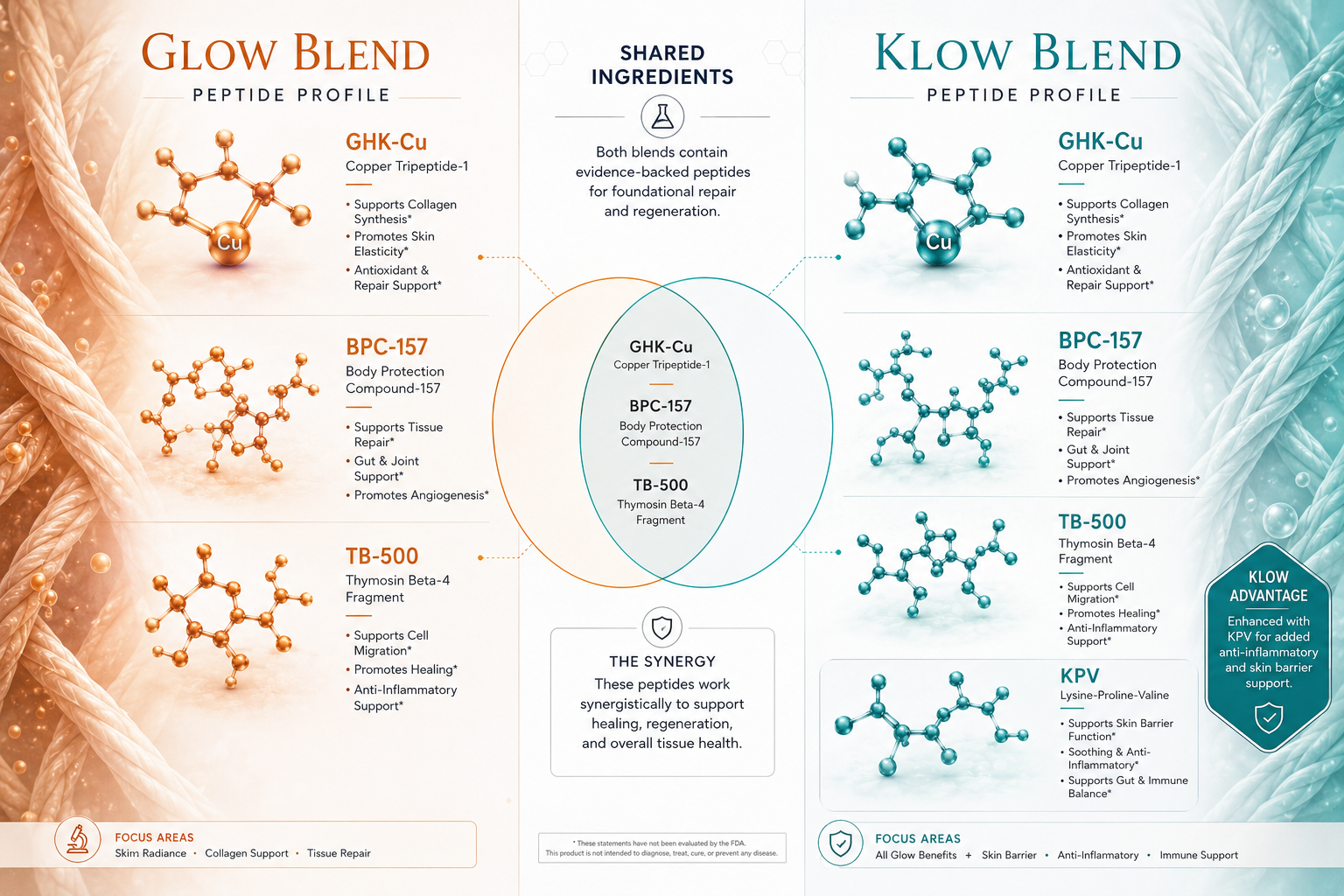
  • Both blends share three core peptides: GHK-Cu, BPC-157, and TB-500
  • Klow Blend adds KPV, a tripeptide with documented anti-inflammatory properties
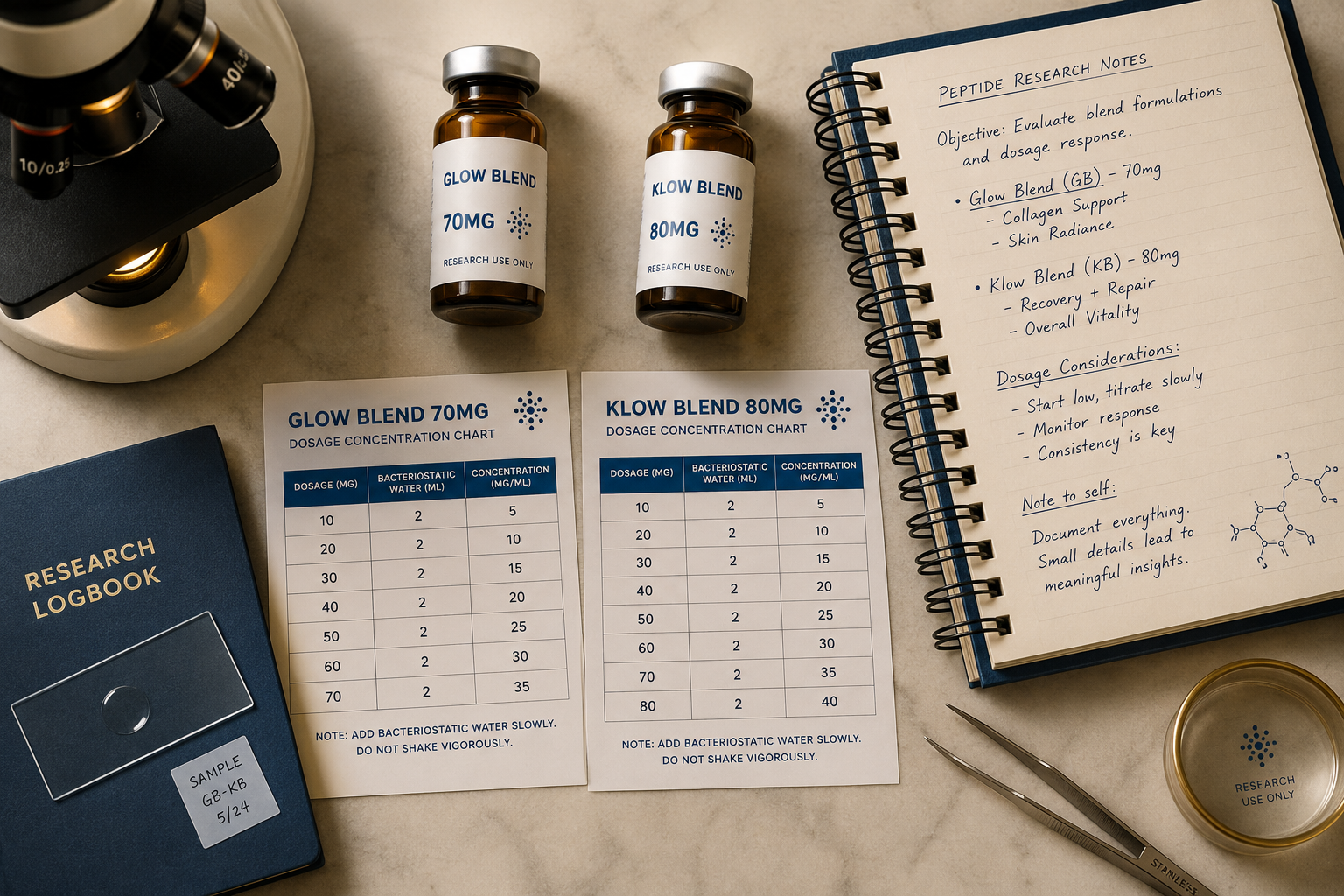
  • Glow Blend (70 mg total) targets skin enhancement; Klow Blend (80 mg total) targets systemic healing
  • Neither blend has been studied as a combined formulation in controlled trials
  • Researchers should evaluate each blend based on the individual peptide evidence available
Key Takeaways

Shared Ingredients and the Logic Behind the Overlap

Both blends are built on the same three-peptide foundation. Researchers familiar with any one of these compounds will recognize the rationale immediately.

GHK-Cu (Copper Tripeptide-1) is the anchor of both formulations. This copper-binding peptide has been studied extensively for its role in extracellular matrix remodeling. Research on GHK-Cu and extracellular matrix dynamics suggests it may stimulate collagen synthesis and support wound healing at the dermal level. Both blends include 50 mg of GHK-Cu.

BPC-157 is a synthetic peptide derived from a gastric protein. It has been examined in preclinical models for tissue repair, angiogenesis, and tendon recovery. For a deeper look at its research profile, the BPC-157 angiogenesis and tendon research overview provides useful context. Both blends include 10 mg.

TB-500 (Thymosin Beta-4 fragment) supports actin regulation and has been linked to cell migration and tissue repair signaling. Both blends include 10 mg.

"The shared foundation of GHK-Cu, BPC-157, and TB-500 gives both blends overlapping potential in skin and tissue research — but the divergence begins with what Klow Blend adds."

Concentration Breakdown: Glow Blend vs Klow Blend

Peptide Glow Blend Klow Blend
GHK-Cu 50 mg 50 mg
BPC-157 10 mg 10 mg
TB-500 10 mg 10 mg
KPV Not included 10 mg
Total 70 mg 80 mg

The addition of KPV is the defining difference. KPV is a tripeptide fragment of alpha-MSH with a focused anti-inflammatory profile. Research on KPV and epithelial barrier function suggests it may help modulate inflammatory signaling in gut and mucosal tissue — which explains why Klow Blend is positioned toward systemic healing rather than cosmetic endpoints.

Pricing reflects the added ingredient: Glow Blend is approximately $145 per vial, while Klow Blend runs approximately $160 per vial.
Concentration Breakdown: Glow Blend vs Klow Blend

Evaluating Research Applications for Each Formulation

Understanding Glow Blend vs Klow Blend: What Researchers Should Know About These Skin-Focused Peptide Formulations means matching each blend to the right research question.

Glow Blend is best suited for:

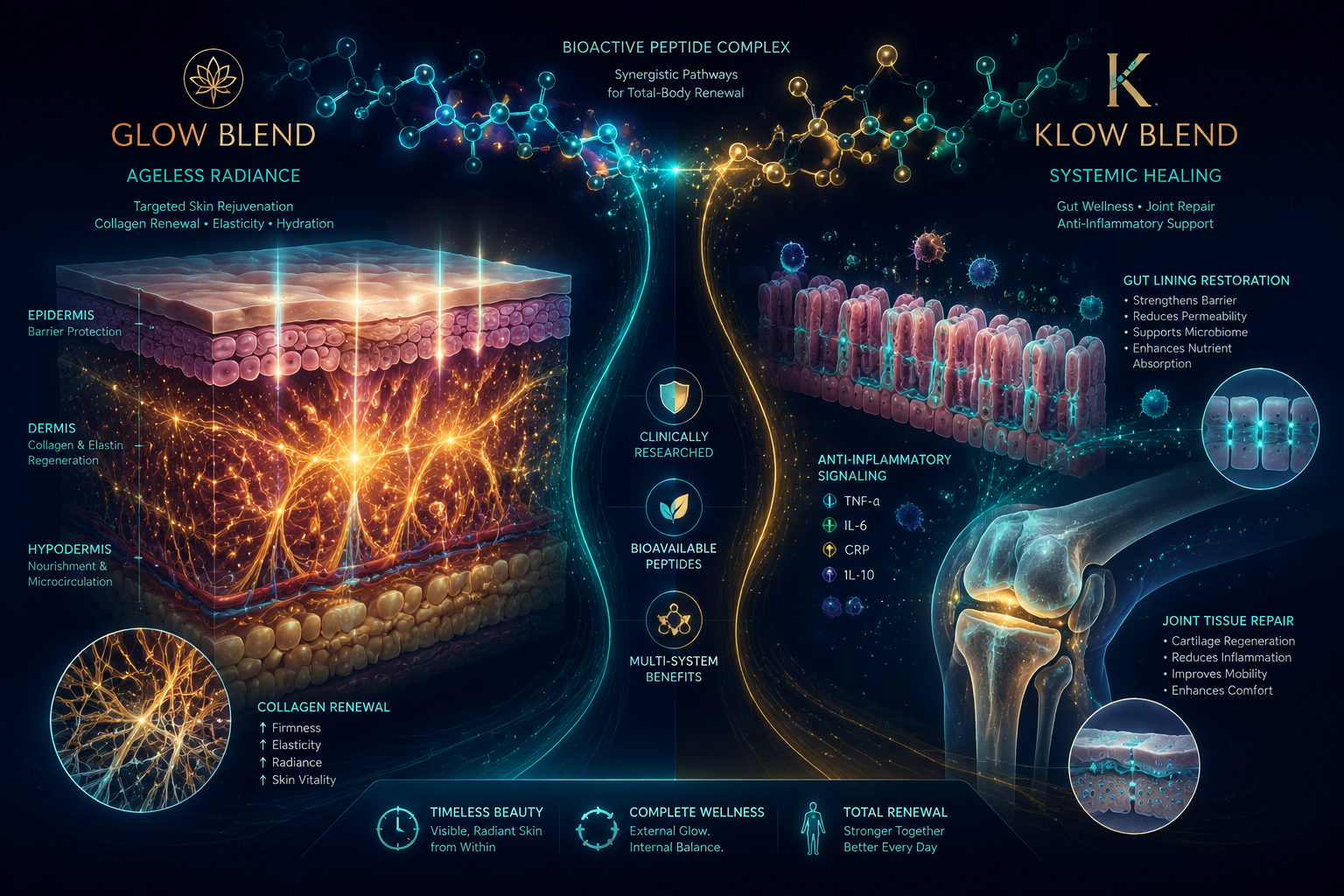
  • Collagen production and skin texture studies
  • Anti-aging and dermal remodeling research
  • Hair follicle and scalp biology investigations

Researchers interested in topical peptide delivery may also find value in reviewing topical GHK-Cu research themes as a parallel reference point.

Klow Blend is best suited for:

  • Gut repair and intestinal barrier research
  • Joint inflammation and injury recovery models
  • Systemic anti-inflammatory pathway studies

The inclusion of KPV alongside BPC-157 creates a potentially synergistic anti-inflammatory profile. Researchers studying broader innovative peptide delivery systems may find the Klow formulation particularly relevant for mucosal delivery models.

A critical note on combination research: Neither blend has been tested as a complete formulation in peer-reviewed controlled studies. All available evidence is drawn from individual peptide research. Researchers should treat these blends as hypothesis-generating tools rather than validated combination therapies.

For those building broader research frameworks, the longevity peptide research catalog and comprehensive peptide catalog tour offer useful orientation across related compound categories.
Evaluating Research Applications for Each Formulation

Conclusion

The Glow Blend vs Klow Blend: What Researchers Should Know About These Skin-Focused Peptide Formulations comparison ultimately comes down to research focus. Both blends share a strong three-peptide foundation with documented individual-level evidence. Glow Blend is the cleaner choice for skin-focused and anti-aging research protocols. Klow Blend is the stronger candidate when inflammation, gut repair, or systemic tissue recovery is the primary variable.

Actionable next steps for researchers in 2026:

  1. Define the primary research endpoint before selecting a blend
  2. Review individual peptide literature for GHK-Cu, BPC-157, TB-500, and KPV separately
  3. Document baseline inflammatory markers if using Klow Blend in systemic models
  4. Treat combination-level effects as exploratory until controlled data exists
  5. Source from suppliers with verified purity documentation to ensure data integrity
Tags: bpc-157 research, collagen peptide research, ghk-cu peptide, glow blend, klow blend, kpv anti-inflammatory, multi-peptide blends, peptide blend comparison, peptide research 2026, skin peptide formulations, tb-500 peptide, tissue repair peptides
https://www.puretestedpeptides.com/wp-content/uploads/2026/07/Glow-Blend-vs-Klow-Blend-What-Researchers-Should-Know-About-These-Skin-Focused-Peptide-Formulations.png 1024 1536 https://www.puretestedpeptides.com/wp-content/uploads/2026/01/buy-peptides-online.jpg 2026-07-01 13:03:432026-07-01 13:03:43Glow Blend vs Klow Blend: What Researchers Should Know About These Skin-Focused Peptide Formulations
You might also like
Epithalon Peptide: Telomerase Activation and its Role in Cellular Aging Research Mitochondria, MOTS‑c, and 5‑Amino‑1MQ: How Polypeptide Peptides Rewire Cellular Energy Metabolism
BPC-157 and TB-500 in Experimental Tissue-Repair Models: Synergy, Overlaps, and Key Differences BPC-157 and TB-500 in Experimental Tissue-Repair Models: Synergy, Overlaps, and Key Differences
PT-141 Peptide Research: Melanocortin Receptor Targeting and Comparison With Sildenafil and Tadalafil PT-141 Peptide Research: Melanocortin Receptor Targeting and Comparison With Sildenafil and Tadalafil
Tesamorelin, CJC‑1295, and Ipamorelin Stacks: How Researchers Compare Multi‑Peptide Blends to Single‑Peptide Protocols Tesamorelin, CJC‑1295, and Ipamorelin Stacks: How Researchers Compare Multi‑Peptide Blends to Single‑Peptide Protocols
The Role of 5-Amino-1MQ Peptide in Mitochondrial Function and Metabolic Pathways Research The Role of 5-Amino-1MQ Peptide in Mitochondrial Function and Metabolic Pathways Research
GHK-Cu Peptide and Collagen Biology: What Research Suggests About Skin, Wound Repair, and Matrix Remodeling GHK-Cu Peptide and Collagen Biology: What Research Suggests About Skin, Wound Repair, and Matrix Remodeling
Understanding DNA, Telomeres, and Epithalon: How Genetic and Telomeric Markers Are Used in Peptide Longevity Research Understanding DNA, Telomeres, and Epithalon: How Genetic and Telomeric Markers Are Used in Peptide Longevity Research
Epithalon Peptide: Telomerase Activation and its Role in Cellular Aging Research Epithalon Peptide: Telomerase Activation and its Role in Cellular Aging Research
0 replies

Leave a Reply

Want to join the discussion?
Feel free to contribute!

Leave a Reply Cancel reply

Your email address will not be published. Required fields are marked *

×

Helpful Links

  • My account
  • Cart
  • Checkout
  • Refund and Returns Policy
  • Privacy Policy
  • SMS Privacy Policy
  • Login
  • My Account
  • Logout

USA Made Lab Tested Peptides

All products are sold for research, laboratory, or analytical purposes only, and are not for human consumption


Pure Tested Peptides is a chemical supplier. Pure Tested Peptides is not a compounding / chemical compounding facility as defined under 503A of the Federal Food, Drug, and Cosmetic act. Pure Tested Peptides is not an outsourcing facility as defined under 503B of the Federal Food, Drug, and Cosmetic act.

The statements made within this website have not been evaluated by the US Food and Drug Administration. The products we offer are not intended to diagnose, treat, cure or prevent any disease.

Human/Animal Consumption Prohibited. Laboratory/In-Vitro Experimental Use Only

Link to: Enclomiphene: A Selective Estrogen Receptor Modulator (serm) for Male Reproductive Health Research Link to: Enclomiphene: A Selective Estrogen Receptor Modulator (serm) for Male Reproductive Health Research Enclomiphene: A Selective Estrogen Receptor Modulator (serm) for Male Reproductive...Enclomiphene: A Selective Estrogen Receptor Modulator (serm) for Male Reproductive Health Research Link to: Peptides vs Polypeptides: A Simple Scientific Guide for Research Buyers and Lab Readers Link to: Peptides vs Polypeptides: A Simple Scientific Guide for Research Buyers and Lab Readers Peptides vs Polypeptides: A Simple Scientific Guide for Research Buyers and Lab ReadersPeptides vs Polypeptides: A Simple Scientific Guide for Research Buyers and...
Scroll to top Scroll to top Scroll to top