Call or Text 727-513-9780
  • Shopping Cart Shopping Cart
    0Shopping Cart
Pure Tested Peptides | America's most trusted Peptides for sale online
  • Peptides for sale
    • Oral Peptides for sale
      • Peptide Capsules for sale
      • BPC 157 Capsules 1000mcg
      • SLU-PP-332 Capsules | 1000 mcg
      • 5-Amino-1MQ 50mg Capsules
      • Tesofensine 500mcg
    • All Peptides for sale
    • Peptide Sprays
      • BPC 157 Nasal Spray Kit
      • BPC-157 TB500 Nasal Spray Kit
      • Semax Nasal Spray 10mg
      • Selank – Nasal Spray Kit – 10mg
      • Epithalon 50MG Nasal Spray Kit
      • Ipamorelin 10mg Nasal Spray
      • Klow Nasal Spray (BPC-157 + TB-500 + GHK-Cu + KPV) | 80mg
      • Hulk Nasal Spray Tesa / Ipa Blend 6/3 MG
      • Klow Nasal Spray
      • NAD + 500 mg Nasal Spray
      • PT-141 Nasal Spray Kit
    • GHRH Peptides
      • Ipa Peptides
      • CJC-1295 Peptides
        • CJC-1295 with DAC 5 mg
        • CJC-1295 without DAC 5 mg
        • CJC-1295 Ipa 10mg
      • Tesa Peptides
        • Tesa Peptide
        • Tesa 20 mg
    • GHK-Cu Peptides
      • All GHK-Cu Peptides
      • GHK-Cu 100mg
      • KLOW Peptide Blend – Buy KLOW blend online
    • BPC Peptides
      • All BPC Peptides
      • BPC-157
      • BPC-157 TB-500
      • BPC 157 capsules 1000mcg
    • SLU-PP-332 Peptides
      • All SLU-PP-332 Peptides
      • SLU-PP-332 5mg
    • GLP3 Peptides
      • GLP3-R
      • GLP3-R CAG 10mg
      • GLP3-R 20mg
    • PT-141 Peptides
      • PT-141 Peptides for sale
      • PT-141 10mg
      • PT-141 Nasal Spray
    • CAG Peptides
      • Lipo-C Peptide Blend
      • CAG 5mg
      • CAG 10mg
    • MOTS-C Peptides
      • MOTS-C Peptides for sale
      • MOTS-c peptide
      • MOTS-c 10mg *6 pack*
    • 5 Amino 1MQ Peptides
      • 5 Amino 1MQ Peptides for sale
      • 5-Amino-1MQ 50mg Capsules
      • 5-Amino-1MQ 5mg
    • Epithalon Peptides
      • Epithalon Peptides for sale
      • Epithalon 10mg
      • Epithalon 50mg
  • Shop
    • GLPs
      • 5-Amino-1MQ 50mg Capsules
      • 5-Amino-1MQ 5mg
      • GLP3-Reta
      • L-Carnitine 500mg/ml
      • Tesofensine 500mcg
      • SLU-PP-332 5mg
      • MOTS-c 10mg *6 pack*
    • Epithalon & BPC Peptides
      • Epithalon 10mg
      • Epithalon 50mg
      • BPC-157
      • BPC 157 capsules 1000mcg
      • BPC-157 TB-500
      • BPC-157 TB500 Nasal Spray Kit
      • BPC 157 Nasal Spray Kit
    • BPC TB-500 & NAD+ Peptides
      • NAD+ 500 mg
      • KLOW Peptide Blend – Buy KLOW blend online
      • GLOW Peptide Blend
      • TB 500 5mg
      • BPC 157 capsules 1000mcg – Supplement
      • BPC 157 Nasal Spray Kit
      • BPC-157
      • BPC-157 TB500 Nasal Spray Kit
      • BPC-157 TB-500
      • BPC 157 capsules 1000mcg
    • LL-37 Peptide
      • LL-37 10 mg
    • MOTS-C & Selank
      • MOTS-c peptide
      • Selank 10mg
    • GHK Peptides
      • GHK-Cu 100mg
      • GLOW Peptide Blend
      • KLOW Peptide Blend – Buy KLOW blend online
  • COAs
  • Wholesale
    • Wholesale Peptides for sale
  • PTP FAQ
  • Affiliates
    • Affiliate Program
    • Affiliate Signup
  • Contact
    • Contact Customer Service
    • Text Customer Support
  • About US
  • Shop all peptides
  • Login / Register Login / Register Page Link Login / Register Page Link
  • Click to open the search input field Click to open the search input field Search
  • Menu Menu
GLP-3 Retatrutide Mechanism of Action Explained: Triple Agonism, Appetite Signaling, and Energy Expenditure

GLP-3 Retatrutide Mechanism of Action Explained: Triple Agonism, Appetite Signaling, and Energy Expenditure

July 9, 2026/0 Comments/in Uncategorized/by

Forty-five percent of participants in a landmark 2026 obesity trial lost more than 30% of their body weight from a single weekly injection, a result previously reserved for bariatric surgery. That compound is retatrutide, and its extraordinary performance comes down to a precise molecular strategy: simultaneous activation of three metabolic receptors. Understanding the GLP-3 Retatrutide mechanism of action explained through triple agonism, appetite signaling, and energy expenditure is essential for researchers, clinicians, and anyone tracking the frontier of metabolic science.

Key Takeaways

  • Retatrutide activates GLP-1, GIP, and glucagon receptors simultaneously, producing effects no single or dual agonist can replicate.
  • Glucagon receptor activation is the distinguishing feature that drives enhanced energy expenditure and fat oxidation beyond appetite suppression alone.
  • In the TRIUMPH-1 trial, participants on 12 mg lost an average of 70.3 lbs (28.3% of body weight) over 80 weeks.
  • The peptide's fatty acid side chain enables albumin binding, supporting a convenient once-weekly dosing schedule.
  • Beyond weight loss, retatrutide shows clinically meaningful improvements in type 2 diabetes, sleep apnea, and osteoarthritis pain.

The Structural Foundation Behind Triple Agonism
The Structural Foundation Behind Triple Agonism

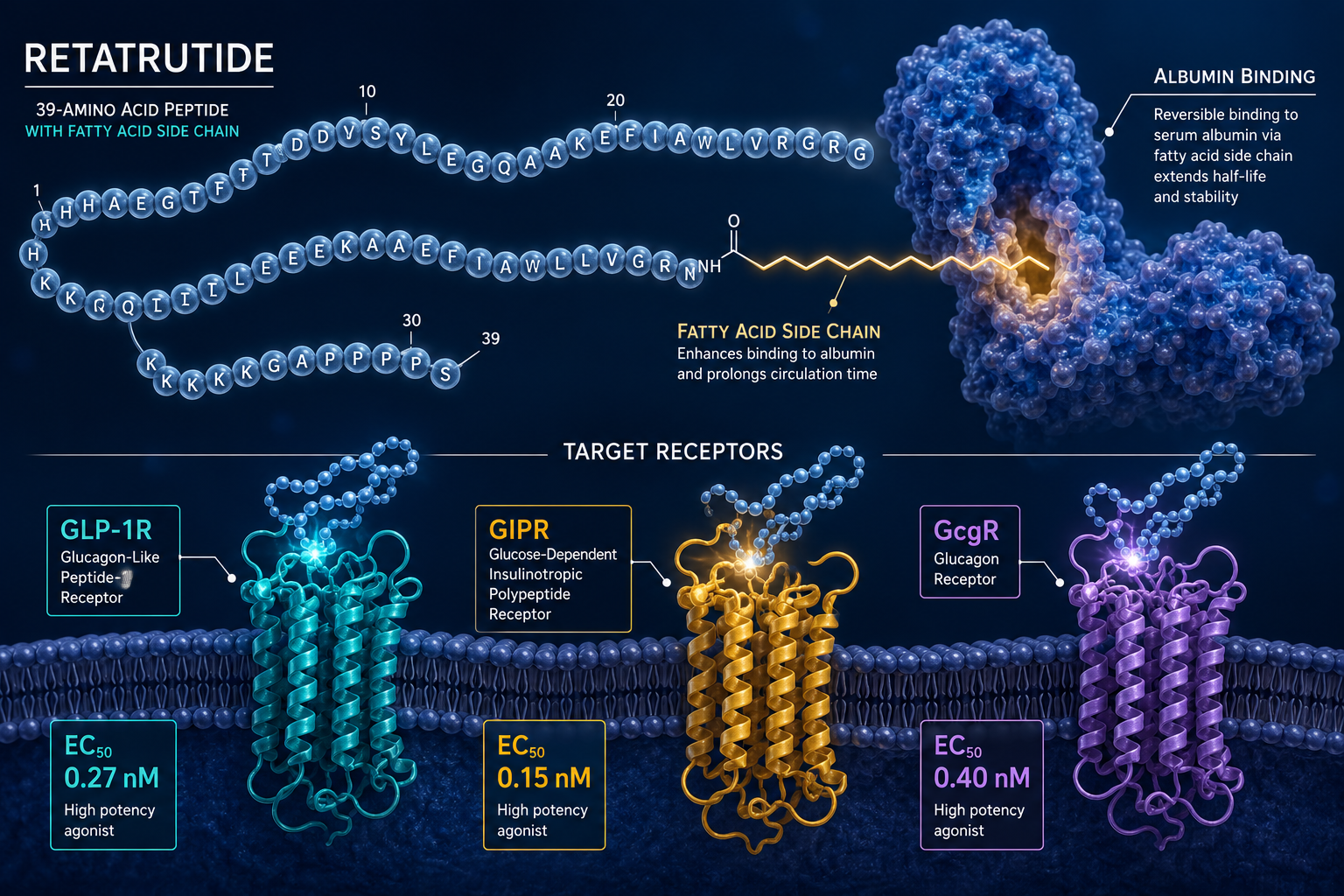
Retatrutide is a 39-amino acid peptide engineered with a fatty acid side chain. That side chain binds to albumin in the bloodstream, extending the compound's half-life to approximately six days. The practical result is once-weekly dosing, a significant advantage for sustained research protocols and patient adherence.

What sets retatrutide apart structurally is its receptor potency profile:

Receptor EC50 (nM) Primary Effect
GIP Receptor (GIPR) 0.0643 Insulin secretion, fat metabolism
GLP-1 Receptor (GLP-1R) 0.775 Appetite suppression, glucose control
Glucagon Receptor (GcgR) 5.79 Energy expenditure, fat oxidation

The compound shows the highest potency at the GIP receptor, followed by GLP-1, then glucagon. This gradient is intentional. GIP and GLP-1 agonism work synergistically on insulin release and satiety, while glucagon agonism, typically avoided in metabolic drugs due to hyperglycemia risk, is carefully balanced to drive thermogenesis without destabilizing blood glucose.

Researchers exploring related metabolic peptide pathways can find additional context in the metabolic modulation research lines overview, which covers complementary compounds under active investigation.


How Appetite Signaling and Energy Expenditure Work Together
How Appetite Signaling and Energy Expenditure Work Together

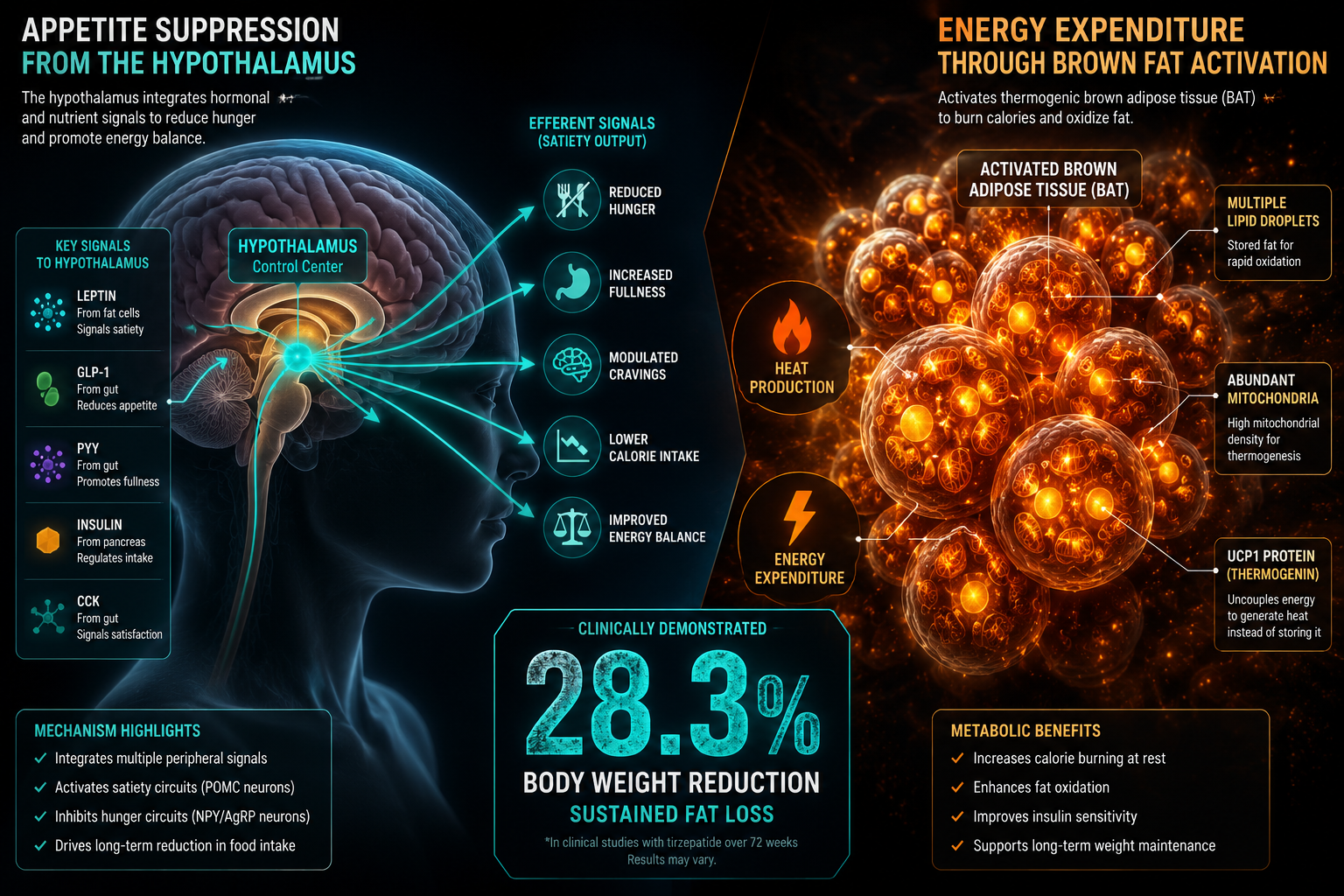
The GLP-3 Retatrutide mechanism of action explained through appetite signaling begins in the hypothalamus. GLP-1 receptor activation slows gastric emptying and signals satiety centers in the brain, reducing caloric intake. GIP receptor activation amplifies insulin secretion in a glucose-dependent manner, lowering postprandial glucose spikes while also modulating fat storage in adipose tissue.

The glucagon component is where retatrutide diverges from its predecessors.

"The addition of glucagon receptor activation may play a key role in enhancing weight loss beyond what GLP-1 and GIP agonism achieve alone."

Glucagon receptor activation increases hepatic glucose output under fasting conditions, but more critically for obesity research, it stimulates thermogenesis in brown adipose tissue and promotes fatty acid oxidation. This creates a dual-pathway effect: the body consumes fewer calories through appetite suppression while simultaneously burning more through elevated energy expenditure.

This mechanism contrasts with earlier GLP-1 generation drugs. For a deeper look at how incretin-based therapies have evolved, the generations of GLP-1 differences resource provides useful comparative context.

Researchers studying overlapping metabolic pathways may also find value in reviewing 5-Amino-1MQ, a NNMT inhibitor that targets fat cell metabolism through a distinct but complementary mechanism.


Clinical Evidence: What the Data Shows in 2026
Clinical Evidence: What the Data Shows in 2026

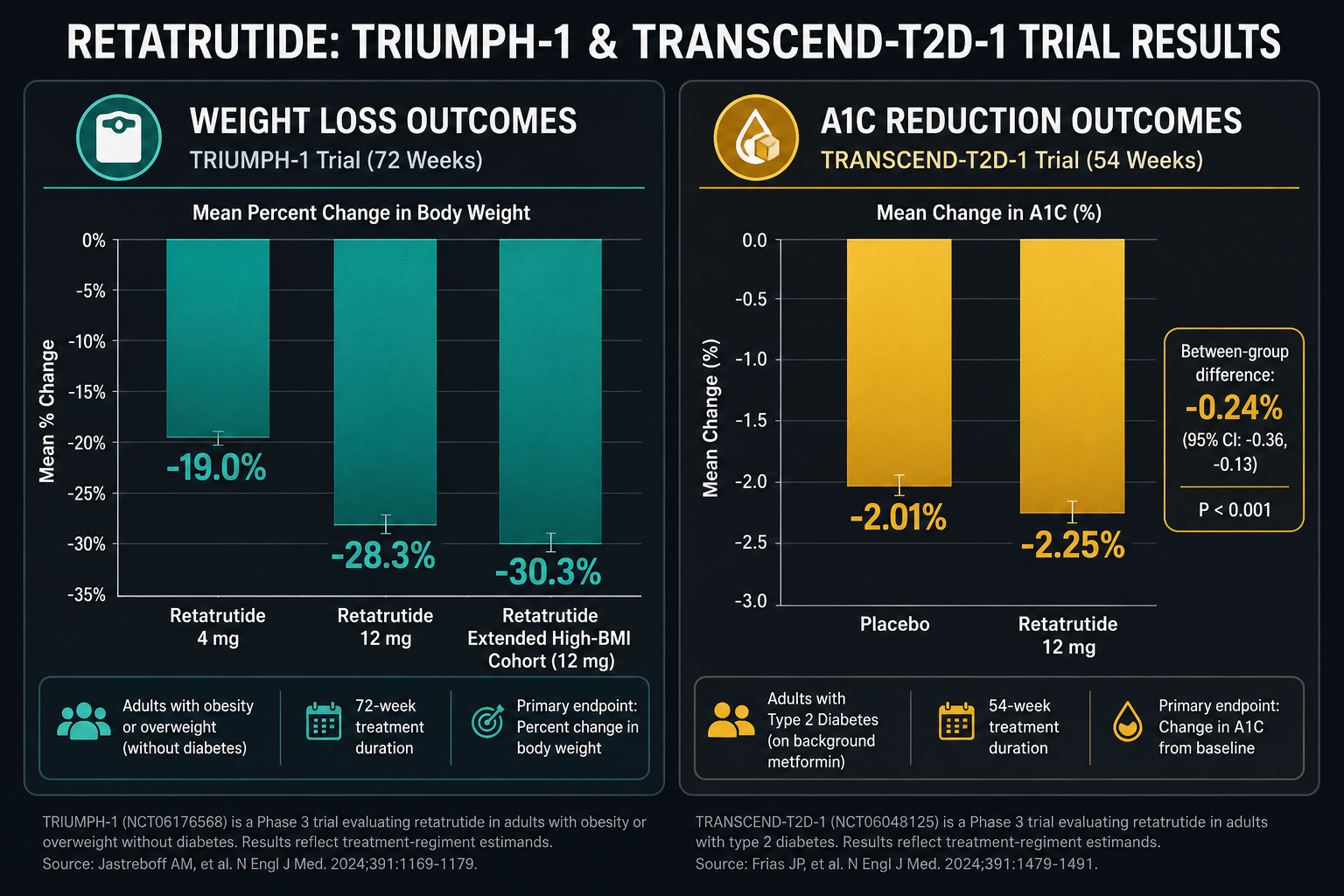
The TRIUMPH-1 Phase 3 trial delivered the most compelling data yet. Participants receiving 12 mg of retatrutide lost an average of 70.3 lbs (28.3% of body weight) over 80 weeks. Among those with a baseline BMI of 35 or higher who continued into a study extension, average weight loss reached 85.0 lbs (30.3%) at 104 weeks.

Even the lower 4 mg dose produced meaningful results: an average of 47.2 lbs (19.0%) lost over 80 weeks, with a favorable discontinuation profile compared to placebo.

The TRANSCEND-T2D-1 trial, reported in March 2026, showed retatrutide achieving A1C reductions of up to 2.0% and weight loss of up to 36.6 lbs (16.8%) at 40 weeks in adults with type 2 diabetes. Up to 46% of participants reached normal A1C levels.

Beyond metabolic markers, retatrutide reduced knee osteoarthritis pain by up to 73.1% and decreased obstructive sleep apnea severity by up to 60.6 events per hour, outcomes that reflect the systemic reach of triple receptor agonism.

Common side effects include nausea, vomiting, and dysesthesia. Some participants discontinued due to rapid weight loss, underscoring the importance of careful monitoring.

Eli Lilly is conducting additional late-stage trials with potential FDA approval sought by end of 2026.

For researchers working with GLP-based compounds, the GLP-3 for sale: triple agonist research planning and catalog navigation page offers practical sourcing and protocol guidance. Those seeking specific product details can also review the GLP-3 Retatrutide research catalog entry directly.

Researchers interested in how growth hormone-related peptides interact with metabolic outcomes may also find the Tesamorelin body composition research themes page a useful adjacent resource.


Conclusion

Retatrutide's triple agonism, targeting GLP-1, GIP, and glucagon receptors with precision-tuned potency, represents a genuine leap in metabolic research. The mechanism is not simply additive; the glucagon component introduces an energy expenditure dimension that earlier incretin therapies could not access. Combined with appetite suppression and improved insulin dynamics, this produces weight loss outcomes that rival surgical intervention.

Actionable next steps for researchers:

  • Review the receptor potency profile carefully when designing dosing protocols; GIP receptor sensitivity is highest and may drive early responses.
  • Monitor for nausea and dysesthesia, particularly during dose escalation phases.
  • Consider how triple agonism data intersects with other metabolic modulators in your research stack.
  • Consult the Retatrutide GLP-3 research overview for updated sourcing, purity standards, and protocol references before initiating any study.

The science behind retatrutide is still unfolding, but the 2026 clinical data makes one thing clear: three receptors, activated together, can accomplish what none could achieve alone.

Tags: appetite signaling, energy expenditure, gip receptor, glp-1 receptor agonist, glp-3 triple agonist, glucagon receptor activation, metabolic peptides, obesity research, retatrutide, retatrutide mechanism of action, triple agonism, triumph-1 trial
https://www.puretestedpeptides.com/wp-content/uploads/2026/07/GLP-3-Retatrutide-Mechanism-of-Action-Explained-Triple-Agonism-Appetite-Signaling-and-Energy-Expenditure.png 1024 1536 https://www.puretestedpeptides.com/wp-content/uploads/2026/01/buy-peptides-online.jpg 2026-07-09 13:04:382026-07-09 13:04:38GLP-3 Retatrutide Mechanism of Action Explained: Triple Agonism, Appetite Signaling, and Energy Expenditure
You might also like
Retatrutide vs GLP3 Peptide: How to Interpret the Naming Difference in Research Context Retatrutide vs GLP3 Peptide: How to Interpret the Naming Difference in Research Context
Safety, stability, and storage of research‑grade retatrutide/“GLP‑3” solutions Safety, stability, and storage of research‑grade retatrutide/“GLP‑3” solutions
5-Amino-1MQ Peptide: Mechanisms of NNMT Inhibition and Research into Metabolic Disorders 5-Amino-1MQ Peptide: Mechanisms of NNMT Inhibition and Research into Metabolic Disorders
SLUPP332 With 5-Amino-1MQ: Designing Mitochondrial and NNMT-Targeted Peptide Stacks for Obesity Research SLUPP332 With 5-Amino-1MQ: Designing Mitochondrial and NNMT-Targeted Peptide Stacks for Obesity Research
How Retatrutide Compares With GLP-1 and GLP-2 Research Peptides in Obesity Models How Retatrutide Compares With GLP-1 and GLP-2 Research Peptides in Obesity Models
GLP-3 Retatrutide: The Future of Metabolic Research Beyond GLP-1 GLP-3 Retatrutide: The Future of Metabolic Research Beyond GLP-1
Retatrutide as so‑called “GLP‑3” triple agonist vs. GLP‑1 drugs (latest Phase 3 obesity and MASLD data) Retatrutide as so‑called “GLP‑3” triple agonist vs. GLP‑1 drugs (latest Phase 3 obesity and MASLD data)
GLP-3, GLP-1, and GLP-2 Explained: A Researcher’s Guide to the Peptide Family GLP-3, GLP-1, and GLP-2 Explained: A Researcher’s Guide to the Peptide Family
0 replies

Leave a Reply

Want to join the discussion?
Feel free to contribute!

Leave a Reply Cancel reply

Your email address will not be published. Required fields are marked *

×

Helpful Links

  • My account
  • Cart
  • Checkout
  • Refund and Returns Policy
  • Privacy Policy
  • SMS Privacy Policy
  • Login
  • My Account
  • Logout

USA Made Lab Tested Peptides

All products are sold for research, laboratory, or analytical purposes only, and are not for human consumption


Pure Tested Peptides is a chemical supplier. Pure Tested Peptides is not a compounding / chemical compounding facility as defined under 503A of the Federal Food, Drug, and Cosmetic act. Pure Tested Peptides is not an outsourcing facility as defined under 503B of the Federal Food, Drug, and Cosmetic act.

The statements made within this website have not been evaluated by the US Food and Drug Administration. The products we offer are not intended to diagnose, treat, cure or prevent any disease.

Human/Animal Consumption Prohibited. Laboratory/In-Vitro Experimental Use Only

Link to: Regulatory Scrutiny in the GLP‑1/GLP‑3 Era: How BPC‑157, PT‑141, and Enclomiphene Are Being Re‑Evaluated Link to: Regulatory Scrutiny in the GLP‑1/GLP‑3 Era: How BPC‑157, PT‑141, and Enclomiphene Are Being Re‑Evaluated Regulatory Scrutiny in the GLP‑1/GLP‑3 Era: How BPC‑157, PT‑141, and...Regulatory Scrutiny in the GLP‑1/GLP‑3 Era: How BPC‑157, PT‑141, and Enclomiphene Are Being Re‑Evaluated Link to: BPC-157 Research Mechanisms: Angiogenesis, Fibroblast Activity, and Tissue Repair Pathways Link to: BPC-157 Research Mechanisms: Angiogenesis, Fibroblast Activity, and Tissue Repair Pathways BPC-157 Research Mechanisms: Angiogenesis, Fibroblast Activity, and Tissue Repair PathwaysBPC-157 Research Mechanisms: Angiogenesis, Fibroblast Activity, and Tissue Repair...
Scroll to top Scroll to top Scroll to top