

Fewer than 5% of selective estrogen receptor modulators studied in preclinical settings reach meaningful clinical endpoints, yet enclomiphene has consistently stood apart from that trend. Research into enclomiphene and estrogen receptor signaling in research: how it compares with serm-based hormone studies reveals a compound with a precise mechanistic profile that challenges older, less selective approaches to hormone axis modulation.
Key Takeaways
- Enclomiphene is the trans-isomer of clomiphene citrate and functions as a pure estrogen receptor antagonist at the hypothalamic level
- By blocking estrogen receptors in the hypothalamus, it drives LH and FSH secretion, which in turn stimulates endogenous testosterone production
- Unlike mixed clomiphene, enclomiphene eliminates the weak estrogenic activity of the zuclomiphene isomer, producing a cleaner receptor signal
- Compared to classical serms, enclomiphene preserves spermatogenesis, making it distinct in fertility-relevant research contexts
- Its short half-life of approximately 10 to 15 hours supports daily oral dosing protocols in research models
Mechanistic Foundations: How Enclomiphene Engages Estrogen Receptors
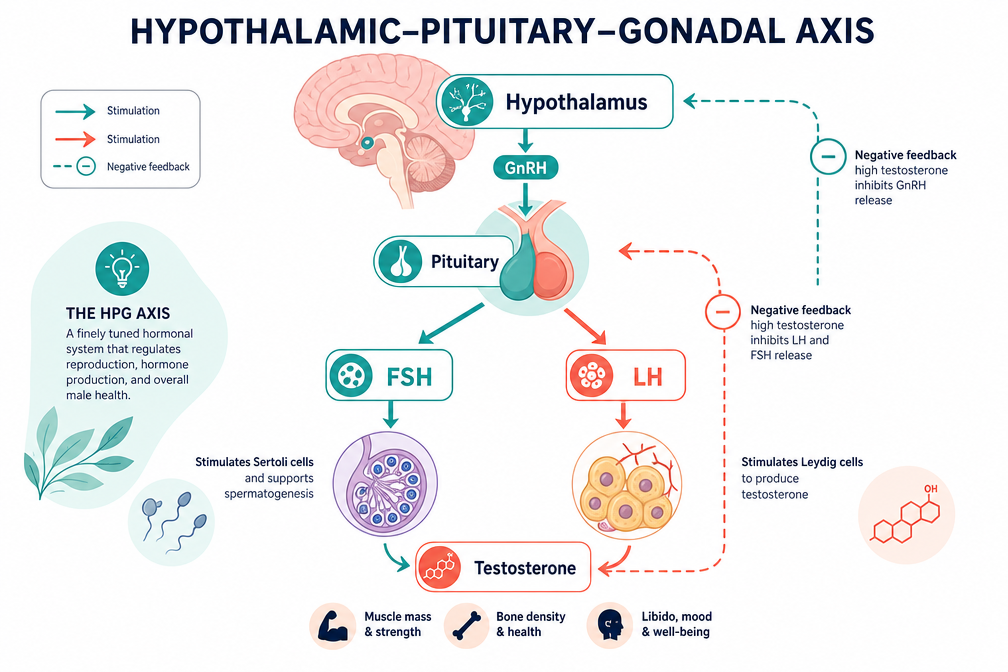
Enclomiphene acts as a competitive antagonist at estrogen receptors in the hypothalamus. When estrogen receptors in this region are blocked, the hypothalamus interprets the signal as low circulating estrogen. It responds by releasing more gonadotropin-releasing hormone (GnRH), which then stimulates the pituitary gland to secrete luteinizing hormone (LH) and follicle-stimulating hormone (FSH).
This upstream effect is what separates enclomiphene from direct androgen therapies. Rather than supplying testosterone externally, it restores the signaling chain that produces testosterone endogenously. For researchers studying the hypothalamic-pituitary-gonadal (HPG) axis, this makes enclomiphene a valuable tool for observing how estrogen receptor blockade translates into downstream hormonal change.
Key receptor-level distinctions:
- Enclomiphene binds estrogen receptor alpha (ERa) with high affinity in hypothalamic tissue
- It does not carry the residual estrogenic agonist activity seen in its sister isomer, zuclomiphene
- A 2022 computational study using fragment molecular orbital calculations confirmed that ligand-receptor complementarity at ERa is highly sensitive to isomeric configuration, a finding directly relevant to enclomiphene's clean antagonist profile
For researchers exploring related receptor modulation pathways, serm-based research compounds offer a useful comparative reference point.
Enclomiphene and Estrogen Receptor Signaling in Research: How It Compares With serm-Based Hormone Studies
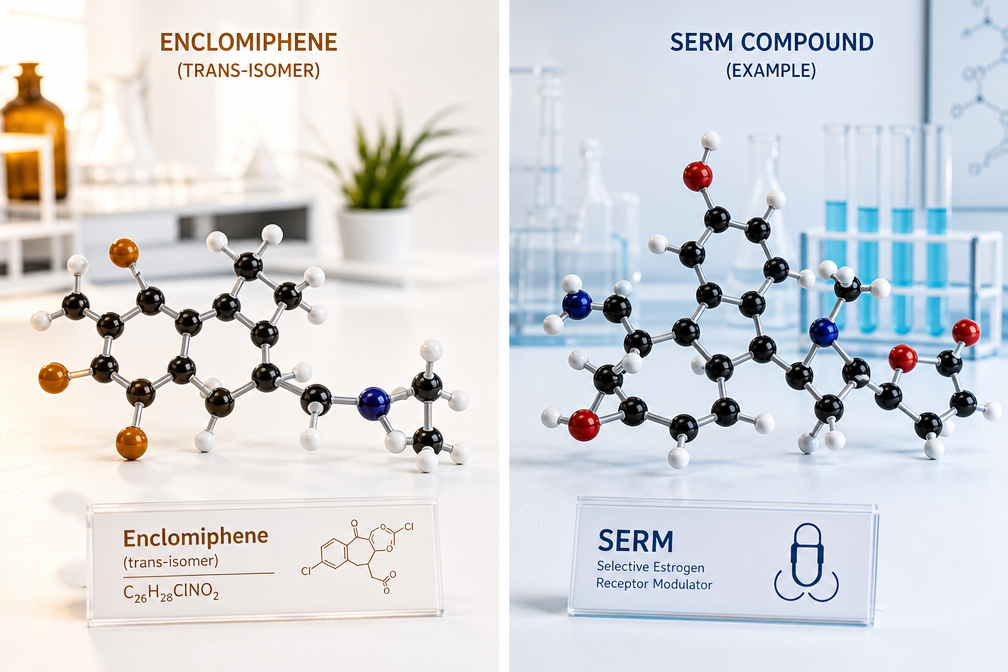
The broader serm category includes compounds like tamoxifen, raloxifene, and toremifene, each with different tissue selectivity profiles. What makes enclomiphene stand out in this landscape is its isomeric purity and its specific action on the HPG axis rather than peripheral estrogen-sensitive tissues.
Comparison Across Key Research Parameters
| Parameter | Enclomiphene | Mixed Clomiphene | Tamoxifen |
|---|---|---|---|
| Receptor action | Pure antagonist (hypothalamus) | Mixed agonist/antagonist | Tissue-selective mixed |
| HPG axis activation | Strong LH/FSH increase | Moderate | Minimal |
| Estrogenic side effects | Low | Moderate | Variable |
| Spermatogenesis impact | Preserved | Partially preserved | Not studied for this |
| Half-life | 10-15 hours | 5-7 days (zuclomiphene) | 5-7 days |
In a 2016 clinical study, enclomiphene citrate raised serum testosterone in men with secondary hypogonadism while keeping sperm concentrations within normal ranges. This contrasts sharply with topical testosterone replacement, which suppresses spermatogenesis by shutting down the HPG axis feedback loop entirely.
From a pure research standpoint, this distinction matters. Enclomiphene allows investigators to model testosterone elevation without disrupting the gonadotropin signal, something no exogenous androgen can replicate.
"Enclomiphene's value in receptor research lies not in what it adds to the system, but in what it allows the system to do on its own."
Researchers interested in multi-pathway hormonal signaling may also find value in reviewing longevity peptide research themes and IPA as a GHRH secretagogue, which explore adjacent endocrine signaling mechanisms.
Regulatory Context and the Ongoing Research Landscape in 2026

Enclomiphene completed Phase III clinical trials and demonstrated strong efficacy data, yet it has not received FDA approval as a standalone therapeutic. As of 2026, it remains an active subject in research settings focused on male hypogonadism, fertility preservation, and serm receptor pharmacology.
Early antitumor research from the 1980s first identified enclomiphene's estrogen receptor affinity, noting its potential in vitro against certain estrogen-dependent cell lines. That foundational work laid the groundwork for the more targeted HPG axis studies that followed decades later.
What current research continues to examine:
- Dose-response relationships between enclomiphene and LH/FSH output
- Long-term receptor desensitization at hypothalamic ERa sites
- Comparative receptor occupancy versus newer generation serms
- Interaction effects when combined with metabolic or peptide-based research compounds
For researchers working across broader hormonal and metabolic frameworks, related reading on GIP receptor importance, GLP-1 peptide generational research, and NAD+ energetics and longevity provides useful context on how endocrine signaling intersects with metabolic research themes.
Additionally, researchers studying tissue repair and systemic signaling may find BPC-157 research themes and PT-141 neural metabolic research relevant when designing multi-system research protocols.
Conclusion
The study of enclomiphene and estrogen receptor signaling in research: how it compares with serm-based hormone studies highlights a compound that earns its place in receptor pharmacology through precision rather than broad activity. Its isomeric purity, short half-life, and clean hypothalamic antagonism make it a more tractable research tool than mixed clomiphene or classical serms when the goal is to isolate HPG axis dynamics.
Actionable next steps for researchers:
- Review published LH/FSH dose-response data before designing enclomiphene-based protocols
- Compare receptor binding affinity data across ERa ligands using computational models as a pre-screening step
- Consider enclomiphene as a positive control in serm comparison studies focused on hypothalamic signaling
- Evaluate its spermatogenesis-preserving profile against exogenous androgen models when fertility endpoints are relevant
- Cross-reference findings with adjacent endocrine and metabolic research to build a more complete picture of HPG axis behavior
Leave a Reply
Want to join the discussion?Feel free to contribute!