

Fewer than 5% of men diagnosed with secondary hypogonadism are offered alternatives to exogenous testosterone replacement, yet enclomiphene, a single stereoisomer of clomiphene, has drawn sustained attention in research circles precisely because it targets the same estrogen receptor signaling axis that endocrinologists have studied for decades. Understanding estrogen receptor signaling and enclomiphene: linking classic endocrine pharmacology to modern serm research models requires tracing a path from foundational receptor biology to today's selective estrogen receptor modulator (serm) science.
Key Takeaways
- Enclomiphene is the trans-isomer of clomiphene and acts as an estrogen receptor antagonist at the hypothalamic-pituitary level.
- By blocking estrogen negative feedback, enclomiphene stimulates LH and FSH release, which in turn supports endogenous testosterone production.
- Legacy serms such as tamoxifen and raloxifene established the receptor-binding framework that modern enclomiphene research builds upon.
- Tissue-selective receptor modulation distinguishes serms from both full agonists and pure antagonists.
- Enclomiphene research fits within a broader landscape of endocrine-modulating compounds studied alongside peptide-based secretagogues and metabolic agents.
How Estrogen Receptor Signaling Governs the HPG Axis
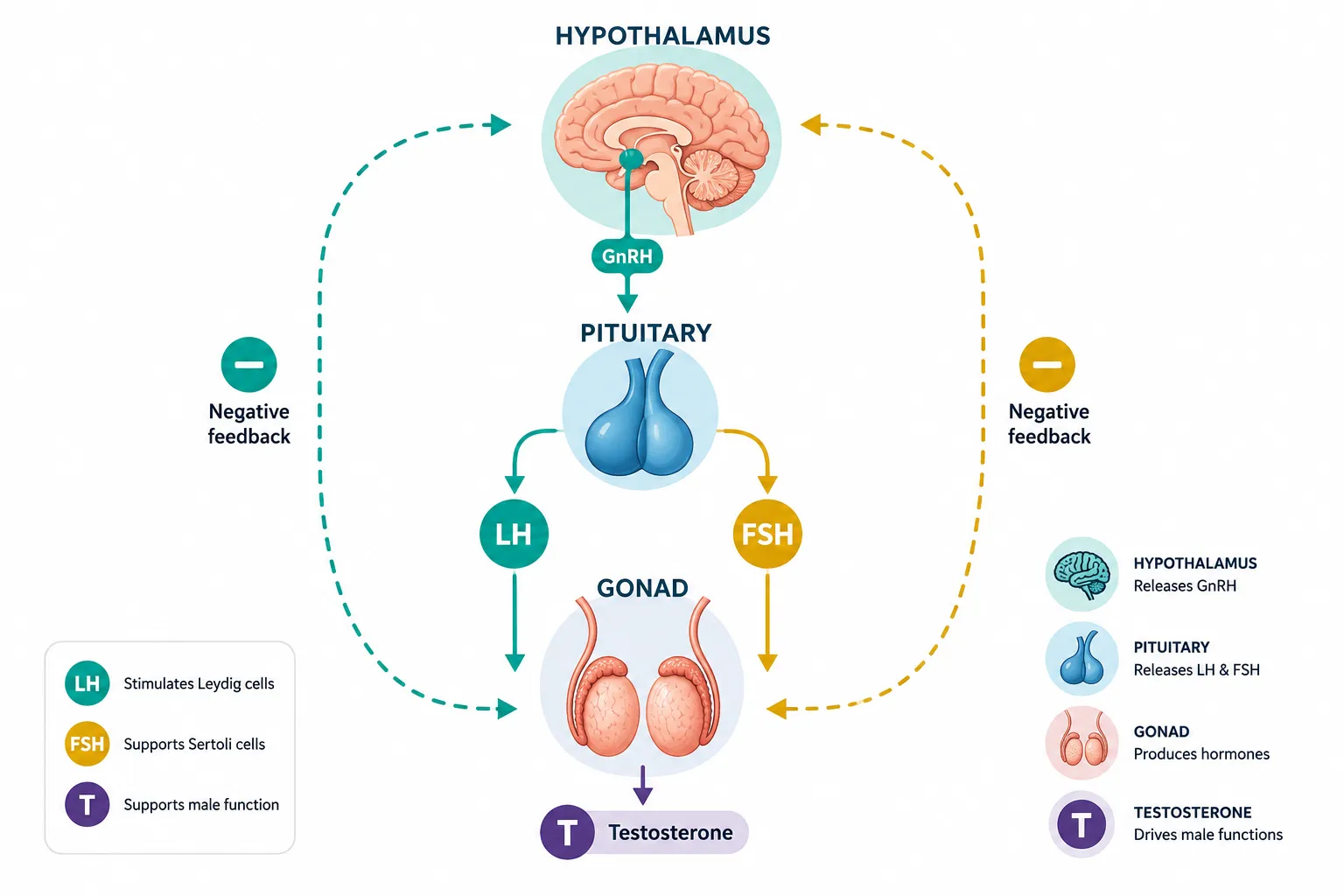
The hypothalamic-pituitary-gonadal (HPG) axis operates through a tightly regulated feedback loop. The hypothalamus releases gonadotropin-releasing hormone (GnRH), which prompts the anterior pituitary to secrete luteinizing hormone (LH) and follicle-stimulating hormone (FSH). These gonadotropins then stimulate gonadal steroidogenesis, testosterone production in males, estradiol and progesterone in females.
Estrogen receptor alpha (ERα) plays a central role in this loop. When circulating estradiol binds ERα at hypothalamic neurons, it suppresses GnRH pulse frequency, reducing downstream LH and FSH. This negative feedback is the primary target of serm pharmacology.
Key receptor-level concepts researchers track:
- Ligand-binding domain (LBD) conformation, determines whether a compound acts as agonist or antagonist
- Coactivator vs. corepressor recruitment, drives tissue-specific gene transcription
- ERα vs. ERβ selectivity, explains differential effects across bone, breast, uterine, and neural tissue
This framework, established through decades of tamoxifen and raloxifene research, is the same scaffold used when evaluating enclomiphene in preclinical and clinical models. Researchers exploring related neuroendocrine and innate immunity pathways will recognize how tightly hormonal and immune signaling are intertwined at the receptor level.
Legacy serms vs. Enclomiphene: A Pharmacological Contrast

Tamoxifen, introduced in the 1970s, was the first clinically significant serm. Raloxifene followed, offering improved bone and cardiovascular profiles. Clomiphene citrate, a racemic mixture of zuclomiphene (cis) and enclomiphene (trans), became standard for ovulation induction.
"Enclomiphene's pharmacological advantage lies in its shorter half-life and cleaner receptor profile compared to the racemic parent compound."
The table below summarizes key distinctions:
| Compound | Primary Target | Half-Life | Key Research Use |
|---|---|---|---|
| Tamoxifen | ERα (breast) | ~5-7 days | Oncology models |
| Raloxifene | ERα/ERβ (bone) | ~28 hours | Osteoporosis research |
| Clomiphene (racemic) | Hypothalamic ERα | ~5-7 days | Ovulation induction |
| Enclomiphene | Hypothalamic ERα | ~10 hours | Male HPG axis research |
Enclomiphene's shorter half-life reduces receptor occupancy duration, which researchers hypothesize may lower the risk of prolonged estrogenic side effects seen with zuclomiphene accumulation. Those studying IPA serm stack research will find this receptor-selectivity distinction directly relevant to how serms are combined with growth hormone secretagogues in research protocols.
Enclomiphene in Modern serm Research Models

Modern research into estrogen receptor signaling and enclomiphene: linking classic endocrine pharmacology to modern serm research models has moved beyond simple agonist/antagonist labeling. Current models examine:
- Pulse dynamics, how enclomiphene alters GnRH pulse frequency in ex-vivo hypothalamic preparations
- Receptor occupancy kinetics, binding affinity data compared to endogenous estradiol
- Downstream steroidogenesis, LH-driven Leydig cell testosterone output in preclinical models
- Metabolic co-effects, interactions with insulin sensitivity and lipid metabolism markers
This last point connects enclomiphene research to a wider metabolic research landscape. Investigators studying metabolic modulation research lines or AOD-9604 metabolic research often encounter overlapping endpoints, since testosterone and growth hormone axes share downstream metabolic effectors.
Enclomiphene is also being contrasted with small-molecule approaches, including statins, which modestly influence testosterone biosynthesis through cholesterol substrate effects, to isolate receptor-mediated from substrate-mediated hormonal changes. This distinction matters when designing clean research models.
For researchers sourcing reference-grade compounds, the serm 10mg research compound page provides purity and specification data relevant to in-vitro and preclinical study design.
Broader endocrine research often pairs serm compounds with secretagogue stacks. The IPA sermorelin stack research context illustrates how HPG-axis and GH-axis modulation are studied in parallel, since both systems converge on body composition and metabolic outcomes. Similarly, longevity peptide research increasingly incorporates hormonal axis optimization as a foundational variable.
Conclusion
Estrogen receptor signaling and enclomiphene: linking classic endocrine pharmacology to modern serm research models is not a niche academic exercise, it is a convergence point for reproductive endocrinology, metabolic biology, and precision pharmacology. Researchers in 2026 have access to a far richer mechanistic toolkit than the tamoxifen era provided.
Actionable next steps for researchers:
- Map ERα and ERβ expression profiles in target tissues before designing serm intervention studies
- Use enclomiphene's short half-life as a variable to study pulse-dependent vs. tonic receptor occupancy effects
- Compare HPG-axis outcomes alongside metabolic markers to capture full-system responses
- Review compound purity documentation carefully, as stereoisomer contamination confounds receptor-binding data
- Consider pairing serm research with secretagogue or metabolic peptide protocols to capture cross-axis interactions
The field is moving rapidly. Grounding new enclomiphene research in the deep literature of estrogen receptor pharmacology ensures that modern findings build on, rather than repeat, the foundational work that made serm science possible.
Leave a Reply
Want to join the discussion?Feel free to contribute!