

Every time a human cell divides, its chromosomes lose a small fragment from their protective ends. After enough divisions, those ends, called telomeres, erode to a critical threshold, triggering cellular senescence or death. This biological clock ticks inside every tissue, and slowing it has become one of the most active frontiers in longevity research. The study of DNA, Telomeres, and Epithalon: How Longevity-Focused Peptides Interface With Genomic Stability in Research Models sits at the center of that frontier, asking whether short synthetic peptides can meaningfully alter genomic aging trajectories in controlled experimental settings.
Key Takeaways
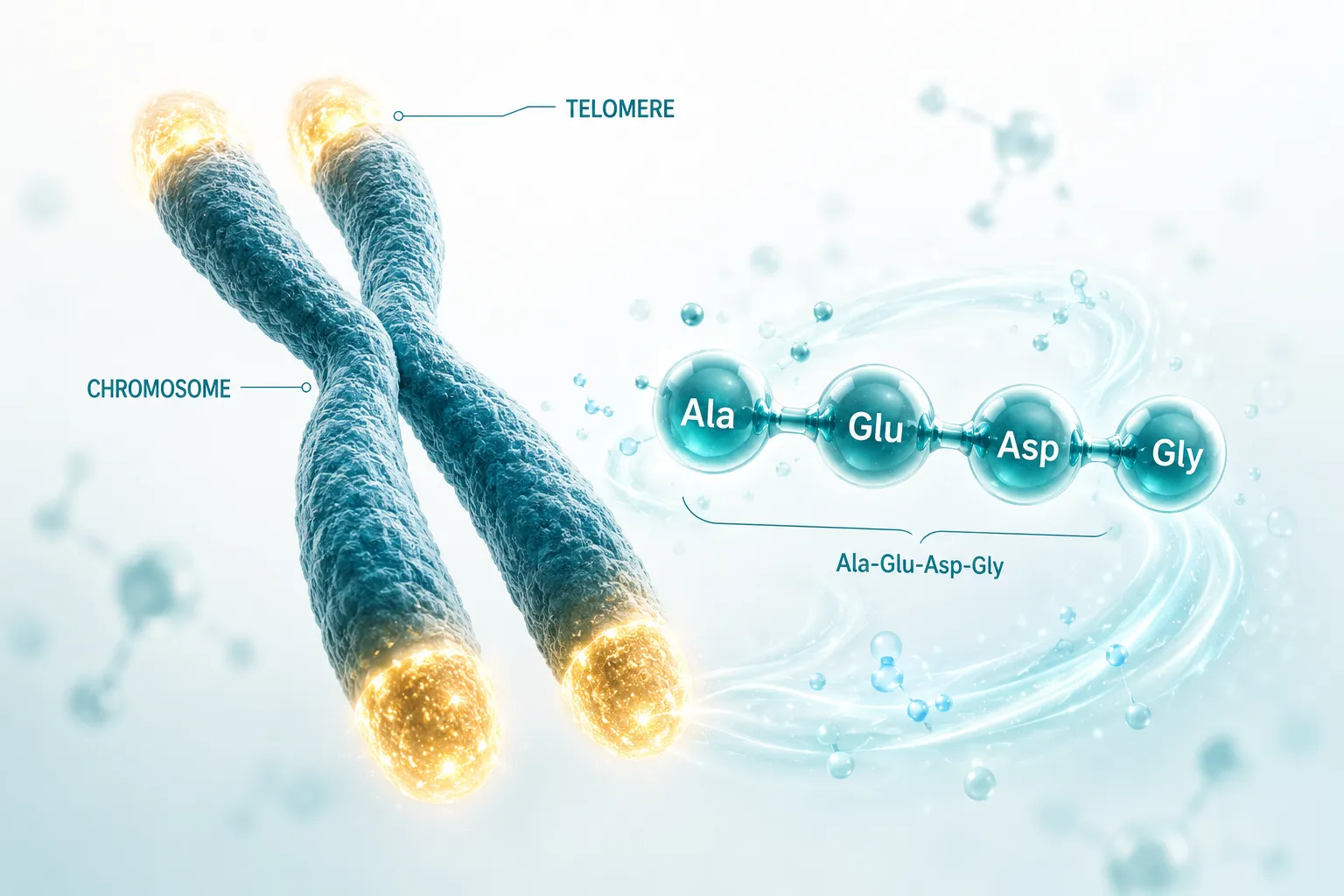
- Epithalon is a synthetic tetrapeptide (Ala-Glu-Asp-Gly) that has been shown in research models to activate telomerase and promote telomere elongation in human cell lines.
- Normal cells and cancer cells appear to use different telomere-lengthening pathways when exposed to Epithalon, suggesting cell-type-specific mechanisms.
- MOTS-c, a mitochondria-derived peptide, complements Epithalon research by targeting nuclear gene expression and DNA repair signaling rather than telomerase directly.
- Preclinical rodent studies report a 10-25% increase in median lifespan with Epithalon, though human evidence remains observational and limited.
- As of 2026, Epithalon is not FDA-approved and is restricted to research use only; independent replication of findings is still needed.
The Molecular Architecture of Telomere Biology and Epithalon
Telomeres are repetitive nucleotide sequences (TTAGGG in humans) that cap chromosome ends, preventing degradation and illegitimate recombination. The enzyme telomerase, specifically its catalytic subunit hTERT, rebuilds these sequences after division. In most somatic cells, telomerase activity is low or absent, which means telomeres shorten with each replication cycle.
Epithalon enters this picture as a four-amino-acid chain (alanine-glutamic acid-aspartic acid-glycine) that mimics a peptide naturally produced by the pineal gland. Research published in 2025 demonstrated that Epithalon induces measurable telomerase activity in human cell lines, including upregulation of hTERT mRNA expression. The result was documented telomere elongation, a finding that directly links a short peptide to one of the most studied molecular clocks in biology.
A particularly notable detail from that same research: the mechanism differed by cell type. In normal human cells, Epithalon promoted telomere extension through telomerase activation. In cancer cell lines, elongation occurred instead via the Alternative Lengthening of Telomeres (ALT) pathway, a recombination-based mechanism that bypasses telomerase entirely. This distinction matters enormously for research design, since it implies Epithalon does not simply amplify telomerase indiscriminately.
For researchers exploring Epithalon's research profile and sourcing, understanding this cell-type specificity is essential context when designing experimental protocols.
Key structural fact: Epithalon's tetrapeptide sequence is small enough to cross cellular membranes with relative ease, which may explain its ability to influence nuclear gene expression, including hTERT transcription.
How DNA, Telomeres, and Epithalon Research Extends Into Broader Genomic Pathways
The study of DNA, Telomeres, and Epithalon: How Longevity-Focused Peptides Interface With Genomic Stability in Research Models does not stop at telomerase. Genomic stability involves a wider network: base-excision repair, double-strand break repair, chromatin remodeling, and the regulation of age-related gene expression. Several longevity-focused peptides are now being studied for their roles across these overlapping systems.
MOTS-c is a prime example. Encoded within mitochondrial DNA, this peptide translocates to the nucleus under metabolic stress and directly modulates nuclear gene expression. Research on MOTS-c mitochondrial and metabolic research themes shows it activates AMPK pathways and influences the expression of genes tied to oxidative stress response and DNA damage repair, functions that are complementary to, rather than redundant with, Epithalon's telomerase-focused action.
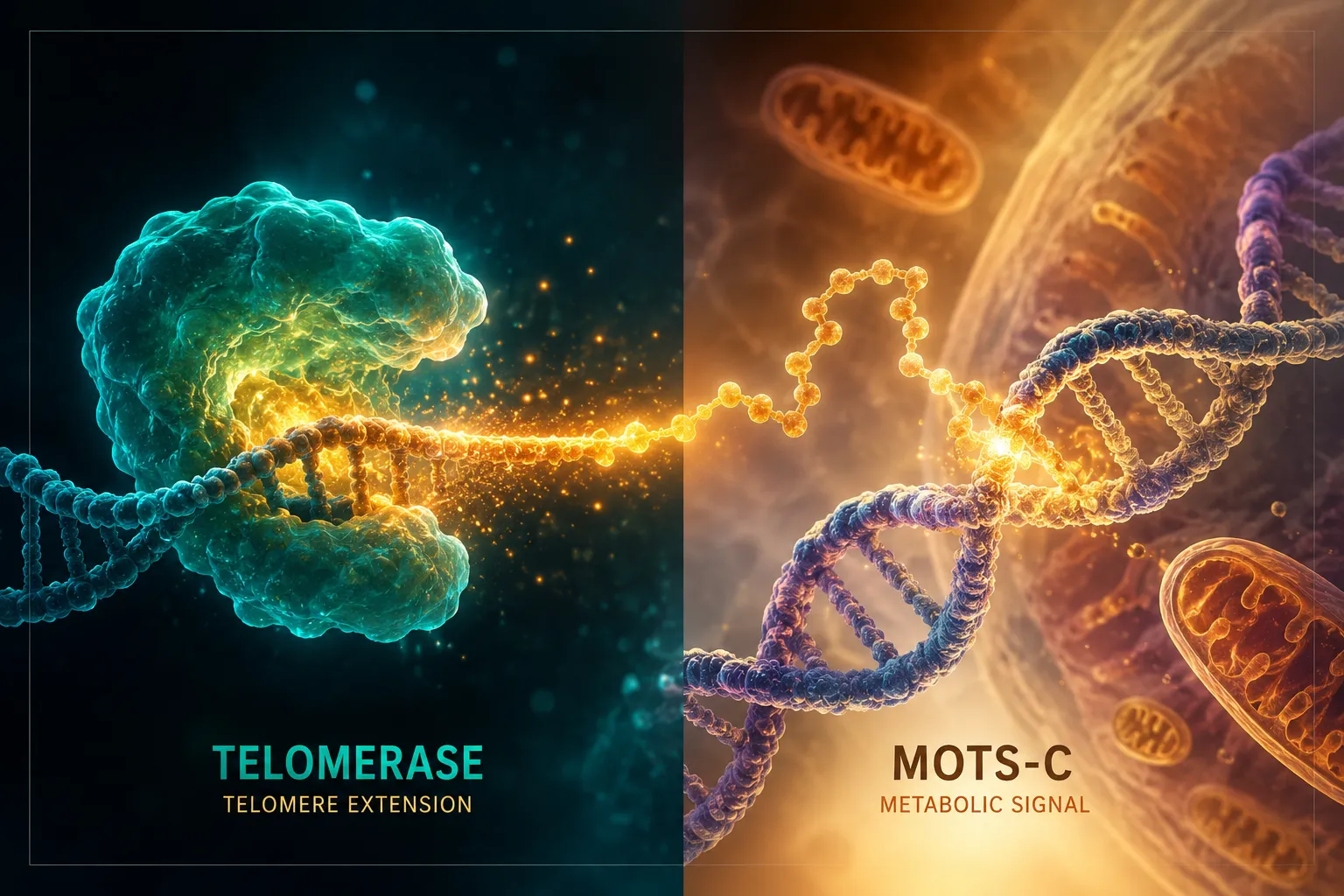
This distinction is worth mapping clearly:
| Peptide | Primary Genomic Target | Key Pathway |
|---|---|---|
| Epithalon | Telomere length / hTERT | Telomerase activation, ALT |
| MOTS-c | Nuclear gene expression | AMPK, oxidative stress response |
| GHK-Cu | DNA repair gene upregulation | Chromatin remodeling |
GHK-Cu, a copper-binding tripeptide, has been studied for its ability to upregulate genes involved in DNA repair and antioxidant defense. Researchers interested in this angle can explore GHK-Cu peptide research and sourcing for additional context on its genomic activity.
By contrast, SS-31 (Elamipretide) focuses primarily on mitochondrial membrane integrity rather than nuclear DNA. The SS-31 mechanism and research overview provides a useful comparison point: SS-31 has undergone more extensive clinical trials and received FDA approval for certain conditions, illustrating the disparity in evidence depth between peptides targeting mitochondria versus those targeting telomeres.
Evidence Quality, Limitations, and Research Outlook in 2026
Preclinical data on Epithalon includes rodent lifespan studies reporting a 10-25% increase in median survival with administration. Observational studies in elderly human subjects have noted improvements in melatonin secretion and antioxidant biomarkers. Epithalon may also modulate circadian rhythms through its influence on the pineal gland axis, with downstream effects on sleep regulation and systemic inflammatory tone.
However, the evidence base carries significant caveats:
- Single-source concentration: A substantial portion of Epithalon research originates from one research group, raising reproducibility concerns.
- Non-randomized human data: Observational studies lack control groups, limiting causal inference.
- Regulatory status: As of 2026, Epithalon holds no FDA approval for any medical indication and is classified for research use only, with noted immunogenicity considerations.
Experts consistently call for independent, large-scale randomized controlled trials before any clinical conclusions can be drawn.
For researchers building broader longevity-focused protocols, mitochondrial longevity research themes and MOTS-c research data offer complementary genomic angles. Those examining thymic and immune-aging connections may also find Thymalin thymus bioregulation research relevant to the wider genomic stability picture.

"The most rigorous research programs treat Epithalon not as a standalone answer but as one variable within a multi-pathway model of genomic aging."
Conclusion
The intersection of DNA, Telomeres, and Epithalon: How Longevity-Focused Peptides Interface With Genomic Stability in Research Models represents one of the most scientifically layered areas in current peptide research. Epithalon's documented ability to activate telomerase in normal human cells, while engaging the ALT pathway in cancer cells, signals a degree of mechanistic sophistication that warrants serious continued investigation. When placed alongside MOTS-c's nuclear gene regulation and GHK-Cu's DNA repair activity, a picture emerges of peptides operating across complementary genomic nodes rather than a single target.
Actionable next steps for researchers:
- Design cell-type-specific assays that distinguish telomerase-dependent from ALT-dependent telomere changes.
- Pair Epithalon studies with MOTS-c protocols to assess whether mitochondrial and telomere pathways show additive effects on genomic stability markers.
- Prioritize sourcing from lab-tested, verified peptide suppliers to ensure compound purity in experimental models.
- Track hTERT mRNA expression as a primary endpoint alongside telomere length measurements.
- Monitor the independent replication literature closely, as 2026 is an active year for longevity peptide research publication.
Leave a Reply
Want to join the discussion?Feel free to contribute!