Call or Text 727-513-9780
  • Shopping Cart Shopping Cart
    0Shopping Cart
Pure Tested Peptides | America's most trusted Peptides for sale online
  • Peptides for sale
    • Oral Peptides for sale
      • Peptide Capsules for sale
      • BPC 157 Capsules 1000mcg
      • SLU-PP-332 Capsules | 1000 mcg
      • 5-Amino-1MQ 50mg Capsules
      • Tesofensine 500mcg
    • All Peptides for sale
    • Peptide Sprays
      • BPC 157 Nasal Spray Kit
      • BPC-157 TB500 Nasal Spray Kit
      • Semax Nasal Spray 10mg
      • Selank – Nasal Spray Kit – 10mg
      • Epithalon 50MG Nasal Spray Kit
      • Ipamorelin 10mg Nasal Spray
      • Klow Nasal Spray (BPC-157 + TB-500 + GHK-Cu + KPV) | 80mg
      • Hulk Nasal Spray Tesa / Ipa Blend 6/3 MG
      • Klow Nasal Spray
      • NAD + 500 mg Nasal Spray
      • PT-141 Nasal Spray Kit
    • GHRH Peptides
      • Ipa Peptides
      • CJC-1295 Peptides
        • CJC-1295 with DAC 5 mg
        • CJC-1295 without DAC 5 mg
        • CJC-1295 Ipa 10mg
      • Tesa Peptides
        • Tesa Peptide
        • Tesa 20 mg
    • GHK-Cu Peptides
      • All GHK-Cu Peptides
      • GHK-Cu 100mg
      • KLOW Peptide Blend – Buy KLOW blend online
    • BPC Peptides
      • All BPC Peptides
      • BPC-157
      • BPC-157 TB-500
      • BPC 157 capsules 1000mcg
    • SLU-PP-332 Peptides
      • All SLU-PP-332 Peptides
      • SLU-PP-332 5mg
    • GLP3 Peptides
      • GLP3-R
      • GLP3-R CAG 10mg
      • GLP3-R 20mg
    • PT-141 Peptides
      • PT-141 Peptides for sale
      • PT-141 10mg
      • PT-141 Nasal Spray
    • CAG Peptides
      • Lipo-C Peptide Blend
      • CAG 5mg
      • CAG 10mg
    • MOTS-C Peptides
      • MOTS-C Peptides for sale
      • MOTS-c peptide
      • MOTS-c 10mg *6 pack*
    • 5 Amino 1MQ Peptides
      • 5 Amino 1MQ Peptides for sale
      • 5-Amino-1MQ 50mg Capsules
      • 5-Amino-1MQ 5mg
    • Epithalon Peptides
      • Epithalon Peptides for sale
      • Epithalon 10mg
      • Epithalon 50mg
  • Shop
    • GLPs
      • 5-Amino-1MQ 50mg Capsules
      • 5-Amino-1MQ 5mg
      • GLP3-Reta
      • L-Carnitine 500mg/ml
      • Tesofensine 500mcg
      • SLU-PP-332 5mg
      • MOTS-c 10mg *6 pack*
    • Epithalon & BPC Peptides
      • Epithalon 10mg
      • Epithalon 50mg
      • BPC-157
      • BPC 157 capsules 1000mcg
      • BPC-157 TB-500
      • BPC-157 TB500 Nasal Spray Kit
      • BPC 157 Nasal Spray Kit
    • BPC TB-500 & NAD+ Peptides
      • NAD+ 500 mg
      • KLOW Peptide Blend – Buy KLOW blend online
      • GLOW Peptide Blend
      • TB 500 5mg
      • BPC 157 capsules 1000mcg – Supplement
      • BPC 157 Nasal Spray Kit
      • BPC-157
      • BPC-157 TB500 Nasal Spray Kit
      • BPC-157 TB-500
      • BPC 157 capsules 1000mcg
    • LL-37 Peptide
      • LL-37 10 mg
    • MOTS-C & Selank
      • MOTS-c peptide
      • Selank 10mg
    • GHK Peptides
      • GHK-Cu 100mg
      • GLOW Peptide Blend
      • KLOW Peptide Blend – Buy KLOW blend online
  • COAs
  • Wholesale
    • Wholesale Peptides for sale
  • PTP FAQ
  • Affiliates
    • Selank Peptide: Advanced Pharmacological Mechanisms Underlying Its Anxiolytic and Nootropic Effects in Research
      • 5-Amino-1MQ Peptide: Detailed Mechanisms of NNMT Inhibition and Its Impact on Cellular Metabolism Research
        • MOTS-C Peptide: Unraveling Its Role in Mitochondrial Dynamics and Energy Metabolism Research
          • Epithalon Peptide and Telomerase Regulation: Investigating Its Impact on Cellular Senescence and Lifespan Research Models
            • GLP2-T vs GLP2 Tirz Peptide: Understanding the Naming, Mechanistic Nuances, and Research Implications for Gut Health
      • Peptides and Polypeptides in Modern Pharmacology: What Research on Metoprolol, Prednisone, and Amlodipine Reveals
        • Polypeptide Peptides vs NSAIDs: What Naproxen and Diclofenac Teach Tissue-Repair Researchers About BPC‑157 and TB‑500
          • Peptides and Polypeptides in Endocrine Pharmacology: How GLP-1, GLP-2, and GLP-3 Retatrutide Differ From Classic Drugs Like Prednisone and Amlodipine
          • 5‑Amino‑1MQ Peptide and NNMT Inhibition: How It Compares With Statins Like Atorvastatin in Adipose and Lipid Metabolism Research
      • Enclomiphene, Estrogen Receptor Signaling, and Luteinizing Phase Biology: What Hormone Researchers Should Measure
        • Mesenchymal Stem Cells, BPC‑157, and GHK‑Cu: How Tissue Repair Peptides Compare With Classic NSAIDs Like Naproxen in Injury Models
          • Peptide Calculator Use Cases Beyond Growth Hormone: Working Through GLP‑3 Retatrutide, MOTS‑c, and BPC‑157 Research Dosing
        • Polypeptide Peptides in Endocrine and Metabolic Pharmacology: Lessons From Amlodipine, Prednisone, and Metoprolol
        • Peptides Calculator for Advanced Blends: Worked Examples for Tesamorelin, CJC‑1295, and Ipamorelin Stacks
          • Peptides and Polypeptides in Human Physiology: How Molecular Size Shapes Research Applications
            • Selank Peptide: Advanced Pharmacological Mechanisms Underlying Its Anxiolytic and Nootropic Effects in Research
          • 5-Amino-1MQ Peptide: Detailed Mechanisms of NNMT Inhibition and Its Impact on Cellular Metabolism Research
            • MOTS-C Peptide: Unraveling Its Role in Mitochondrial Dynamics and Energy Metabolism Research
              • Epithalon Peptide and Telomerase Regulation: Investigating Its Impact on Cellular Senescence and Lifespan Research Models
                • GLP2-T vs GLP2 Tirz Peptide: Understanding the Naming, Mechanistic Nuances, and Research Implications for Gut Health
                  • Peptides and Polypeptides in Endocrine Pharmacology: How GLP-1, GLP-2, and GLP-3 Retatrutide Differ From Classic Drugs Like Prednisone and Amlodipine
                    • Polypeptide Peptides vs NSAIDs: What Naproxen and Diclofenac Teach Tissue-Repair Researchers About BPC‑157 and TB‑500
                      • Peptides and Polypeptides in Modern Pharmacology: What Research on Metoprolol, Prednisone, and Amlodipine Reveals
                        • 5‑Amino‑1MQ Peptide and NNMT Inhibition: How It Compares With Statins Like Atorvastatin in Adipose and Lipid Metabolism Research
                        • Enclomiphene, Estrogen Receptor Signaling, and Luteinizing Phase Biology: What Hormone Researchers Should Measure
                        • Mesenchymal Stem Cells, BPC‑157, and GHK‑Cu: How Tissue Repair Peptides Compare With Classic NSAIDs Like Naproxen in Injury Models
                        • Peptide Calculator Use Cases Beyond Growth Hormone: Working Through GLP‑3 Retatrutide, MOTS‑c, and BPC‑157 Research Dosing
                        • Polypeptide Peptides in Endocrine and Metabolic Pharmacology: Lessons From Amlodipine, Prednisone, and Metoprolol
                        • Peptides Calculator for Advanced Blends: Worked Examples for Tesamorelin, CJC‑1295, and Ipamorelin Stacks
                        • Peptides and Polypeptides in Human Physiology: How Molecular Size Shapes Research Applications
                        • Selank Peptide: Advanced Pharmacological Mechanisms Underlying Its Anxiolytic and Nootropic Effects in Research
                        • MOTS-C Peptide: Unraveling Its Role in Mitochondrial Dynamics and Energy Metabolism Research
                        • Peptides and Polypeptides in Modern Pharmacology: What Research on Metoprolol, Prednisone, and Amlodipine Reveals
                        • Peptides and Polypeptides in Endocrine Pharmacology: How GLP-1, GLP-2, and GLP-3 Retatrutide Differ From Classic Drugs Like Prednisone and Amlodipine
                        • 5-Amino-1MQ Peptide: Detailed Mechanisms of NNMT Inhibition and Its Impact on Cellular Metabolism Research
                        • Mesenchymal Stem Cells, BPC‑157, and GHK‑Cu: How Tissue Repair Peptides Compare With Classic NSAIDs Like Naproxen in Injury Models
                        • Peptide Calculator Use Cases Beyond Growth Hormone: Working Through GLP‑3 Retatrutide, MOTS‑c, and BPC‑157 Research Dosing
                        • GLP2-T vs GLP2 Tirz Peptide: Understanding the Naming, Mechanistic Nuances, and Research Implications for Gut Health
                        • Polypeptide Peptides in Endocrine and Metabolic Pharmacology: Lessons From Amlodipine, Prednisone, and Metoprolol
                        • Polypeptide Peptides vs NSAIDs: What Naproxen and Diclofenac Teach Tissue-Repair Researchers About BPC‑157 and TB‑500
                        • Peptides and Polypeptides in Human Physiology: How Molecular Size Shapes Research Applications
                        • Peptides Calculator for Advanced Blends: Worked Examples for Tesamorelin, CJC‑1295, and Ipamorelin Stacks
                        • 5‑Amino‑1MQ Peptide and NNMT Inhibition: How It Compares With Statins Like Atorvastatin in Adipose and Lipid Metabolism Research
                        • Enclomiphene, Estrogen Receptor Signaling, and Luteinizing Phase Biology: What Hormone Researchers Should Measure
                        • Epithalon Peptide and Telomerase Regulation: Investigating Its Impact on Cellular Senescence and Lifespan Research Models
                        • Best research protocol Klow blend
                        • best time to take BPC-157
                        • best time to take DSIP (Delta Sleep Inducing Peptide)
                        • best time to take CJC-1295
                        • best time to take AOD-9604
                        • best time to take Follistatin 344
                        • best time to take Ipamorelin
                        • best time to take MK-677 (Ibutamoren)
                        • best time to take Ligandrol (LGD-4033) — research compound
                        • best time to take Ostarine (MK-2866) — research compound
                        • best time to take GHK-CU
                        • best time to take TB-500
                        • best time to take MOTS-c
                        • best time to take Semax
                        • best time to take RAD-140 (Testolone) — research compound
                        • best time to take Thymosin Alpha-1
                        • best time to take PEG-MGF
                        • Biolife Plasma, Octapharma Plasma, and Research Peptides: How Plasma Donation Labs Differ From Peptide Suppliers
                        • best time to take YK-11 — research compound
                        • best time to take PT-141 (Bremelanotide)
                        • Best research protocol Klow blend
  • Contact
    • Contact Customer Service
    • Text Customer Support
  • About US
  • Shop all peptides
  • Affiliate Program
    • Affiliate Signup
  • Login / Register Login / Register Page Link Login / Register Page Link
  • Click to open the search input field Click to open the search input field Search
  • Menu Menu
Collagen Biology and Copper‑Binding Peptides: How GHK‑Cu, Glow Blend, and Klow Blend Interact with Skin and Connective Tissue

Collagen Biology and Copper‑Binding Peptides: How GHK‑Cu, Glow Blend, and Klow Blend Interact with Skin and Connective Tissue

July 24, 2026/0 Comments/in Uncategorized/by

Collagen accounts for roughly 30% of all protein in the human body, yet its production begins declining measurably after age 25, a structural shift that drives visible skin aging, slower wound closure, and reduced connective tissue resilience. Understanding the precise biochemistry behind this decline is the first step toward evaluating whether copper-binding peptides such as GHK-Cu, and formulated research blends like Glow and Klow, represent meaningful tools in tissue biology. This article on Collagen Biology and Copper-Binding Peptides: How GHK-Cu, Glow Blend, and Klow Blend Interact with Skin and Connective Tissue offers a rigorous, mechanistic overview grounded in current preclinical evidence.
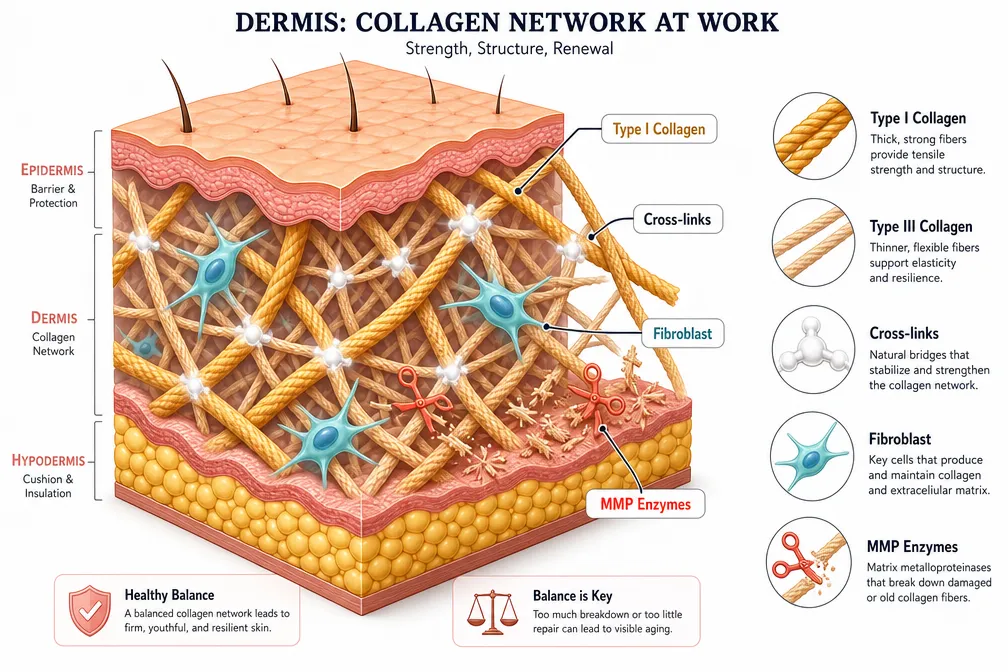
Isometric scientific illustration in bright daylight palette (): a 3D cross-section of human skin dermis showing collagen

Key Takeaways

  • Collagen synthesis, cross-linking, and enzymatic degradation form a tightly regulated cycle that copper-dependent enzymes help govern.
  • GHK-Cu (glycyl-L-histidyl-L-lysine copper) is a naturally occurring tripeptide that stimulates fibroblast activity and upregulates collagen gene expression in preclinical models.
  • Glow Blend combines GHK-Cu, BPC-157, and TB-500 to target skin remodeling and tissue repair through complementary mechanisms.
  • Klow Blend adds KPV, a tripeptide fragment of alpha-melanocyte-stimulating hormone, to address NF-kB-mediated inflammation alongside structural repair.
  • No controlled in vivo or human clinical trials have evaluated these blended formulations as complete combinations; all current evidence is extrapolated from individual peptide studies.

Collagen Biology: Synthesis, Cross-Linking, and Degradation

Collagen is not a single protein but a family of at least 28 distinct types, with Type I and Type III dominating the dermis and connective tissue. Each collagen molecule begins as a procollagen precursor inside fibroblast cells. Vitamin C-dependent hydroxylation of proline and lysine residues stabilizes the characteristic triple-helix structure before secretion into the extracellular matrix (ECM).

Once outside the cell, lysyl oxidase, a copper-dependent enzyme, catalyzes the cross-linking of collagen fibrils into tensile, load-bearing fibers. This step is critical: without adequate copper availability, cross-linking is incomplete, and the resulting matrix is structurally weaker.

Degradation is handled primarily by matrix metalloproteinases (MMPs), a family of zinc-dependent endopeptidases. MMP-1 (collagenase) cleaves the triple helix, while MMP-2 and MMP-9 degrade the resulting fragments. Chronic UV exposure, oxidative stress, and systemic inflammation all upregulate MMP activity, accelerating net collagen loss.

Process Key Enzyme Cofactor Required
Procollagen hydroxylation Prolyl hydroxylase Vitamin C, Fe2+
Fibril cross-linking Lysyl oxidase Copper
Collagen degradation MMP-1, MMP-2, MMP-9 Zinc

This enzymatic balance, synthesis versus degradation, is precisely where copper-binding peptides enter the mechanistic picture.

GHK-Cu and the Glow Blend: Mechanistic Interactions in Skin Remodeling
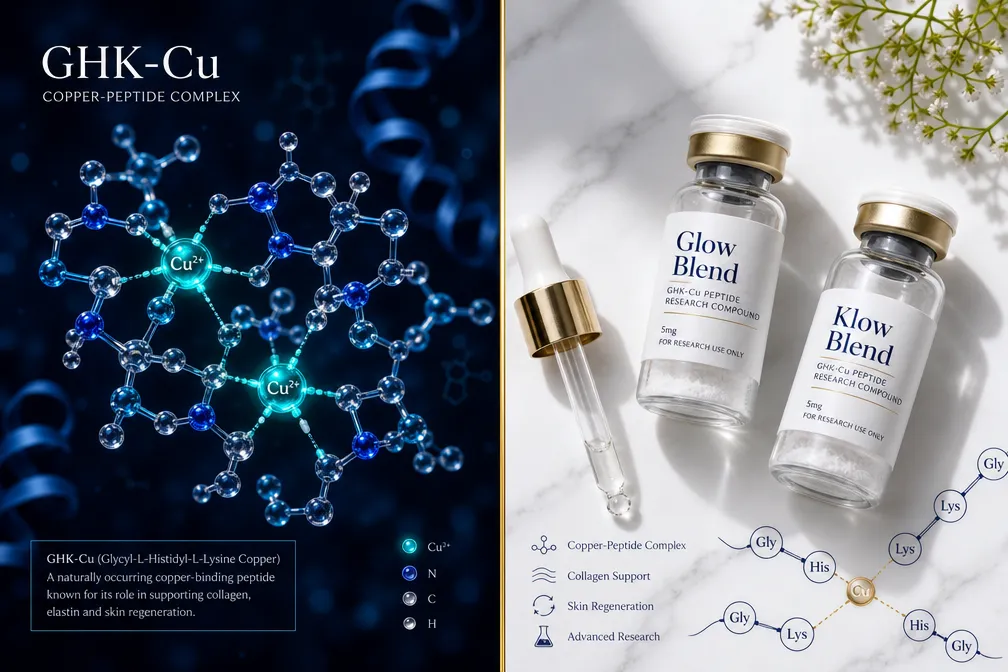
GHK-Cu and the Glow Blend: Mechanistic Interactions in Skin Remodeling

GHK-Cu (glycyl-L-histidyl-L-lysine copper) is a tripeptide found naturally in human plasma, saliva, and urine. Its plasma concentration is highest in youth and declines with age, paralleling the trajectory of collagen density. In preclinical models, GHK-Cu has demonstrated the ability to stimulate fibroblast proliferation, upregulate collagen and glycosaminoglycan synthesis, and simultaneously suppress MMP-1 expression, effectively nudging the synthesis-degradation balance toward net deposition.

Critically, GHK-Cu's molecular weight of approximately 340 daltons allows relatively efficient transdermal penetration compared to larger peptide molecules, though specialized delivery systems improve dermal bioavailability beyond standard aqueous serums. For researchers interested in this area, topical GHK-Cu formulations represent one studied delivery route.

The Glow Blend builds on GHK-Cu by combining it with two additional peptides:

  • BPC-157 (Body Protection Compound-157): A 15-amino-acid peptide derived from gastric juice proteins. In preclinical research, BPC-157 promotes angiogenesis, the formation of new blood vessels, and stabilizes connective tissue by modulating growth factor signaling. Relevant background on BPC-157 and angiogenesis in tendon models illustrates its tissue-repair profile.
  • TB-500 (Thymosin Beta-4 fragment): Enhances cellular migration by upregulating actin polymerization, accelerating the movement of keratinocytes and fibroblasts into wound sites.

The rationale for combining these three is mechanistic complementarity: GHK-Cu drives collagen gene expression, BPC-157 supports vascular supply to healing tissue, and TB-500 accelerates cell recruitment. However, it bears emphasis that no controlled studies have tested this specific combination as a unified formulation. Existing evidence is extrapolated from individual peptide research.

Formulation composition can also vary between vendors, including differences in peptide ratios and excipients, a variable that researchers should account for when reviewing the Glow Blend in any experimental design.

Klow Blend: Adding Anti-Inflammatory Depth to Collagen Biology and Copper-Binding Peptides

Klow Blend: Adding Anti-Inflammatory Depth to Collagen Biology and Copper-Binding Peptides

The Klow Blend extends the Glow Blend framework by incorporating KPV, a C-terminal tripeptide fragment (Lys-Pro-Val) derived from alpha-melanocyte-stimulating hormone (alpha-MSH). KPV's primary mechanism involves suppression of NF-kB, the master transcription factor governing pro-inflammatory cytokine production. By dampening NF-kB signaling, KPV reduces the inflammatory microenvironment that otherwise accelerates MMP activity and impairs fibroblast function.

This addition is biologically logical: chronic low-grade inflammation is one of the primary drivers of collagen degradation in aging skin. Addressing it alongside structural repair creates a dual-axis approach. For additional context on KPV's epithelial barrier research profile, see KPV and epithelial barrier research.

Klow Blend component summary:

  • GHK-Cu: Collagen synthesis stimulation, MMP suppression
  • BPC-157: Angiogenesis, tissue stabilization
  • TB-500: Cell migration, ECM remodeling
  • KPV: NF-kB inhibition, anti-inflammatory modulation

The broader peptide research landscape, including GHK-Cu longevity research themes, continues to explore how copper-binding peptides interact with aging pathways beyond skin alone, including mitochondrial function and systemic inflammation. Researchers exploring adjacent connective tissue peptides may also find the complete peptides for sale catalog useful for sourcing reference-grade compounds.

Regulatory context matters here: none of the peptides in either blend hold FDA approval for therapeutic use. Both Glow and Klow Blend are classified as research-use compounds, not intended for human consumption.

Conclusion

The science of collagen biology and copper-binding peptides reveals a sophisticated interplay between structural synthesis, enzymatic cross-linking, and regulated degradation, a cycle that GHK-Cu is mechanistically positioned to influence through fibroblast stimulation and MMP suppression. The Glow Blend and Klow Blend extend this foundation by layering in angiogenic, migratory, and anti-inflammatory peptide activity through BPC-157, TB-500, and KPV respectively.

Actionable next steps for researchers:

  1. Review individual peptide literature for GHK-Cu, BPC-157, TB-500, and KPV before evaluating blended formulations.
  2. Source research-grade compounds with verified purity documentation to ensure experimental validity.
  3. Design studies that isolate blend variables, including peptide ratios and delivery vehicles, to generate meaningful comparative data.
  4. Monitor emerging controlled trial data, as the field currently lacks in vivo human studies on these specific combinations.
  5. Consult the ultimate guide to peptide therapy research for broader context on peptide research frameworks.

The mechanistic promise is real. The evidentiary gap is equally real. Rigorous experimental design remains the bridge between the two.

Tags: bpc-157, collagen biology, collagen synthesis, connective tissue repair, copper-binding peptides, ghk-cu, glow blend, klow blend, kpv peptide, peptide research, skin remodeling, tb-500
https://www.puretestedpeptides.com/wp-content/uploads/2026/07/collagen-biology-and-copper-binding-peptides-how-ghk-cu-glow-blend-and-klow-blen.webp 672 1008 https://www.puretestedpeptides.com/wp-content/uploads/2026/01/buy-peptides-online.jpg 2026-07-24 13:05:212026-07-24 13:05:21Collagen Biology and Copper‑Binding Peptides: How GHK‑Cu, Glow Blend, and Klow Blend Interact with Skin and Connective Tissue
You might also like
Tesofensine Peptide Research: Mechanism, Appetite Suppression, and Neuropeptide Y Pathways Tesofensine Peptide Research: Mechanism, Appetite Suppression, and Neuropeptide Y Pathways
Epithalon Peptide Research: Telomerase Activation, Aging, and Pineal Gland Function Epithalon Peptide Research: Telomerase Activation, Aging, and Pineal Gland Function
GHK-Cu Peptide: Advanced Mechanisms in Extracellular Matrix Remodeling and Wound Healing Research GHK-Cu Peptide: Advanced Mechanisms in Extracellular Matrix Remodeling and Wound Healing Research
Ipamorelin and Tesamorelin Combination: Synergistic GH Secretagogue Research and Dosing Protocols Ipamorelin and Tesamorelin Combination: Synergistic GH Secretagogue Research and Dosing Protocols
BPC-157 and TB-500: Investigating Their Combined Effects on Angiogenesis and Cellular Migration in Tissue Repair Models BPC-157 and TB-500: Investigating Their Combined Effects on Angiogenesis and Cellular Migration in Tissue Repair Models
Collagen Biology and Regenerative Peptides: How GHK‑Cu, Glow Blend, and Klow Blend Affect Extracellular Matrix Research Collagen Biology and Regenerative Peptides: How GHK‑Cu, Glow Blend, and Klow Blend Affect Extracellular Matrix Research
0 replies

Leave a Reply

Want to join the discussion?
Feel free to contribute!

Leave a Reply Cancel reply

Your email address will not be published. Required fields are marked *

×

Helpful Links

  • My account
  • Cart
  • Checkout
  • Refund and Returns Policy
  • Privacy Policy
  • SMS Privacy Policy
  • Login
  • My Account
  • Logout

USA Made Lab Tested Peptides

All products are sold for research, laboratory, or analytical purposes only, and are not for human consumption


Pure Tested Peptides is a chemical supplier. Pure Tested Peptides is not a compounding / chemical compounding facility as defined under 503A of the Federal Food, Drug, and Cosmetic act. Pure Tested Peptides is not an outsourcing facility as defined under 503B of the Federal Food, Drug, and Cosmetic act.

The statements made within this website have not been evaluated by the US Food and Drug Administration. The products we offer are not intended to diagnose, treat, cure or prevent any disease.

Human/Animal Consumption Prohibited. Laboratory/In-Vitro Experimental Use Only

Link to: Tesofensine Peptide Research: Mechanism, Appetite Suppression, and Neuropeptide Y Pathways Link to: Tesofensine Peptide Research: Mechanism, Appetite Suppression, and Neuropeptide Y Pathways Tesofensine Peptide Research: Mechanism, Appetite Suppression, and Neuropeptide...Tesofensine Peptide Research: Mechanism, Appetite Suppression, and Neuropeptide Y Pathways Link to: Ipamorelin and Tesamorelin Combination: Synergistic GH Secretagogue Research and Dosing Protocols Link to: Ipamorelin and Tesamorelin Combination: Synergistic GH Secretagogue Research and Dosing Protocols Ipamorelin and Tesamorelin Combination: Synergistic GH Secretagogue Research and Dosing ProtocolsIpamorelin and Tesamorelin Combination: Synergistic GH Secretagogue Research...
Scroll to top Scroll to top Scroll to top