Call or Text 727-513-9780
  • Shopping Cart Shopping Cart
    0Shopping Cart
Pure Tested Peptides | America's most trusted Peptides for sale online
  • Peptides for sale
    • Oral Peptides for sale
      • Peptide Capsules for sale
      • BPC 157 Capsules 1000mcg
      • SLU-PP-332 Capsules | 1000 mcg
      • 5-Amino-1MQ 50mg Capsules
      • Tesofensine 500mcg
    • All Peptides for sale
    • Peptide Sprays
      • BPC 157 Nasal Spray Kit
      • BPC-157 TB500 Nasal Spray Kit
      • Semax Nasal Spray 10mg
      • Selank – Nasal Spray Kit – 10mg
      • Epithalon 50MG Nasal Spray Kit
      • Ipamorelin 10mg Nasal Spray
      • Klow Nasal Spray (BPC-157 + TB-500 + GHK-Cu + KPV) | 80mg
      • Hulk Nasal Spray Tesa / Ipa Blend 6/3 MG
      • Klow Nasal Spray
      • NAD + 500 mg Nasal Spray
      • PT-141 Nasal Spray Kit
    • GHRH Peptides
      • Ipa Peptides
      • CJC-1295 Peptides
        • CJC-1295 with DAC 5 mg
        • CJC-1295 without DAC 5 mg
        • CJC-1295 Ipa 10mg
      • Tesa Peptides
        • Tesa Peptide
        • Tesa 20 mg
    • GHK-Cu Peptides
      • All GHK-Cu Peptides
      • GHK-Cu 100mg
      • KLOW Peptide Blend – Buy KLOW blend online
    • BPC Peptides
      • All BPC Peptides
      • BPC-157
      • BPC-157 TB-500
      • BPC 157 capsules 1000mcg
    • SLU-PP-332 Peptides
      • All SLU-PP-332 Peptides
      • SLU-PP-332 5mg
    • GLP3 Peptides
      • GLP3-R
      • GLP3-R CAG 10mg
      • GLP3-R 20mg
    • PT-141 Peptides
      • PT-141 Peptides for sale
      • PT-141 10mg
      • PT-141 Nasal Spray
    • CAG Peptides
      • Lipo-C Peptide Blend
      • CAG 5mg
      • CAG 10mg
    • MOTS-C Peptides
      • MOTS-C Peptides for sale
      • MOTS-c peptide
      • MOTS-c 10mg *6 pack*
    • 5 Amino 1MQ Peptides
      • 5 Amino 1MQ Peptides for sale
      • 5-Amino-1MQ 50mg Capsules
      • 5-Amino-1MQ 5mg
    • Epithalon Peptides
      • Epithalon Peptides for sale
      • Epithalon 10mg
      • Epithalon 50mg
  • Shop
    • GLPs
      • 5-Amino-1MQ 50mg Capsules
      • 5-Amino-1MQ 5mg
      • GLP3-Reta
      • L-Carnitine 500mg/ml
      • Tesofensine 500mcg
      • SLU-PP-332 5mg
      • MOTS-c 10mg *6 pack*
    • Epithalon & BPC Peptides
      • Epithalon 10mg
      • Epithalon 50mg
      • BPC-157
      • BPC 157 capsules 1000mcg
      • BPC-157 TB-500
      • BPC-157 TB500 Nasal Spray Kit
      • BPC 157 Nasal Spray Kit
    • BPC TB-500 & NAD+ Peptides
      • NAD+ 500 mg
      • KLOW Peptide Blend – Buy KLOW blend online
      • GLOW Peptide Blend
      • TB 500 5mg
      • BPC 157 capsules 1000mcg – Supplement
      • BPC 157 Nasal Spray Kit
      • BPC-157
      • BPC-157 TB500 Nasal Spray Kit
      • BPC-157 TB-500
      • BPC 157 capsules 1000mcg
    • LL-37 Peptide
      • LL-37 10 mg
    • MOTS-C & Selank
      • MOTS-c peptide
      • Selank 10mg
    • GHK Peptides
      • GHK-Cu 100mg
      • GLOW Peptide Blend
      • KLOW Peptide Blend – Buy KLOW blend online
  • COAs
  • Wholesale
    • Wholesale Peptides for sale
  • PTP FAQ
  • Affiliates
    • Selank Peptide: Advanced Pharmacological Mechanisms Underlying Its Anxiolytic and Nootropic Effects in Research
      • 5-Amino-1MQ Peptide: Detailed Mechanisms of NNMT Inhibition and Its Impact on Cellular Metabolism Research
        • MOTS-C Peptide: Unraveling Its Role in Mitochondrial Dynamics and Energy Metabolism Research
          • Epithalon Peptide and Telomerase Regulation: Investigating Its Impact on Cellular Senescence and Lifespan Research Models
            • GLP2-T vs GLP2 Tirz Peptide: Understanding the Naming, Mechanistic Nuances, and Research Implications for Gut Health
      • Peptides and Polypeptides in Modern Pharmacology: What Research on Metoprolol, Prednisone, and Amlodipine Reveals
        • Polypeptide Peptides vs NSAIDs: What Naproxen and Diclofenac Teach Tissue-Repair Researchers About BPC‑157 and TB‑500
          • Peptides and Polypeptides in Endocrine Pharmacology: How GLP-1, GLP-2, and GLP-3 Retatrutide Differ From Classic Drugs Like Prednisone and Amlodipine
          • 5‑Amino‑1MQ Peptide and NNMT Inhibition: How It Compares With Statins Like Atorvastatin in Adipose and Lipid Metabolism Research
      • Enclomiphene, Estrogen Receptor Signaling, and Luteinizing Phase Biology: What Hormone Researchers Should Measure
        • Mesenchymal Stem Cells, BPC‑157, and GHK‑Cu: How Tissue Repair Peptides Compare With Classic NSAIDs Like Naproxen in Injury Models
          • Peptide Calculator Use Cases Beyond Growth Hormone: Working Through GLP‑3 Retatrutide, MOTS‑c, and BPC‑157 Research Dosing
        • Polypeptide Peptides in Endocrine and Metabolic Pharmacology: Lessons From Amlodipine, Prednisone, and Metoprolol
        • Peptides Calculator for Advanced Blends: Worked Examples for Tesamorelin, CJC‑1295, and Ipamorelin Stacks
          • Peptides and Polypeptides in Human Physiology: How Molecular Size Shapes Research Applications
            • Selank Peptide: Advanced Pharmacological Mechanisms Underlying Its Anxiolytic and Nootropic Effects in Research
          • 5-Amino-1MQ Peptide: Detailed Mechanisms of NNMT Inhibition and Its Impact on Cellular Metabolism Research
            • MOTS-C Peptide: Unraveling Its Role in Mitochondrial Dynamics and Energy Metabolism Research
              • Epithalon Peptide and Telomerase Regulation: Investigating Its Impact on Cellular Senescence and Lifespan Research Models
                • GLP2-T vs GLP2 Tirz Peptide: Understanding the Naming, Mechanistic Nuances, and Research Implications for Gut Health
                  • Peptides and Polypeptides in Endocrine Pharmacology: How GLP-1, GLP-2, and GLP-3 Retatrutide Differ From Classic Drugs Like Prednisone and Amlodipine
                    • Polypeptide Peptides vs NSAIDs: What Naproxen and Diclofenac Teach Tissue-Repair Researchers About BPC‑157 and TB‑500
                      • Peptides and Polypeptides in Modern Pharmacology: What Research on Metoprolol, Prednisone, and Amlodipine Reveals
                        • 5‑Amino‑1MQ Peptide and NNMT Inhibition: How It Compares With Statins Like Atorvastatin in Adipose and Lipid Metabolism Research
                        • Enclomiphene, Estrogen Receptor Signaling, and Luteinizing Phase Biology: What Hormone Researchers Should Measure
                        • Mesenchymal Stem Cells, BPC‑157, and GHK‑Cu: How Tissue Repair Peptides Compare With Classic NSAIDs Like Naproxen in Injury Models
                        • Peptide Calculator Use Cases Beyond Growth Hormone: Working Through GLP‑3 Retatrutide, MOTS‑c, and BPC‑157 Research Dosing
                        • Polypeptide Peptides in Endocrine and Metabolic Pharmacology: Lessons From Amlodipine, Prednisone, and Metoprolol
                        • Peptides Calculator for Advanced Blends: Worked Examples for Tesamorelin, CJC‑1295, and Ipamorelin Stacks
                        • Peptides and Polypeptides in Human Physiology: How Molecular Size Shapes Research Applications
                        • Selank Peptide: Advanced Pharmacological Mechanisms Underlying Its Anxiolytic and Nootropic Effects in Research
                        • MOTS-C Peptide: Unraveling Its Role in Mitochondrial Dynamics and Energy Metabolism Research
                        • Peptides and Polypeptides in Modern Pharmacology: What Research on Metoprolol, Prednisone, and Amlodipine Reveals
                        • Peptides and Polypeptides in Endocrine Pharmacology: How GLP-1, GLP-2, and GLP-3 Retatrutide Differ From Classic Drugs Like Prednisone and Amlodipine
                        • 5-Amino-1MQ Peptide: Detailed Mechanisms of NNMT Inhibition and Its Impact on Cellular Metabolism Research
                        • Mesenchymal Stem Cells, BPC‑157, and GHK‑Cu: How Tissue Repair Peptides Compare With Classic NSAIDs Like Naproxen in Injury Models
                        • Peptide Calculator Use Cases Beyond Growth Hormone: Working Through GLP‑3 Retatrutide, MOTS‑c, and BPC‑157 Research Dosing
                        • GLP2-T vs GLP2 Tirz Peptide: Understanding the Naming, Mechanistic Nuances, and Research Implications for Gut Health
                        • Polypeptide Peptides in Endocrine and Metabolic Pharmacology: Lessons From Amlodipine, Prednisone, and Metoprolol
                        • Polypeptide Peptides vs NSAIDs: What Naproxen and Diclofenac Teach Tissue-Repair Researchers About BPC‑157 and TB‑500
                        • Peptides and Polypeptides in Human Physiology: How Molecular Size Shapes Research Applications
                        • Peptides Calculator for Advanced Blends: Worked Examples for Tesamorelin, CJC‑1295, and Ipamorelin Stacks
                        • 5‑Amino‑1MQ Peptide and NNMT Inhibition: How It Compares With Statins Like Atorvastatin in Adipose and Lipid Metabolism Research
                        • Enclomiphene, Estrogen Receptor Signaling, and Luteinizing Phase Biology: What Hormone Researchers Should Measure
                        • Epithalon Peptide and Telomerase Regulation: Investigating Its Impact on Cellular Senescence and Lifespan Research Models
                        • Best research protocol Klow blend
                        • best time to take BPC-157
                        • best time to take DSIP (Delta Sleep Inducing Peptide)
                        • best time to take CJC-1295
                        • best time to take AOD-9604
                        • best time to take Follistatin 344
                        • best time to take Ipamorelin
                        • best time to take MK-677 (Ibutamoren)
                        • best time to take Ligandrol (LGD-4033) — research compound
                        • best time to take Ostarine (MK-2866) — research compound
                        • best time to take GHK-CU
                        • best time to take TB-500
                        • best time to take MOTS-c
                        • best time to take Semax
                        • best time to take RAD-140 (Testolone) — research compound
                        • best time to take Thymosin Alpha-1
                        • best time to take PEG-MGF
                        • Biolife Plasma, Octapharma Plasma, and Research Peptides: How Plasma Donation Labs Differ From Peptide Suppliers
                        • best time to take YK-11 — research compound
                        • best time to take PT-141 (Bremelanotide)
                        • Best research protocol Klow blend
  • Contact
    • Contact Customer Service
    • Text Customer Support
  • About US
  • Shop all peptides
  • Affiliate Program
    • Affiliate Signup
  • Login / Register Login / Register Page Link Login / Register Page Link
  • Click to open the search input field Click to open the search input field Search
  • Menu Menu
5-Amino-1MQ and MOTS-C Synergy: Metabolic Signaling, Mitochondria, and Research Design

5-Amino-1MQ and MOTS-C Synergy: Metabolic Signaling, Mitochondria, and Research Design

July 26, 2026/0 Comments/in Uncategorized/by

"

Professional () hero image with (≤42 chars): '5-Amino-1MQ & MOTS-C Synergy' in crisp white on a deep teal semi-transparent

Metabolic dysfunction now affects more than one billion people globally, yet the molecular tools available to researchers studying its root causes have expanded dramatically in recent years. Among the most discussed pairings in preclinical metabolic research is the combination of 5-Amino-1MQ and MOTS-C, two mechanistically distinct agents that may converge on shared mitochondrial and energy-sensing pathways. Understanding the rationale behind this pairing, what the current evidence actually shows, and how to design studies that test synergy claims rigorously is essential for any researcher working in this space in 2026.
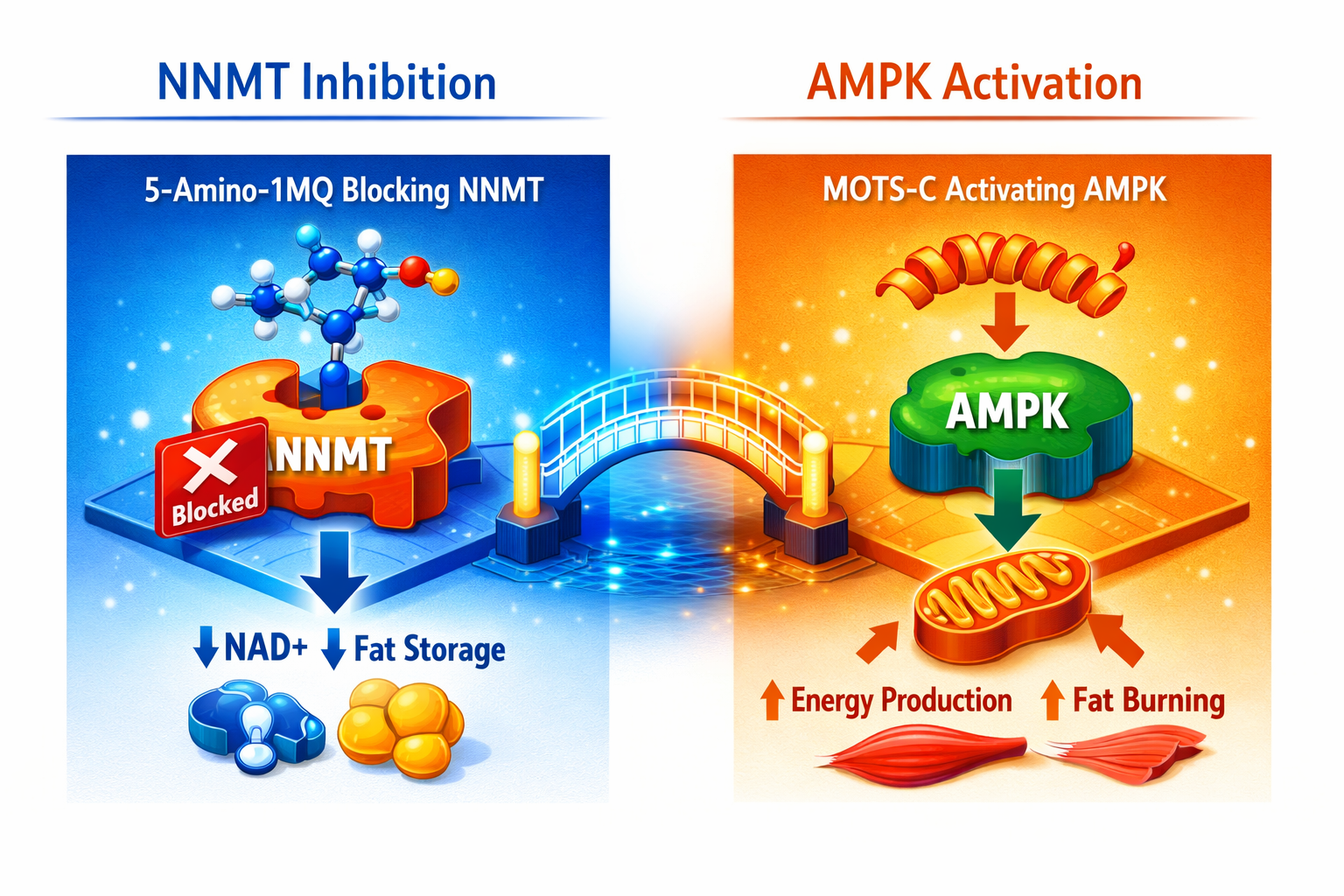
Bright isometric scientific illustration () showing two distinct molecular pathway diagrams side by side — left panel

Key Takeaways

  • 5-Amino-1MQ inhibits the enzyme NNMT, which plays a central role in regulating cellular NAD+ availability and fat storage.
  • MOTS-C is a mitochondria-derived peptide that activates AMPK and influences glucose and lipid metabolism.
  • Both agents may converge on NAD+/AMPK signaling nodes, providing a mechanistic basis for studying their combination.
  • Synergy claims require carefully controlled study designs with defined endpoints and appropriate controls.
  • Current evidence is largely preclinical; researchers should approach combination protocols with methodological rigor.

Understanding the Mechanistic Basis for 5-Amino-1MQ and MOTS-C Synergy in Metabolic Signaling

To evaluate whether two compounds produce synergistic effects, researchers must first map their individual mechanisms. Pairing agents without this foundation leads to uninterpretable results.

5-Amino-1MQ (5-amino-1-methylquinolinium) is a small-molecule inhibitor of nicotinamide N-methyltransferase (NNMT). NNMT consumes S-adenosylmethionine (SAM) and converts nicotinamide into 1-methylnicotinamide, effectively reducing the substrate pool available for NAD+ synthesis. By blocking NNMT, 5-Amino-1MQ increases intracellular NAD+ precursor availability, which in turn supports sirtuin activity and mitochondrial biogenesis. Preclinical studies in adipocyte models have linked NNMT inhibition to reduced lipid accumulation and improved insulin sensitivity.

MOTS-C is a 16-amino-acid peptide encoded within the mitochondrial 12S rRNA gene. It is one of a class of compounds called mitochondria-derived peptides (MDPs). MOTS-C translocates to the nucleus under metabolic stress and activates AMP-activated protein kinase (AMPK), a master regulator of cellular energy homeostasis. AMPK activation promotes glucose uptake, fatty acid oxidation, and mitochondrial function while suppressing anabolic processes that consume ATP.

"The mechanistic overlap between NNMT inhibition and AMPK activation creates a plausible framework for studying additive or synergistic metabolic effects, but plausibility is not evidence."

The convergence point is significant. Both pathways feed into the broader NAD+/AMPK energy-sensing network. Elevated NAD+ supports SIRT1 activity, which can activate AMPK indirectly through LKB1 deacetylation. MOTS-C activates AMPK directly. This dual-input model is why researchers have begun exploring 5-Amino-1MQ and MOTS-C synergy in metabolic signaling contexts, particularly in models of obesity and insulin resistance.

For researchers exploring the broader landscape of mitochondrially targeted peptides, the SS-31 mitochondrial research themes page provides useful context on how mitochondria-focused compounds are studied across different experimental frameworks.

Mitochondrial Targets and Pathway Interactions

Mitochondrial Targets and Pathway Interactions

Mitochondria sit at the center of the 5-Amino-1MQ and MOTS-C synergy story. Both agents influence mitochondrial function, but through different entry points.

NAD+ and Sirtuin Signaling

Pathway Element 5-Amino-1MQ Role MOTS-C Role
NAD+ availability Increases via NNMT inhibition Indirectly supported via AMPK
AMPK activation Indirect (via NAD+/SIRT1/LKB1) Direct activation
Mitochondrial biogenesis Supported via PGC-1alpha Supported via AMPK/PGC-1alpha
Fatty acid oxidation Enhanced Enhanced
Glucose uptake Improved in adipocyte models Improved via GLUT4 translocation

This table illustrates why the combination is mechanistically attractive. Both compounds influence PGC-1alpha, the transcriptional coactivator that drives mitochondrial biogenesis. However, they do so through different upstream signals, which means a combined protocol could theoretically produce stronger or more sustained PGC-1alpha activation than either agent alone.

Key pathway interactions to monitor in research:

  • NAD+/SIRT1/LKB1/AMPK axis
  • PGC-1alpha transcriptional activity
  • Mitochondrial membrane potential
  • Reactive oxygen species (ROS) output
  • Fatty acid oxidation rates (beta-oxidation markers)

Researchers studying mitochondrial dynamics in related peptide systems may also find value in reviewing SS-31 mitochondrial dynamics research, which covers complementary mechanistic endpoints relevant to energy metabolism studies.

For those sourcing compounds for preclinical work, reviewing research-only peptides and quality peptide sourcing standards is an important step before designing any study.

Research Design Considerations for Studying 5-Amino-1MQ and MOTS-C Synergy
Research Design Considerations for Studying 5-Amino-1MQ and MOTS-C Synergy

Claiming synergy between two metabolic agents requires more than observing that a combination produces a larger effect than either compound alone. Rigorous research design is non-negotiable.

Defining Synergy Quantitatively

True synergy is defined using interaction models such as the Bliss Independence model or the Loewe Additivity model. Researchers must test:

  1. Compound A alone across a dose range
  2. Compound B alone across a dose range
  3. Combination at fixed ratios across a dose range
  4. Vehicle control matched for solvent and volume

Without all four arms, distinguishing synergy from simple additivity is not possible.

Recommended Endpoints for Combination Studies

Primary metabolic endpoints:

  • Oxygen consumption rate (OCR) via Seahorse XF analysis
  • Extracellular acidification rate (ECAR)
  • Intracellular NAD+/NADH ratio
  • AMPK phosphorylation (Thr172)
  • Lipid accumulation (Oil Red O staining in adipocyte models)

Secondary endpoints:

  • Mitochondrial membrane potential (JC-1 assay)
  • ATP production rate
  • Gene expression of PGC-1alpha, TFAM, CPT1

Model Selection

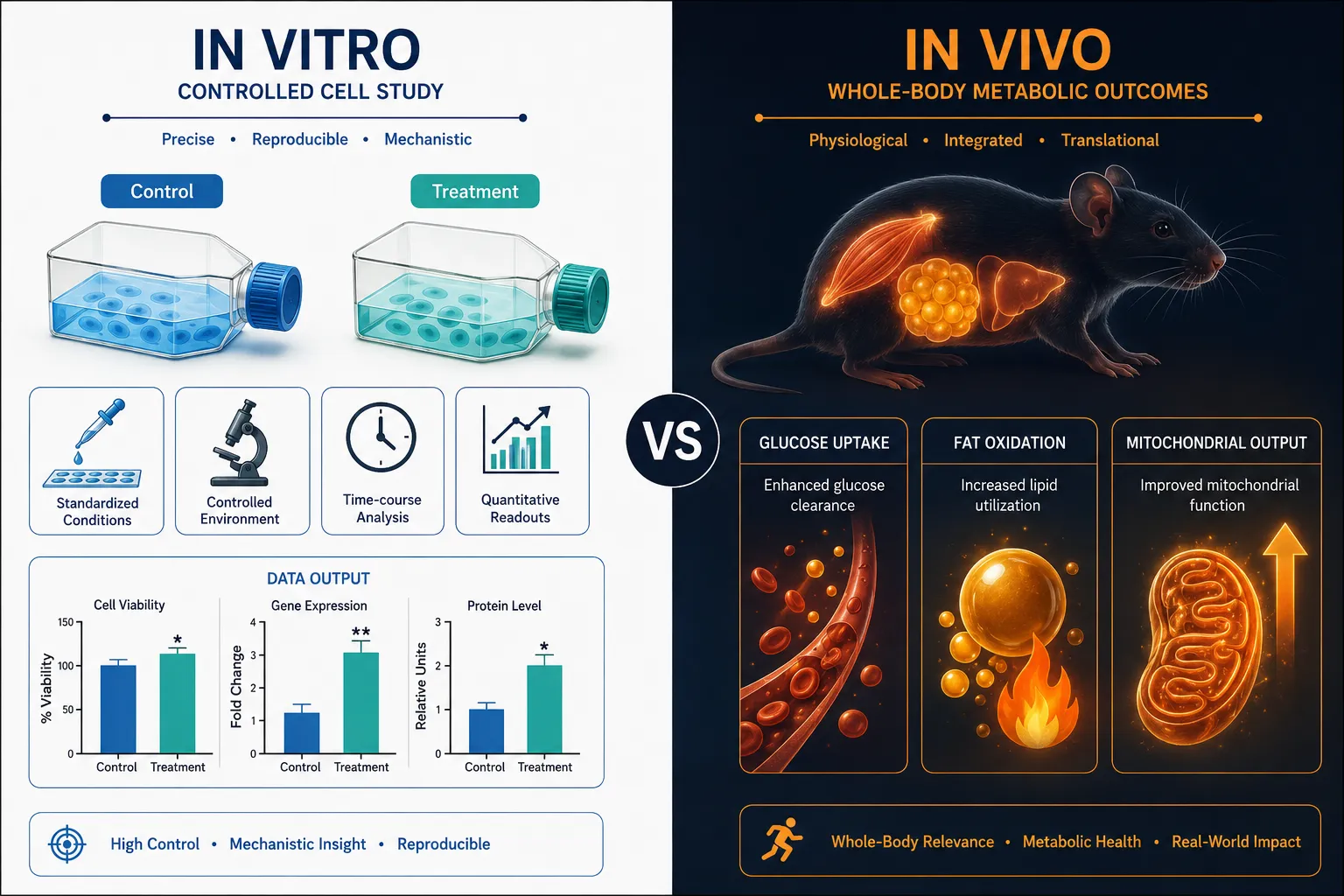
In vitro models (3T3-L1 adipocytes, C2C12 myotubes) are appropriate for initial mechanistic work. In vivo models, typically diet-induced obese (DIO) mice, are needed to assess systemic metabolic effects. Researchers should note that MOTS-C has shown tissue-specific effects, with skeletal muscle being a primary target, while 5-Amino-1MQ effects have been most characterized in adipose tissue. Combination studies should therefore include both tissue types.

For broader context on how peptide combinations are approached in research settings, the research blog and articles covering peptide benchmarking standards offer relevant methodological perspective.

Researchers interested in how other metabolic peptides interact with energy-sensing pathways may also find the discussion of biochemistry-tagged research topics useful for cross-referencing related mechanisms.

Conclusion

The pairing of 5-Amino-1MQ and MOTS-C in metabolic research is grounded in a coherent mechanistic rationale. Both agents influence the NAD+/AMPK/PGC-1alpha network through distinct upstream inputs, making their combination a scientifically reasonable subject of investigation. However, the gap between mechanistic plausibility and demonstrated synergy remains wide in 2026. Most evidence is preclinical, and rigorous dose-matrix study designs with validated endpoints have not yet been widely published for this specific combination.

Actionable next steps for researchers:

  • Map the dose-response curves for each compound independently before designing combination experiments.
  • Select model systems that reflect the tissue targets of both agents (adipose and skeletal muscle).
  • Use quantitative synergy frameworks (Bliss or Loewe) rather than informal comparisons.
  • Prioritize mitochondrial function endpoints (OCR, NAD+ ratio, AMPK phosphorylation) as primary readouts.
  • Source compounds from suppliers with verified purity documentation and reference standards to ensure data reproducibility.

Treating synergy as a hypothesis to be tested, rather than an assumption to be confirmed, is what separates productive metabolic research from noise.

Tags: 5-amino-1mq, ampk activation, metabolic signaling, mitochondria research, mitochondria-derived peptides, mots-c, nad+ metabolism, nnmt inhibitor, peptide synergy, pgc-1alpha, preclinical metabolism, research design
https://www.puretestedpeptides.com/wp-content/uploads/2026/07/5-amino-1mq-and-mots-c-synergy-metabolic-signaling-mitochondria-and-research-des.webp 1024 1536 https://www.puretestedpeptides.com/wp-content/uploads/2026/01/buy-peptides-online.jpg 2026-07-26 13:41:522026-07-26 13:41:525-Amino-1MQ and MOTS-C Synergy: Metabolic Signaling, Mitochondria, and Research Design
You might also like
MOTS-c Peptide: Mitochondrial Function, Energy Metabolism, and What Researchers Measure MOTS-c Peptide: Mitochondrial Function, Energy Metabolism, and What Researchers Measure
Mitochondria, NNMT Inhibition, and Peptide Modulators: Where MOTS‑c and 5‑Amino‑1MQ Fit in Cellular Energy Research Mitochondria, NNMT Inhibition, and Peptide Modulators: Where MOTS‑c and 5‑Amino‑1MQ Fit in Cellular Energy Research
5‑Amino‑1MQ and MOTS‑c Synergy in Metabolic Research: Designing NNMT and Mitochondrial Biogenesis Stacks 5‑Amino‑1MQ and MOTS‑c Synergy in Metabolic Research: Designing NNMT and Mitochondrial Biogenesis Stacks
0 replies

Leave a Reply

Want to join the discussion?
Feel free to contribute!

Leave a Reply Cancel reply

Your email address will not be published. Required fields are marked *

×

Helpful Links

  • My account
  • Cart
  • Checkout
  • Refund and Returns Policy
  • Privacy Policy
  • SMS Privacy Policy
  • Login
  • My Account
  • Logout

USA Made Lab Tested Peptides

All products are sold for research, laboratory, or analytical purposes only, and are not for human consumption


Pure Tested Peptides is a chemical supplier. Pure Tested Peptides is not a compounding / chemical compounding facility as defined under 503A of the Federal Food, Drug, and Cosmetic act. Pure Tested Peptides is not an outsourcing facility as defined under 503B of the Federal Food, Drug, and Cosmetic act.

The statements made within this website have not been evaluated by the US Food and Drug Administration. The products we offer are not intended to diagnose, treat, cure or prevent any disease.

Human/Animal Consumption Prohibited. Laboratory/In-Vitro Experimental Use Only

Link to: MOTS-c Peptide: Mitochondrial Function, Energy Metabolism, and What Researchers Measure Link to: MOTS-c Peptide: Mitochondrial Function, Energy Metabolism, and What Researchers Measure MOTS-c Peptide: Mitochondrial Function, Energy Metabolism, and What Researchers...MOTS-c Peptide: Mitochondrial Function, Energy Metabolism, and What Researchers Measure
Scroll to top Scroll to top Scroll to top