

As of February 2026, 14 GH analogue peptides were officially announced for return to Category 1 compounding status — a major regulatory shift reversing restrictions imposed in late 2023. For researchers and clinicians tracking growth hormone secretagogues, this moment redefines what compounds are accessible and how they may be studied.
Key Takeaways 🔬
- 14 GH analogue peptides regained Category 1 compounding status in early 2026
- CJC-1295 and Ipamorelin are among the most studied growth hormone secretagogues
- These peptides require a doctor's prescription and are not OTC or FDA-approved
- Stacking complementary GH analogue peptides is a common research approach
- Purity and sourcing from a verified peptide manufacturer is critical for valid results
What Are GH Analogue Peptides?
GH analogue peptides are synthetic compounds designed to mimic or stimulate the body's natural growth hormone (GH) release pathways. They generally fall into two categories:
| Type | Mechanism | Examples |
|---|---|---|
| GHRH Analogues | Mimic growth hormone-releasing hormone | CJC-1295, Tesamorelin, Sermorelin |
| Ghrelin Mimetics / GHRPs | Stimulate GH release via ghrelin receptor | Ipamorelin, GHRP-2, GHRP-6 |
These two classes are often studied together because they work through complementary pathways, producing a synergistic effect on GH pulse amplitude and duration.
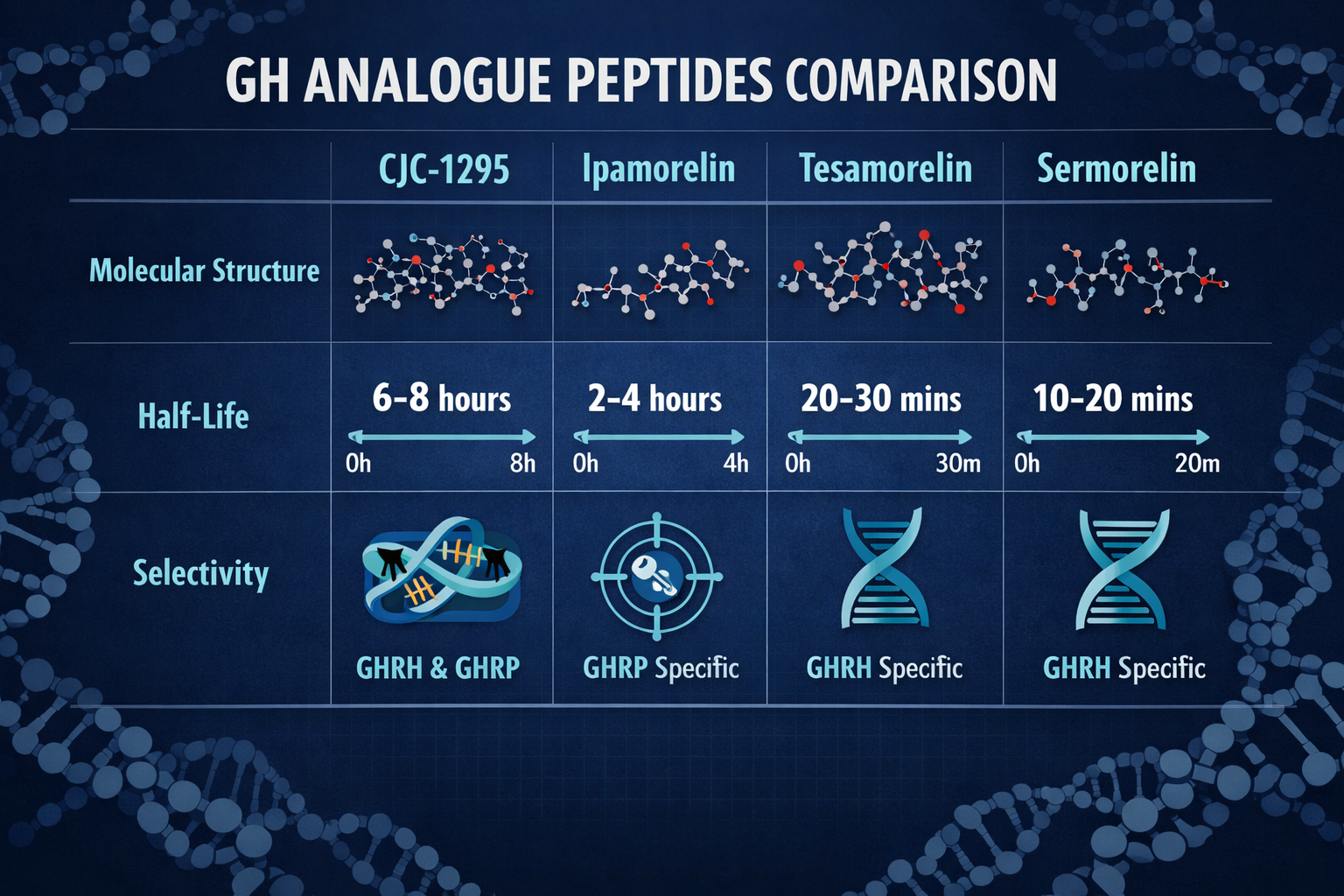
7 Key Facts About GH Analogue Peptides Researchers Should Know
1. 🔄 February 2026 Regulatory Shift Is Significant
Fourteen GH analogue peptides moved back to Category 1 compounding status following a government announcement in February 2026. However, formal FDA reclassification paperwork has not yet been published, so researchers should monitor official channels closely.
2. 🧬 CJC-1295 Features an Extended Half-Life
CJC-1295 is a synthetic GHRH analogue engineered with a drug affinity complex (DAC) that binds to albumin in the bloodstream. This extends its half-life significantly compared to native GHRH, enabling sustained GH release over days rather than minutes.
3. 🎯 Ipamorelin Is Highly Selective
Unlike broader-acting ghrelin agonists, Ipamorelin selectively targets growth hormone release without significantly affecting cortisol or prolactin levels. This selectivity makes it a preferred compound in research contexts where hormonal specificity matters.
4. ⚗️ Stacking These Compounds Is Common Practice
CJC-1295 and Ipamorelin are frequently studied together. Their complementary time-release profiles — one sustaining baseline GH elevation, the other amplifying GH pulses — make them a logical pairing in muscle and metabolic research.
5. 🏥 Tesamorelin Has the Strongest Clinical Record
Tesamorelin holds FDA approval for a specific indication (HIV-associated lipodystrophy), giving it the most robust clinical data among GHRH analogues. It remains a benchmark compound in GH secretagogue research.
6. ⚠️ MK-677 Remains Restricted
Not all growth hormone secretagogues received favorable regulatory treatment. MK-677 remains restricted due to safety concerns, including its potential to elevate cortisol and other off-target effects. Researchers should verify current status before sourcing.
7. 🔍 Source Purity Is Non-Negotiable
Research validity depends entirely on compound purity. Always source GH analogue peptides from suppliers with verifiable third-party testing and documented quality controls.
[product_slider category="gh-peptides" limit="8"]
Conclusion: What Researchers Should Do Next
The 2026 regulatory shift creates new opportunities for studying GH analogue peptides through legitimate compounding channels. Actionable next steps include:
- ✅ Confirm current Category 1 status through official FDA channels before sourcing
- ✅ Review Tesamorelin research as a clinical baseline for GHRH analogue comparisons
- ✅ Prioritize suppliers with documented purity testing — explore the full peptides catalog for verified options
- ✅ Consider combination protocols only after reviewing individual compound profiles
💡 Pull Quote: "Selectivity, half-life, and regulatory status are the three pillars that define a research-grade GH analogue peptide in 2026."
Tags: GH analogue peptides, growth hormone secretagogues, CJC-1295, Ipamorelin, Tesamorelin, GHRH analogues, peptide research 2026, compounding peptides, ghrelin mimetics, peptide sourcing, Category 1 peptides, growth hormone peptides