

5-Amino-1MQ Peptide Research: NNMT Inhibition, Fat Metabolism, and Why It Is Often Paired With Mitochondrial Stacks
Nicotinamide N-methyltransferase, or NNMT, is overexpressed in the adipose tissue of individuals with obesity at rates roughly two to four times higher than in lean controls — a biochemical pattern that has made it one of the more compelling metabolic targets in current research. At the center of that research sits 5-Amino-1MQ, a small-molecule NNMT inhibitor that has attracted growing interest for its role in fat metabolism and energy regulation. This article breaks down 5-Amino-1MQ peptide research: NNMT inhibition, fat metabolism, and why it is often paired with mitochondrial stacks — covering the core biology, the metabolic rationale, and how researchers are thinking about combination protocols.
Key Takeaways
- 5-Amino-1MQ is a selective NNMT inhibitor, not a true peptide, though it is commonly grouped with peptide-based metabolic compounds in research contexts.
- NNMT regulates the methyl economy of cells; inhibiting it raises SAM levels and shifts adipose tissue toward greater energy expenditure.
- Preclinical data suggest NNMT inhibition can reduce fat mass, improve insulin sensitivity, and support a shift from white to beige adipose phenotype.
- Mitochondrial peptides such as SS-31 and MOTS-c are frequently studied alongside 5-Amino-1MQ because they address complementary steps in the same metabolic pathway.
- Research into this compound remains at the preclinical stage; no approved clinical applications exist as of 2026.
Understanding NNMT and What 5-Amino-1MQ Actually Does
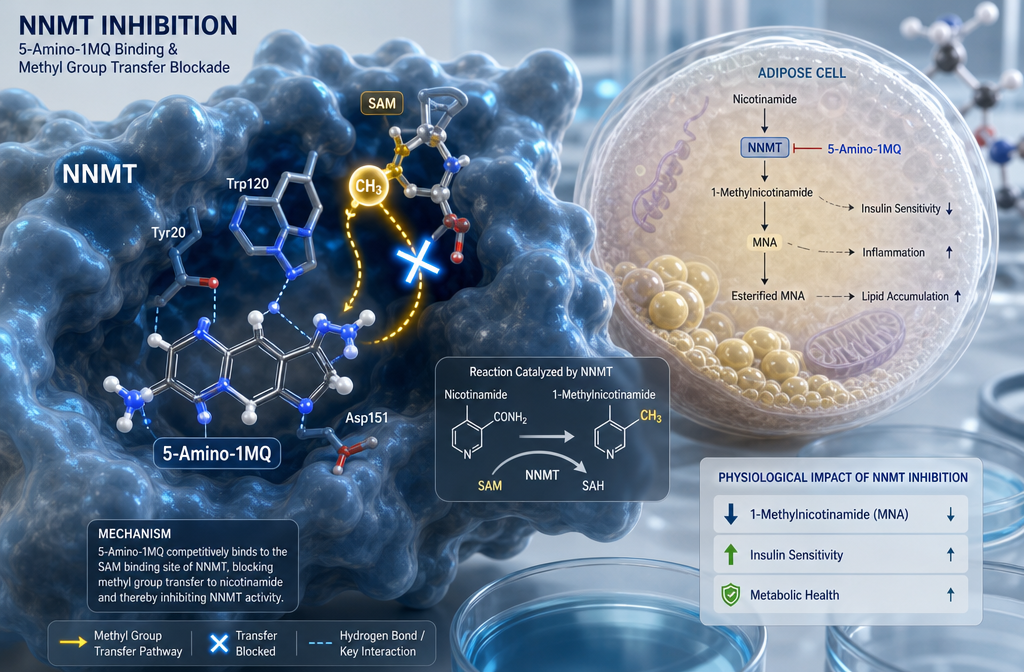
Despite being called a peptide in many research discussions, 5-Amino-1MQ is technically a small-molecule compound — a methylquinolinium derivative. The distinction matters because its mechanism is enzymatic inhibition rather than receptor binding in the conventional peptide sense. However, it is routinely grouped with peptide-based metabolic stacks because it targets overlapping biological pathways.
NNMT's core function is to transfer methyl groups from S-adenosylmethionine (SAM) to nicotinamide, producing S-adenosylhomocysteine (SAH) and 1-methylnicotinamide. This process consumes methyl groups that would otherwise support epigenetic regulation, NAD+ recycling, and mitochondrial signaling. When NNMT activity is high — as it tends to be in obese adipose tissue — the methyl pool is depleted, and cellular energy metabolism slows.
By selectively blocking NNMT, 5-Amino-1MQ preserves SAM availability. The downstream effects observed in preclinical models include:
- Increased NAD+ and NADH cycling
- Upregulation of thermogenic gene expression in adipose tissue
- Reduced lipid accumulation in fat cells
- Improved insulin sensitivity markers
"NNMT sits at a metabolic crossroads — its inhibition does not simply block one pathway but redistributes methyl currency across multiple energy-sensing systems."
This broad upstream influence is precisely why 5-Amino-1MQ peptide research has attracted attention beyond simple fat-loss applications.
NNMT Inhibition, Fat Metabolism, and the Adipose Tissue Connection
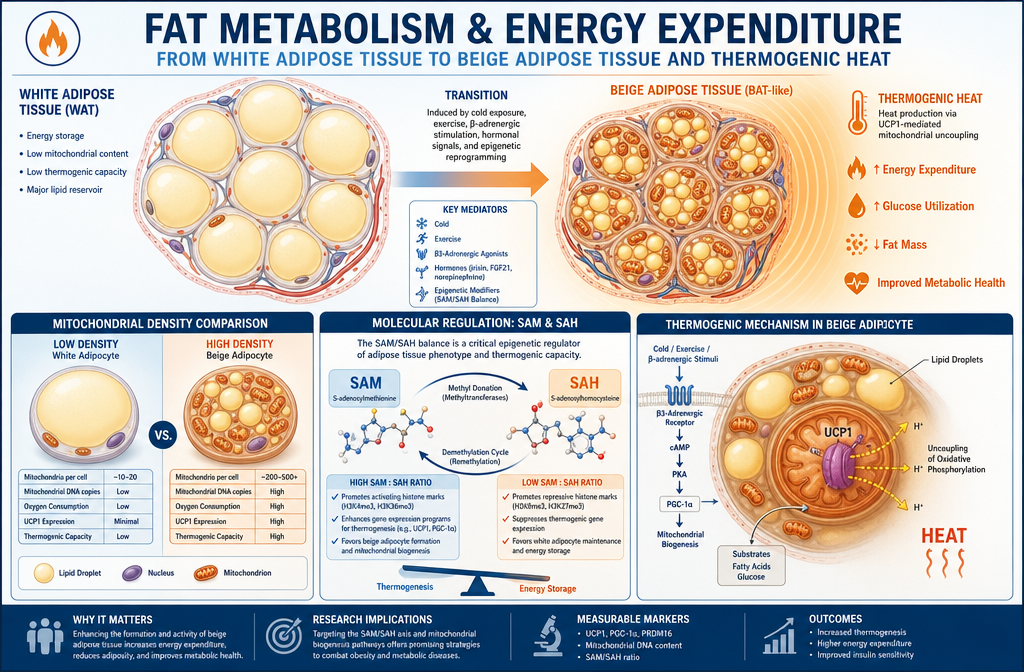
The adipose tissue findings from 5-Amino-1MQ research are among its most discussed features. In mouse models, NNMT inhibition has been associated with a shift in white adipose tissue toward a beige or brown-like phenotype — a process sometimes called "beiging." Beige adipocytes express higher levels of uncoupling protein 1 (UCP1), which dissipates energy as heat rather than storing it as fat.
Key metabolic outcomes observed in preclinical studies:
| Outcome | Direction |
|---|---|
| Body fat mass | Decreased |
| Lean mass | Preserved or increased |
| Insulin sensitivity | Improved |
| SAM/SAH ratio | Increased |
| UCP1 expression | Upregulated |
This metabolic profile makes 5-Amino-1MQ relevant to researchers studying AOD-9604 metabolic research and other compounds targeting adipose function. It also connects naturally to GLP-1 and incretin research themes, since both pathways converge on insulin sensitivity and energy partitioning.
Researchers studying MOTS-c and metabolic flexibility have noted similar adipose remodeling effects, which has prompted interest in whether combining these compounds produces additive or synergistic outcomes.
Why 5-Amino-1MQ Is Often Paired With Mitochondrial Stacks
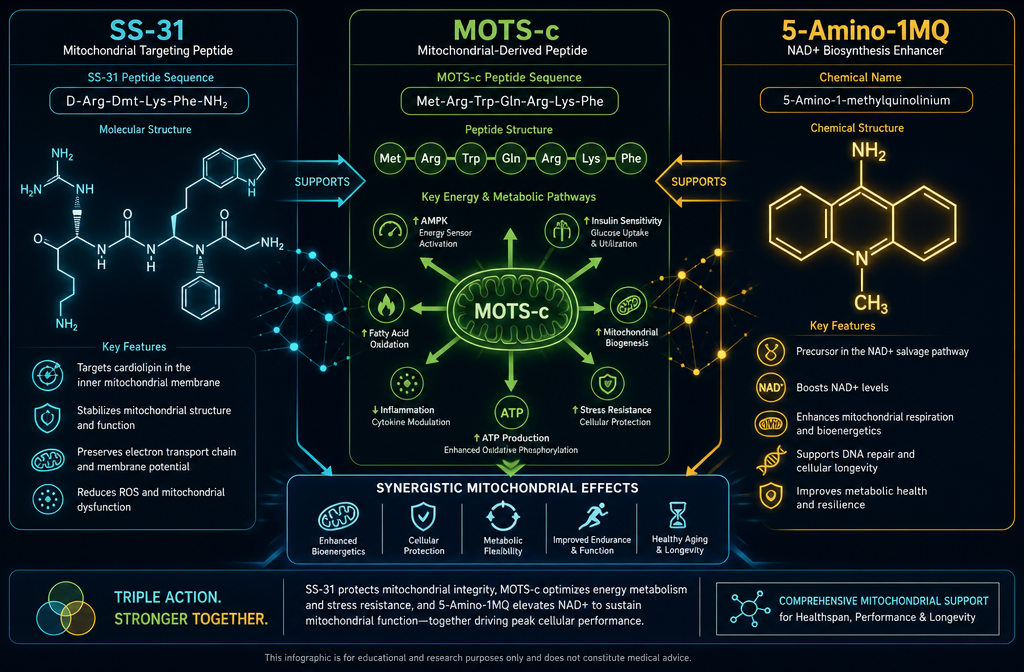
The pairing of 5-Amino-1MQ with mitochondrial peptides is not arbitrary. It reflects a layered approach to metabolic research where each compound addresses a distinct step in the same energy-production hierarchy.
The rationale works like this:
- 5-Amino-1MQ preserves the methyl pool and raises NAD+ availability — setting the biochemical conditions for efficient mitochondrial function.
- SS-31 (Elamipretide) targets cardiolipin on the inner mitochondrial membrane, stabilizing electron transport chain efficiency. Research on SS-31 mitochondrial research themes highlights its role in reducing oxidative stress at the mitochondrial level.
- MOTS-c is a mitochondria-derived peptide that activates AMPK and supports glucose uptake in skeletal muscle — complementing the insulin-sensitizing effects of NNMT inhibition.
The combination of MOTS-c and SS-31 (Elamipretide) has already been explored in preclinical contexts, and 5-Amino-1MQ is increasingly discussed as a third layer in such stacks.
Researchers also note that NAD+ availability — which NNMT inhibition supports — is directly relevant to NAD+ scientific evidence and the broader sirtuin/AMPK signaling network that mitochondrial peptides also engage.
For those reviewing broader metabolic peptide combinations, IPA muscle and fat research themes offer additional context on how growth hormone secretagogues interact with fat oxidation pathways that 5-Amino-1MQ may also influence.
Conclusion
5-Amino-1MQ occupies a unique position in metabolic research: it acts upstream of both fat storage and mitochondrial efficiency by preserving the methyl economy that both systems depend on. The preclinical evidence for NNMT inhibition — reduced fat mass, beige adipose conversion, improved insulin sensitivity, and elevated NAD+ cycling — provides a mechanistic basis for why researchers pair it with mitochondrial peptides like SS-31 and MOTS-c.
Actionable next steps for researchers:
- Review the preclinical NNMT inhibition literature before designing any combination protocol.
- Examine SS-31 and MOTS-c data independently to understand where their mechanisms overlap with and differ from 5-Amino-1MQ.
- Source compounds only from verified, third-party-tested suppliers to ensure research-grade purity.
- Treat all findings as preclinical; no human clinical approvals exist for 5-Amino-1MQ as of 2026.
The mechanistic logic behind 5-Amino-1MQ peptide research — NNMT inhibition, fat metabolism, and mitochondrial stack pairing — is coherent and well-grounded in cell biology. As research matures, this compound is likely to remain a central figure in metabolic and longevity-focused peptide discussions.