Call or Text 727-513-9780
  • Shopping Cart Shopping Cart
    0Shopping Cart
Pure Tested Peptides | America's most trusted Peptides for sale online
  • Peptides for sale
    • Oral Peptides for sale
      • Peptide Capsules for sale
      • BPC 157 Capsules 1000mcg
      • SLU-PP-332 Capsules | 1000 mcg
      • 5-Amino-1MQ 50mg Capsules
      • Tesofensine 500mcg
    • All Peptides for sale
    • Peptide Sprays
      • BPC 157 Nasal Spray Kit
      • BPC-157 TB500 Nasal Spray Kit
      • Semax Nasal Spray 10mg
      • Selank – Nasal Spray Kit – 10mg
      • Epithalon 50MG Nasal Spray Kit
      • Ipamorelin 10mg Nasal Spray
      • Klow Nasal Spray (BPC-157 + TB-500 + GHK-Cu + KPV) | 80mg
      • Hulk Nasal Spray Tesa / Ipa Blend 6/3 MG
      • Klow Nasal Spray
      • NAD + 500 mg Nasal Spray
      • PT-141 Nasal Spray Kit
    • GHRH Peptides
      • Ipa Peptides
      • CJC-1295 Peptides
        • CJC-1295 with DAC 5 mg
        • CJC-1295 without DAC 5 mg
        • CJC-1295 Ipa 10mg
      • Tesa Peptides
        • Tesa Peptide
        • Tesa 20 mg
    • GHK-Cu Peptides
      • All GHK-Cu Peptides
      • GHK-Cu 100mg
      • KLOW Peptide Blend – Buy KLOW blend online
    • BPC Peptides
      • All BPC Peptides
      • BPC-157
      • BPC-157 TB-500
      • BPC 157 capsules 1000mcg
    • SLU-PP-332 Peptides
      • All SLU-PP-332 Peptides
      • SLU-PP-332 5mg
    • GLP3 Peptides
      • GLP3-R
      • GLP3-R CAG 10mg
      • GLP3-R 20mg
    • PT-141 Peptides
      • PT-141 Peptides for sale
      • PT-141 10mg
      • PT-141 Nasal Spray
    • CAG Peptides
      • Lipo-C Peptide Blend
      • CAG 5mg
      • CAG 10mg
    • MOTS-C Peptides
      • MOTS-C Peptides for sale
      • MOTS-c peptide
      • MOTS-c 10mg *6 pack*
    • 5 Amino 1MQ Peptides
      • 5 Amino 1MQ Peptides for sale
      • 5-Amino-1MQ 50mg Capsules
      • 5-Amino-1MQ 5mg
    • Epithalon Peptides
      • Epithalon Peptides for sale
      • Epithalon 10mg
      • Epithalon 50mg
  • Shop
    • GLPs
      • 5-Amino-1MQ 50mg Capsules
      • 5-Amino-1MQ 5mg
      • GLP3-Reta
      • L-Carnitine 500mg/ml
      • Tesofensine 500mcg
      • SLU-PP-332 5mg
      • MOTS-c 10mg *6 pack*
    • Epithalon & BPC Peptides
      • Epithalon 10mg
      • Epithalon 50mg
      • BPC-157
      • BPC 157 capsules 1000mcg
      • BPC-157 TB-500
      • BPC-157 TB500 Nasal Spray Kit
      • BPC 157 Nasal Spray Kit
    • BPC TB-500 & NAD+ Peptides
      • NAD+ 500 mg
      • KLOW Peptide Blend – Buy KLOW blend online
      • GLOW Peptide Blend
      • TB 500 5mg
      • BPC 157 capsules 1000mcg – Supplement
      • BPC 157 Nasal Spray Kit
      • BPC-157
      • BPC-157 TB500 Nasal Spray Kit
      • BPC-157 TB-500
      • BPC 157 capsules 1000mcg
    • LL-37 Peptide
      • LL-37 10 mg
    • MOTS-C & Selank
      • MOTS-c peptide
      • Selank 10mg
    • GHK Peptides
      • GHK-Cu 100mg
      • GLOW Peptide Blend
      • KLOW Peptide Blend – Buy KLOW blend online
  • COAs
  • Wholesale
    • Wholesale Peptides for sale
  • PTP FAQ
  • Affiliates
    • Selank Peptide: Advanced Pharmacological Mechanisms Underlying Its Anxiolytic and Nootropic Effects in Research
      • 5-Amino-1MQ Peptide: Detailed Mechanisms of NNMT Inhibition and Its Impact on Cellular Metabolism Research
        • MOTS-C Peptide: Unraveling Its Role in Mitochondrial Dynamics and Energy Metabolism Research
          • Epithalon Peptide and Telomerase Regulation: Investigating Its Impact on Cellular Senescence and Lifespan Research Models
            • GLP2-T vs GLP2 Tirz Peptide: Understanding the Naming, Mechanistic Nuances, and Research Implications for Gut Health
      • Peptides and Polypeptides in Modern Pharmacology: What Research on Metoprolol, Prednisone, and Amlodipine Reveals
        • Polypeptide Peptides vs NSAIDs: What Naproxen and Diclofenac Teach Tissue-Repair Researchers About BPC‑157 and TB‑500
          • Peptides and Polypeptides in Endocrine Pharmacology: How GLP-1, GLP-2, and GLP-3 Retatrutide Differ From Classic Drugs Like Prednisone and Amlodipine
          • 5‑Amino‑1MQ Peptide and NNMT Inhibition: How It Compares With Statins Like Atorvastatin in Adipose and Lipid Metabolism Research
      • Enclomiphene, Estrogen Receptor Signaling, and Luteinizing Phase Biology: What Hormone Researchers Should Measure
        • Mesenchymal Stem Cells, BPC‑157, and GHK‑Cu: How Tissue Repair Peptides Compare With Classic NSAIDs Like Naproxen in Injury Models
          • Peptide Calculator Use Cases Beyond Growth Hormone: Working Through GLP‑3 Retatrutide, MOTS‑c, and BPC‑157 Research Dosing
        • Polypeptide Peptides in Endocrine and Metabolic Pharmacology: Lessons From Amlodipine, Prednisone, and Metoprolol
        • Peptides Calculator for Advanced Blends: Worked Examples for Tesamorelin, CJC‑1295, and Ipamorelin Stacks
          • Peptides and Polypeptides in Human Physiology: How Molecular Size Shapes Research Applications
            • Selank Peptide: Advanced Pharmacological Mechanisms Underlying Its Anxiolytic and Nootropic Effects in Research
          • 5-Amino-1MQ Peptide: Detailed Mechanisms of NNMT Inhibition and Its Impact on Cellular Metabolism Research
            • MOTS-C Peptide: Unraveling Its Role in Mitochondrial Dynamics and Energy Metabolism Research
              • Epithalon Peptide and Telomerase Regulation: Investigating Its Impact on Cellular Senescence and Lifespan Research Models
                • GLP2-T vs GLP2 Tirz Peptide: Understanding the Naming, Mechanistic Nuances, and Research Implications for Gut Health
                  • Peptides and Polypeptides in Endocrine Pharmacology: How GLP-1, GLP-2, and GLP-3 Retatrutide Differ From Classic Drugs Like Prednisone and Amlodipine
                    • Polypeptide Peptides vs NSAIDs: What Naproxen and Diclofenac Teach Tissue-Repair Researchers About BPC‑157 and TB‑500
                      • Peptides and Polypeptides in Modern Pharmacology: What Research on Metoprolol, Prednisone, and Amlodipine Reveals
                        • 5‑Amino‑1MQ Peptide and NNMT Inhibition: How It Compares With Statins Like Atorvastatin in Adipose and Lipid Metabolism Research
                        • Enclomiphene, Estrogen Receptor Signaling, and Luteinizing Phase Biology: What Hormone Researchers Should Measure
                        • Mesenchymal Stem Cells, BPC‑157, and GHK‑Cu: How Tissue Repair Peptides Compare With Classic NSAIDs Like Naproxen in Injury Models
                        • Peptide Calculator Use Cases Beyond Growth Hormone: Working Through GLP‑3 Retatrutide, MOTS‑c, and BPC‑157 Research Dosing
                        • Polypeptide Peptides in Endocrine and Metabolic Pharmacology: Lessons From Amlodipine, Prednisone, and Metoprolol
                        • Peptides Calculator for Advanced Blends: Worked Examples for Tesamorelin, CJC‑1295, and Ipamorelin Stacks
                        • Peptides and Polypeptides in Human Physiology: How Molecular Size Shapes Research Applications
                        • Selank Peptide: Advanced Pharmacological Mechanisms Underlying Its Anxiolytic and Nootropic Effects in Research
                        • MOTS-C Peptide: Unraveling Its Role in Mitochondrial Dynamics and Energy Metabolism Research
                        • Peptides and Polypeptides in Modern Pharmacology: What Research on Metoprolol, Prednisone, and Amlodipine Reveals
                        • Peptides and Polypeptides in Endocrine Pharmacology: How GLP-1, GLP-2, and GLP-3 Retatrutide Differ From Classic Drugs Like Prednisone and Amlodipine
                        • 5-Amino-1MQ Peptide: Detailed Mechanisms of NNMT Inhibition and Its Impact on Cellular Metabolism Research
                        • Mesenchymal Stem Cells, BPC‑157, and GHK‑Cu: How Tissue Repair Peptides Compare With Classic NSAIDs Like Naproxen in Injury Models
                        • Peptide Calculator Use Cases Beyond Growth Hormone: Working Through GLP‑3 Retatrutide, MOTS‑c, and BPC‑157 Research Dosing
                        • GLP2-T vs GLP2 Tirz Peptide: Understanding the Naming, Mechanistic Nuances, and Research Implications for Gut Health
                        • Polypeptide Peptides in Endocrine and Metabolic Pharmacology: Lessons From Amlodipine, Prednisone, and Metoprolol
                        • Polypeptide Peptides vs NSAIDs: What Naproxen and Diclofenac Teach Tissue-Repair Researchers About BPC‑157 and TB‑500
                        • Peptides and Polypeptides in Human Physiology: How Molecular Size Shapes Research Applications
                        • Peptides Calculator for Advanced Blends: Worked Examples for Tesamorelin, CJC‑1295, and Ipamorelin Stacks
                        • 5‑Amino‑1MQ Peptide and NNMT Inhibition: How It Compares With Statins Like Atorvastatin in Adipose and Lipid Metabolism Research
                        • Enclomiphene, Estrogen Receptor Signaling, and Luteinizing Phase Biology: What Hormone Researchers Should Measure
                        • Epithalon Peptide and Telomerase Regulation: Investigating Its Impact on Cellular Senescence and Lifespan Research Models
                        • Best research protocol Klow blend
                        • best time to take BPC-157
                        • best time to take DSIP (Delta Sleep Inducing Peptide)
                        • best time to take CJC-1295
                        • best time to take AOD-9604
                        • best time to take Follistatin 344
                        • best time to take Ipamorelin
                        • best time to take MK-677 (Ibutamoren)
                        • best time to take Ligandrol (LGD-4033) — research compound
                        • best time to take Ostarine (MK-2866) — research compound
                        • best time to take GHK-CU
                        • best time to take TB-500
                        • best time to take MOTS-c
                        • best time to take Semax
                        • best time to take RAD-140 (Testolone) — research compound
                        • best time to take Thymosin Alpha-1
                        • best time to take PEG-MGF
                        • Biolife Plasma, Octapharma Plasma, and Research Peptides: How Plasma Donation Labs Differ From Peptide Suppliers
                        • best time to take YK-11 — research compound
                        • best time to take PT-141 (Bremelanotide)
                        • Best research protocol Klow blend
  • Contact
    • Contact Customer Service
    • Text Customer Support
  • About US
  • Shop all peptides
  • Affiliate Program
    • Affiliate Signup
  • Login / Register Login / Register Page Link Login / Register Page Link
  • Click to open the search input field Click to open the search input field Search
  • Menu Menu

Tag Archive for: melanocortin-4 receptor

PT-141 Peptide Research: Mechanism of Action and Melanocortin Receptor Signaling

PT-141 Peptide Research: Mechanism of Action and Melanocortin Receptor Signaling

July 23, 2026/0 Comments/in Uncategorized/by

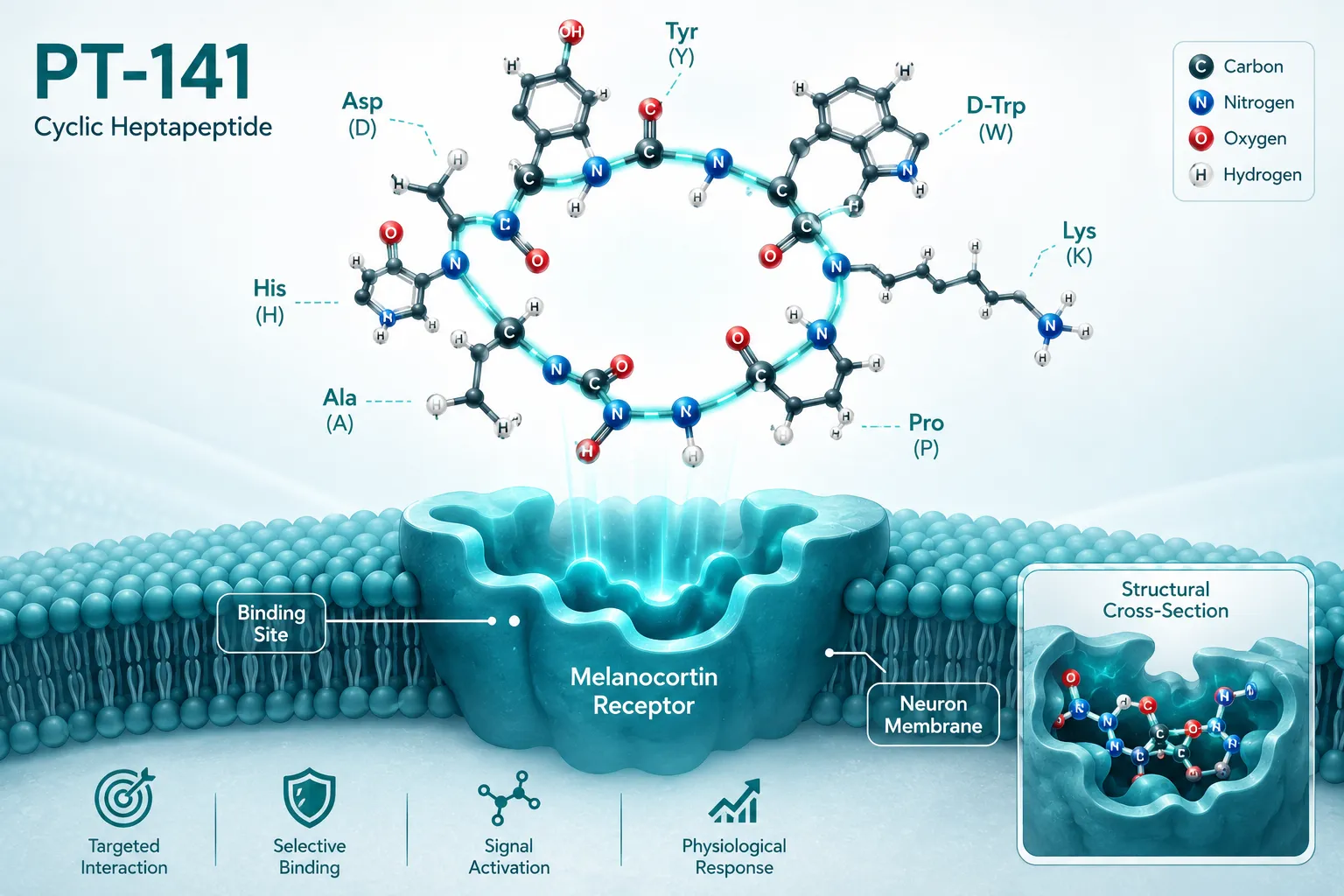
PT-141 peptide molecular structure and receptor binding illustration

A cyclic heptapeptide with a molecular weight of just over 1,025 g/mol has become one of the most pharmacologically interesting compounds in modern neuroendocrine research. PT-141 peptide research, mechanism of action, and melanocortin receptor signaling sit at the intersection of receptor pharmacology, central nervous system neuroscience, and clinical endocrinology, making this compound far more nuanced than its common-use reputation suggests.

Unlike the widely studied phosphodiesterase type 5 (PDE5) inhibitors that work in the periphery, PT-141 acts directly on the brain. That central mechanism is precisely what makes it a compelling subject for researchers exploring neuromodulation, autonomic regulation, and hypothalamic signaling pathways.

Key Takeaways

  • PT-141 is a cyclic heptapeptide derived from Melanotan II, with reduced activity at melanocortin-1 receptors (MC1R), minimizing tanning effects while preserving neuromodulatory activity.
  • Its primary targets are melanocortin-4 (MC4R) and melanocortin-3 (MC3R) receptors in the central nervous system, both G-protein coupled receptors (GPCRs).
  • Receptor activation triggers a cAMP/PKA signaling cascade that elevates dopamine and noradrenaline release in key brain regions.
  • PT-141 received FDA approval in 2019 under the brand name Vyleesi for hypoactive sexual desire disorder (HSDD) in premenopausal women.
  • Its biological effects persist 4 to 6 hours despite a plasma half-life of approximately 2.7 hours, indicating downstream signaling durability.

Structural Characteristics and Derivation from Melanotan II

PT-141, also known as bremelanotide, carries the molecular formula C50H68N14O10. Its cyclic structure is not merely a chemical curiosity; it directly confers resistance to enzymatic degradation, extending the compound's functional stability compared to linear peptides.

PT-141 was derived from Melanotan II through selective modification to reduce activity at melanocortin-1 receptors (MC1R). MC1R governs skin pigmentation, so reducing affinity at that site means PT-141 can exert its central effects without the pronounced tanning side effects seen with its parent compound. This receptor selectivity is a key design feature that shapes its entire pharmacological profile.

For researchers working across the full peptide catalog, understanding how structural modifications at the molecular level translate into receptor selectivity is a foundational principle that applies broadly across peptide classes.
Structural Characteristics and Derivation from Melanotan II

PT-141 Peptide Research: Mechanism of Action and Melanocortin Receptor Signaling, The Core Pathway

G-Protein Coupled Receptor Activation

PT-141 functions as an agonist at two primary receptor subtypes: melanocortin-4 receptor (MC4R) and melanocortin-3 receptor (MC3R). Both belong to the G-protein coupled receptor (GPCR) superfamily, which are seven-transmembrane domain proteins that transduce extracellular signals into intracellular biochemical responses.

When PT-141 binds to MC4R or MC3R, it activates the associated Gs protein, which in turn stimulates adenylyl cyclase. This enzyme catalyzes the conversion of ATP into cyclic adenosine monophosphate (cAMP). Elevated intracellular cAMP then activates protein kinase A (PKA), a serine/threonine kinase that phosphorylates downstream effector proteins.

Downstream Neurotransmitter Release

The PKA activation cascade produces a measurable increase in the release of key neurotransmitters, particularly dopamine and noradrenaline, within brain regions associated with motivation, reward, and arousal. This is the biochemical basis for the compound's documented effects on sexual desire and motivation.

This pathway is distinct from peripheral vascular mechanisms. PDE5 inhibitors, for example, act on smooth muscle tissue in genital vasculature. PT-141 bypasses that pathway entirely, acting upstream at the neural level. That distinction is clinically significant: research has explored PT-141 in subjects who do not respond adequately to PDE5 inhibitors, suggesting complementary or independent mechanisms.

Hypothalamic and Limbic System Involvement

MC4R is expressed densely in the hypothalamus and limbic system, brain regions that govern homeostatic regulation, emotional processing, and motivated behavior. PT-141's agonist activity in these regions explains both its therapeutic effects and its side effect profile, which includes transient blood pressure increases and nausea attributable to autonomic melanocortin receptor activation.

Researchers interested in the broader neuroendocrine context will find useful parallels in neuroendocrine and innate immunity research, where overlapping receptor systems demonstrate how peptide signaling pathways intersect across physiological domains.

Hypothalamic and Limbic System Involvement

Clinical Evidence and Pharmacokinetics

FDA Approval and Phase 3 Trial Data

In 2019, PT-141 became the first FDA-approved subcutaneous treatment for acquired, generalized hypoactive sexual desire disorder (HSDD) in premenopausal women, marketed as Vyleesi. This approval rested on two Phase 3 randomized, double-blind, placebo-controlled trials enrolling 1,247 participants. Both trials demonstrated statistically significant improvements in sexual desire scores and meaningful reductions in distress associated with low desire.

The approved dosing protocol calls for 1.75 mg administered subcutaneously approximately 45 minutes before anticipated sexual activity, with a maximum of one dose per 24-hour period and no more than eight doses per month.

Pharmacokinetic Profile

PT-141 has an elimination half-life of approximately 2.7 hours. However, its biological effects, including heightened arousal and desire, persist for 4 to 6 hours post-administration. This dissociation between plasma half-life and effect duration suggests that downstream signaling events, particularly sustained PKA-mediated phosphorylation, outlast the compound's circulating presence.

Parameter Value
Molecular Weight 1,025.2 g/mol
Half-Life ~2.7 hours
Effect Duration 4-6 hours
Approved Dose 1.75 mg subcutaneous
Route Subcutaneous injection

For researchers sourcing verified compounds, reviewing PT-141 peptide for sale in a research context provides important quality assurance considerations.

PT-141 Peptide Research: Mechanism of Action and Melanocortin Receptor Signaling, Broader Research Applications

Male Sexual Dysfunction Research

While the FDA indication applies specifically to premenopausal women with HSDD, research has examined PT-141 in male subjects experiencing erectile dysfunction, particularly those who are non-responsive to PDE5 inhibitors. Preliminary findings suggest MC4R activation may support erectile function through central neural pathways, though these applications remain off-label and require further controlled investigation.

Autonomic and Cardiovascular Considerations

Because MC3R and MC4R are expressed in brain regions governing autonomic function, PT-141 produces dose-dependent transient increases in blood pressure and heart rate. These effects are consistent with noradrenaline release in autonomic regulatory centers. Researchers designing protocols must account for these cardiovascular variables, particularly in subjects with pre-existing hypertension.

Comparative Peptide Research Context

PT-141's central mechanism stands in instructive contrast to other peptides studied for metabolic and body composition effects. For example, adipotide peptide research targets adipose vasculature through a completely different receptor system, illustrating how peptide pharmacology spans radically different tissue targets. Similarly, GH-axis peptides like those explored in CJC-1295 DAC muscle research operate through pituitary GHRH receptors, a reminder that receptor specificity defines the entire downstream biology.

Researchers comparing central neuromodulatory peptides may also find value in reviewing ipamorelin muscle and fat research themes, where ghrelin receptor signaling offers another GPCR-mediated model for comparison.

Comparative Peptide Research Context

Safety Profile and Research Considerations

Common adverse effects observed in clinical and research settings include:

  • Nausea, the most frequently reported effect, dose-dependent
  • Flushing, attributable to peripheral vasodilation via melanocortin receptor activation
  • Transient hypertension, linked to noradrenaline release in autonomic centers
  • Injection site reactions, typical of subcutaneous peptide administration

These effects are generally transient and resolve without intervention. Researchers should note that PT-141 is contraindicated in subjects with cardiovascular disease due to its blood pressure effects, and all research use should adhere to applicable institutional and regulatory guidelines.

For researchers evaluating purity standards and certificate of analysis documentation, reviewing COA standards for research peptides is an essential step before initiating any protocol.

Conclusion

PT-141 peptide research, mechanism of action, and melanocortin receptor signaling represent a well-characterized pharmacological model with direct clinical validation. The compound's agonist activity at MC4R and MC3R, its cAMP/PKA signaling cascade, and its downstream effects on dopamine and noradrenaline release in the hypothalamus and limbic system provide a clear mechanistic framework for researchers.

Actionable next steps for researchers in 2026:

  1. Review Phase 3 clinical trial data to understand the validated dosing parameters and outcome measures before designing analogous protocols.
  2. Account for the pharmacokinetic dissociation between plasma half-life (2.7 hours) and effect duration (4-6 hours) when structuring observation windows.
  3. Source compounds with documented purity verification, certificate of analysis data is non-negotiable for reproducible research.
  4. Consider PT-141's central mechanism as a comparative reference point when evaluating other GPCR-targeting peptides in neuroendocrine research.
  5. Consult current regulatory guidance, as off-label applications in male subjects or other populations require careful institutional review.

The precision of PT-141's receptor selectivity, combined with its FDA-validated clinical profile, makes it one of the more thoroughly understood peptides available for neuromodulatory research, a strong foundation for investigators exploring melanocortin system pharmacology.

https://www.puretestedpeptides.com/wp-content/uploads/2026/07/pt-141-peptide-research-mechanism-of-action-and-melanocortin-receptor-signaling.webp 1024 1536 https://www.puretestedpeptides.com/wp-content/uploads/2026/01/buy-peptides-online.jpg 2026-07-23 13:07:222026-07-23 13:07:22PT-141 Peptide Research: Mechanism of Action and Melanocortin Receptor Signaling
×

Helpful Links

  • My account
  • Cart
  • Checkout
  • Refund and Returns Policy
  • Privacy Policy
  • SMS Privacy Policy
  • Login
  • My Account
  • Logout

USA Made Lab Tested Peptides

All products are sold for research, laboratory, or analytical purposes only, and are not for human consumption


Pure Tested Peptides is a chemical supplier. Pure Tested Peptides is not a compounding / chemical compounding facility as defined under 503A of the Federal Food, Drug, and Cosmetic act. Pure Tested Peptides is not an outsourcing facility as defined under 503B of the Federal Food, Drug, and Cosmetic act.

The statements made within this website have not been evaluated by the US Food and Drug Administration. The products we offer are not intended to diagnose, treat, cure or prevent any disease.

Human/Animal Consumption Prohibited. Laboratory/In-Vitro Experimental Use Only

Scroll to top Scroll to top Scroll to top