

GLP3 Peptide vs Retatrutide: Why the Naming Confusion Matters in Obesity Research
Over 1 billion adults worldwide live with obesity, and the race to find more effective treatments has never moved faster. Yet one of the biggest obstacles in 2026 is not a scientific one — it is a language problem. The debate around GLP3 Peptide vs Retatrutide: Why the Naming Confusion Matters in Obesity Research is more than a semantic argument. When researchers, clinicians, and consumers use the same term to mean different things, the consequences range from misread study data to misguided purchasing decisions.
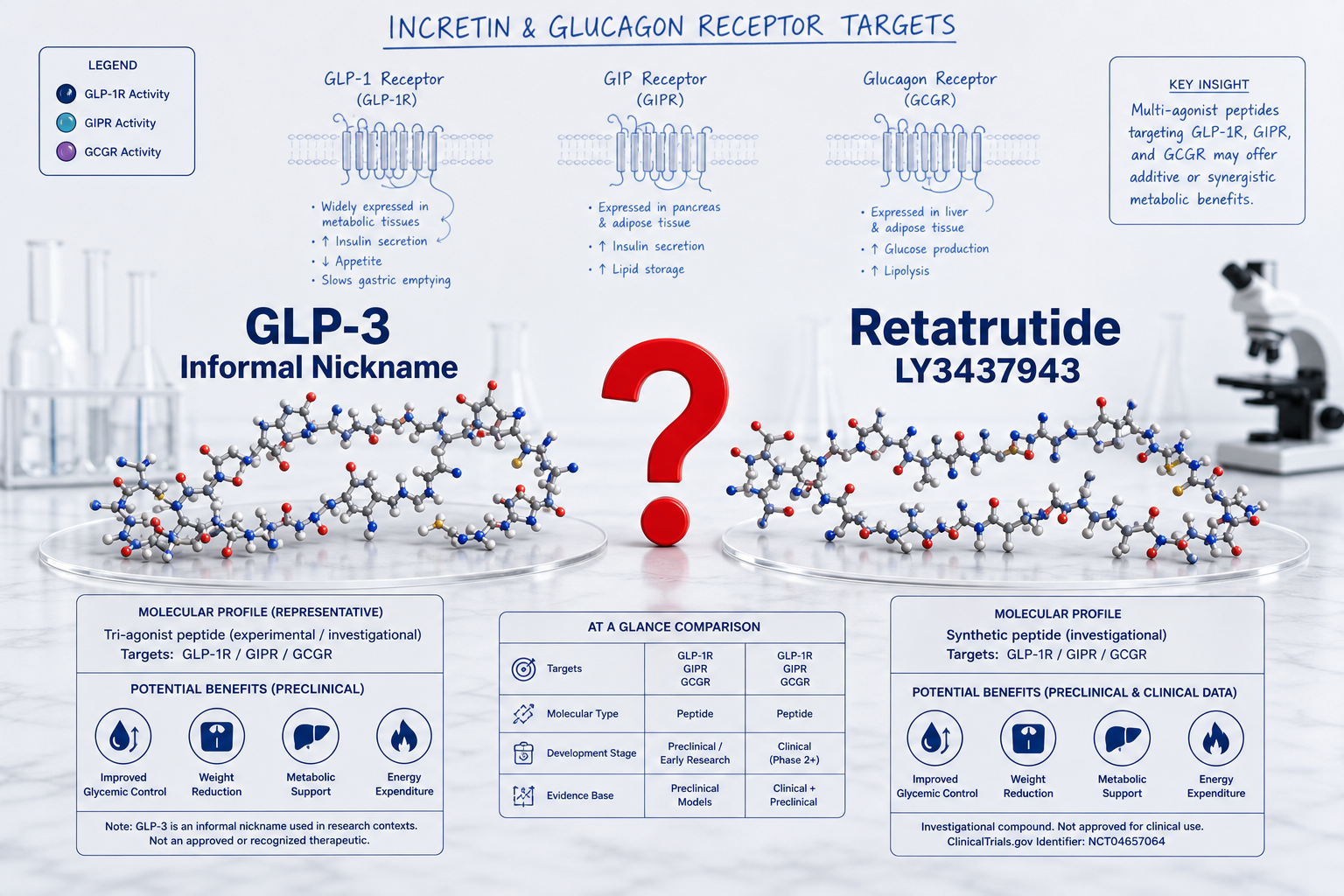
Key Takeaways
- "GLP-3" is an informal, consumer-driven nickname — not a recognized scientific classification for retatrutide.
- Retatrutide (LY3437943) is a triple-receptor agonist targeting GLP-1, GIP, and glucagon receptors simultaneously.
- Phase 3 trials have shown weight loss results as high as 28.7%, the highest ever recorded in an obesity drug trial.
- Terminology confusion can distort research interpretation, marketplace trust, and regulatory understanding.
- Researchers and buyers should verify compound identity by chemical name or CAS number, not informal labels.
What Is Retatrutide and Where Does "GLP-3" Come From
Retatrutide, developed by Eli Lilly under the code name LY3437943, is a first-in-class triple-receptor agonist. It activates three distinct hormone receptors at once:
| Receptor | Role in Metabolism |
|---|---|
| GLP-1 | Appetite suppression, insulin secretion |
| GIP | Fat metabolism, insulin sensitivity |
| Glucagon | Energy expenditure, liver fat reduction |
No approved drug before retatrutide has hit all three targets simultaneously. Semaglutide (Ozempic, Wegovy) targets only GLP-1. Tirzepatide (Mounjaro, Zepbound) targets GLP-1 and GIP. Retatrutide adds glucagon to the mix.
The nickname "GLP-3" emerged organically in consumer forums and social media. The logic was simple: GLP-1 targets one receptor, tirzepatide targets two, so this "third generation" drug must be GLP-3. The label stuck — but it is scientifically inaccurate.
"GLP-3" does not describe a receptor, a peptide family, or a drug class. It is marketing shorthand that has migrated into research discussions where precision is critical.
For a broader look at where peptide research is heading, the latest updates in peptide research provide useful context on how naming conventions evolve in this space.
Why the Naming Confusion Matters in Obesity Research and Clinical Trials

The stakes of this terminology gap become clear when looking at the trial data. In the TRIUMPH-4 Phase 3 trial, retatrutide produced a mean weight loss of 28.7% at 68 weeks in adults with obesity and knee osteoarthritis — the highest figure ever recorded in any Phase 3 obesity drug trial. The TRIUMPH-3 trial, presented at the American College of Cardiology Annual Scientific Session in March 2026, reported 24.2% mean weight loss at 72 weeks in adults with elevated cardiovascular risk.
These are landmark numbers. But when a researcher searches for "GLP-3 trial results" and finds a mix of retatrutide data alongside unrelated GLP receptor biology, the confusion compounds.
Three specific risks created by the GLP-3 label:
- Research misattribution: Studies on actual GLP receptor peptide biology get conflated with retatrutide clinical outcomes.
- Regulatory misunderstanding: Eli Lilly plans to file a New Drug Application in late 2026 or early 2027. Informal naming can create confusion in public commentary on regulatory submissions.
- Marketplace errors: Buyers searching for research-grade retatrutide may encounter mislabeled products. Reviewing a detailed GLP-3 and retatrutide compound overview helps clarify what is actually being sourced.
For those researching metabolic peptides more broadly, resources on AOD9604 metabolic research and tesa benefits show how naming precision matters across the entire category.
How Researchers and Buyers Can Navigate the GLP3 Peptide vs Retatrutide Naming Issue

The clearest solution is to anchor every discussion to the compound's chemical identity, not its nickname.
Best practices for accurate identification:
- Always reference retatrutide by its INN (International Nonproprietary Name) or Eli Lilly's code: LY3437943.
- Cross-check any "GLP-3" product listing against verified chemical specifications.
- Use peer-reviewed databases rather than consumer forums as primary sources.
- When sourcing for research, prioritize suppliers with transparent quality testing protocols and third-party verification.
The GLP-3 retatrutide product page and the RETA GLP-3 research overview are examples of how suppliers can bridge the naming gap by providing both the informal label and the verified compound name together.
For researchers exploring related metabolic compounds, the 5-Amino-1MQ research overview offers a useful parallel on how novel compounds gain informal names before formal classification catches up.
Conclusion
The GLP3 Peptide vs Retatrutide naming confusion is not a trivial issue. It shapes how clinical trial data is interpreted, how regulatory conversations unfold, and how research-grade compounds are sourced. Retatrutide is a precisely defined triple-receptor agonist with Phase 3 data that sets a new benchmark for obesity pharmacology. "GLP-3" is a convenient shorthand that, when used carelessly, undermines that precision.
Actionable next steps:
- Replace "GLP-3" with "retatrutide" or "LY3437943" in all research documentation.
- Verify any compound labeled "GLP-3" against its full chemical specification before use.
- Stay current with TRIUMPH trial publications and the anticipated NDA filing timeline.
- Source research peptides only from suppliers who publish verified testing data alongside both the common and scientific names.
Precision in language is the foundation of precision in science. In obesity research, where the stakes are high and the compounds are complex, that foundation matters more than ever.