
Ideal Dose and Dosing for KLOW Blend Peptide: A Complete 2026 Guide
Finding the ideal dose and dosing for KLOW blend peptide can feel overwhelming when you're navigating the complex world of peptide therapy. With countless anecdotes online and limited standardized protocols, peptide shoppers, fitness enthusiasts, and medi-spa professionals often struggle to determine safe, effective dosing strategies. The KLOW blend—a synergistic combination of KPV, LL-37, Oxytocin, and Wormwood extract—has emerged as a powerful option for those researching anti-inflammatory, antimicrobial, and wellness-supporting compounds. This comprehensive guide breaks down everything needed to understand proper dosing protocols, administration techniques, and safety considerations for KLOW blend peptide in 2026. 🔬
Key Takeaways
- Starting doses for KLOW blend peptide typically range from 100-200mcg daily, with gradual increases based on individual response and research goals
- Optimal maintenance dosing generally falls between 300-500mcg per day, administered subcutaneously for maximum bioavailability
- Reconstitution ratios and proper storage techniques are critical for maintaining peptide stability and ensuring accurate dosing
- Cycling protocols of 4-8 weeks followed by rest periods help maintain peptide effectiveness and minimize potential tolerance development
- Individual factors including body weight, research objectives, and sensitivity levels should guide personalized dosing strategies
Understanding KLOW Blend Peptide Composition
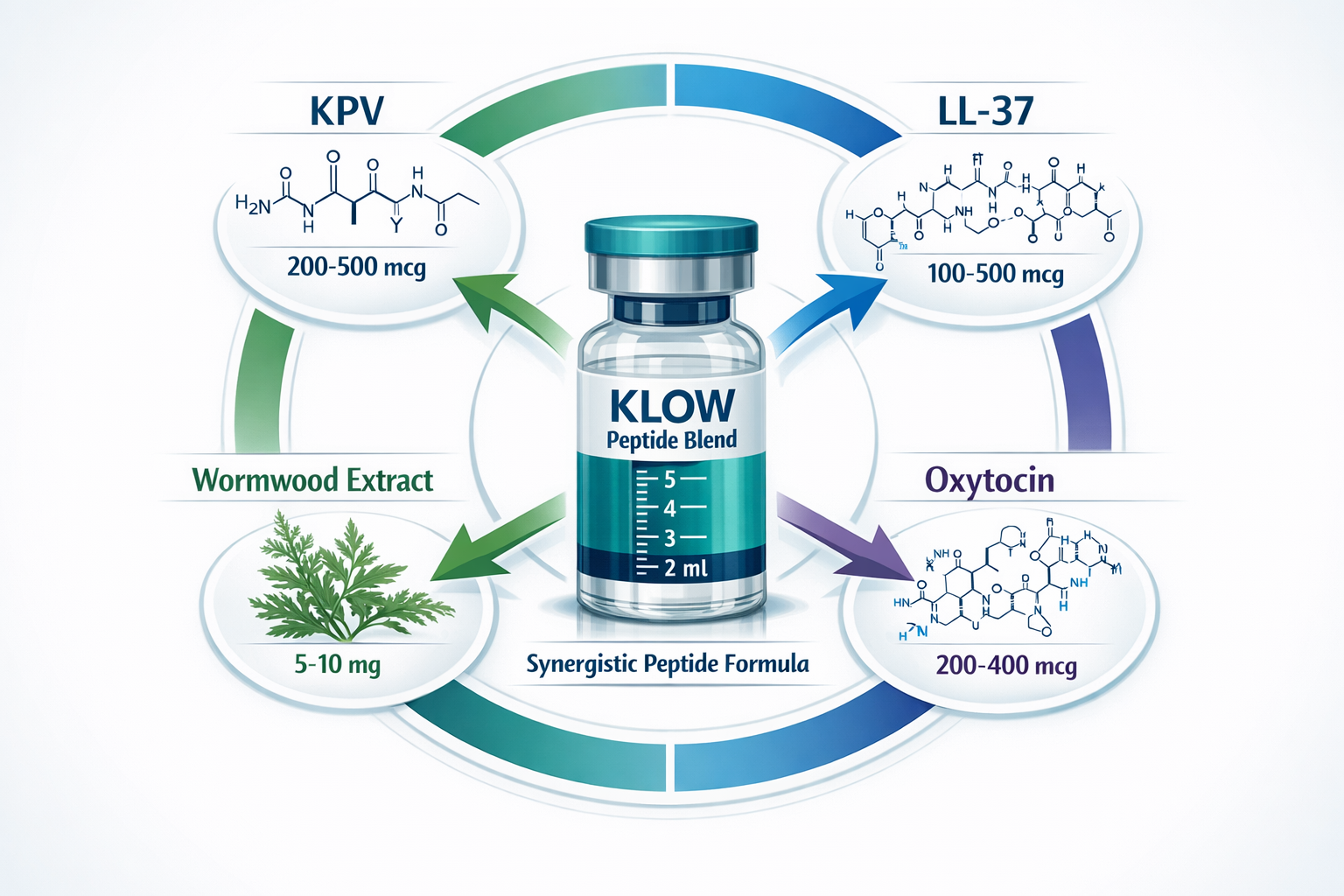
Before diving into the ideal dose and dosing for KLOW blend peptide, it's essential to understand what makes this formulation unique. The KLOW blend combines four distinct components, each contributing specific properties to the overall formula.
The Four Components of KLOW
KPV (Lys-Pro-Val) forms the foundation of this blend, representing a tripeptide derived from alpha-melanocyte-stimulating hormone (α-MSH). Research published in peptide science journals indicates KPV demonstrates notable anti-inflammatory properties at the cellular level. This component typically constitutes a significant portion of the KLOW formulation.
LL-37 serves as an antimicrobial peptide naturally occurring in the human body. This cathelicidin antimicrobial peptide plays roles in immune system modulation and has been extensively studied in clinical research settings. When combined with other KLOW components, LL-37 contributes to the blend's comprehensive wellness profile.
Oxytocin, often recognized for its role in social bonding and emotional regulation, adds a unique dimension to the KLOW blend. At specific dosing levels, oxytocin may support stress response modulation and overall well-being markers in research models.
Wormwood extract (Artemisia absinthium) completes the formulation, bringing botanical compounds that have been traditionally associated with digestive wellness and microbial balance. The inclusion of this herbal component distinguishes KLOW from purely synthetic peptide blends.
For those interested in exploring individual peptide components, Pure Tested Peptides offers comprehensive research-grade options. Understanding each element helps researchers make informed decisions about their peptide blend research protocols.
Ideal Dose and Dosing for KLOW Blend Peptide: Starting Protocols
Determining the ideal dose and dosing for KLOW blend peptide begins with establishing appropriate starting parameters. Conservative initial dosing allows researchers to assess individual response patterns while minimizing the risk of adverse reactions.
Beginner Dosing Guidelines
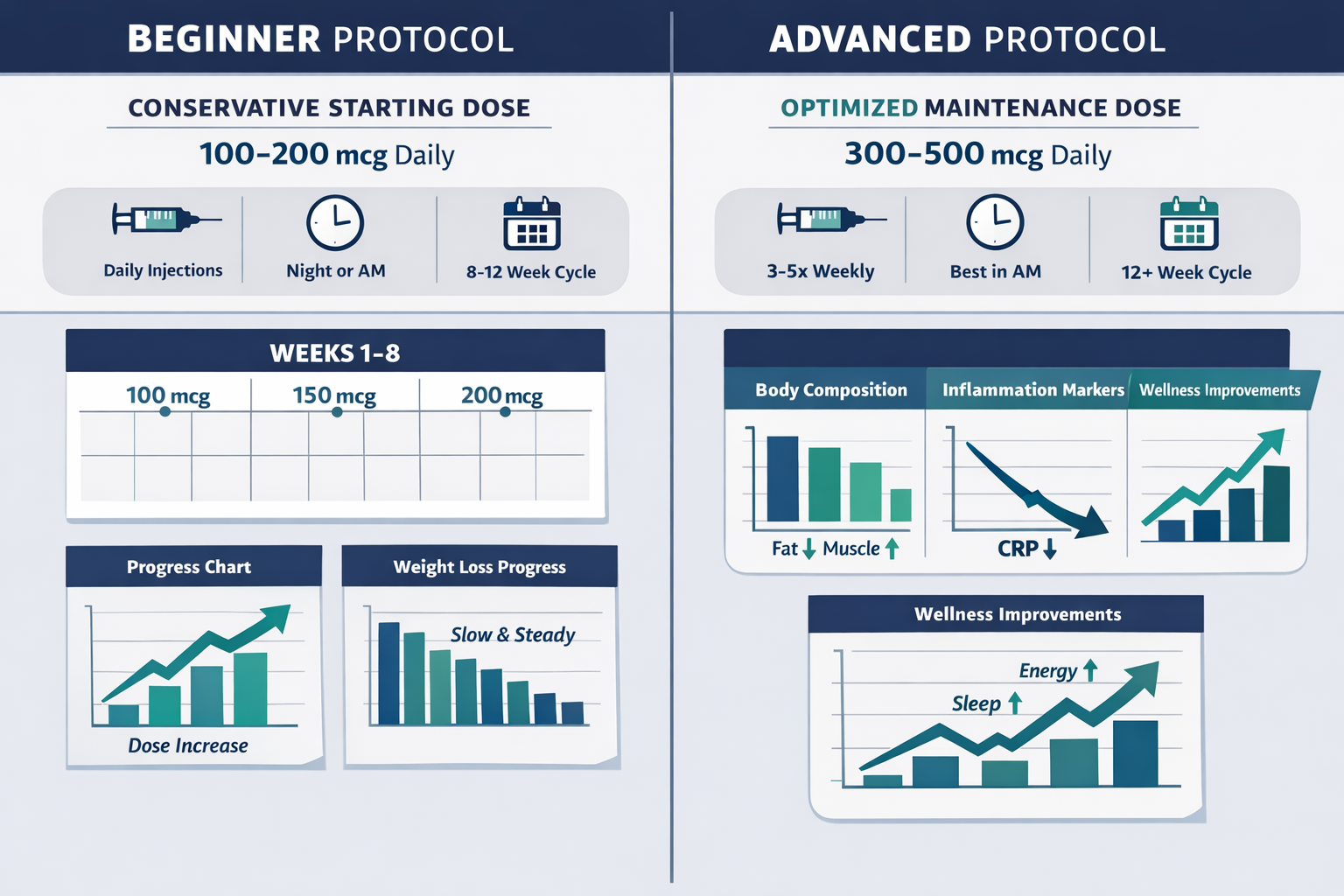
For those new to KLOW blend peptide research, starting doses of 100-200mcg daily represent the most commonly recommended approach in 2026. This conservative range allows for observation of initial responses while maintaining a safety-first methodology.
Week 1-2 Protocol:
- Begin with 100mcg administered once daily
- Optimal timing: morning administration on an empty stomach
- Monitor and document any observable changes
- Maintain consistent injection sites (rotating between abdomen, thighs)
Week 3-4 Adjustment:
- If well-tolerated, increase to 150mcg daily
- Continue once-daily administration schedule
- Assess response patterns and document findings
- Consider splitting dose if preferred (75mcg twice daily)
The subcutaneous route of administration remains the gold standard for KLOW blend peptide delivery. This method ensures reliable absorption and bioavailability compared to oral routes, which face degradation challenges in the digestive system.
Reconstitution and Preparation
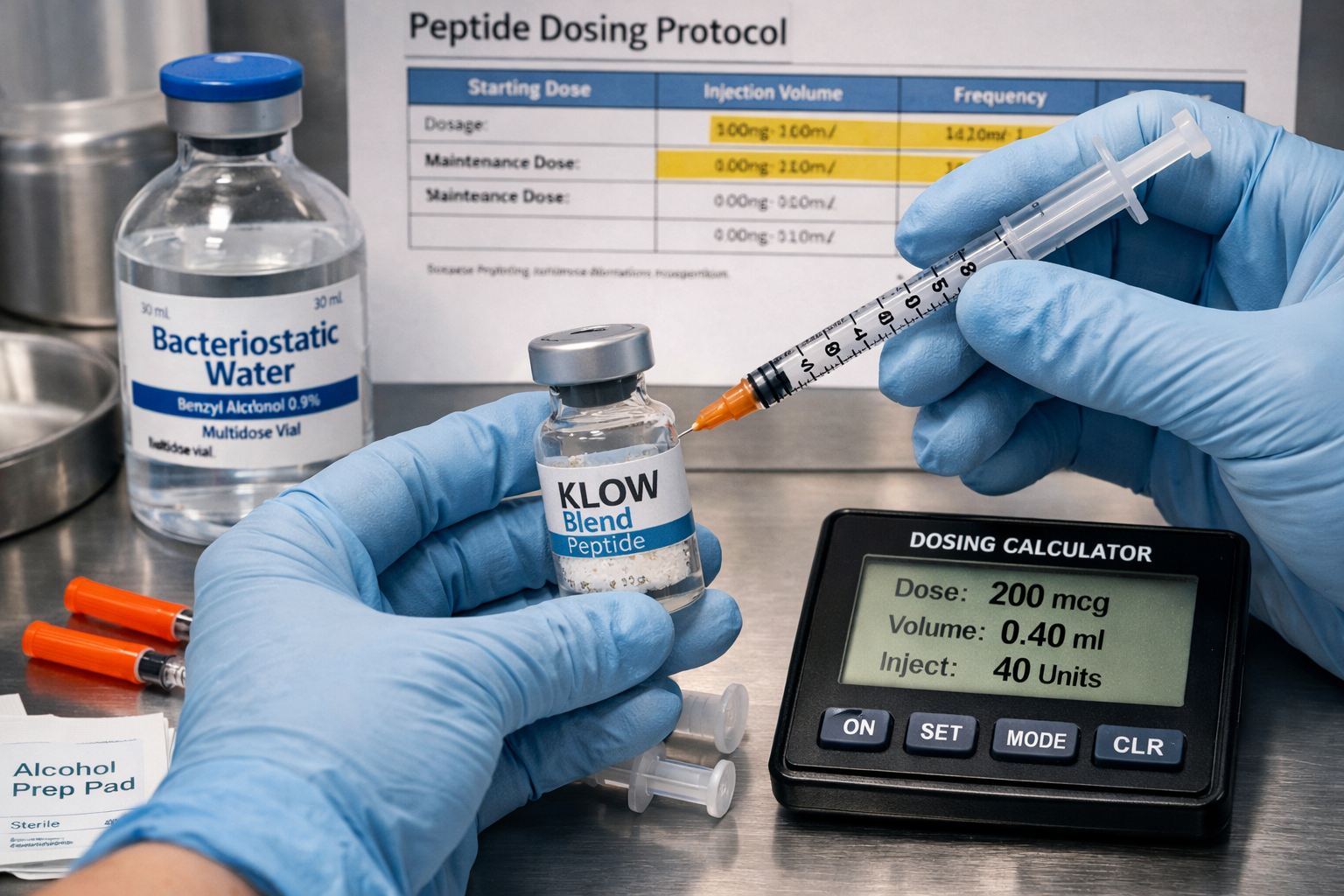
Proper reconstitution is crucial for achieving accurate dosing. KLOW blend peptide typically arrives as lyophilized powder requiring reconstitution with bacteriostatic water.
Standard Reconstitution Ratio:
- 5mg KLOW blend peptide powder
- 2ml bacteriostatic water
- Final concentration: 2.5mg/ml (2,500mcg/ml)
With this concentration, a 100mcg dose equals 0.04ml on an insulin syringe. A 200mcg dose equals 0.08ml. Using a calculator or conversion chart ensures dosing accuracy and prevents errors that could compromise research outcomes.
Those researching related compounds might find valuable information in resources about 5-amino-1-mq dosage protocols, as similar principles apply across peptide research methodologies. Additionally, exploring all products for sale can provide context for complementary research compounds.
Optimal Maintenance Dosing for KLOW Blend Peptide
Once initial tolerance has been established, advancing to maintenance dosing represents the next phase in KLOW blend peptide research protocols. The ideal dose and dosing for KLOW blend peptide at the maintenance level typically increases from starting parameters.
Standard Maintenance Ranges
Maintenance dosing for KLOW blend peptide generally falls within 300-500mcg daily for most research applications. This range has been observed in various research contexts and represents a balance between effectiveness and conservative administration.
| Experience Level | Daily Dose Range | Administration Frequency | Typical Duration |
|---|---|---|---|
| Beginner | 100-200mcg | Once daily | 2-4 weeks |
| Intermediate | 200-350mcg | Once or twice daily | 4-6 weeks |
| Advanced | 300-500mcg | Split into 2 doses | 6-8 weeks |
| Research Maximum | Up to 600mcg | Twice daily | Limited duration |
Split Dosing Considerations
Many researchers find that splitting daily doses into two administrations (morning and evening) provides more consistent results than single larger doses. For example, a 400mcg daily protocol might be divided into:
- 200mcg upon waking (6-8 AM)
- 200mcg before bed (9-11 PM)
This approach maintains more stable peptide levels throughout the 24-hour cycle and may optimize the synergistic effects of the KLOW blend components.
Body Weight Adjustments
While not universally applied, some research protocols adjust KLOW blend peptide dosing based on body weight:
- Under 150 lbs: 250-350mcg daily
- 150-200 lbs: 350-450mcg daily
- Over 200 lbs: 450-550mcg daily
These ranges serve as general guidelines rather than strict rules. Individual response patterns should always take precedence over weight-based calculations.
For fitness enthusiasts exploring peptide options, comparing best peptide kits for beginner researchers can provide valuable context for comprehensive research approaches. The all products for sale page offers additional options for those building complete research protocols.
Administration Techniques and Timing
Proper administration technique directly impacts the effectiveness of any dosing protocol. Understanding the ideal dose and dosing for KLOW blend peptide includes mastering injection methodology and timing considerations.
Subcutaneous Injection Best Practices
Subcutaneous (SubQ) injection remains the preferred method for KLOW blend peptide administration. This technique involves injecting into the fatty tissue layer between skin and muscle.
Step-by-Step Injection Protocol:
-
Preparation Phase 🧪
- Wash hands thoroughly with antibacterial soap
- Gather supplies: reconstituted peptide, insulin syringe, alcohol wipes
- Allow refrigerated peptide to reach room temperature (10-15 minutes)
-
Drawing the Dose
- Remove cap from peptide vial
- Wipe vial top with alcohol swab
- Draw air into syringe equal to dose amount
- Insert needle into vial and inject air
- Invert vial and draw peptide solution slowly
- Check for air bubbles; tap syringe and expel if present
-
Injection Site Selection
- Rotate between approved sites: abdomen, thighs, upper arms
- Choose area with adequate subcutaneous fat
- Avoid areas with scar tissue, bruising, or irritation
- Clean injection site with alcohol wipe in circular motion
-
Injection Technique
- Pinch skin to create a fold
- Insert needle at 45-90 degree angle (depending on fat thickness)
- Inject slowly and steadily over 5-10 seconds
- Release skin fold and withdraw needle
- Apply gentle pressure with clean gauze (do not rub)
Optimal Timing Strategies
Morning administration on an empty stomach remains the most popular timing strategy for KLOW blend peptide. This approach capitalizes on natural circadian rhythms and avoids potential interference from food intake.
Timing Options:
- ⏰ Upon waking: 30-60 minutes before breakfast
- 🌙 Before bed: 2-3 hours after last meal
- 🔄 Split dosing: Morning and evening for higher doses
Consistency in timing helps maintain stable peptide levels and allows for better tracking of response patterns. Setting daily reminders or alarms can support adherence to dosing schedules.
Those researching comprehensive peptide protocols might benefit from exploring benefits of the KLOW and GLOW blends to understand complementary formulations. Additionally, the all products for sale section provides access to various research compounds.
Cycling and Duration Protocols
Understanding cycling strategies forms a critical component of the ideal dose and dosing for KLOW blend peptide. Proper cycling helps maintain peptide effectiveness while allowing the body's natural systems to reset.
Standard Cycling Approaches
4-8 week cycles represent the most commonly observed protocol for KLOW blend peptide research. This duration provides sufficient time to observe effects while preventing potential tolerance development.
Basic Cycling Protocol:
- Weeks 1-6: Active dosing phase (100-500mcg daily based on experience)
- Weeks 7-10: Rest period (no KLOW administration)
- Weeks 11-16: Optional second cycle with adjusted dosing
Rest Period Importance
Rest periods between cycles serve multiple purposes in peptide research:
✅ Receptor sensitivity maintenance – Prevents downregulation of peptide receptors
✅ Baseline assessment – Allows evaluation of lasting effects
✅ Safety monitoring – Provides time for comprehensive health marker assessment
✅ Cost efficiency – Reduces overall peptide consumption and expense
During rest periods, many researchers maintain detailed logs of any changes or observations. This data helps inform adjustments for subsequent cycles.
Extended Protocol Considerations
Some research contexts explore extended protocols lasting 12-16 weeks, particularly when investigating long-term effects. These approaches typically involve:
- Lower maintenance doses (200-300mcg daily)
- Monthly assessment checkpoints
- Flexible adjustment windows
- Extended rest periods (4-6 weeks minimum)
Research Note: Extended protocols should only be undertaken with comprehensive monitoring and documentation. Individual response patterns vary significantly, making personalized approaches essential.
For those interested in related peptide research, exploring best peptide for joint muscle pain and recovery can provide complementary information. The all products for sale page offers additional research options.
Safety Considerations and Monitoring
Responsible research with KLOW blend peptide requires attention to safety protocols and ongoing monitoring. The ideal dose and dosing for KLOW blend peptide must always be balanced against individual tolerance and response patterns.
Common Observations and Management
While KLOW blend peptide is generally well-tolerated in research settings, some individuals may experience various responses:
Injection Site Reactions:
- Mild redness or swelling at injection site
- Temporary discomfort or itching
- Management: Rotate injection sites, ensure proper technique, apply cold compress if needed
Systemic Responses:
- Mild headache (typically transient)
- Temporary fatigue or energy fluctuations
- Digestive changes
- Management: Reduce dose, increase hydration, monitor patterns
Rare Observations:
- Allergic reactions (discontinue immediately if suspected)
- Unusual persistent symptoms
- Action: Cease administration and seek professional consultation
Monitoring Best Practices
Comprehensive monitoring supports safe and effective KLOW blend peptide research:
📊 Documentation Protocol:
- Daily dose amounts and timing
- Injection sites used
- Any observable changes or responses
- Baseline measurements (weight, body composition, wellness markers)
- Weekly progress photos (if applicable to research goals)
🔬 Periodic Assessment:
- Monthly review of documented observations
- Comparison to baseline measurements
- Adjustment of protocols based on findings
- Consultation with qualified professionals when appropriate
Contraindications and Precautions
Certain situations warrant extra caution or avoidance of KLOW blend peptide research:
⚠️ Exercise Caution With:
- Known allergies to peptide compounds
- Active infections or immune system concerns
- Pregnancy or nursing (research contraindicated)
- Existing medical conditions requiring professional oversight
- Concurrent use of multiple peptide compounds (without proper planning)
The adaptive capacity and peptide mapping resource provides additional context for understanding individual response variations. Researchers should also review all products for sale to ensure they're selecting appropriate compounds for their specific research objectives.
Storage and Handling Guidelines
Proper storage and handling directly impact the stability and effectiveness of KLOW blend peptide. Understanding these requirements ensures that dosing protocols deliver consistent results.
Lyophilized Powder Storage
Unopened vials of KLOW blend peptide in powder form should be stored:
- Temperature: 2-8°C (refrigerated) for optimal stability
- Alternative: -20°C (frozen) for extended storage (up to 2 years)
- Protection: Keep away from light and moisture
- Location: Store in original packaging until ready for use
Reconstituted Solution Storage
Once reconstituted with bacteriostatic water, storage requirements become more stringent:
❄️ Refrigeration Requirements:
- Temperature: 2-8°C (36-46°F) consistently
- Duration: Use within 30 days of reconstitution
- Container: Keep in original sterile vial with rubber stopper
- Protection: Store away from light (use amber vials or wrap in foil)
🚫 Avoid:
- Freezing reconstituted peptide solutions
- Storing at room temperature for extended periods
- Exposure to direct sunlight or heat sources
- Contamination from non-sterile handling
Handling Best Practices
Maintaining sterility and proper handling techniques preserves peptide integrity:
- Always use sterile technique when accessing vials
- Wipe vial tops with alcohol before each needle insertion
- Use fresh needles for each draw and injection
- Minimize air exposure by working quickly and efficiently
- Check solution clarity before each use (should be clear, not cloudy)
- Discard if contaminated or past expiration date
Travel Considerations
Transporting KLOW blend peptide requires planning to maintain proper storage conditions:
- Use insulated cooler bags with ice packs
- Monitor temperature with portable thermometer
- Plan for refrigeration access at destination
- Consider timing cycles to avoid travel during active dosing
- Keep peptides in carry-on luggage (not checked baggage)
For those building comprehensive research protocols, exploring best peptide retail US options can ensure access to quality compounds. The all products for sale section provides additional storage and handling information for various peptide formulations.
Factors Affecting Individual Dosing
The ideal dose and dosing for KLOW blend peptide varies significantly between individuals based on multiple factors. Personalization represents a key principle in peptide research protocols.
Body Composition Variables
Body weight and composition influence peptide distribution and metabolism:
- Higher lean muscle mass may require adjusted dosing
- Body fat percentage affects subcutaneous injection depth and absorption
- Metabolic rate impacts peptide clearance timing
- Hydration status influences distribution volume
Research Objectives
Different research goals may warrant different dosing strategies:
Anti-inflammatory Research:
- Moderate doses (250-400mcg daily)
- Consistent daily administration
- Longer cycle durations (6-8 weeks)
Immune System Studies:
- Variable dosing based on research phase
- Potential for higher doses (400-500mcg daily)
- Cycling with assessment periods
General Wellness Exploration:
- Conservative doses (200-300mcg daily)
- Flexible administration schedules
- Emphasis on long-term sustainability
Sensitivity and Response Patterns
Individual sensitivity to peptides varies widely:
High Sensitivity Indicators:
- Strong responses to lower doses
- Pronounced effects within first week
- May require dose reduction from standard protocols
Lower Sensitivity Indicators:
- Minimal response to starting doses
- Gradual effects over several weeks
- May benefit from higher end of dosing ranges
Age and Metabolic Factors
Age-related considerations impact peptide research protocols:
- Younger individuals (18-35): Often respond well to standard dosing
- Middle age (35-55): May benefit from moderate adjustments
- Older researchers (55+): Sometimes require longer assessment periods
Metabolic health markers also influence optimal dosing:
- Insulin sensitivity status
- Thyroid function indicators
- Overall metabolic efficiency
- Digestive health and absorption capacity
Those exploring complementary research might find value in applied wellness research with peptides for broader context. The all products for sale page offers various options for personalized research approaches.
Combining KLOW with Other Research Compounds
Many researchers explore KLOW blend peptide alongside other compounds to investigate synergistic effects. Understanding potential combinations helps optimize research protocols while maintaining safety.
Compatible Peptide Combinations
KLOW + GLOW Blend:
This popular combination pairs the anti-inflammatory focus of KLOW with the skin-supporting properties of GLOW blend. Researchers typically administer these separately:
- KLOW in morning (200-400mcg)
- GLOW in evening (according to GLOW protocols)
KLOW + Recovery Peptides:
Some fitness-focused research combines KLOW with recovery-supporting compounds:
- Standard KLOW dosing (300-400mcg daily)
- Recovery peptides administered post-workout
- Minimum 4-hour spacing between different peptides
KLOW + Metabolic Research Compounds:
Researchers exploring metabolic wellness sometimes pair KLOW with compounds like 5-amino-1-mq:
- KLOW: Morning administration (250-350mcg)
- Metabolic compounds: According to specific protocols
- Careful monitoring of combined effects
Stacking Considerations
When combining multiple research compounds, several principles apply:
✅ Spacing Protocol:
- Allow minimum 2-4 hours between different peptide administrations
- Rotate injection sites to avoid tissue saturation
- Document timing of each compound carefully
✅ Dose Adjustments:
- Consider reducing individual compound doses when stacking
- Start with lower ends of dosing ranges
- Increase gradually based on response patterns
✅ Monitoring Intensity:
- Increase documentation frequency
- Pay closer attention to any unusual responses
- Maintain clear records of which compounds are active
Compounds to Separate
Some research compounds should not be combined with KLOW blend peptide without careful planning:
⚠️ Exercise Caution:
- Multiple anti-inflammatory peptides simultaneously
- Compounds with overlapping mechanisms
- Excessive total peptide load (>3-4 compounds concurrently)
For those interested in peptide synergies, exploring resources like synergy of LL37 and MOTS-C provides valuable insights into combination research. The all products for sale section offers comprehensive options for building research protocols.
Cost Considerations and Sourcing
Understanding the financial aspects of KLOW blend peptide research helps researchers plan sustainable protocols. The ideal dose and dosing for KLOW blend peptide directly impacts overall research costs.
Dosing and Cost Relationship
Monthly cost estimates based on different dosing protocols:
| Daily Dose | Monthly Usage | Approximate Cost Range* |
|---|---|---|
| 200mcg | 6mg total | $80-$120 |
| 300mcg | 9mg total | $120-$180 |
| 400mcg | 12mg total | $160-$240 |
| 500mcg | 15mg total | $200-$300 |
*Costs vary by supplier, quantity purchased, and current market conditions in 2026
Bulk Purchase Considerations
Many researchers find that purchasing larger quantities reduces per-milligram costs:
- Single 5mg vial: Higher per-mg cost
- Three 5mg vials: 10-15% savings typically
- Five+ vials: 15-25% savings often available
However, bulk purchasing requires consideration of:
- Storage capacity and conditions
- Expiration dates and usage timeline
- Commitment to specific research protocols
- Budget allocation over time
Quality vs. Price Balance
While cost matters, quality should remain paramount in peptide research:
🔬 Quality Indicators:
- Third-party testing and certificates of analysis
- Transparent sourcing and manufacturing information
- Proper packaging and storage during shipping
- Responsive customer support and research resources
- Established reputation in peptide research community
💰 False Economy Warning:
Extremely low-priced peptides may indicate:
- Questionable purity levels
- Improper storage or handling
- Lack of quality control testing
- Potential contamination risks
Sourcing Best Practices
When selecting a KLOW blend peptide supplier:
- Verify third-party testing documentation
- Review customer feedback from research community
- Assess shipping methods and temperature control
- Evaluate customer service responsiveness
- Compare total value (not just price)
Pure Tested Peptides provides comprehensive quality documentation and transparent sourcing information for researchers prioritizing reliability. Their all products for sale section offers detailed product information and testing results.
Troubleshooting Common Dosing Challenges
Even with careful planning, researchers may encounter challenges when implementing KLOW blend peptide protocols. Addressing these issues helps optimize research outcomes.
Inconsistent Results
Problem: Effects seem to vary significantly day-to-day or week-to-week.
Potential Solutions:
- Review reconstitution technique for accuracy
- Verify consistent storage temperatures
- Check injection technique and site rotation
- Assess timing consistency (same time daily)
- Evaluate concurrent lifestyle factors (sleep, nutrition, stress)
- Consider dose adjustment (may be too high or too low)
Minimal Observable Effects
Problem: Little to no noticeable changes after several weeks at standard doses.
Potential Approaches:
- Extend assessment period (some effects develop gradually)
- Increase dose incrementally (add 50-100mcg weekly)
- Verify peptide quality and storage conditions
- Review administration technique
- Consider individual sensitivity factors
- Assess realistic expectations for research timeline
Injection Site Issues
Problem: Persistent redness, swelling, or discomfort at injection sites.
Management Strategies:
- Ensure proper injection technique (angle, depth, speed)
- Rotate sites more frequently (different location each day)
- Allow peptide to reach room temperature before injection
- Verify needle gauge appropriateness (typically 29-31G)
- Check for potential sensitivity to bacteriostatic water preservatives
- Consider switching injection locations (abdomen vs. thigh)
Reconstitution Difficulties
Problem: Powder doesn't dissolve completely or solution appears cloudy.
Resolution Steps:
- Inject bacteriostatic water slowly down vial side (not directly onto powder)
- Gently swirl vial (never shake vigorously)
- Allow 5-10 minutes for complete dissolution
- Refrigerate if slight cloudiness persists, check after 30 minutes
- Discard if solution remains cloudy or shows particles
- Contact supplier if problem persists across multiple vials
Dose Calculation Errors
Problem: Uncertainty about accurate dose measurement on insulin syringe.
Clarification Tools:
- Use online peptide calculators for verification
- Create reference chart for common doses
- Mark syringe with permanent marker at target volume
- Practice drawing air to visualize volume before using peptide
- Consider pre-loading syringes for weekly use (if storage permits)
For additional guidance on peptide research methodologies, exploring baseline trends and data quality can provide valuable context. The all products for sale page offers resources and support materials for researchers.
<!DOCTYPE html>
<html lang="en">
<head>
    <meta charset="UTF-8">
    <meta name="viewport" content="width=device-width, initial-scale=1.0">
    <title>KLOW Blend Peptide Dosing Calculator</title>
    <style>
        * {
            margin: 0;
            padding: 0;
            box-sizing: border-box;
        }

        .cg-calculator-container {
            max-width: 800px;
            margin: 20px auto;
            padding: 30px;
            background: linear-gradient(135deg, #667eea 0%, #764ba2 100%);
            border-radius: 20px;
            box-shadow: 0 10px 40px rgba(0,0,0,0.2);
            font-family: 'Segoe UI', Tahoma, Geneva, Verdana, sans-serif;
        }

        .cg-calculator-title {
            color: white;
            text-align: center;
            font-size: 28px;
            margin-bottom: 10px;
            font-weight: 700;
        }

        .cg-calculator-subtitle {
            color: rgba(255,255,255,0.9);
            text-align: center;
            font-size: 14px;
            margin-bottom: 25px;
        }

        .cg-calculator-content {
            background: white;
            padding: 30px;
            border-radius: 15px;
        }

        .cg-input-group {
            margin-bottom: 25px;
        }

        .cg-label {
            display: block;
            color: #333;
            font-weight: 600;
            margin-bottom: 8px;
            font-size: 15px;
        }

        .cg-input, .cg-select {
            width: 100%;
            padding: 12px 15px;
            border: 2px solid #e0e0e0;
            border-radius: 8px;
            font-size: 16px;
            transition: border-color 0.3s;
        }

        .cg-input:focus, .cg-select:focus {
            outline: none;
            border-color: #667eea;
        }

        .cg-slider {
            width: 100%;
            height: 8px;
            border-radius: 5px;
            background: #e0e0e0;
            outline: none;
            -webkit-appearance: none;
        }

        .cg-slider::-webkit-slider-thumb {
            -webkit-appearance: none;
            appearance: none;
            width: 24px;
            height: 24px;
            border-radius: 50%;
            background: #667eea;
            cursor: pointer;
            box-shadow: 0 2px 8px rgba(102,126,234,0.4);
        }

        .cg-slider::-moz-range-thumb {
            width: 24px;
            height: 24px;
            border-radius: 50%;
            background: #667eea;
            cursor: pointer;
            border: none;
            box-shadow: 0 2px 8px rgba(102,126,234,0.4);
        }

        .cg-slider-value {
            display: inline-block;
            background: #667eea;
            color: white;
            padding: 4px 12px;
            border-radius: 20px;
            font-weight: 600;
            margin-left: 10px;
            font-size: 14px;
        }

        .cg-calculate-btn {
            width: 100%;
            padding: 15px;
            background: linear-gradient(135deg, #667eea 0%, #764ba2 100%);
            color: white;
            border: none;
            border-radius: 10px;
            font-size: 18px;
            font-weight: 700;
            cursor: pointer;
            transition: transform 0.2s, box-shadow 0.2s;
            margin-top: 10px;
        }

        .cg-calculate-btn:hover {
            transform: translateY(-2px);
            box-shadow: 0 5px 20px rgba(102,126,234,0.4);
        }

        .cg-calculate-btn:active {
            transform: translateY(0);
        }

        .cg-results {
            margin-top: 30px;
            padding: 25px;
            background: #f8f9ff;
            border-radius: 12px;
            border-left: 5px solid #667eea;
            display: none;
        }

        .cg-results.cg-show {
            display: block;
            animation: cg-slideIn 0.4s ease;
        }

        @keyframes cg-slideIn {
            from {
                opacity: 0;
                transform: translateY(20px);
            }
            to {
                opacity: 1;
                transform: translateY(0);
            }
        }

        .cg-result-title {
            color: #667eea;
            font-size: 20px;
            font-weight: 700;
            margin-bottom: 15px;
        }

        .cg-result-item {
            padding: 12px;
            margin-bottom: 10px;
            background: white;
            border-radius: 8px;
            display: flex;
            justify-content: space-between;
            align-items: center;
        }

        .cg-result-label {
            color: #555;
            font-weight: 600;
        }

        .cg-result-value {
            color: #667eea;
            font-weight: 700;
            font-size: 18px;
        }

        .cg-info-box {
            margin-top: 15px;
            padding: 15px;
            background: #fff3cd;
            border-left: 4px solid #ffc107;
            border-radius: 6px;
            font-size: 13px;
            color: #856404;
        }

        .cg-recommendation {
            margin-top: 15px;
            padding: 15px;
            background: #d1ecf1;
            border-left: 4px solid #17a2b8;
            border-radius: 6px;
            color: #0c5460;
        }

        .cg-recommendation-title {
            font-weight: 700;
            margin-bottom: 8px;
            font-size: 15px;
        }

        @media (max-width: 600px) {
            .cg-calculator-container {
                padding: 20px 15px;
            }

            .cg-calculator-content {
                padding: 20px;
            }

            .cg-calculator-title {
                font-size: 22px;
            }

            .cg-result-item {
                flex-direction: column;
                align-items: flex-start;
                gap: 5px;
            }
        }
    </style>
</head>
<body>
    <div class="cg-calculator-container">
        <h1 class="cg-calculator-title">🧪 KLOW Blend Peptide Dosing Calculator</h1>
        <p class="cg-calculator-subtitle">Calculate your ideal dose and syringe measurements</p>

        <div class="cg-calculator-content">
            <div class="cg-input-group">
                <label class="cg-label">Experience Level</label>
                <select id="cg-experience" class="cg-select">
                    <option value="beginner">Beginner (First 4 weeks)</option>
                    <option value="intermediate">Intermediate (4-8 weeks)</option>
                    <option value="advanced">Advanced (8+ weeks)</option>
                </select>
            </div>

            <div class="cg-input-group">
                <label class="cg-label">Body Weight (lbs)</label>
                <input type="number" id="cg-weight" class="cg-input" placeholder="Enter your weight" value="170" min="100" max="350">
            </div>

            <div class="cg-input-group">
                <label class="cg-label">
                    Desired Daily Dose (mcg): <span class="cg-slider-value" id="cg-dose-display">300</span>
                </label>
                <input type="range" id="cg-dose" class="cg-slider" min="100" max="600" value="300" step="50">
            </div>

            <div class="cg-input-group">
                <label class="cg-label">Peptide Amount (mg)</label>
                <input type="number" id="cg-peptide-amount" class="cg-input" value="5" min="1" max="20">
            </div>

            <div class="cg-input-group">
                <label class="cg-label">Bacteriostatic Water (ml)</label>
                <input type="number" id="cg-water-amount" class="cg-input" value="2" min="1" max="5" step="0.1">
            </div>

            <div class="cg-input-group">
                <label class="cg-label">Doses Per Day</label>
                <select id="cg-frequency" class="cg-select">
                    <option value="1">Once daily</option>
                    <option value="2">Twice daily (split dose)</option>
                </select>
            </div>

            <button class="cg-calculate-btn" onclick="cgCalculateDose()">Calculate My Dosing Protocol</button>

            <div id="cg-results" class="cg-results">
                <div class="cg-result-title">📊 Your Personalized Dosing Protocol</div>

                <div class="cg-result-item">
                    <span class="cg-result-label">Daily Dose:</span>
                    <span class="cg-result-value" id="cg-daily-dose">--</span>
                </div>

                <div class="cg-result-item">
                    <span class="cg-result-label">Per-Injection Dose:</span>
                    <span class="cg-result-value" id="cg-per-injection">--</span>
                </div>

                <div class="cg-result-item">
                    <span class="cg-result-label">Syringe Measurement:</span>
                    <span class="cg-result-value" id="cg-syringe-ml">--</span>
                </div>

                <div class="cg-result-item">
                    <span class="cg-result-label">Concentration:</span>
                    <span class="cg-result-value" id="cg-concentration">--</span>
                </div>

                <div class="cg-result-item">
                    <span class="cg-result-label">Vial Duration:</span>
                    <span class="cg-result-value" id="cg-duration">--</span>
                </div>

                <div class="cg-result-item">
                    <span class="cg-result-label">Monthly Cost Estimate:</span>
                    <span class="cg-result-value" id="cg-monthly-cost">--</span>
                </div>

                <div class="cg-recommendation">
                    <div class="cg-recommendation-title">💡 Personalized Recommendations</div>
                    <div id="cg-recommendation-text"></div>
                </div>

                <div class="cg-info-box">
                    ⚠️ <strong>Important:</strong> These calculations are for research purposes only. Always verify measurements before administration and consult relevant resources for comprehensive protocols.
                </div>
            </div>
        </div>
    </div>

    <script>
        // Update slider display
        document.getElementById('cg-dose').addEventListener('input', function() {
            document.getElementById('cg-dose-display').textContent = this.value;
        });

        function cgCalculateDose() {
            // Get input values
            const experience = document.getElementById('cg-experience').value;
            const weight = parseFloat(document.getElementById('cg-weight').value);
            const desiredDose = parseFloat(document.getElementById('cg-dose').value);
            const peptideAmount = parseFloat(document.getElementById('cg-peptide-amount').value);
            const waterAmount = parseFloat(document.getElementById('cg-water-amount').value);
            const frequency = parseInt(document.getElementById('cg-frequency').value);

            // Validate inputs
            if (!weight || weight < 100 || weight > 350) {
                alert('Please enter a valid weight between 100-350 lbs');
                return;
            }

            // Calculate concentration (mcg/ml)
            const concentration = (peptideAmount * 1000) / waterAmount;

            // Calculate per-injection dose
            const perInjectionDose = desiredDose / frequency;

            // Calculate syringe measurement in ml
            const syringeMl = perInjectionDose / concentration;

            // Calculate vial duration
            const totalDoses = (peptideAmount * 1000) / desiredDose;
            const durationDays = Math.floor(totalDoses);

            // Estimate monthly cost (rough estimate)
            const vialsPerMonth = 30 / durationDays;
            const costPerVial = 100; // Average estimate
            const monthlyCost = Math.round(vialsPerMonth * costPerVial);

            // Display results
            document.getElementById('cg-daily-dose').textContent = desiredDose + ' mcg';
            document.getElementById('cg-per-injection').textContent = perInjectionDose.toFixed(0) + ' mcg';
            document.getElementById('cg-syringe-ml').textContent = syringeMl.toFixed(3) + ' ml (' + (syringeMl * 100).toFixed(1) + ' units)';
            document.getElementById('cg-concentration').textContent = concentration.toFixed(0) + ' mcg/ml';
            document.getElementById('cg-duration').textContent = durationDays + ' days';
            document.getElementById('cg-monthly-cost').textContent = '$' + monthlyCost + ' - $' + Math.round(monthlyCost * 1.5);

            // Generate recommendations
            let recommendations = '';

            if (experience === 'beginner' && desiredDose > 250) {
                recommendations += '⚠️ Consider starting with a lower dose (100-200mcg) for your first 2-4 weeks.<br><br>';
            }

            if (weight < 150 && desiredDose > 400) {
                recommendations += '💭 Your dose may be high relative to body weight. Consider 250-350mcg range.<br><br>';
            }

            if (weight > 200 && desiredDose < 300) {
                recommendations += '💭 You may benefit from slightly higher dosing (350-450mcg) based on body weight.<br><br>';
            }

            if (frequency === 2) {
                recommendations += '✅ Split dosing protocol selected. Administer doses 8-12 hours apart (e.g., morning and evening).<br><br>';
            } else {
                recommendations += '✅ Single daily dose. Best administered in the morning, 30-60 minutes before breakfast.<br><br>';
            }

            if (durationDays < 20) {
                recommendations += '📦 Your current protocol uses peptide quickly. Consider bulk purchasing for cost savings.<br><br>';
            }

            recommendations += '🔄 Recommended cycle: ' + (experience === 'beginner' ? '4-6 weeks active, 3-4 weeks rest' : '6-8 weeks active, 4-6 weeks rest');

            document.getElementById('cg-recommendation-text').innerHTML = recommendations;

            // Show results with animation
            const resultsDiv = document.getElementById('cg-results');
            resultsDiv.classList.add('cg-show');
            resultsDiv.scrollIntoView({ behavior: 'smooth', block: 'nearest' });
        }

        // Auto-adjust dose based on experience level
        document.getElementById('cg-experience').addEventListener('change', function() {
            const doseSlider = document.getElementById('cg-dose');
            if (this.value === 'beginner') {
                doseSlider.value = 200;
            } else if (this.value === 'intermediate') {
                doseSlider.value = 300;
            } else {
                doseSlider.value = 400;
            }
            document.getElementById('cg-dose-display').textContent = doseSlider.value;
        });
    </script>
</body>
</html>
Advanced Dosing Strategies for Specific Research Goals
The ideal dose and dosing for KLOW blend peptide can be further refined based on specific research objectives. Tailoring protocols to particular focus areas may enhance research outcomes.
Anti-Inflammatory Research Focus
For researchers primarily investigating anti-inflammatory properties:
Protocol Structure:
- Starting dose: 200mcg daily for 2 weeks
- Maintenance dose: 300-400mcg daily
- Cycle length: 6-8 weeks
- Administration timing: Morning on empty stomach
- Assessment frequency: Weekly documentation of markers
This approach emphasizes consistent daily administration to maintain steady anti-inflammatory compound levels. The KPV component of KLOW blend specifically contributes to this research direction.
Immune System Modulation Studies
Research focusing on immune system effects may benefit from different parameters:
Protocol Considerations:
- Variable dosing: 250-450mcg based on research phase
- Timing flexibility: May split doses for sustained coverage
- Cycle structure: 4-6 weeks active, 2-4 weeks assessment
- Combination potential: May pair with other immune-supporting compounds
The LL-37 component plays a significant role in immune-related research applications, making KLOW blend particularly relevant for these investigations.
Wellness and Longevity Research
Long-term wellness studies often employ conservative, sustainable approaches:
Sustainable Protocol:
- Moderate dosing: 250-350mcg daily
- Extended cycles: 8-12 weeks with proper monitoring
- Consistent timing: Same time daily for routine establishment
- Lifestyle integration: Paired with comprehensive wellness practices
This approach prioritizes long-term sustainability over aggressive dosing, recognizing that wellness research often requires extended observation periods.
Athletic Performance and Recovery
Fitness enthusiasts researching performance support may explore:
Performance-Oriented Protocol:
- Dose range: 300-500mcg daily
- Timing strategy: Post-workout or pre-sleep for recovery
- Cycle coordination: Aligned with training phases
- Combination research: Often paired with recovery-supporting peptides
Athletes should note that peptide use in competitive sports may be restricted by various organizations. Research should be conducted with full awareness of relevant regulations.
For those exploring comprehensive peptide research approaches, reviewing best dosage KLOW peptide blend provides additional protocol insights. The all products for sale page offers related compounds for multi-faceted research programs.
Documentation and Research Tracking
Comprehensive documentation forms the foundation of meaningful peptide research. Tracking the ideal dose and dosing for KLOW blend peptide alongside observable outcomes enables informed protocol adjustments.
Essential Documentation Elements
Daily Tracking Components:
📝 Administration Details:
- Exact dose administered (mcg)
- Time of administration
- Injection site location
- Any variations from standard protocol
📊 Observable Markers:
- Subjective wellness indicators
- Energy levels (scale 1-10)
- Sleep quality assessments
- Recovery observations
- Any notable changes
📸 Visual Documentation:
- Weekly progress photos (if applicable)
- Injection site condition photos
- Comparison to baseline images
Digital Tracking Tools
Modern researchers benefit from various tracking methods:
Spreadsheet Approach:
- Create columns for date, dose, timing, site, observations
- Use formulas to calculate cumulative usage
- Generate charts showing trends over time
- Easy to share with consultants or research partners
Mobile Apps:
- Medication reminder apps adapted for peptide tracking
- Note-taking apps with photo integration
- Specialized peptide tracking applications
- Cloud backup for data security
Research Journal:
- Traditional notebook method
- Detailed narrative observations
- Sketch injection site rotation patterns
- Record contextual factors (stress, diet changes, etc.)
Analysis and Adjustment
Regular review of documentation informs protocol refinement:
Weekly Review Process:
- Compile week's data into summary format
- Identify patterns or trends
- Compare to previous weeks
- Note any correlations with dose changes
- Plan adjustments if needed
Monthly Assessment:
- Comprehensive review of 4-week period
- Compare to baseline measurements
- Evaluate progress toward research goals
- Determine if protocol modifications warranted
- Document decision-making rationale
Cycle Completion Analysis:
- Full cycle data compilation
- Before/after comparison
- Effectiveness evaluation
- Planning for rest period or next cycle
- Lessons learned documentation
Research Principle: The quality of research outcomes correlates directly with documentation thoroughness. Detailed records enable pattern recognition that casual observation might miss.
Those interested in evidence-based peptide research methodologies can explore Bachem and reference standards building robust peptide benchmarks for quality assurance insights. The all products for sale section provides access to research-grade compounds with proper documentation.
Frequently Asked Questions About KLOW Dosing
How quickly should I increase my KLOW blend peptide dose?
Gradual increases over 2-4 week periods allow proper assessment of individual response. Most researchers add 50-100mcg increments after establishing tolerance at lower doses. Rushing dose escalation prevents accurate evaluation of effects at each level.
Can I take KLOW blend peptide orally instead of injecting?
While oral administration is possible, subcutaneous injection provides superior bioavailability. Peptides face degradation in the digestive system, significantly reducing effectiveness. Researchers seeking oral options might explore specifically formulated oral peptide products, though KLOW blend is designed for injection.
What happens if I miss a dose?
Missing occasional doses typically doesn't compromise research significantly. Simply resume the normal schedule with the next planned dose—avoid "doubling up" to compensate. Consistency matters more than perfection, and occasional gaps won't negate accumulated effects.
Should I adjust my dose during the rest period?
Rest periods involve complete cessation of KLOW blend peptide administration. The purpose is allowing natural receptor sensitivity restoration and baseline assessment. No dosing occurs during rest phases.
How do I know if my dose is too high?
Indicators of excessive dosing may include persistent injection site reactions, unusual fatigue, or other notable changes. If suspected, reduce dose by 25-50% and monitor response. Conservative dosing prioritizes safety and sustainability over aggressive protocols.
Can I use KLOW blend peptide long-term?
Current research protocols typically employ cycling approaches (4-8 weeks active, 2-6 weeks rest) rather than continuous long-term use. This strategy helps maintain effectiveness and allows periodic assessment. Extended continuous use lacks substantial research backing.
Does body weight significantly affect KLOW dosing?
While body weight provides general guidance, individual response patterns matter more than strict weight-based calculations. Heavier individuals may require slightly higher doses, but starting conservatively remains appropriate regardless of weight.
What time of day is best for KLOW administration?
Morning administration on an empty stomach represents the most common approach. However, timing flexibility exists—some researchers prefer evening dosing. Consistency matters more than specific timing, though avoiding administration immediately after meals optimizes absorption.
Conclusion: Implementing Your KLOW Blend Peptide Protocol
Understanding the ideal dose and dosing for KLOW blend peptide empowers researchers to design effective, safe protocols tailored to individual needs and research objectives. This comprehensive guide has explored dosing ranges from conservative starting points (100-200mcg daily) through optimized maintenance levels (300-500mcg daily), along with critical considerations for administration, cycling, and monitoring.
Key Implementation Steps
For Beginners Starting KLOW Research:
- Begin conservatively with 100-200mcg daily for the first 2-4 weeks
- Master reconstitution and injection techniques before advancing
- Document thoroughly from day one to track patterns
- Assess tolerance before increasing doses
- Plan complete cycles including rest periods from the start
For Intermediate Researchers:
- Optimize maintenance dosing in the 300-400mcg range based on previous experience
- Refine timing strategies to match research goals and lifestyle
- Consider split dosing if pursuing higher daily amounts
- Explore complementary compounds with proper spacing and monitoring
- Maintain detailed records for cycle-to-cycle comparison
For Advanced Protocols:
- Fine-tune dosing within the 400-500mcg range based on comprehensive data
- Implement sophisticated cycling strategies aligned with specific research phases
- Coordinate with other peptides using evidence-based combination approaches
- Conduct thorough assessments at regular intervals
- Contribute to research knowledge by documenting outcomes systematically
Moving Forward
The peptide research landscape continues evolving in 2026, with increasing emphasis on personalized protocols and evidence-based approaches. KLOW blend peptide represents a sophisticated formulation combining multiple bioactive compounds, requiring thoughtful dosing strategies that respect individual variability.
Actionable Next Steps:
✅ Source quality peptides from reputable suppliers with third-party testing
✅ Gather necessary supplies including bacteriostatic water, insulin syringes, and storage solutions
✅ Create documentation system before starting your first dose
✅ Set realistic expectations based on research timelines (weeks to months, not days)
✅ Establish support network of fellow researchers or knowledgeable consultants
✅ Commit to safety-first approach prioritizing conservative protocols over aggressive dosing
Remember that peptide research remains an individual journey. What works optimally for one researcher may require adjustment for another. The ideal dose and dosing for KLOW blend peptide ultimately emerges from careful observation, thorough documentation, and willingness to adjust protocols based on personal response patterns.
For those ready to begin their KLOW blend peptide research journey, Pure Tested Peptides provides research-grade compounds with comprehensive quality documentation. Explore their all products for sale section to access KLOW blend peptide and complementary research compounds backed by rigorous testing standards.
The path to effective peptide research combines scientific understanding, careful methodology, and patient observation. By implementing the protocols outlined in this guide, researchers position themselves for meaningful discoveries while maintaining the highest standards of safety and documentation. 🔬✨
SEO Meta Information
Meta Title: KLOW Blend Peptide Dosing Guide: Ideal Doses for 2026
Meta Description: Complete guide to ideal dose and dosing for KLOW blend peptide. Learn starting doses, maintenance protocols, administration techniques, and cycling strategies.
Keywords: KLOW blend peptide dosing, KLOW peptide dose, KPV LL-37 dosing, peptide blend protocols, KLOW administration guide, peptide dosing 2026