
Ideal Dose and Dosing for Epithalon: A Comprehensive 2026 Guide
Imagine unlocking the cellular mechanisms that govern aging itself. Epithalon, a synthetic tetrapeptide that has captured the attention of longevity researchers and wellness enthusiasts worldwide, offers a fascinating glimpse into this possibility. Understanding the ideal dose and dosing for Epithalon is crucial for anyone considering this peptide for research purposes, whether you're a fitness enthusiast exploring cutting-edge recovery protocols or a medi-spa professional seeking evidence-based wellness solutions.
The ideal dose and dosing for Epithalon isn't a one-size-fits-all recommendation—it requires careful consideration of research objectives, individual factors, and established protocols from published studies. This comprehensive guide will walk you through everything you need to know about Epithalon dosing, from basic principles to advanced cycling strategies.
Key Takeaways
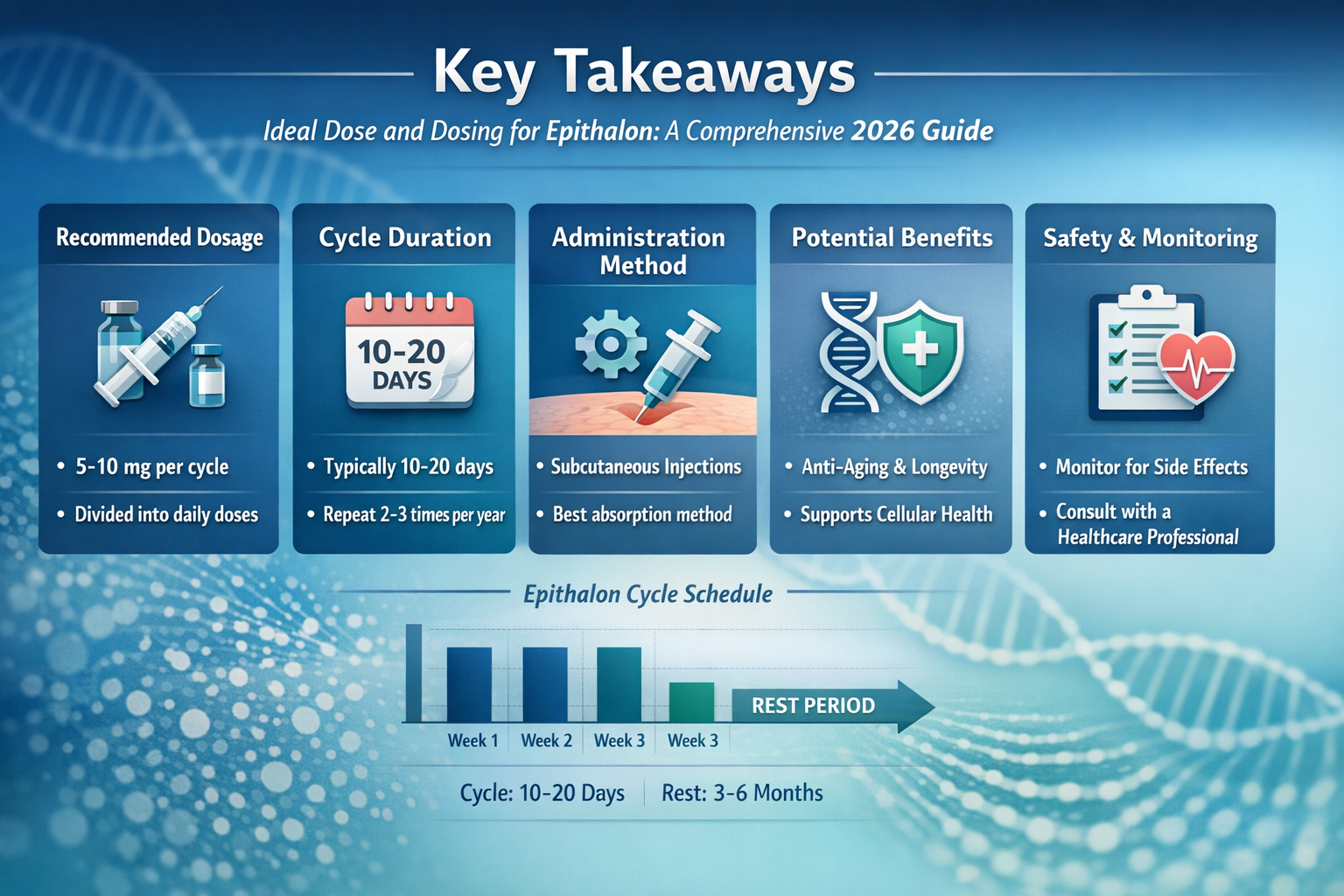
- 💉 Standard dosing ranges for Epithalon typically fall between 5-10mg per administration, with most research protocols using subcutaneous injection
- 📅 Cycle duration commonly follows 10-day or 20-day protocols, with administration occurring once daily, preferably in the evening
- 🔬 Research evidence suggests that consistent timing and proper reconstitution are critical factors for optimal results
- ⚖️ Individual variation in response means starting with conservative doses and adjusting based on observed outcomes is recommended
- 🔄 Cycling protocols typically include rest periods between cycles, with many researchers implementing 2-4 cycles annually
Understanding Epithalon: The Foundation for Proper Dosing
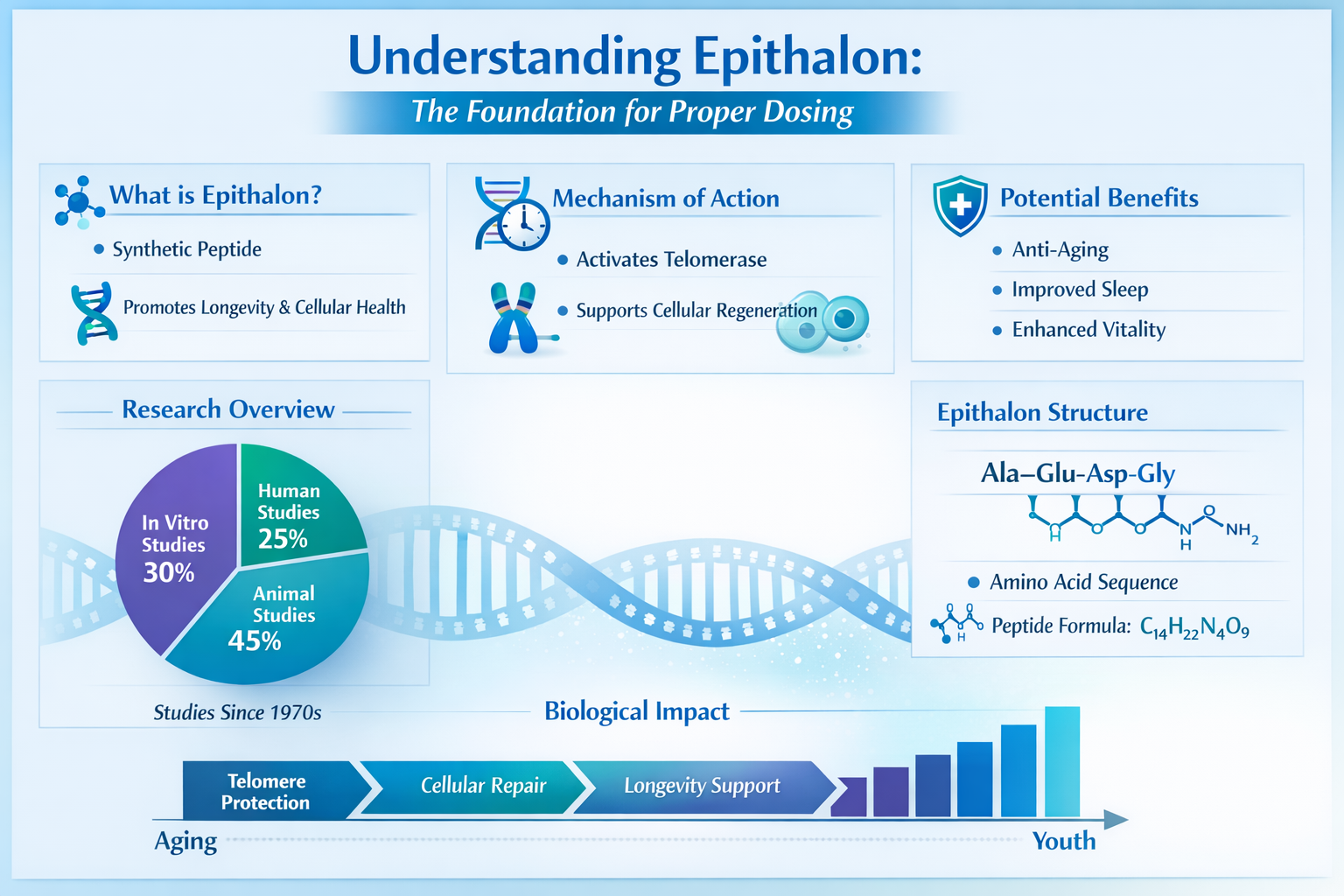
Before diving into the ideal dose and dosing for Epithalon, it's essential to understand what this peptide actually is and how it functions at the cellular level. Epithalon (also known as Epitalon or Epithalone) is a synthetic version of epithalamin, a naturally occurring peptide produced by the pineal gland.
What Makes Epithalon Unique?
Epithalon consists of four amino acids: alanine, glutamic acid, aspartic acid, and glycine (Ala-Glu-Asp-Gly). This simple structure belies its sophisticated mechanism of action. Research published in peer-reviewed journals suggests that Epithalon may interact with telomerase, the enzyme responsible for maintaining telomere length—those protective caps on the ends of chromosomes that shorten with each cell division.
The peptide's primary research applications focus on:
- Cellular aging mechanisms
- Circadian rhythm regulation
- Antioxidant activity
- Melatonin production normalization
- DNA repair processes
Understanding these mechanisms helps contextualize why precise dosing matters. When exploring peptide research, the relationship between dose, frequency, and biological response becomes paramount.
The Science Behind Epithalon Dosing 🔬
Research into Epithalon dates back several decades, primarily conducted by Russian scientists at the St. Petersburg Institute of Bioregulation and Gerontology. The dosing protocols that emerged from this research have become the foundation for current recommendations.
Key research findings that inform dosing include:
| Study Parameter | Typical Protocol | Research Observation |
|---|---|---|
| Dose per injection | 5-10mg | Effective range in published studies |
| Administration frequency | Once daily | Consistent plasma levels |
| Cycle duration | 10-20 days | Optimal response window |
| Administration timing | Evening | Aligns with natural pineal function |
These protocols didn't emerge arbitrarily—they represent years of systematic investigation into how the peptide behaves in biological systems. For those interested in comparing different peptide protocols, exploring resources about peptide dosage strategies can provide valuable context.
Ideal Dose and Dosing for Epithalon: Standard Protocols
The ideal dose and dosing for Epithalon has been refined through decades of research, though it's important to note that most studies have been conducted in laboratory settings. The following protocols represent the most commonly cited approaches in the scientific literature.
The Standard 10-Day Protocol
The 10-day protocol is perhaps the most widely referenced approach in Epithalon research:
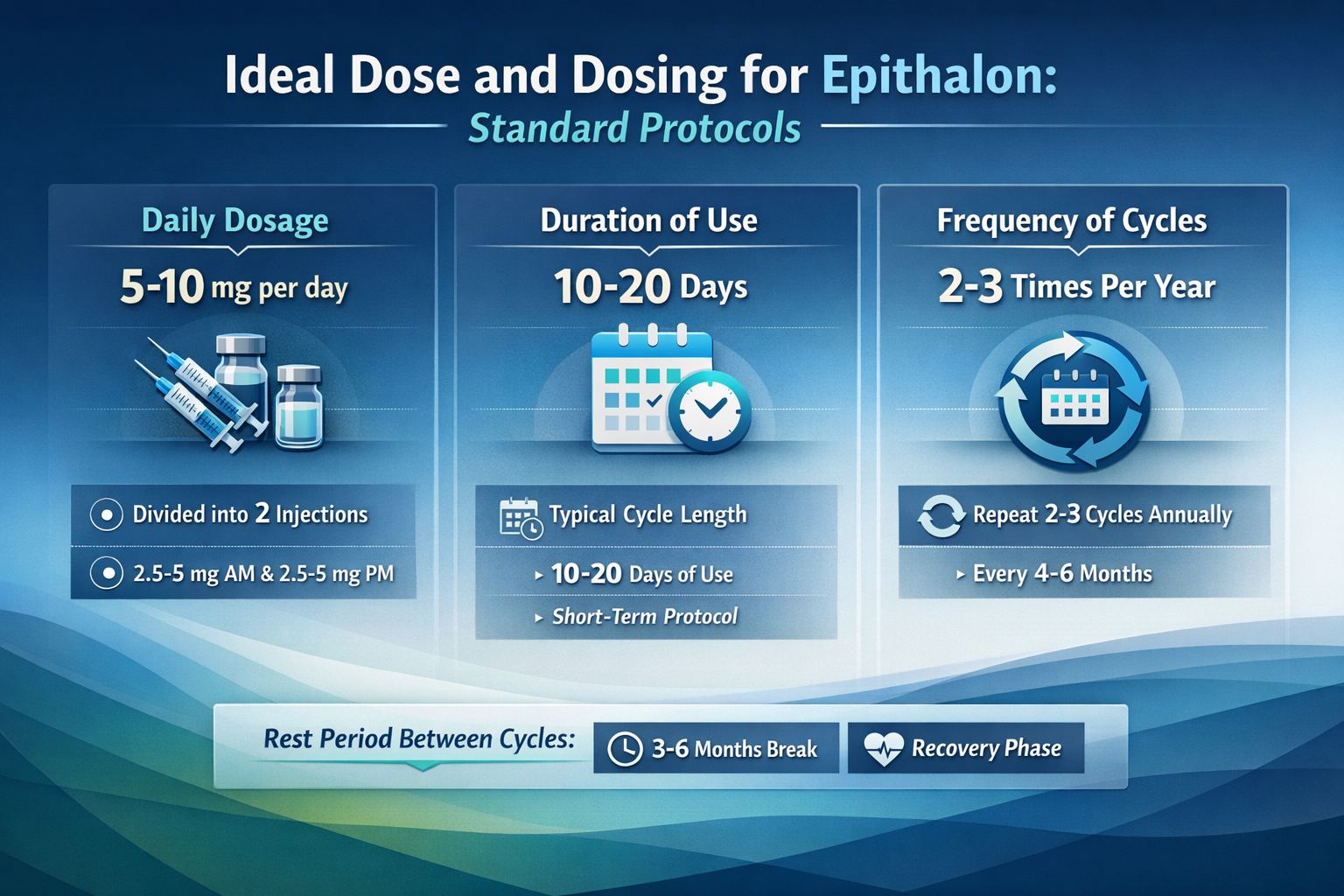
Daily dose: 5-10mg per day
Route: Subcutaneous injection
Timing: Evening (approximately 1-2 hours before bed)
Duration: 10 consecutive days
Rest period: 4-6 months before next cycle
This protocol aligns with the body's natural circadian rhythms, as the pineal gland—which produces the natural version of this peptide—is most active during evening hours. The evening administration timing is not arbitrary; it's designed to work synergistically with the body's endogenous melatonin production.
The Extended 20-Day Protocol
Some research protocols extend the administration period to 20 days:
Daily dose: 5-10mg per day
Route: Subcutaneous injection
Timing: Evening
Duration: 20 consecutive days
Rest period: 4-6 months before next cycle
The extended protocol may be considered for more comprehensive research objectives, though the evidence supporting superiority over the 10-day protocol remains limited. When considering various peptide options, understanding these timing differences becomes crucial.
Dosage Calculation and Preparation 📊
Proper reconstitution is absolutely critical for achieving the ideal dose and dosing for Epithalon. Here's the step-by-step process:
- Starting material: Epithalon typically comes as lyophilized (freeze-dried) powder in 10mg or 20mg vials
- Reconstitution solution: Bacteriostatic water is the standard choice
- Concentration calculation: For a 10mg vial with 2mL bacteriostatic water, the concentration becomes 5mg/mL
Example calculation:
- 10mg Epithalon vial
- Add 2mL bacteriostatic water
- Final concentration: 5mg/mL
- For a 5mg dose: draw 1mL (100 units on insulin syringe)
- For a 10mg dose: draw 2mL (or use entire vial if single-use)
"Precision in peptide reconstitution isn't just about accuracy—it's about ensuring the stability and efficacy of the compound throughout the research period." – Peptide Research Guidelines
Those new to peptide research might benefit from reviewing comprehensive guides on peptide preparation and handling to ensure proper technique.
Factors Influencing Ideal Dose and Dosing for Epithalon
While standard protocols provide a starting point, several factors can influence the ideal dose and dosing for Epithalon for specific research applications.
Body Weight and Composition
Unlike some peptides that are strictly dosed per kilogram of body weight, Epithalon protocols have traditionally used fixed dosing rather than weight-adjusted dosing. However, some researchers suggest that individuals with significantly different body compositions might consider adjusting within the 5-10mg range:
- Lower range (5mg): May be appropriate for smaller individuals or initial research phases
- Mid-range (7.5mg): A common middle ground for average-sized individuals
- Upper range (10mg): Sometimes used for larger individuals or extended protocols
Research Objectives and Timeline
The specific goals of the research can influence dosing strategies:
Short-term research focus:
- Standard 10-day protocol
- 5-10mg daily dose
- Single cycle observation
Long-term research objectives:
- Multiple cycles throughout the year
- Typically 2-4 cycles annually
- Consistent 4-6 month rest periods between cycles
When planning comprehensive peptide research protocols, exploring related peptide compounds can provide insights into complementary approaches.
Previous Peptide Experience
For those new to peptide research, a conservative approach is generally recommended:
First-time researchers:
- Start with 5mg daily dose
- Complete 10-day protocol
- Monitor and document observations
- Adjust subsequent cycles based on initial findings
Experienced researchers:
- May begin with 7.5-10mg doses
- Can consider 20-day protocols
- Better equipped to recognize and document subtle changes
Age Considerations in Research Models 👥
While Epithalon research has been conducted across various age groups, some studies suggest that older research models may show different response patterns:
- Younger models (under 40): Standard protocols typically sufficient
- Middle-aged models (40-60): May benefit from full 10mg doses
- Older models (60+): Some research suggests enhanced response, though dosing remains consistent
Administration Techniques for Optimal Results
Achieving the ideal dose and dosing for Epithalon requires not just the right amount, but also proper administration technique. The subcutaneous injection method is standard for this peptide.
Subcutaneous Injection Protocol
Preparation steps:
- Ensure refrigerated peptide has reached room temperature (15-20 minutes)
- Clean injection site with alcohol swab
- Draw precise dose using insulin syringe
- Pinch skin to create injection site
- Insert needle at 45-90 degree angle
- Inject slowly and steadily
- Dispose of needle in sharps container
Preferred injection sites:
- Abdomen (2 inches from navel)
- Outer thigh
- Upper arm (less common)
Site rotation is essential to prevent lipodystrophy (abnormal fat distribution) and maintain consistent absorption. Create a rotation schedule that doesn't repeat the same site for at least 7-10 days.
Timing Optimization ⏰
The timing of Epithalon administration significantly impacts its effectiveness:
Evening administration (recommended):
- Aligns with natural pineal gland activity
- May support natural melatonin production
- Typically 1-2 hours before sleep
- Consistent daily timing is crucial
Morning administration (alternative):
- Less commonly used
- May be considered for specific research protocols
- Should remain consistent if chosen
Research comparing timing protocols is limited, but the evening administration has the strongest theoretical foundation based on the peptide's relationship to pineal gland function. For those exploring comprehensive peptide protocols, timing consistency across all compounds becomes even more critical.
Cycling Strategies and Long-Term Protocols
Understanding cycling is essential for grasping the complete picture of the ideal dose and dosing for Epithalon. Proper cycling maximizes research value while allowing for observation periods.
Standard Cycling Approach
The most common cycling strategy follows this pattern:
Cycle 1: 10-20 days of daily administration
Rest period: 4-6 months
Cycle 2: Repeat protocol
Annual frequency: 2-4 cycles per year
This approach is based on research suggesting that:
- Effects may persist beyond the administration period
- Receptor sensitivity is maintained with adequate rest
- Long-term observations require periodic intervention
Advanced Cycling Strategies 🔄
Some researchers implement more sophisticated cycling approaches:
Quarterly protocol:
- 10-day cycle every 3 months
- Consistent seasonal timing
- 4 cycles annually
- Easier to track and maintain
Biannual intensive protocol:
- 20-day cycle twice yearly
- 6-month intervals
- Longer observation periods between cycles
- May be preferred for specific research objectives
Seasonal variation approach:
- Cycles timed with seasonal changes
- May account for natural circadian variations
- Spring and fall administration common
- Aligns with traditional research timing
Combining with Other Peptides
Many researchers explore Epithalon alongside other peptides. When combining compounds, careful consideration of the ideal dose and dosing for Epithalon in context becomes crucial:
Compatible peptide combinations:
- Growth hormone secretagogues (with appropriate timing separation)
- Thymosin peptides for immune research
- Metabolic peptides like MOTS-C
Timing considerations:
- Separate administration by at least 30-60 minutes
- Maintain consistent timing for each compound
- Document all combinations thoroughly
- Consider potential interactions
When exploring multiple peptide research, resources on peptide synergies and protocols can provide valuable guidance.
Storage and Stability: Protecting Your Investment
Even perfect dosing becomes meaningless if the peptide degrades due to improper storage. Maintaining peptide integrity is crucial for achieving the ideal dose and dosing for Epithalon.
Storage Guidelines 🧊
Lyophilized (powder) form:
- Store in freezer (-20°C to -80°C) for long-term storage
- Refrigerator (2-8°C) acceptable for short-term (up to 6 months)
- Protect from light
- Keep in original sealed vial
- Shelf life: 2-3 years when properly stored
Reconstituted form:
- Must be refrigerated (2-8°C)
- Protect from light (amber vials or wrapped in foil)
- Use within 30 days for optimal potency
- Never freeze reconstituted peptide
- Discard if cloudiness or particles appear
Handling Best Practices
Proper handling extends peptide viability:
- Minimize temperature fluctuations: Remove from refrigerator only when needed
- Avoid contamination: Use sterile technique for all handling
- Gentle reconstitution: Add bacteriostatic water slowly down vial side
- No shaking: Swirl gently to mix; vigorous shaking can denature peptides
- Document dates: Label vials with reconstitution date
"The difference between successful peptide research and disappointing results often comes down to storage and handling practices, not the peptide itself." – Research Laboratory Standards
For those sourcing peptides, working with reputable suppliers who provide proper storage guidance is essential.
Monitoring and Adjusting Your Protocol
The ideal dose and dosing for Epithalon isn't static—it should be informed by careful observation and documentation throughout the research period.
Documentation Practices 📝
Comprehensive record-keeping enables meaningful analysis:
Essential documentation elements:
- Date and time of each administration
- Exact dose administered
- Injection site used
- Batch/lot number of peptide
- Storage conditions
- Any observations or notes
- Concurrent supplements or compounds
Observation tracking:
- Sleep quality and duration
- Energy levels throughout day
- Recovery metrics (if applicable)
- Any unusual observations
- Subjective well-being assessments
When to Adjust Dosing
Consider dosing adjustments under these circumstances:
Increase dose (within 5-10mg range) if:
- No observable changes after complete cycle
- Previous cycles at lower dose showed minimal response
- Research objectives require more intensive protocol
Decrease dose if:
- Initial cycle at higher dose
- Excessive response observed
- Sensitivity to peptides noted with other compounds
Maintain current dose if:
- Observations align with research objectives
- No adverse effects noted
- Consistent, reproducible results
Red Flags and Discontinuation Considerations ⚠️
While Epithalon is generally well-tolerated in research settings, certain observations warrant protocol adjustment or discontinuation:
- Persistent injection site reactions beyond normal redness
- Unexpected systemic responses
- Contamination suspected (cloudiness, particles in solution)
- Storage integrity compromised
When exploring various peptide options, understanding individual response patterns helps inform future research decisions.
Quality and Sourcing Considerations
The ideal dose and dosing for Epithalon assumes you're working with high-quality, properly synthesized peptide. Sourcing quality directly impacts research outcomes.
Purity Standards and Testing 🔬
Quality peptides should meet these standards:
Minimum purity: ≥98% (verified by HPLC)
Testing documentation: Certificate of Analysis (CoA) available
Sterility: Tested for bacterial contamination
Endotoxin levels: <1 EU/mg
Proper labeling: Batch numbers, synthesis date, storage requirements
Evaluating Suppliers
When sourcing Epithalon, consider these factors:
Essential supplier qualities:
- Third-party testing verification
- Transparent sourcing information
- Proper storage during shipping (cold packs, insulated packaging)
- Responsive customer support
- Clear "for research purposes only" labeling
- Established reputation in research community
Warning signs to avoid:
- No testing documentation available
- Unusually low prices (may indicate impurity)
- Poor packaging or storage practices
- Vague product descriptions
- No batch/lot tracking
Working with established peptide suppliers who prioritize quality control ensures your research starts with a solid foundation.
Cost Considerations and Value Assessment 💰
Understanding the economics of Epithalon research helps with planning:
Typical cost ranges (2026):
- 10mg vial: $40-80
- 20mg vial: $70-140
- 10-day cycle cost: $40-140 (depending on dose and supplier)
- Annual research cost (4 cycles): $160-560
Value factors beyond price:
- Purity level (higher purity = better value)
- Testing documentation (reduces uncertainty)
- Proper packaging (protects investment)
- Supplier reliability (consistent quality)
Common Mistakes and How to Avoid Them
Even with knowledge of the ideal dose and dosing for Epithalon, researchers often make preventable errors that compromise results.
Reconstitution Errors ❌
Mistake: Adding bacteriostatic water too quickly or directly onto powder
Impact: Can denature peptide, reducing effectiveness
Solution: Add water slowly down the side of the vial; swirl gently to mix
Mistake: Using incorrect water volume
Impact: Inaccurate dosing, difficulty measuring
Solution: Calculate concentration beforehand; use precise measurement tools
Mistake: Shaking the vial vigorously
Impact: Peptide degradation through mechanical stress
Solution: Gentle swirling motion only; allow time to dissolve naturally
Timing and Consistency Issues
Mistake: Inconsistent administration times
Impact: Disrupts circadian alignment; reduces protocol effectiveness
Solution: Set daily alarm; maintain within 1-hour window
Mistake: Missing doses during cycle
Impact: Breaks protocol continuity; affects research validity
Solution: Plan cycles during stable periods; prepare backup plans
Mistake: Inadequate rest periods between cycles
Impact: Potential receptor desensitization; reduced long-term effectiveness
Solution: Adhere to 4-6 month rest periods; document cycle timing
Storage and Handling Mistakes 🌡️
Mistake: Allowing reconstituted peptide to reach room temperature repeatedly
Impact: Accelerated degradation; reduced potency
Solution: Remove from refrigerator only for administration; return immediately
Mistake: Exposing to light
Impact: Photodegradation of peptide structure
Solution: Use amber vials or wrap in aluminum foil; store in dark location
Mistake: Freezing reconstituted peptide
Impact: Crystal formation damages peptide structure
Solution: Refrigerate only; never freeze after reconstitution
Understanding these pitfalls helps ensure your research with the ideal dose and dosing for Epithalon produces meaningful, reproducible results. For comprehensive guidance on peptide handling and protocols, consulting specialized resources proves invaluable.
Comparing Epithalon Dosing to Other Peptides
Context helps understanding—comparing the ideal dose and dosing for Epithalon to other common research peptides illuminates its unique characteristics.
Dosing Comparison Table
| Peptide | Typical Dose | Frequency | Cycle Length | Administration |
|---|---|---|---|---|
| Epithalon | 5-10mg | Daily | 10-20 days | Subcutaneous |
| BPC-157 | 250-500mcg | 1-2x daily | 4-6 weeks | Subcutaneous/Oral |
| TB-500 | 2-5mg | 2x weekly | 4-6 weeks | Subcutaneous |
| Ipamorelin | 200-300mcg | 1-3x daily | 8-12 weeks | Subcutaneous |
| CJC-1295 | 1-2mg | Weekly | 8-12 weeks | Subcutaneous |
Key Differences in Dosing Philosophy
Epithalon's unique characteristics:
- Short, intensive cycles vs. extended protocols
- Fixed dosing rather than weight-based
- Evening timing specifically recommended
- Longer rest periods between cycles
- Lower injection frequency during active cycle
These differences reflect Epithalon's distinct mechanism of action. Unlike growth hormone secretagogues that require frequent pulsing, or healing peptides that need sustained presence, Epithalon's effects on cellular mechanisms may persist beyond the administration period.
The Future of Epithalon Research and Dosing
As peptide research evolves, so does understanding of the ideal dose and dosing for Epithalon. Emerging trends and future directions offer exciting possibilities.
Emerging Research Areas 🔬
Current research frontiers:
- Bioavailability enhancement methods
- Oral delivery systems (currently experimental)
- Combination protocols with complementary peptides
- Personalized dosing based on genetic markers
- Extended-release formulations
Potential protocol innovations:
- Micro-dosing approaches (lower doses, more frequent)
- Pulsed protocols (alternating dose levels)
- Seasonal optimization strategies
- Integration with circadian biology research
Technology and Dosing Precision
Advances in technology may refine Epithalon protocols:
Emerging tools:
- Wearable devices tracking circadian markers
- Advanced biomarker testing for personalized dosing
- Improved delivery systems for enhanced absorption
- AI-assisted protocol optimization
- Real-time stability monitoring for reconstituted peptides
These innovations may eventually allow for more personalized approaches to the ideal dose and dosing for Epithalon, moving beyond one-size-fits-all protocols to individualized optimization.
Practical Implementation: Your Action Plan
Armed with comprehensive knowledge about the ideal dose and dosing for Epithalon, here's a practical roadmap for implementation.
Pre-Research Checklist ✅
Before beginning your first Epithalon cycle:
Sourcing and supplies:
- Source high-quality Epithalon from reputable supplier
- Obtain bacteriostatic water for reconstitution
- Acquire insulin syringes (0.5mL or 1mL)
- Prepare alcohol swabs
- Set up sharps disposal container
- Ensure proper refrigeration available
Planning and documentation:
- Choose protocol (10-day vs. 20-day)
- Determine dose (5mg, 7.5mg, or 10mg)
- Create administration schedule
- Prepare documentation system
- Set daily reminders for consistent timing
- Plan cycle timing (avoid travel, disruptions)
Knowledge preparation:
- Review reconstitution techniques
- Practice injection technique
- Understand storage requirements
- Identify observation metrics to track
- Research potential interactions with current supplements
Week-by-Week Protocol Example
Week 1 (Days 1-7):
- Day 1: Reconstitute peptide, first administration
- Days 2-7: Daily administration at consistent time
- Document all observations
- Monitor injection site rotation
- Track sleep quality and energy
Week 2 (Days 8-10 for standard protocol):
- Days 8-10: Complete cycle
- Final documentation
- Properly store remaining peptide (if applicable)
- Begin observation period
Weeks 3-4 (Post-cycle observation):
- Continue documentation
- Note any sustained changes
- Plan next cycle timing
- Review and analyze data collected
Months 2-6 (Rest period):
- No Epithalon administration
- Long-term observation
- Prepare for next cycle
- Consider protocol adjustments based on findings
Troubleshooting Common Scenarios 🔧
Scenario 1: Missed dose during cycle
Solution: Take as soon as remembered if within 12 hours; if beyond that, skip and continue with next scheduled dose; do not double dose
Scenario 2: Reconstituted peptide appears cloudy
Solution: Do not use; cloudiness indicates contamination or degradation; discard and reconstitute fresh vial
Scenario 3: Injection site reaction persists
Solution: Rotate sites more frequently; ensure proper injection technique; consider slight dose reduction; discontinue if reaction worsens
Scenario 4: Travel during cycle
Solution: Plan cycles to avoid travel; if unavoidable, use insulated travel case with ice packs; maintain refrigeration; consider rescheduling cycle if proper storage cannot be ensured
Conclusion: Mastering the Ideal Dose and Dosing for Epithalon
Understanding the ideal dose and dosing for Epithalon represents the foundation of meaningful peptide research. This comprehensive guide has explored the multifaceted aspects of Epithalon protocols—from basic dosing principles to advanced cycling strategies, from proper reconstitution techniques to long-term planning.
The key principles to remember:
- Standard protocols work: The 10-day cycle at 5-10mg daily, administered subcutaneously in the evening, represents decades of research refinement
- Consistency matters: Regular timing, proper storage, and adherence to protocols produce the most reliable results
- Quality is paramount: High-purity peptides from trusted sources form the foundation of successful research
- Documentation drives insight: Careful record-keeping transforms individual cycles into valuable long-term data
- Patience yields results: Adequate rest periods and realistic expectations support sustainable research practices
Your Next Steps 🎯
Immediate actions:
- Determine your research objectives and timeline
- Source high-quality Epithalon and necessary supplies
- Create your documentation system
- Schedule your first cycle during a stable period
- Review reconstitution and administration techniques
Long-term planning:
- Map out annual cycle schedule (2-4 cycles)
- Consider complementary peptides for comprehensive research
- Establish baseline measurements for comparison
- Join research communities for ongoing learning
- Stay informed about emerging research and protocol innovations
Ongoing education:
- Monitor published research for protocol updates
- Explore comprehensive peptide resources
- Document and analyze your findings
- Consider consulting with knowledgeable professionals
- Share insights with the research community (while respecting privacy)
The journey into Epithalon research represents more than just following a dosing protocol—it's an exploration of cutting-edge longevity science, a commitment to rigorous methodology, and an investment in understanding cellular aging mechanisms. By mastering the ideal dose and dosing for Epithalon, you position yourself at the forefront of peptide research, equipped with the knowledge to conduct meaningful, reproducible investigations.
Whether you're a fitness enthusiast exploring recovery optimization, a medi-spa professional seeking evidence-based wellness protocols, or a dedicated researcher committed to understanding longevity mechanisms, the principles outlined in this guide provide a solid foundation. Remember that peptide research is an evolving field—what we understand about the ideal dose and dosing for Epithalon in 2026 may be refined further as new research emerges.
Start with the established protocols, maintain meticulous documentation, prioritize quality in your sourcing, and approach your research with both enthusiasm and scientific rigor. The potential insights awaiting discovery through proper Epithalon research make the attention to dosing detail absolutely worthwhile.
<!DOCTYPE html>
<html lang="en">
<head>
    <meta charset="UTF-8">
    <meta name="viewport" content="width=device-width, initial-scale=1.0">
    <title>Epithalon Dosing Calculator</title>
    <style>
        * {
            margin: 0;
            padding: 0;
            box-sizing: border-box;
        }

        .cg-element-calculator-container {
            font-family: -apple-system, BlinkMacSystemFont, 'Segoe UI', Roboto, Oxygen, Ubuntu, Cantarell, sans-serif;
            max-width: 800px;
            margin: 20px auto;
            background: linear-gradient(135deg, #667eea 0%, #764ba2 100%);
            border-radius: 16px;
            padding: 30px;
            box-shadow: 0 10px 40px rgba(0,0,0,0.2);
        }

        .cg-element-calculator-header {
            text-align: center;
            color: white;
            margin-bottom: 30px;
        }

        .cg-element-calculator-header h2 {
            font-size: 28px;
            margin-bottom: 10px;
        }

        .cg-element-calculator-header p {
            font-size: 14px;
            opacity: 0.9;
        }

        .cg-element-calculator-content {
            background: white;
            border-radius: 12px;
            padding: 30px;
        }

        .cg-element-input-group {
            margin-bottom: 25px;
        }

        .cg-element-input-group label {
            display: block;
            font-weight: 600;
            color: #333;
            margin-bottom: 8px;
            font-size: 15px;
        }

        .cg-element-input-group select,
        .cg-element-input-group input {
            width: 100%;
            padding: 12px 15px;
            border: 2px solid #e0e0e0;
            border-radius: 8px;
            font-size: 16px;
            transition: border-color 0.3s;
        }

        .cg-element-input-group select:focus,
        .cg-element-input-group input:focus {
            outline: none;
            border-color: #667eea;
        }

        .cg-element-input-group small {
            display: block;
            color: #666;
            margin-top: 5px;
            font-size: 13px;
        }

        .cg-element-calculate-btn {
            width: 100%;
            padding: 15px;
            background: linear-gradient(135deg, #667eea 0%, #764ba2 100%);
            color: white;
            border: none;
            border-radius: 8px;
            font-size: 18px;
            font-weight: 600;
            cursor: pointer;
            transition: transform 0.2s, box-shadow 0.2s;
        }

        .cg-element-calculate-btn:hover {
            transform: translateY(-2px);
            box-shadow: 0 5px 20px rgba(102, 126, 234, 0.4);
        }

        .cg-element-results {
            margin-top: 30px;
            padding: 25px;
            background: #f8f9fa;
            border-radius: 8px;
            display: none;
        }

        .cg-element-results.active {
            display: block;
        }

        .cg-element-result-item {
            margin-bottom: 20px;
            padding-bottom: 20px;
            border-bottom: 1px solid #e0e0e0;
        }

        .cg-element-result-item:last-child {
            margin-bottom: 0;
            padding-bottom: 0;
            border-bottom: none;
        }

        .cg-element-result-label {
            font-size: 14px;
            color: #666;
            margin-bottom: 5px;
        }

        .cg-element-result-value {
            font-size: 24px;
            font-weight: 700;
            color: #667eea;
        }

        .cg-element-result-detail {
            font-size: 13px;
            color: #888;
            margin-top: 5px;
        }

        .cg-element-protocol-summary {
            background: white;
            padding: 20px;
            border-radius: 8px;
            margin-top: 15px;
            border-left: 4px solid #667eea;
        }

        .cg-element-protocol-summary h4 {
            color: #333;
            margin-bottom: 15px;
            font-size: 16px;
        }

        .cg-element-protocol-summary ul {
            list-style: none;
            padding: 0;
        }

        .cg-element-protocol-summary li {
            padding: 8px 0;
            color: #555;
            font-size: 14px;
        }

        .cg-element-protocol-summary li:before {
            content: "✓ ";
            color: #667eea;
            font-weight: bold;
            margin-right: 8px;
        }

        .cg-element-warning {
            background: #fff3cd;
            border-left: 4px solid #ffc107;
            padding: 15px;
            margin-top: 20px;
            border-radius: 4px;
            font-size: 13px;
            color: #856404;
        }

        @media (max-width: 600px) {
            .cg-element-calculator-container {
                padding: 20px;
                margin: 10px;
            }

            .cg-element-calculator-content {
                padding: 20px;
            }

            .cg-element-calculator-header h2 {
                font-size: 24px;
            }

            .cg-element-result-value {
                font-size: 20px;
            }
        }
    </style>
</head>
<body>
    <div class="cg-element-calculator-container">
        <div class="cg-element-calculator-header">
            <h2>💉 Epithalon Dosing Calculator</h2>
            <p>Calculate your precise Epithalon reconstitution and dosing protocol</p>
        </div>

        <div class="cg-element-calculator-content">
            <div class="cg-element-input-group">
                <label for="vialSize">Epithalon Vial Size</label>
                <select id="vialSize">
                    <option value="10">10mg</option>
                    <option value="20">20mg</option>
                </select>
                <small>Select the size of your Epithalon vial</small>
            </div>

            <div class="cg-element-input-group">
                <label for="waterVolume">Bacteriostatic Water Volume (mL)</label>
                <input type="number" id="waterVolume" value="2" min="1" max="5" step="0.1">
                <small>Recommended: 2mL for easier measurement</small>
            </div>

            <div class="cg-element-input-group">
                <label for="targetDose">Target Daily Dose (mg)</label>
                <select id="targetDose">
                    <option value="5">5mg (Conservative)</option>
                    <option value="7.5">7.5mg (Moderate)</option>
                    <option value="10">10mg (Standard)</option>
                </select>
                <small>Choose based on your research protocol</small>
            </div>

            <div class="cg-element-input-group">
                <label for="cycleDuration">Cycle Duration (days)</label>
                <select id="cycleDuration">
                    <option value="10">10 days (Standard)</option>
                    <option value="20">20 days (Extended)</option>
                </select>
                <small>Most research uses 10-day cycles</small>
            </div>

            <button class="cg-element-calculate-btn" onclick="calculateDosing()">Calculate Dosing Protocol</button>

            <div class="cg-element-results" id="results">
                <div class="cg-element-result-item">
                    <div class="cg-element-result-label">Concentration After Reconstitution</div>
                    <div class="cg-element-result-value" id="concentration"></div>
                    <div class="cg-element-result-detail" id="concentrationDetail"></div>
                </div>

                <div class="cg-element-result-item">
                    <div class="cg-element-result-label">Volume to Draw Per Dose</div>
                    <div class="cg-element-result-value" id="volumeToDraw"></div>
                    <div class="cg-element-result-detail" id="volumeDetail"></div>
                </div>

                <div class="cg-element-result-item">
                    <div class="cg-element-result-label">Total Vials Needed for Cycle</div>
                    <div class="cg-element-result-value" id="vialsNeeded"></div>
                    <div class="cg-element-result-detail" id="vialsDetail"></div>
                </div>

                <div class="cg-element-protocol-summary">
                    <h4>📋 Your Complete Protocol Summary</h4>
                    <ul id="protocolSteps"></ul>
                </div>

                <div class="cg-element-warning">
                    ⚠️ <strong>Important:</strong> This calculator is for research planning purposes only. Always verify calculations independently and follow proper peptide handling protocols.
                </div>
            </div>
        </div>
    </div>

    <script>
        function calculateDosing() {
            // Get input values
            const vialSize = parseFloat(document.getElementById('vialSize').value);
            const waterVolume = parseFloat(document.getElementById('waterVolume').value);
            const targetDose = parseFloat(document.getElementById('targetDose').value);
            const cycleDuration = parseInt(document.getElementById('cycleDuration').value);

            // Calculate concentration (mg/mL)
            const concentration = vialSize / waterVolume;

            // Calculate volume to draw (mL)
            const volumeToDraw = targetDose / concentration;

            // Calculate volume in units (for insulin syringe)
            const volumeInUnits = volumeToDraw * 100;

            // Calculate total mg needed for cycle
            const totalMgNeeded = targetDose * cycleDuration;

            // Calculate vials needed
            const vialsNeeded = Math.ceil(totalMgNeeded / vialSize);

            // Update results
            document.getElementById('concentration').textContent = concentration.toFixed(2) + ' mg/mL';
            document.getElementById('concentrationDetail').textContent = vialSize + 'mg peptide in ' + waterVolume + 'mL bacteriostatic water';

            document.getElementById('volumeToDraw').textContent = volumeToDraw.toFixed(2) + ' mL';
            document.getElementById('volumeDetail').textContent = '(' + volumeInUnits.toFixed(0) + ' units on insulin syringe)';

            document.getElementById('vialsNeeded').textContent = vialsNeeded + ' vial' + (vialsNeeded > 1 ? 's' : '');
            document.getElementById('vialsDetail').textContent = 'Total: ' + totalMgNeeded + 'mg needed for ' + cycleDuration + '-day cycle';

            // Generate protocol steps
            const protocolSteps = [
                'Reconstitute ' + vialSize + 'mg vial with ' + waterVolume + 'mL bacteriostatic water',
                'Final concentration: ' + concentration.toFixed(2) + 'mg/mL',
                'Draw ' + volumeToDraw.toFixed(2) + 'mL (' + volumeInUnits.toFixed(0) + ' units) for each ' + targetDose + 'mg dose',
                'Administer subcutaneously once daily in the evening',
                'Continue for ' + cycleDuration + ' consecutive days',
                'Store reconstituted peptide refrigerated (2-8°C)',
                'Use within 30 days of reconstitution',
                'Rest 4-6 months before next cycle'
            ];

            const protocolList = document.getElementById('protocolSteps');
            protocolList.innerHTML = '';
            protocolSteps.forEach(step => {
                const li = document.createElement('li');
                li.textContent = step;
                protocolList.appendChild(li);
            });

            // Show results
            document.getElementById('results').classList.add('active');

            // Scroll to results
            document.getElementById('results').scrollIntoView({ behavior: 'smooth', block: 'nearest' });
        }

        // Allow Enter key to calculate
        document.addEventListener('DOMContentLoaded', function() {
            document.getElementById('waterVolume').addEventListener('keypress', function(e) {
                if (e.key === 'Enter') {
                    calculateDosing();
                }
            });
        });
    </script>
</body>
</html>
SEO Meta Information
Meta Title: Ideal Dose and Dosing for Epithalon: 2026 Complete Guide
Meta Description: Discover the ideal dose and dosing for Epithalon with evidence-based protocols, reconstitution guides, cycling strategies, and expert tips for peptide research in 2026.
Keywords: ideal dose and dosing for Epithalon, Epithalon dosage, Epithalon protocol, Epithalon cycling, peptide dosing, Epithalon reconstitution, Epithalon administration, peptide research