
The Ultimate Guide to Synthetic Peptides Wholesale Pricing in 2026 💪
The peptide market has exploded in recent years, with athletes, researchers, and fitness enthusiasts seeking cost-effective ways to access research-grade compounds. Understanding synthetic peptides wholesale pricing can mean the difference between spending hundreds of dollars per month and securing the same quality materials at a fraction of the cost. Whether you're a martial artist looking to optimize recovery, a weightlifter seeking performance enhancement research compounds, or a fitness professional conducting legitimate research, navigating wholesale peptide markets requires knowledge of pricing structures, quality indicators, and supplier reliability.
In 2026, the landscape of wholesale peptides for sale has become increasingly complex, with domestic suppliers competing against international manufacturers while maintaining vastly different price points and quality standards. This comprehensive guide breaks down everything you need to know about synthetic peptides wholesale pricing, from understanding bulk discount structures to identifying legitimate suppliers who provide third-party testing documentation.
Key Takeaways
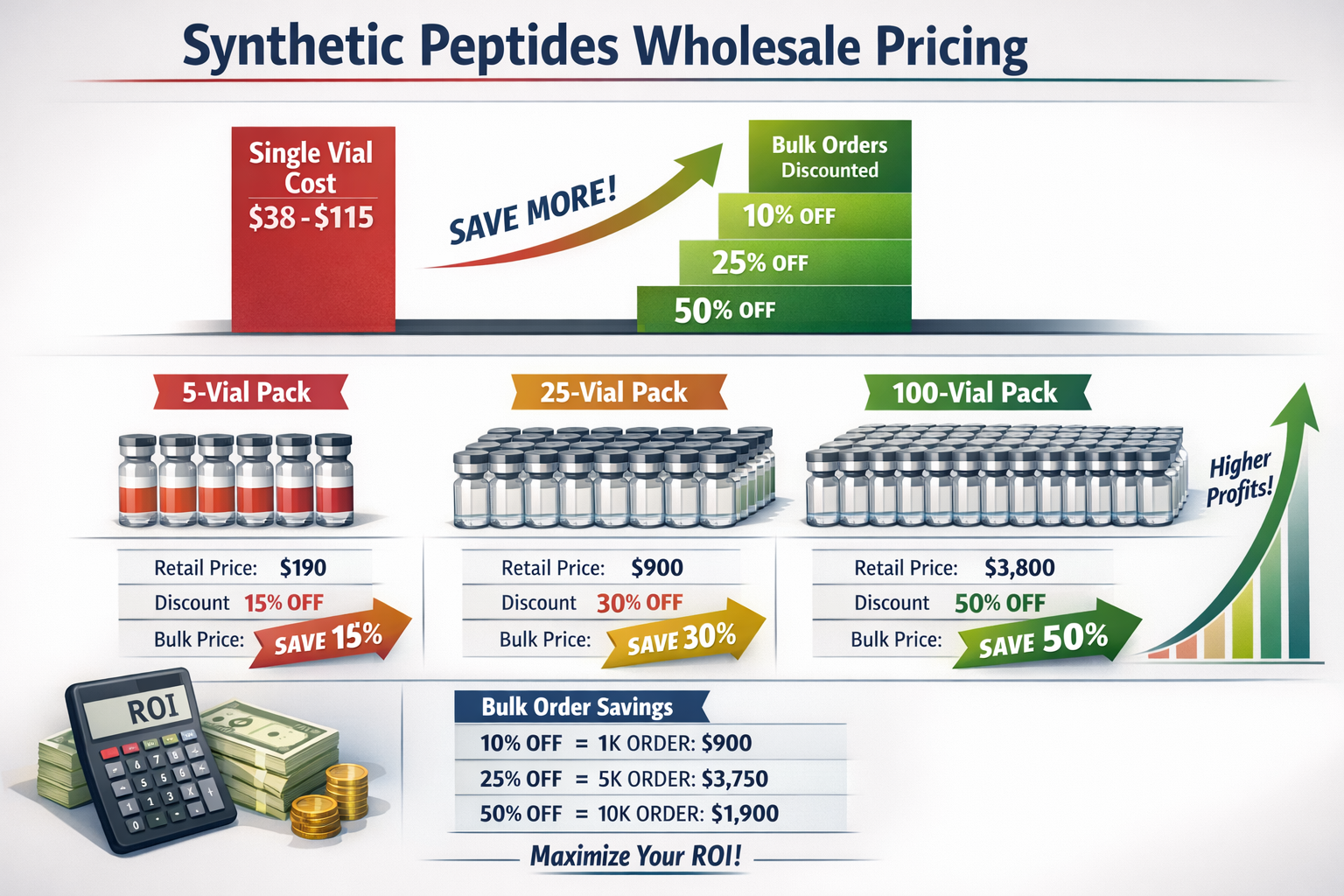
- Wholesale peptide pricing typically ranges from $38-115 per vial for small quantities, with bulk discounts of 10-50% available for orders of 5-100+ vials
- Quality verification through third-party testing is essential when comparing wholesale prices, as cheaper options may lack purity guarantees
- Minimum order quantities vary significantly between domestic suppliers (often 5-10 vials) and international manufacturers (sometimes 100+ units)
- Cost-per-milligram calculations reveal the true value when comparing different peptide concentrations and vial sizes
- Strategic bulk purchasing can reduce monthly peptide research costs by 30-50% for serious fitness enthusiasts and researchers
Understanding Synthetic Peptides Wholesale Pricing Structures 📊
The foundation of smart peptide purchasing begins with understanding how synthetic peptides wholesale pricing actually works. Unlike retail consumer products with standardized pricing, peptide suppliers operate on tiered pricing models that reward volume purchases with progressively deeper discounts.
Retail vs. Wholesale Peptide Costs
At the retail level, individual peptide vials typically cost between $38-115 depending on the specific compound and concentration[2]. Common research peptides like PT-141 peptide or SS-31 peptides fall within this range when purchased as single units. However, the economics change dramatically when transitioning to wholesale quantities.
Wholesale pricing structures generally follow these patterns:
- 5-10 vials: 10-15% discount from retail pricing
- 25-50 vials: 20-30% discount from retail pricing
- 100+ vials: 30-50% discount from retail pricing[3]
For fitness professionals, martial arts instructors, or research groups conducting extended studies, these discounts translate to substantial savings. A weightlifter purchasing a year's supply of research peptides could save $500-1,500 annually by buying wholesale rather than individual vials.
Volume Tier Breakdowns
Understanding the specific volume tiers helps optimize purchasing decisions. Most reputable suppliers offering wholesale peptides structure their pricing around these common breakpoints:
| Order Quantity | Typical Discount | Example Cost (per 10mg vial) |
|---|---|---|
| 1-4 vials | 0% (retail) | $85 |
| 5-9 vials | 10-15% | $72-77 |
| 10-24 vials | 15-25% | $64-72 |
| 25-49 vials | 25-35% | $55-64 |
| 50-99 vials | 35-45% | $47-55 |
| 100+ vials | 45-50% | $43-47 |
These figures represent typical market rates for quality-tested research peptides from USA-based suppliers[2][4]. International manufacturers may offer lower base prices but often require significantly higher minimum order quantities.
Cost-Per-Milligram Analysis
Smart peptide shoppers calculate cost-per-milligram rather than simply comparing vial prices. A 5mg vial at $40 costs $8 per milligram, while a 10mg vial at $65 costs only $6.50 per milligram—representing an 18.75% better value despite the higher upfront cost.
When evaluating all peptides for sale, consider these concentration-based value calculations:
- 5mg vials: Typically $38-55 retail ($7.60-11.00 per mg)
- 10mg vials: Typically $65-115 retail ($6.50-11.50 per mg)
- Peptide blends: Variable pricing based on component ratios
The most economical approach combines bulk purchasing with higher-concentration vials, maximizing both volume discounts and per-milligram value.
Comparing Domestic and International Synthetic Peptides Wholesale Pricing 🌍
The global nature of peptide manufacturing creates significant price variations between domestic USA-based suppliers and international manufacturers, particularly those based in China and India. Understanding these differences is crucial for making informed purchasing decisions that balance cost savings with quality assurance.
USA-Based Supplier Pricing Models
American peptide suppliers typically operate with higher base prices but offer several advantages that justify the premium. Domestic suppliers offering lab-tested peptides generally charge $38-115 per vial for research-grade compounds[2].
Advantages of USA-based suppliers include:
- Third-party testing verification: Certificates of analysis from independent laboratories
- Regulatory compliance: Manufacturing standards aligned with FDA guidelines for research compounds
- Customer support: English-speaking technical assistance and research guidance
- Shipping reliability: Domestic delivery within 3-5 business days
- Quality consistency: Batch-to-batch reliability with documented purity levels
For serious fitness enthusiasts, martial artists, and weightlifters conducting research, these quality assurances often outweigh the higher costs. The difference between 95% pure and 98% pure peptides can significantly impact research outcomes and safety profiles.
International Manufacturer Pricing
Chinese manufacturers listed on platforms like Made-in-China advertise wholesale pricing ranging from $1-300 USD per unit with minimum orders of 1-100 pieces[1]. While these prices appear dramatically lower than domestic options, several critical factors complicate direct comparisons.
Challenges with international suppliers:
- Quality verification uncertainty: Limited third-party testing documentation
- Regulatory status concerns: Unclear manufacturing standards and oversight
- Shipping complexities: International customs, extended delivery times (2-6 weeks)
- Communication barriers: Language differences complicating technical inquiries
- Minimum order requirements: Often 100+ units, requiring substantial upfront investment
For researchers purchasing MOTS-C peptides or Epithalon peptides, the apparent savings from international sources may disappear when factoring in quality concerns, shipping costs, and potential customs issues.
Price-Quality Correlation Analysis
The relationship between price and quality in peptide markets follows predictable patterns. Ultra-low pricing often indicates compromises in purity, testing, or manufacturing standards. Conversely, premium pricing doesn't automatically guarantee superior quality—some suppliers charge inflated prices based on marketing rather than product excellence.
Red flags indicating quality concerns:
- Prices significantly below market averages (50%+ lower)
- Lack of third-party testing certificates
- No batch-specific purity documentation
- Vague manufacturing location information
- Absence of customer reviews or research community feedback
When evaluating synthetic peptides wholesale pricing, the sweet spot typically falls within 10-20% of the median market price for established, reputable suppliers. Prices at this level usually reflect genuine quality while avoiding unnecessary premium markups.
Strategic Bulk Purchasing for Fitness and Research Applications 🏋️
For martial artists, weightlifters, and fitness professionals conducting extended research protocols, strategic bulk purchasing represents the most effective approach to managing peptide costs while maintaining quality standards. Understanding how to calculate needs, time purchases, and store compounds properly maximizes the value of wholesale pricing.
Calculating Research Needs
Before committing to bulk orders, accurate calculation of research requirements prevents over-purchasing while ensuring sufficient supply. Most peptide research protocols follow structured dosing schedules that allow precise quantity forecasting.
Typical research protocol calculations:
A standard research cycle might involve:
- Daily dosage: 250-500mcg per administration
- Frequency: 5-7 days per week
- Cycle duration: 8-12 weeks
- Total requirement: 14-42mg per cycle
For a 10-week research cycle at 300mcg daily (6 days/week), total consumption equals approximately 18mg. Purchasing two 10mg vials provides adequate supply with a small buffer for measurement variations.
Fitness enthusiasts researching compounds like GHK-Cu peptides should calculate annual needs based on planned research cycles. If conducting four 10-week cycles annually, total requirements reach approximately 72mg, making a bulk purchase of eight 10mg vials economically sensible.
Timing Wholesale Purchases
Strategic timing of bulk peptide purchases can enhance savings beyond standard volume discounts. Many suppliers offer seasonal promotions, holiday sales, or periodic discount codes that stack with wholesale pricing.
Optimal purchasing windows:
- January: New year promotions and inventory clearances
- March-April: Spring research season preparation
- July: Mid-year sales events
- November: Pre-holiday bulk purchase incentives
Additionally, monitoring supplier inventory levels can reveal opportunities. When suppliers introduce new peptide products or reformulations, they often discount existing inventory to make warehouse space. Subscribing to supplier newsletters from quality testing protocols verified sources ensures awareness of these opportunities.
Proper Storage for Bulk Orders
Purchasing peptides in wholesale quantities requires appropriate storage infrastructure to maintain compound stability and potency. Lyophilized (freeze-dried) peptides remain stable for extended periods under proper conditions, but improper storage degrades quality rapidly.
Storage requirements for bulk peptide inventory:
- Unreconstituted peptides: Store at -20°C (standard freezer) for up to 2 years
- Reconstituted peptides: Store at 2-8°C (refrigerator) for 2-4 weeks maximum
- Light protection: Keep vials in original packaging or opaque containers
- Moisture control: Maintain low humidity environment
- Temperature stability: Avoid freeze-thaw cycles
For researchers maintaining significant peptide inventories, investing in a dedicated mini-freezer ($100-200) provides reliable long-term storage. This one-time equipment cost becomes negligible when spread across years of research activities.
When storing diverse compounds like SS-31 peptides alongside nasal spray peptides, maintaining detailed inventory logs prevents confusion and tracks expiration timelines. Simple spreadsheet tracking ensures optimal rotation and prevents waste from expired compounds.
Quality Verification and Testing Standards in Wholesale Markets 🔬
The most critical factor when evaluating synthetic peptides wholesale pricing isn't the cost itself—it's the relationship between price and verified quality. In 2026, the peptide market includes suppliers ranging from pharmaceutical-grade manufacturers to questionable operations producing compounds of uncertain purity. Understanding quality verification standards protects researchers from wasting money on ineffective or contaminated products.
Third-Party Testing Requirements
Legitimate wholesale peptide suppliers provide comprehensive third-party testing documentation for every batch. These certificates of analysis (COAs) come from independent laboratories using standardized testing methodologies to verify peptide identity, purity, and composition.
Essential testing documentation includes:
- HPLC (High-Performance Liquid Chromatography): Confirms peptide purity percentage (typically 95-99%)
- Mass Spectrometry: Verifies molecular weight and peptide sequence accuracy
- Endotoxin Testing: Ensures absence of bacterial contamination
- Batch Numbers: Links testing results to specific production runs
- Testing Date: Confirms recent analysis (within 6-12 months)
Suppliers offering wholesale peptides for sale without readily available COAs should raise immediate concerns. Reputable suppliers make testing documentation accessible on product pages or provide it upon request without hesitation.
When purchasing compounds like PT-141 peptide or specialized blends, request batch-specific testing rather than generic certificates. Some lower-quality suppliers reuse old testing documentation or provide results from different batches, misrepresenting actual product quality.
Purity Standards and Pricing Correlation
Peptide purity directly impacts both effectiveness and safety in research applications. The difference between 95% and 99% purity might seem minor, but it represents a 4% variation in active compound concentration—significant when conducting precise research protocols.
Purity tiers and typical pricing:
- 90-95% purity: Budget tier, $30-50 per 10mg vial (often international sources)
- 95-98% purity: Standard research grade, $50-85 per 10mg vial (most USA suppliers)
- 98-99%+ purity: Premium research grade, $85-115 per 10mg vial (pharmaceutical-grade sources)
For fitness applications, martial arts recovery research, and weightlifting performance studies, 95-98% purity generally provides excellent results while maintaining cost-effectiveness. The premium for 99%+ purity rarely justifies the additional expense outside specialized research contexts.
When comparing synthetic peptides wholesale pricing across suppliers, normalize costs to equivalent purity levels. A $40 vial at 93% purity delivers less actual peptide than a $60 vial at 98% purity, making the latter potentially more economical despite the higher sticker price.
Identifying Quality Red Flags
Experience in the peptide market reveals consistent patterns distinguishing legitimate suppliers from questionable operations. Recognizing these warning signs prevents costly mistakes when evaluating wholesale options.
Warning signs of quality concerns:
- Suspiciously low pricing: Costs 50%+ below market averages without explanation
- Missing testing documentation: No COAs available or outdated certificates
- Vague sourcing information: Unclear manufacturing locations or facility details
- Poor communication: Unresponsive customer service or evasive answers about testing
- No research community presence: Absence of reviews, discussions, or user feedback
- Pressure tactics: Aggressive sales approaches or limited-time urgency claims
Conversely, quality suppliers demonstrate transparency through detailed product information, accessible testing results, responsive technical support, and established reputations within research communities. Suppliers providing peptide research documentation and educational resources typically prioritize quality over quick sales.
Navigating Minimum Order Quantities and Payment Terms 💳
Understanding the financial logistics of wholesale peptide purchasing extends beyond unit pricing to encompass minimum order requirements, payment methods, and terms that significantly impact total costs and cash flow management.
Minimum Order Requirements
Wholesale suppliers implement minimum order quantities (MOQs) to ensure profitability on bulk transactions. These requirements vary dramatically between domestic and international sources, affecting accessibility for different buyer categories.
Typical MOQ structures:
- Small wholesale (USA suppliers): 5-10 vials minimum ($200-500 order value)[4]
- Medium wholesale (USA suppliers): 25-50 vials minimum ($1,000-2,500 order value)
- Large wholesale (international): 100+ units minimum ($2,000-10,000+ order value)[1]
For individual fitness enthusiasts or martial artists conducting personal research, small wholesale minimums from domestic suppliers offer the most practical entry point. These modest requirements allow access to bulk discounts without requiring thousands of dollars in upfront capital.
Research groups, training facilities, or professional organizations can leverage medium to large wholesale tiers for maximum savings. A martial arts academy purchasing peptides for multiple instructors conducting recovery research might easily meet 25-50 vial minimums while securing 25-35% discounts.
Payment Methods and Terms
Payment flexibility varies significantly across peptide suppliers, with implications for cash flow management and buyer protection. Understanding available payment options helps structure purchases optimally.
Common payment methods:
- Credit/Debit Cards: Standard for domestic suppliers, offers buyer protection
- Cryptocurrency: Increasingly common, sometimes offers 5-10% additional discounts
- Bank Transfers: Required by some international suppliers, limited recourse options
- Payment Plans: Rare but occasionally available for large wholesale orders
When purchasing all peptides for sale in bulk quantities, credit card payments provide the strongest buyer protection through chargeback rights if products fail to meet specifications or quality claims. Cryptocurrency payments offer privacy and sometimes cost savings but eliminate traditional dispute resolution mechanisms.
Some progressive suppliers offer payment plans for qualified buyers placing large wholesale orders. These arrangements might involve 50% upfront with the balance due upon delivery or 30-day payment terms for established customers. Such flexibility makes larger wholesale purchases more accessible without requiring full capital commitment upfront.
Shipping Costs and Delivery Considerations
Shipping expenses can significantly impact the true cost of wholesale peptide orders, particularly when comparing domestic versus international sources. Calculating total landed costs—including shipping, insurance, and potential customs fees—reveals the complete financial picture.
Shipping cost factors:
- Domestic shipping: Typically $10-25 for standard delivery, often free above order thresholds
- Expedited domestic: $25-50 for overnight or 2-day delivery with cold packing
- International shipping: $50-150+ depending on weight, speed, and customs requirements
- Cold chain maintenance: Premium charges for temperature-controlled shipping
Many USA-based suppliers offering wholesale peptides waive shipping fees for orders exceeding specific thresholds—commonly $200-500. This effectively adds 2-5% to the bulk discount value, enhancing overall savings.
International orders face additional complexities including customs clearance, potential duties, and extended transit times (2-6 weeks versus 3-5 days domestic). These factors often erode the apparent price advantages of offshore suppliers, particularly for time-sensitive research protocols.
Specialized Peptide Categories and Wholesale Pricing Variations 🧬
Different peptide categories command varying price points in wholesale markets based on synthesis complexity, raw material costs, and market demand. Understanding these variations helps researchers allocate budgets effectively and identify the best value opportunities within specific peptide classes.
Growth Hormone Secretagogues
Peptides that stimulate growth hormone release represent one of the most popular categories for fitness research. Compounds in this class include Ipamorelin, CJC-1295, and various blends combining multiple secretagogues.
Wholesale pricing for GH secretagogues:
- Ipamorelin (10mg): $45-75 per vial at wholesale volumes
- CJC-1295 (5mg): $50-85 per vial at wholesale volumes
- Combination blends: $65-115 per vial depending on component ratios
Research into IPA peptides and secretagogue combinations remains popular among weightlifters and fitness enthusiasts studying recovery optimization. Bulk purchasing these compounds typically yields 20-35% savings compared to single-vial retail pricing.
Mitochondrial and Metabolic Peptides
Emerging research interest in mitochondrial function and metabolic optimization has increased demand for specialized peptides in these categories. Compounds like SS-31, MOTS-C, and AOD-9604 fall into this classification.
Wholesale pricing for metabolic peptides:
- SS-31 (10mg): $75-110 per vial at wholesale volumes
- MOTS-C (5mg): $55-85 per vial at wholesale volumes
- AOD-9604 (5mg): $45-70 per vial at wholesale volumes
These specialized compounds often command premium pricing due to synthesis complexity and relatively lower production volumes. However, wholesale discounts still apply, with bulk purchases of 10+ vials typically securing 15-25% savings.
Martial artists and endurance athletes researching mitochondrial enhancement often combine compounds like MOTS-C with other metabolic peptides, making bulk purchasing particularly economical for comprehensive research protocols.
Peptide Blends and Combination Products
Pre-mixed peptide blends offer convenience for researchers following established protocols but typically carry pricing premiums over purchasing individual components separately. Understanding the economics of blends versus individual peptides informs optimal purchasing decisions.
Blend pricing considerations:
- Convenience premium: Blends typically cost 10-20% more than equivalent individual peptides
- Dosing precision: Pre-mixed ratios may not match specific research requirements
- Wholesale discounts: Apply similarly to blends as individual compounds (20-40% for bulk orders)
For researchers following standardized protocols, blends like peptide combinations offer time savings that may justify the modest premium. However, those conducting customized research with specific ratio requirements often achieve better value purchasing individual components and mixing according to protocol needs.
Seasonal Trends and Market Timing for Synthetic Peptides Wholesale Pricing 📅
The peptide market exhibits predictable seasonal patterns that savvy researchers leverage to maximize purchasing power. Understanding these trends enables strategic timing of bulk orders to capture optimal pricing.
Annual Demand Cycles
Peptide demand follows fitness industry patterns, with peak interest periods driving pricing dynamics. January through March represents the highest demand season as fitness enthusiasts launch New Year research protocols, while summer months (June-August) see secondary peaks as individuals prepare for beach season and athletic competitions.
Seasonal demand patterns:
- January-March: Peak demand, limited promotional pricing
- April-May: Moderate demand, occasional spring sales
- June-August: Secondary peak, pre-summer promotions
- September-October: Moderate demand, back-to-routine sales
- November-December: Lower demand, year-end clearance opportunities
For maximum savings on synthetic peptides wholesale pricing, timing bulk purchases during November-December or April-May shoulder seasons often yields additional 5-15% discounts beyond standard wholesale pricing. Suppliers clearing inventory or stimulating off-peak sales offer promotional codes and special pricing during these windows.
New Product Introduction Impacts
When suppliers introduce new peptide formulations or updated versions of existing compounds, they frequently discount previous inventory to make warehouse space. Monitoring peptide research developments helps identify these opportunities.
Clearance opportunities:
- Reformulated products: Original versions discounted 20-40%
- Discontinued variants: Deep discounts (40-60%) on remaining inventory
- Packaging updates: Previous packaging versions reduced 10-20%
These clearance situations create excellent opportunities for bulk purchases, particularly when the underlying peptide remains unchanged and only packaging or presentation differs. A weightlifter researching a specific compound can stock up on discounted inventory when suppliers transition to new vial designs or label formats.
Supplier Competition and Market Entry
The peptide market continues attracting new suppliers, creating competitive pricing pressure that benefits informed buyers. When new suppliers enter the market, they often offer aggressive introductory pricing to build customer bases and compete with established players.
Market entry pricing patterns:
- Launch promotions: 20-30% below established market rates
- Sample programs: Discounted trial sizes for new customers
- Loyalty incentives: Progressive discounts for repeat bulk purchases
While new suppliers may offer attractive pricing, thorough quality verification becomes even more critical. Request comprehensive testing documentation and start with smaller orders before committing to large wholesale purchases from unfamiliar sources. The peptide research community often shares experiences with new suppliers through forums and discussion groups, providing valuable due diligence information.
Building Relationships with Wholesale Peptide Suppliers 🤝
Long-term relationships with reliable suppliers provide advantages extending beyond simple pricing considerations. Established customers often access preferential treatment, exclusive promotions, and enhanced support that adds significant value to wholesale purchasing arrangements.
Customer Loyalty Programs
Progressive peptide suppliers implement formal loyalty programs rewarding repeat customers with escalating benefits. These programs typically operate on points-based systems or tiered status levels based on cumulative purchase volume.
Common loyalty benefits:
- Points accumulation: 5-10% of purchase value as redeemable points
- Tier-based discounts: Additional 5-15% off for platinum/elite status customers
- Early access: Advance notification of sales and new product launches
- Exclusive products: Access to limited-availability or pre-release compounds
- Priority support: Dedicated customer service and technical consultation
For serious researchers conducting ongoing peptide studies, loyalty programs can reduce effective costs by an additional 10-20% beyond standard wholesale pricing. A martial arts instructor purchasing peptides quarterly for recovery research might accumulate sufficient points for one free order annually—effectively a 25% discount on the fourth purchase.
Communication and Technical Support
Establishing rapport with supplier technical teams provides access to valuable research guidance, dosing recommendations, and protocol optimization advice. Quality suppliers employ knowledgeable staff capable of discussing peptide research applications beyond simple order processing.
Value-added support services:
- Protocol consultation: Guidance on research design and peptide selection
- Dosing calculations: Assistance determining optimal quantities for specific applications
- Reconstitution guidance: Instructions for proper peptide preparation
- Storage recommendations: Best practices for maintaining compound stability
- Research updates: Information about new findings and emerging applications
When purchasing specialized compounds like innovative peptide delivery systems, access to knowledgeable technical support significantly enhances research success. Suppliers viewing customer relationships as partnerships rather than transactions typically provide superior long-term value despite potentially higher baseline pricing.
Negotiating Custom Wholesale Arrangements
Large-volume buyers or research organizations can often negotiate customized wholesale agreements beyond standard published pricing tiers. These arrangements might include volume commitments in exchange for guaranteed pricing, payment terms, or exclusive access to specific products.
Negotiable terms for large buyers:
- Volume discounts: Custom pricing for commitments of 100+ vials quarterly
- Payment terms: Net-30 or net-60 payment windows for qualified accounts
- Custom blends: Proprietary formulations mixed to specific ratio requirements
- Dedicated inventory: Reserved stock ensuring availability during supply constraints
- Private labeling: Custom packaging for organizational or commercial applications
Research facilities, training centers, or professional organizations conducting extensive peptide research should explore these custom arrangements. A fitness facility with multiple trainers conducting peptide research might negotiate a blanket purchase agreement providing 40-50% discounts in exchange for minimum quarterly orders, substantially reducing per-unit costs below standard wholesale pricing.
Risk Management and Due Diligence in Wholesale Peptide Purchasing ⚠️
Wholesale peptide purchasing involves larger financial commitments and inventory management responsibilities compared to single-vial retail purchases. Implementing proper risk management practices protects investments and ensures research quality.
Supplier Verification Processes
Before committing to significant wholesale orders, thorough supplier verification reduces risks of quality issues, delivery problems, or financial losses. Systematic due diligence follows established protocols that experienced peptide researchers employ consistently.
Essential verification steps:
- Business legitimacy: Verify business registration, physical address, and operational history
- Testing documentation: Review multiple batch COAs for consistency and legitimacy
- Community reputation: Research supplier reviews and feedback from other researchers
- Sample orders: Place small initial orders to evaluate quality before bulk purchases
- Communication assessment: Evaluate responsiveness and knowledge of support staff
- Return policies: Understand terms for defective products or quality disputes
Suppliers offering quality testing protocols and transparent business practices typically welcome verification inquiries. Defensive or evasive responses to basic due diligence questions signal potential concerns warranting caution.
Quality Assurance for Bulk Orders
Receiving wholesale peptide shipments requires systematic quality verification before committing to long-term storage or use. Even established suppliers occasionally experience quality control issues, making batch verification essential for large orders.
Bulk order verification procedures:
- Visual inspection: Check vial integrity, vacuum seals, and lyophilization quality
- Documentation review: Confirm batch numbers match COAs and ordered products
- Sample testing: Consider independent testing of random samples from large orders
- Storage verification: Ensure cold chain maintenance during shipping
- Expiration dating: Verify adequate shelf life for planned usage timeline
For extremely large wholesale orders (100+ vials), investing in independent third-party testing of random samples ($100-300 per test) provides additional quality assurance. This modest expense represents insurance against receiving substandard products when thousands of dollars are at stake.
Financial Protection Strategies
Large wholesale purchases require financial protection mechanisms beyond standard retail consumer safeguards. Implementing these strategies minimizes exposure to supplier failures, quality issues, or delivery problems.
Financial protection approaches:
- Payment method selection: Use credit cards for chargeback protection on domestic orders
- Incremental scaling: Gradually increase order sizes as supplier reliability proves consistent
- Diversified sourcing: Maintain relationships with 2-3 suppliers rather than single-source dependency
- Escrow services: Consider third-party escrow for very large international orders
- Documentation retention: Maintain detailed records of orders, communications, and testing results
When purchasing wholesale peptides for sale in substantial quantities, these protective measures provide recourse options if issues arise. The peptide industry includes both highly professional operations and questionable suppliers—proper protection strategies distinguish between them through consequences for poor performance.
Future Trends in Synthetic Peptides Wholesale Pricing 🔮
The peptide market continues evolving rapidly, with technological advances, regulatory developments, and market dynamics shaping future pricing trends. Understanding these trajectories helps researchers plan long-term purchasing strategies and budget allocations.
Manufacturing Technology Advances
Improvements in peptide synthesis technology gradually reduce production costs, potentially translating to lower wholesale pricing over time. Solid-phase peptide synthesis (SPPS) efficiency gains and automation advances enable higher-quality production at reduced costs.
Technology-driven pricing impacts:
- Automated synthesis: Reduces labor costs and improves consistency
- Improved purification: Higher yields from synthesis reactions lower raw material costs
- Quality control automation: Reduces testing costs through high-throughput analysis
- Scale economies: Larger production batches spread fixed costs across more units
These advances may reduce synthetic peptides wholesale pricing by 10-20% over the next 3-5 years for commonly produced compounds. However, specialized or complex peptides will likely maintain premium pricing due to synthesis challenges that automation cannot fully address.
Regulatory Environment Changes
Evolving regulatory frameworks surrounding peptide sales and research applications may impact market dynamics and pricing structures. Increased regulation could raise compliance costs while potentially improving overall market quality and consumer protection.
Potential regulatory impacts:
- Testing requirements: Mandatory third-party verification could increase baseline costs 5-10%
- Manufacturing standards: Enhanced facility requirements may consolidate suppliers
- Distribution controls: Tighter oversight might reduce availability but improve quality
- Documentation mandates: Additional paperwork could add administrative costs
While regulatory changes might increase short-term costs, they typically benefit serious researchers by eliminating low-quality suppliers and improving market transparency. The resulting competitive landscape often stabilizes at higher quality levels with pricing that reflects genuine value rather than race-to-bottom dynamics.
Market Demand Projections
Growing awareness of peptide research applications among fitness enthusiasts, martial artists, and weightlifters continues expanding the market. Increased demand typically drives both supply expansion and competitive pricing pressure.
Demand growth factors:
- Fitness industry expansion: Growing interest in performance optimization research
- Aging population: Increased focus on longevity and recovery research
- Athletic applications: Expanded research into recovery and adaptation
- Accessibility improvements: Better education and information availability
As the peptide research community expands, wholesale markets will likely see increased competition, improved quality standards, and more sophisticated pricing structures. Buyers benefit from this maturation through better value, enhanced quality, and improved supplier professionalism.
Conclusion: Maximizing Value in Synthetic Peptides Wholesale Pricing 🎯
Navigating the complex landscape of synthetic peptides wholesale pricing requires balancing cost considerations with quality verification, supplier reliability, and research needs. The potential savings from wholesale purchasing—typically 20-50% compared to retail pricing—make bulk buying strategies essential for serious peptide researchers, fitness enthusiasts, martial artists, and weightlifters conducting extended research protocols.
The key principles for maximizing value include:
Calculate true costs by considering purity levels, concentration, shipping, and testing documentation rather than simply comparing sticker prices. A seemingly expensive supplier providing 98% purity with comprehensive COAs often delivers better value than cheaper alternatives of questionable quality.
Start strategically with smaller wholesale orders (5-10 vials) from new suppliers before committing to large bulk purchases. This incremental approach allows quality verification while still capturing meaningful discounts of 10-20%.
Prioritize quality verification through third-party testing documentation, supplier reputation research, and systematic due diligence. The modest time investment in verification prevents costly mistakes from substandard products.
Time purchases strategically around seasonal demand patterns, taking advantage of off-peak promotions and clearance opportunities that can add 5-15% to standard wholesale discounts.
Build supplier relationships that provide long-term value through loyalty programs, technical support, and preferential treatment beyond simple transactional pricing.
Actionable Next Steps
For researchers ready to transition from retail to wholesale peptide purchasing:
- Assess annual research needs by calculating total peptide requirements based on planned protocols and cycles
- Research 3-5 potential suppliers offering wholesale peptides with strong quality verification and positive community reputation
- Request testing documentation and compare purity levels, batch consistency, and certificate legitimacy across suppliers
- Place initial trial orders of 5-10 vials to evaluate product quality, shipping reliability, and customer service
- Calculate total costs including shipping, payment method fees, and storage requirements to determine true wholesale value
- Scale gradually to larger wholesale quantities as supplier reliability proves consistent and quality meets standards
- Maintain detailed records of purchases, testing results, and supplier performance to inform future buying decisions
The wholesale peptide market in 2026 offers substantial opportunities for cost savings without compromising research quality—but only for informed buyers who prioritize verification and strategic purchasing. By applying the principles and strategies outlined in this guide, researchers can reduce peptide costs by 30-50% annually while maintaining or improving the quality of compounds used in their fitness, martial arts, and weightlifting research applications.
Whether you're investigating all peptides for sale for the first time or optimizing existing wholesale arrangements, the combination of quality verification, strategic timing, and relationship building creates a sustainable approach to peptide research that balances cost-effectiveness with scientific rigor.
References
[1] Peptides – https://www.made-in-china.com/products-search/hot-china-products/Peptides.html
[2] biotechpeptides – https://biotechpeptides.com
[3] peptidepros – https://www.peptidepros.net
[4] Wholesale Peptides – https://www.evolvepeptides.com/wholesale-peptides/
SEO Meta Title
Synthetic Peptides Wholesale Pricing Guide 2026 | Save 20-50%
SEO Meta Description
Discover synthetic peptides wholesale pricing strategies for 2026. Learn how bulk purchasing saves 20-50% on research peptides for fitness and performance.