

Last updated: May 11, 2026
Quick Answer: The MOTS-C peptide is a short peptide encoded by mitochondrial DNA that acts as a metabolic regulator, influencing energy balance, insulin sensitivity, and cellular stress responses. Unlike most peptides, it originates from within the mitochondria itself — not the nuclear genome — making it a unique target in longevity and metabolic research. It is currently available for research purposes only and is not approved for human therapeutic use.
Key Takeaways
- MOTS-C stands for Mitochondrial Open Reading Frame of the 12S rRNA Type-C, a 16-amino-acid peptide encoded by mitochondrial DNA
- It activates AMPK, a master metabolic switch linked to energy regulation and cellular longevity pathways
- Research suggests MOTS-C may support metabolic flexibility, meaning the ability to switch between fuel sources efficiently
- Circulating MOTS-C levels naturally decline with age, making it a subject of active longevity research
- It has been studied in the context of insulin resistance, exercise mimicry, and age-related metabolic decline
- MOTS-C is often researched alongside other mitochondria-targeting compounds like Elamipretide (SS-31)
- All MOTS-C products are sold for research use only and are not intended for human consumption or therapeutic application
- Researchers often explore MOTS-C in combination with other peptides to examine synergistic signaling effects
What Is the MOTS-C Peptide?
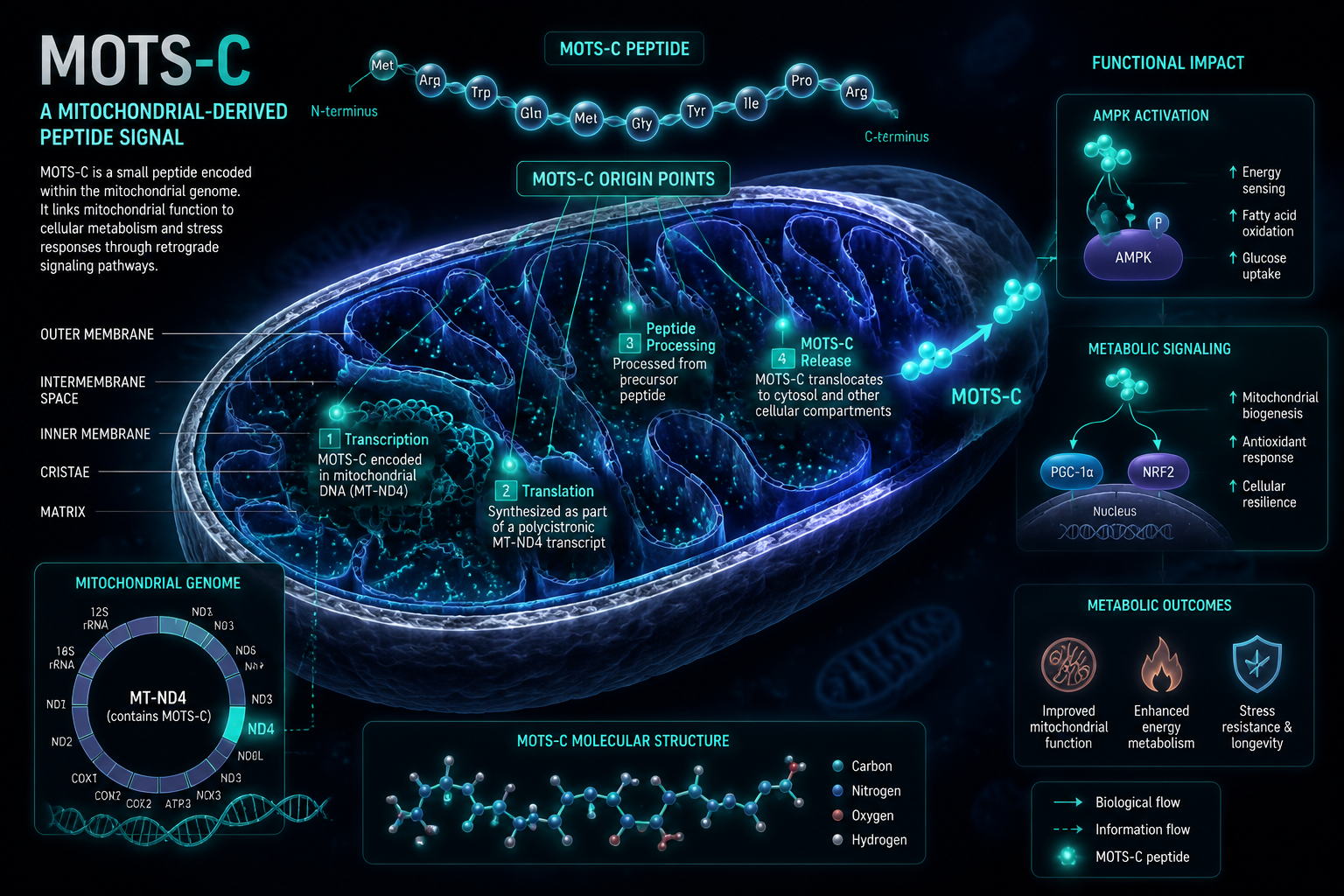
MOTS-C is a 16-amino-acid peptide that originates directly from mitochondrial DNA — specifically from the 12S ribosomal RNA gene. This makes it fundamentally different from most peptides, which are encoded by nuclear DNA.
Discovered by researchers at the University of Southern California and published in Cell Metabolism (Lee et al., 2015), MOTS-C was identified as a mitochondria-derived peptide (MDP) that travels from the mitochondria to the cell nucleus and, under stress conditions, even into systemic circulation.
Key structural facts:
- Length: 16 amino acids
- Origin: Mitochondrial genome (12S rRNA region)
- Primary target: AMPK pathway, FOXO transcription factors
- Behavior: Acts as both an intracellular and circulating signaling molecule
For a deeper background on its biology, see the MOTS-C mitochondrial peptide overview.
How Does the MOTS-C Peptide Work at the Cellular Level?
MOTS-C activates AMPK (AMP-activated protein kinase), a central regulator of cellular energy homeostasis. When AMPK is activated, cells shift toward more efficient fuel use and away from energy-wasting processes.
Specifically, research indicates MOTS-C:
- Inhibits the folate cycle and de novo purine biosynthesis, which triggers AMPK activation indirectly
- Translocates to the nucleus under metabolic stress, where it regulates gene expression related to antioxidant defense
- Mimics some effects of exercise at the cellular level by activating similar metabolic pathways
"MOTS-C represents a new class of signaling molecules that redefine how we think about mitochondrial communication." — paraphrased from Lee et al., 2015, Cell Metabolism
Researchers studying MOTS-C and metabolic flexibility note that this AMPK activation is central to its most studied effects.

Who Is MOTS-C Research Most Relevant To?
MOTS-C research is most relevant to scientists and biohackers studying metabolic aging, exercise physiology, and mitochondrial health. Its age-dependent decline makes it particularly interesting for longevity-focused research models.
Research interest is highest among those studying:
| Research Area | Why MOTS-C Is Relevant |
|---|---|
| Metabolic aging | Circulating levels drop with age in animal models |
| Insulin resistance | AMPK activation improves glucose uptake in preclinical studies |
| Exercise science | May replicate some molecular effects of physical activity |
| Mitochondrial disease | Targets mitochondrial signaling directly |
For context on related mitochondrial research compounds, the MOTS-C and SLU-PP-332 comparison offers useful perspective on how different agents target overlapping pathways.
How Does MOTS-C Compare to Other Longevity Peptides?
MOTS-C is unique because of its mitochondrial origin. Most longevity peptides — like Epithalon or BPC-157 — work through nuclear-encoded pathways or receptor-mediated signaling. MOTS-C adds a mitochondrial dimension that these compounds don't address.
Researchers sometimes combine MOTS-C with Elamipretide for a more complete mitochondrial research protocol, since SS-31/Elamipretide targets mitochondrial membrane integrity while MOTS-C addresses metabolic signaling.
Conclusion
The MOTS-C peptide stands apart in the longevity and metabolic research space because of where it comes from — the mitochondria — and what it does: activate core energy-sensing pathways that decline with age. For researchers and biohackers tracking the frontier of mitochondrial science, it represents one of the most mechanistically distinct compounds available for study.
Actionable next steps for researchers:
- Review the primary literature (Lee et al., 2015, Cell Metabolism) before designing any research protocol
- Explore MOTS-C research themes around metabolic stress for protocol context
- Consider companion compounds like Elamipretide for multi-target mitochondrial models
- Source only from verified suppliers with documented purity testing
- Remember: all MOTS-C peptides are for research use only and are not intended for human therapeutic use
FAQ
Q: What does MOTS-C stand for?
A: MOTS-C stands for Mitochondrial Open Reading Frame of the 12S rRNA Type-C. It is a 16-amino-acid peptide encoded by mitochondrial DNA.
Q: Is the MOTS-C peptide naturally produced in the body?
A: Yes. MOTS-C is endogenously produced, primarily in the mitochondria. Circulating levels appear to decline with age in animal models, according to Lee et al. (2015).
Q: How is MOTS-C different from other peptides?
A: Most peptides are encoded by nuclear DNA. MOTS-C is encoded by mitochondrial DNA, making it one of a small class of mitochondria-derived peptides (MDPs).
Q: What pathway does MOTS-C activate?
A: MOTS-C primarily activates the AMPK pathway by inhibiting the folate cycle and de novo purine biosynthesis, triggering an energy-sensing response in cells.
Q: Can MOTS-C be combined with other research peptides?
A: In research settings, MOTS-C is sometimes studied alongside Elamipretide (SS-31) for complementary mitochondrial effects. All such combinations are for research purposes only.
Q: Is MOTS-C approved for human use?
A: No. As of 2026, MOTS-C is not approved by any regulatory body for human therapeutic use. It is available for research use only.
Q: Where can researchers source MOTS-C peptide?
A: Verified, purity-tested MOTS-C is available through specialized peptide research suppliers. See the MOTS-C peptides for sale page for research-grade options.
Q: What is the relationship between MOTS-C and exercise?
A: Preclinical research suggests MOTS-C activates some of the same cellular pathways triggered by physical exercise, particularly through AMPK. This has made it a subject of exercise mimicry research.
References
- Lee, C., Zeng, J., Drew, B.G., et al. (2015). The mitochondrial-derived peptide MOTS-c promotes metabolic homeostasis and reduces obesity and insulin resistance. Cell Metabolism, 21(3), 443–454. https://doi.org/10.1016/j.cmet.2015.02.009
- Kim, S.J., et al. (2018). MOTS-c: A mitochondrial-encoded regulator of the nucleus. BioEssays, 40(5). https://doi.org/10.1002/bies.201700158
- Reynolds, J.C., et al. (2021). Mitochondrial peptides in aging and metabolic disease. Nature Aging, 1, 748–756.
⚠️ Disclaimer: All peptides referenced in this article are intended for laboratory research purposes only. They are not approved for human consumption, therapeutic use, or veterinary application. Always consult applicable regulations before conducting peptide research.
Tags: MOTS-C peptide, mitochondrial peptide, AMPK activation, longevity peptides, metabolic research, mitochondria-derived peptide, peptide research 2026, biohacking peptides, metabolic flexibility, MOTS-C vs Elamipretide, research peptides, mitochondrial health