

}
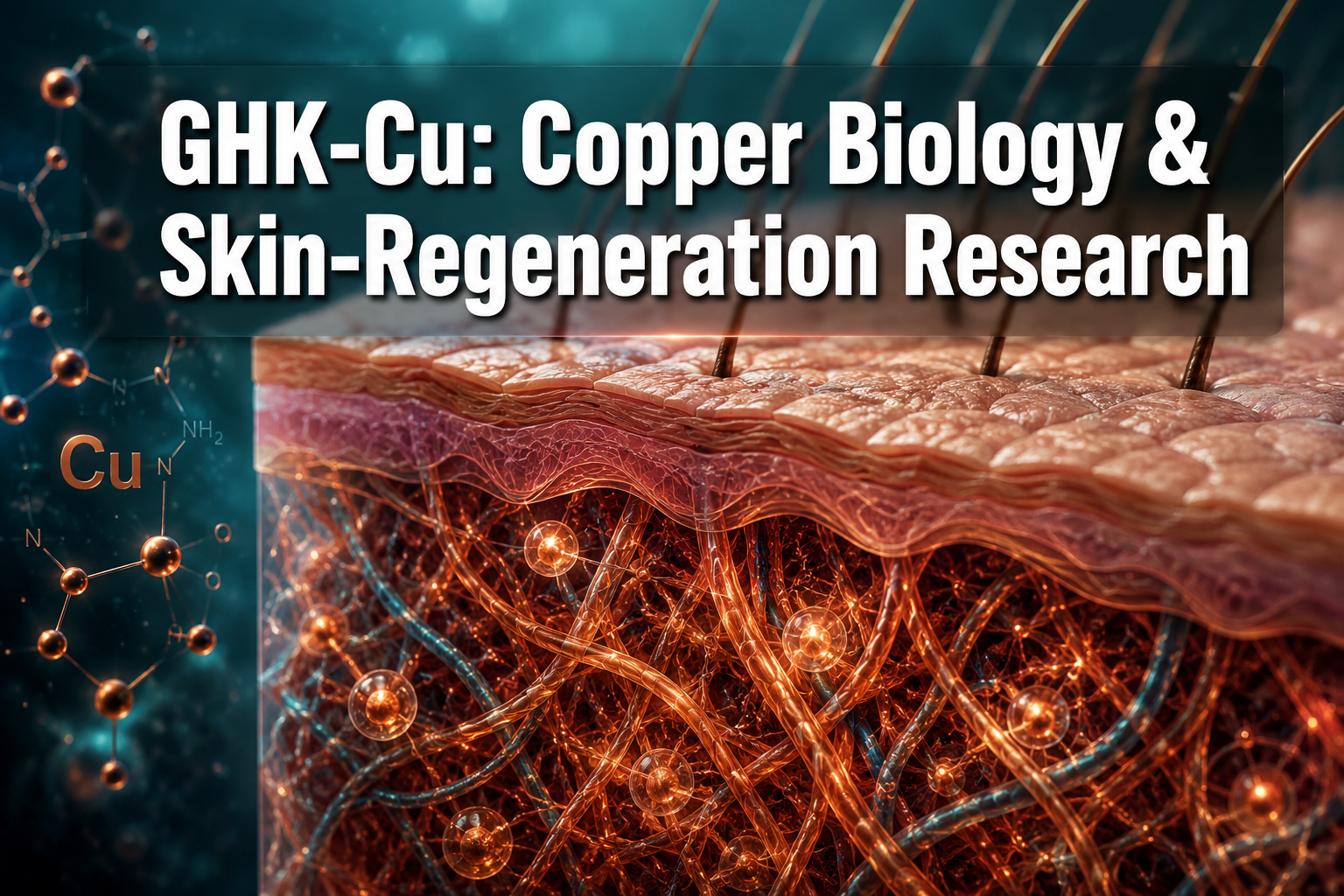
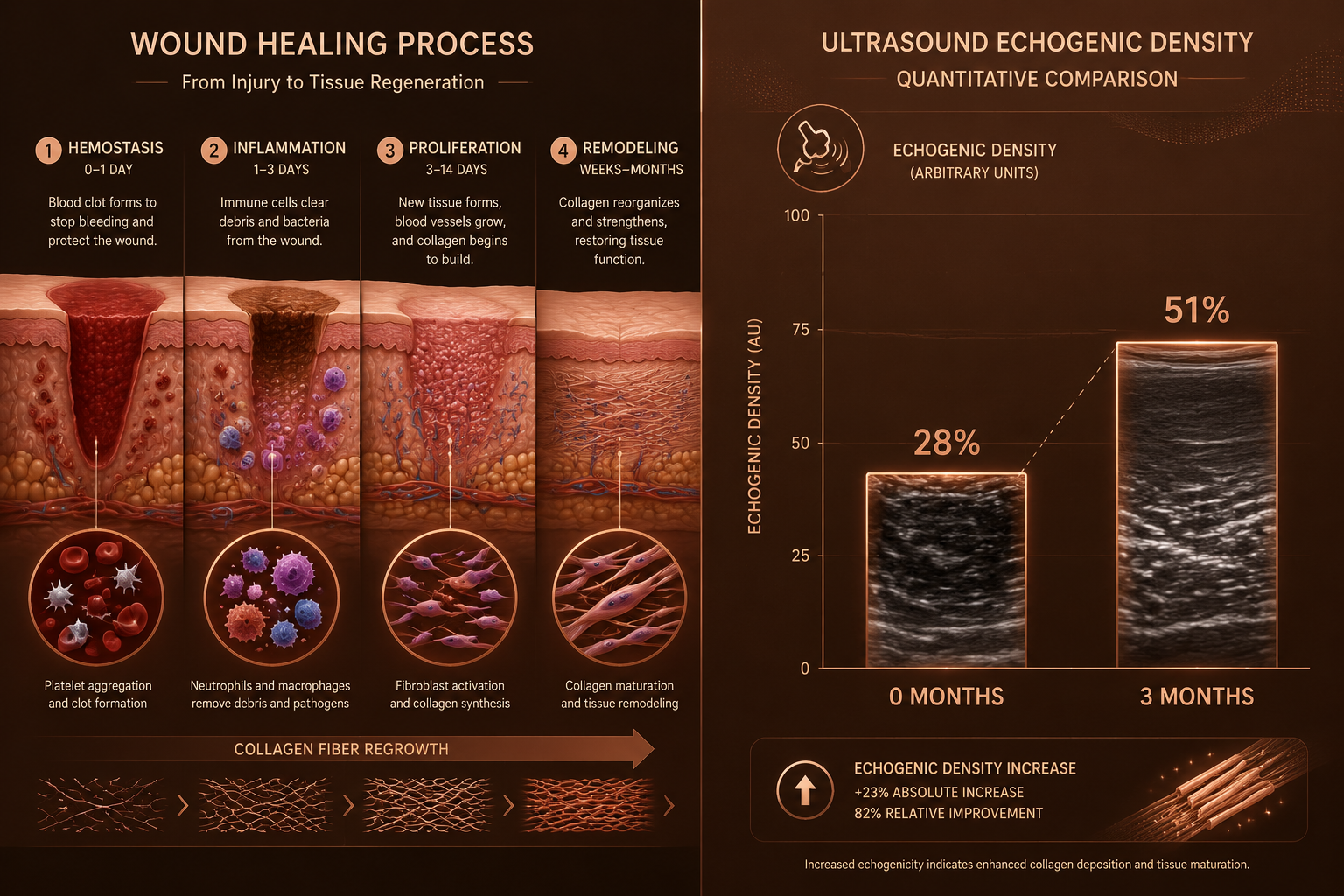
Ultrasound imaging now gives researchers a way to measure what was once only estimated: a 2026 clinical dataset found that topical GHK-Cu produced a mean 28% increase in subdermal echogenic density — a validated proxy for collagen and elastin content — after just three months of use, with the top quartile of participants showing a 51% improvement over baseline. That kind of measurable structural change has pushed GHK-Cu for Collagen, Copper Biology, and Skin-Regeneration Research: A Mechanism-First Overview into a central position in peptide biology discussions.
Key Takeaways
- GHK-Cu is a naturally occurring tripeptide-copper complex that declines sharply with age, making exogenous delivery a key research focus.
- Its primary mechanism involves copper-mediated activation of enzymes that build and remodel the extracellular matrix (ECM).
- GHK-Cu acts as an epigenetic regulator, influencing gene expression related to wound repair, inflammation control, and antioxidant defense.
- Ultrasound-measured data from 2026 confirms meaningful collagen density gains from topical application in a stable, penetrant vehicle.
- Researchers study GHK-Cu alongside other tissue-repair peptides because its signaling touches multiple biological pathways simultaneously.
What Is GHK-Cu and Why Does Copper Matter
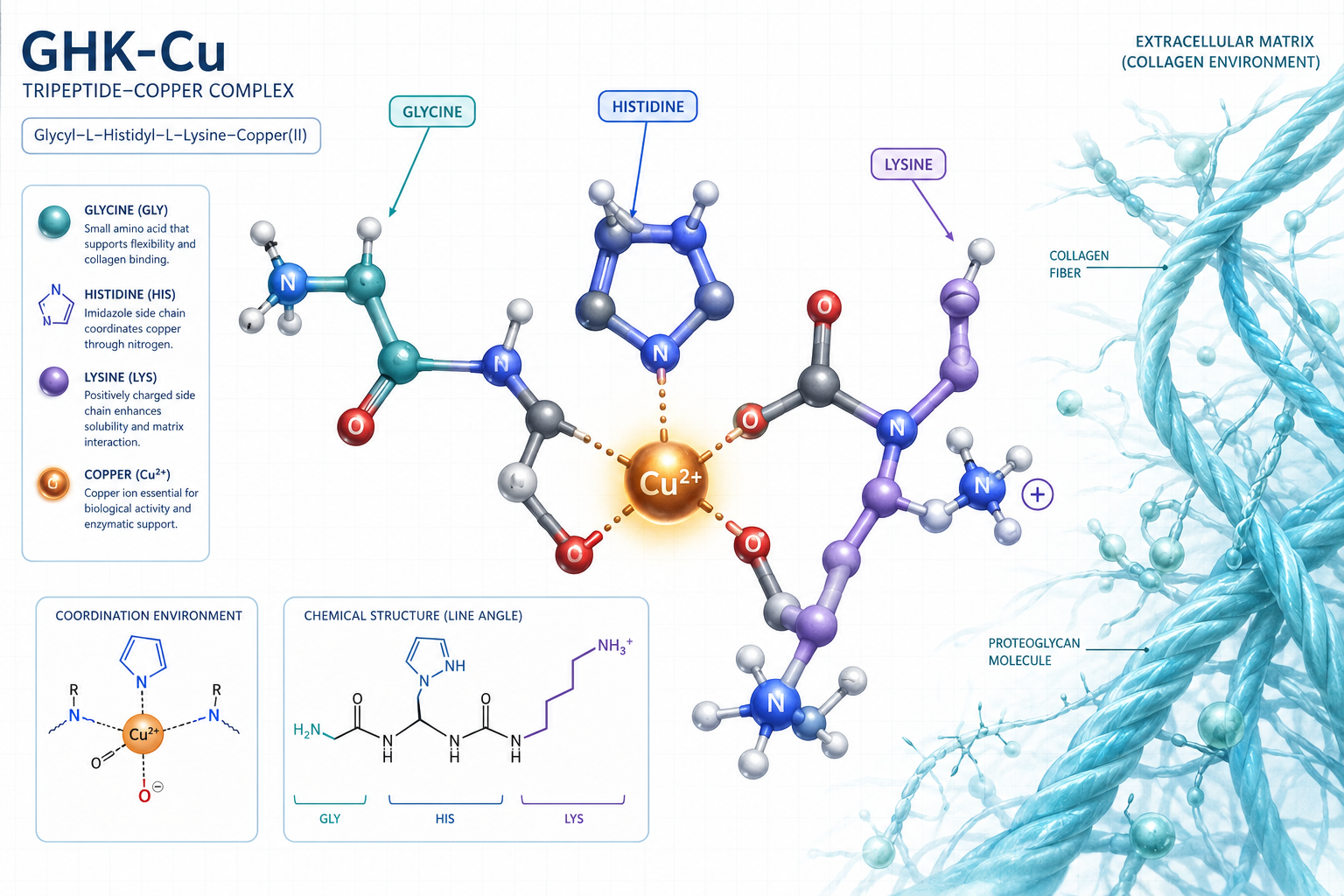
GHK-Cu stands for glycyl-L-histidyl-L-lysine copper(II). The tripeptide backbone — three amino acids — binds a single copper(II) ion with high affinity. That copper binding is not incidental. It is the functional core of the molecule.
Copper is a required cofactor for lysyl oxidase, the enzyme that cross-links collagen and elastin fibers into a stable matrix. Without adequate copper delivery, newly synthesized collagen fibers remain poorly organized. GHK-Cu acts as a chaperone, shuttling bioavailable copper to sites where connective tissue assembly is actively occurring.
Human plasma concentrations of GHK-Cu are estimated at roughly 200 ng/mL in young adults but fall to approximately 80 ng/mL by age 60. Researchers frame this decline as a meaningful loss of a natural repair signal — one the body uses to coordinate wound healing, matrix remodeling, and local immune modulation.
For context on how other peptides interact with tissue repair at the cellular level, the skin matrix biology overview provides useful background on ECM architecture.
Mechanisms: ECM Signaling, Epigenetics, and Antioxidant Defense
Understanding GHK-Cu for Collagen, Copper Biology, and Skin-Regeneration Research: A Mechanism-First Overview requires looking at three distinct but overlapping mechanisms.
1. Extracellular Matrix Upregulation
GHK-Cu stimulates fibroblasts — the cells responsible for producing collagen, elastin, and glycosaminoglycans. In vitro studies show increased transcription of:
| Target | Effect |
|---|---|
| Collagen I and III | Structural fiber production |
| Elastin | Skin elasticity and recoil |
| Fibronectin | Cell adhesion and wound closure |
| Decorin | Collagen fiber organization |
This is not a single-pathway effect. GHK-Cu appears to act as a broad ECM upregulator rather than targeting one receptor.
2. Epigenetic Regulation
One of the more surprising findings in GHK-Cu research is its influence on gene expression at scale. Studies using gene array analysis suggest GHK-Cu modulates the expression of over 4,000 human genes, many of which relate to inflammation resolution, DNA repair, and mitochondrial function. This places it in a category researchers sometimes call "epigenetic peptide regulators."
This overlaps with research themes explored in BPC-157 core peptide documentation and TB-500 cytoskeletal remodeling research, both of which also demonstrate broad gene-level effects on tissue repair.
3. Antioxidant and Anti-Inflammatory Activity
GHK-Cu downregulates pro-inflammatory cytokines including TNF-alpha and IL-6 while simultaneously activating superoxide dismutase (SOD) — a primary cellular antioxidant enzyme. This dual action helps explain why wound sites treated with GHK-Cu in preclinical models show faster resolution of the inflammatory phase.
Clinical and Preclinical Research Highlights
The 2026 ultrasound data represents a meaningful step forward because it uses an objective, non-invasive measurement rather than self-reported outcomes or surface photography.
Key findings from current research include:
- 28% mean increase in subdermal echogenic density after 3 months of topical GHK-Cu
- 51% improvement in the top quartile of participants
- Authors described GHK-Cu as "one of the most powerful peptides in our body that goes down with age," framing the results as empirical confirmation that exogenous delivery can restore dermal collagen density when the vehicle is stable and penetrant
Researchers interested in how delivery vehicles affect peptide bioavailability will find relevant discussion in the peptide purity testing guide and the are peptide serums worth it evidence-based review.
For those studying GHK-Cu alongside immune-modulating peptides, LL-37 mechanism and research covers overlapping anti-inflammatory signaling themes.
Conclusion
GHK-Cu for Collagen, Copper Biology, and Skin-Regeneration Research: A Mechanism-First Overview reveals a peptide with unusual biological reach. Its copper-binding function drives ECM enzyme activity, its epigenetic footprint touches thousands of repair-related genes, and its anti-inflammatory properties help resolve the conditions that slow healing.
Actionable next steps for researchers and informed readers:
- Prioritize delivery vehicle quality — penetration depth directly affects whether GHK-Cu reaches fibroblasts in the dermis.
- Review the latest developments in peptide research to track emerging GHK-Cu data as it is published.
- Consider GHK-Cu in the context of other ECM-active peptides to understand how combination approaches are being studied.
- Use objective measurement tools — such as ultrasound echogenicity — when evaluating research outcomes rather than relying solely on visual assessments.
The 2026 clinical data makes one point clearly: when delivered correctly, GHK-Cu does not just signal repair — it produces measurable structural change.
Leave a Reply
Want to join the discussion?Feel free to contribute!