

Roughly 50 million adults worldwide report clinically significant cognitive complaints each year, yet fewer than a handful of pharmaceutical compounds have received approval specifically for cognitive enhancement. That gap has driven serious research interest toward a class of short-chain amino acid sequences known as nootropic peptides. Among the most studied are three compounds with distinct mechanisms: Selank, Semax, and Epithalon. Evaluating the best research peptides for cognitive enhancement, comparing Selank, Semax, and Epithalon, requires a close look at what the science actually shows, where the evidence is strong, and where critical gaps remain.
Key Takeaways
- Semax is the most directly cognitive-activating of the three, upregulating BDNF and NGF to support memory, attention, and neuroprotection.
- Selank works primarily as an anxiolytic, producing cognitive benefits indirectly by reducing anxiety without sedation or dependence.
- Epithalon is studied mainly for telomerase activation and anti-aging effects; its cognitive role is less established than the other two.
- Both Semax and Selank are approved in Russia but hold no FDA approval; most clinical data originates from Russian-language literature.
- Peptide purity and sourcing quality are critical variables when evaluating any research compound.
Mechanisms of Action: How Each Peptide Works in the Brain
Understanding the best research peptides for cognitive enhancement means starting with mechanism, not marketing.
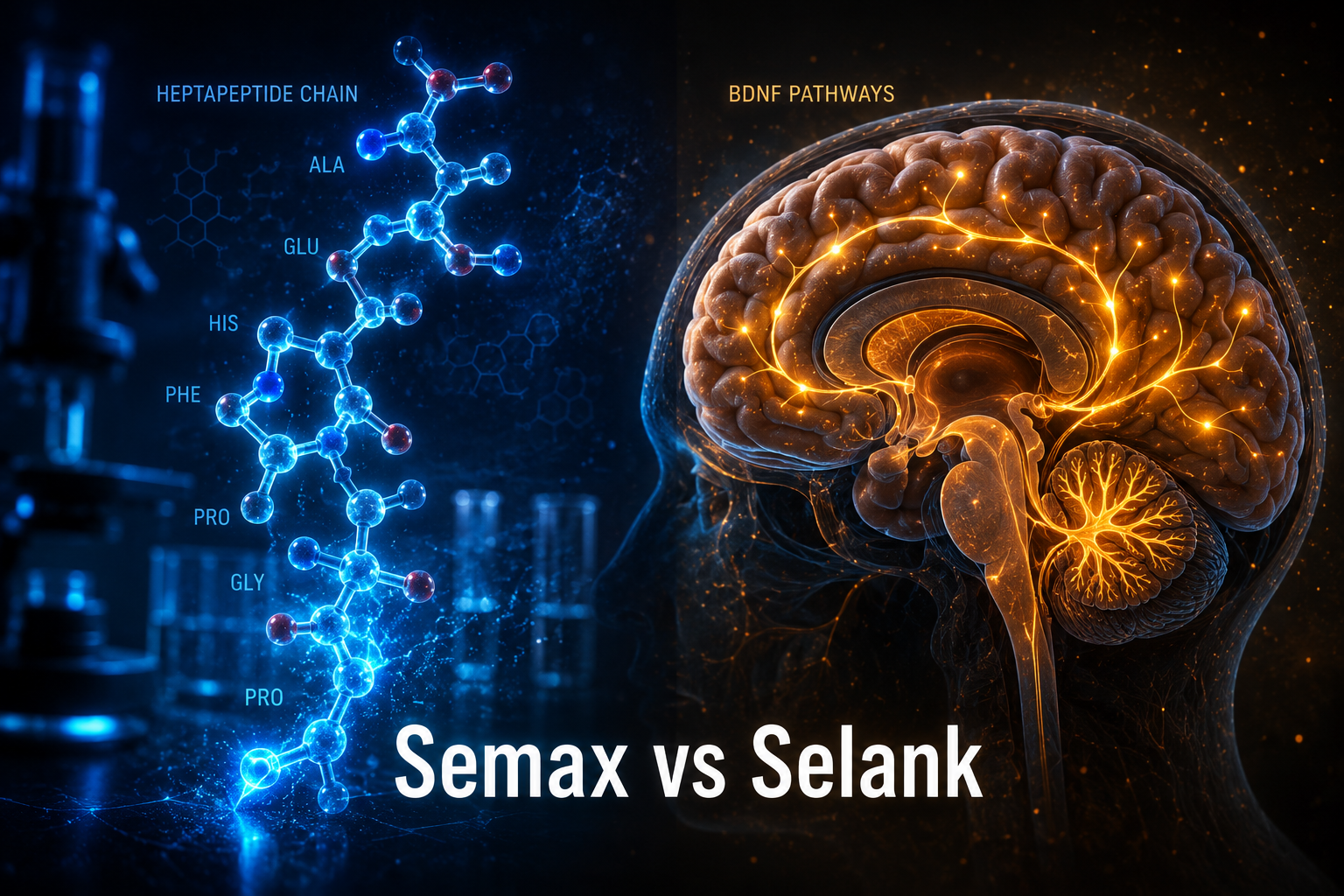
Semax is a synthetic heptapeptide derived from adrenocorticotropic hormone (ACTH). Its primary cognitive effect comes from upregulating brain-derived neurotrophic factor (BDNF) and nerve growth factor (NGF). These proteins support neuron survival, synaptic plasticity, and the formation of new neural connections. Semax also modulates dopaminergic and serotonergic systems, which influence motivation, attention, and working memory. Animal models and limited human trials have shown improvements in learning speed and memory consolidation. A particularly notable line of research demonstrated that Semax improved cognitive function in mice with amyloid-beta-induced Alzheimer's-like pathology, suggesting relevance beyond acute brain injury.
Selank is also a heptapeptide developed at the Russian Academy of Sciences. Rather than directly activating neurotrophic pathways, it modulates GABAergic and serotonergic systems to produce anxiolytic effects without sedation. Its cognitive benefits are largely indirect: by reducing anxiety, it removes a major barrier to attention, memory encoding, and executive function. Importantly, Selank does not appear to cause dependence or withdrawal, which distinguishes it from benzodiazepine-class anxiolytics. For a deeper look at the documented effects of both compounds, the Selank and Semax research overview covers the key findings in accessible detail.
Epithalon is a tetrapeptide (four amino acids) with a different primary target: telomerase activation. Telomerase is the enzyme that maintains telomere length, a key marker of cellular aging. Most Epithalon research focuses on longevity and anti-aging rather than acute cognitive enhancement. Some animal studies suggest neuroprotective properties, but the direct cognitive evidence is considerably thinner than what exists for Semax or Selank.
| Peptide | Primary Mechanism | Main Cognitive Benefit | Evidence Strength |
|---|---|---|---|
| Semax | BDNF/NGF upregulation | Memory, attention, neuroprotection | Moderate (clinical + preclinical) |
| Selank | GABAergic/serotonergic modulation | Anxiety reduction, indirect cognition | Moderate (clinical + preclinical) |
| Epithalon | Telomerase activation | Neuroprotection, anti-aging | Limited (mainly preclinical) |
Comparing Selank, Semax, and Epithalon: Clinical Evidence and Approval Status
When comparing the best research peptides for cognitive enhancement, regulatory status and clinical depth matter.
Semax holds approval in Russia for ischemic stroke and cognitive disorders. Clinical studies have shown improved neurological outcomes when it is administered intranasally shortly after stroke onset. A 2019 Russian review summarizing 25 years of Semax use across more than 15,000 patients reported no serious adverse events at therapeutic doses, though the review was retrospective rather than a prospectively collected safety database.
Selank is approved in Russia for generalized anxiety disorder and neurasthenia. A functional MRI study in 52 healthy participants found that both Selank and Semax produced measurable changes in functional connectivity between the right amygdala and the right temporal cortex, suggesting real neurological activity rather than placebo effects. Researchers interested in how Selank influences stress response and cognition will find the Selank stress and cognition research summary a useful reference. Additional context on Selank side effects is also worth reviewing before drawing research conclusions.
Neither Semax nor Selank holds FDA approval. Epithalon has no regulatory approval in any major Western market. All three are available primarily through research chemical suppliers, which makes sourcing quality a critical variable. Understanding peptide purity testing is essential for anyone working with these compounds in a research context.
"The majority of clinical data on Semax and Selank originates from Russian-language literature, with limited replication in Western studies, a significant gap that shapes how confidently any conclusions can be drawn."
Both Semax and Selank are administered intranasally, which allows them to bypass the blood-brain barrier efficiently and reach the central nervous system directly. This delivery route is a key advantage over oral peptides, which typically degrade before reaching systemic circulation.
Delivery, Safety, and Research Sourcing Considerations
For researchers evaluating the best research peptides for cognitive enhancement, comparing Selank, Semax, and Epithalon, practical sourcing and safety considerations are inseparable from the science.
Delivery method shapes bioavailability significantly. Intranasal delivery for Semax and Selank provides rapid CNS access. Epithalon is typically administered subcutaneously or intravenously in research settings. Oral delivery of any peptide carries degradation risks unless specifically formulated for that route.
Safety profiles for Semax and Selank appear favorable in available data, with no serious adverse events reported at research-relevant doses. However, the evidence base is geographically concentrated and methodologically variable. Epithalon's long-term safety profile in humans remains understudied.
Purity and sourcing represent the most controllable variable in any peptide research protocol. Contaminated or mislabeled compounds introduce confounds that make results uninterpretable. Researchers working across multiple peptide classes, from cognitive compounds to metabolic agents like those explored in GHK-Cu longevity research or NAD+ energetics and longevity themes, consistently cite verified purity as the baseline requirement.
Those exploring broader neuroprotective peptide research may also find the Pinealon neuroprotection overview relevant, as it covers a related class of bioregulator peptides with overlapping research themes.

Conclusion
The best research peptides for cognitive enhancement, comparing Selank, Semax, and Epithalon, each occupy a distinct niche. Semax is the strongest candidate for direct cognitive activation, supported by the most robust clinical data. Selank offers a complementary pathway through anxiety reduction, with a clean safety profile and documented neurological activity. Epithalon's cognitive role remains largely theoretical at this stage, with its primary value lying in anti-aging and neuroprotective research.
Actionable next steps for researchers:
- Prioritize verified, third-party tested peptide sources before beginning any protocol.
- Review the functional MRI and BDNF literature on Semax before designing cognitive outcome measures.
- Treat Epithalon as a longevity compound first and a cognitive enhancer second until more direct human evidence emerges.
- Consult the neuroendocrine and innate immunity research resource for broader context on how peptides interact with CNS regulatory systems.
- Stay current with Western replication studies, as the field is evolving rapidly in 2026.
Leave a Reply
Want to join the discussion?Feel free to contribute!