

Telomeres shorten with every cell division, and by the time a human reaches middle age, some cells have already crossed the threshold into senescence. That single biological fact has driven enormous scientific interest in compounds that may interact with genomic maintenance systems. The study of DNA, Epithalon, and MOTS‑c: How Research Peptides Interface With Genomic and Telomeric Biology sits at the intersection of molecular biology, mitochondrial science, and peptide research, offering a framework for understanding how two distinct compounds may influence cellular aging at its most fundamental level. All discussion here reflects preclinical research contexts only.
Key Takeaways
- Epithalon is a synthetic tetrapeptide studied for its ability to activate telomerase and potentially slow telomere shortening in cell lines.
- MOTS‑c is encoded within mitochondrial DNA and functions as a metabolic regulator by activating the AMPK pathway.
- Both peptides represent distinct anti-aging strategies: one genomic, one mitochondrial.
- Circulating MOTS‑c levels decline with age, and preclinical models suggest exogenous administration may partially restore metabolic function.
- Neither peptide is FDA-approved for human use; both are available strictly for scientific research.
Understanding the Genomic Foundation
Before examining how DNA, Epithalon, and MOTS‑c interact with genomic and telomeric biology, it helps to understand the structures involved.
Telomeres are repetitive nucleotide sequences (TTAGGG in humans) that cap the ends of chromosomes like protective shields. Each time a cell divides, these caps shorten. When they become critically short, the cell either stops dividing or undergoes apoptosis. The enzyme telomerase can rebuild telomere length, but its activity declines sharply in most adult somatic cells.
Mitochondrial DNA (mtDNA) is a separate, circular genome housed inside mitochondria. Unlike nuclear DNA, mtDNA is maternally inherited and encodes proteins essential for cellular energy production. It also encodes small peptides, including MOTS‑c, that act as signaling molecules throughout the body.
These two genomic systems, nuclear and mitochondrial, are the primary targets of Epithalon and MOTS‑c respectively.
Epithalon: Telomerase Activation and Gene Expression
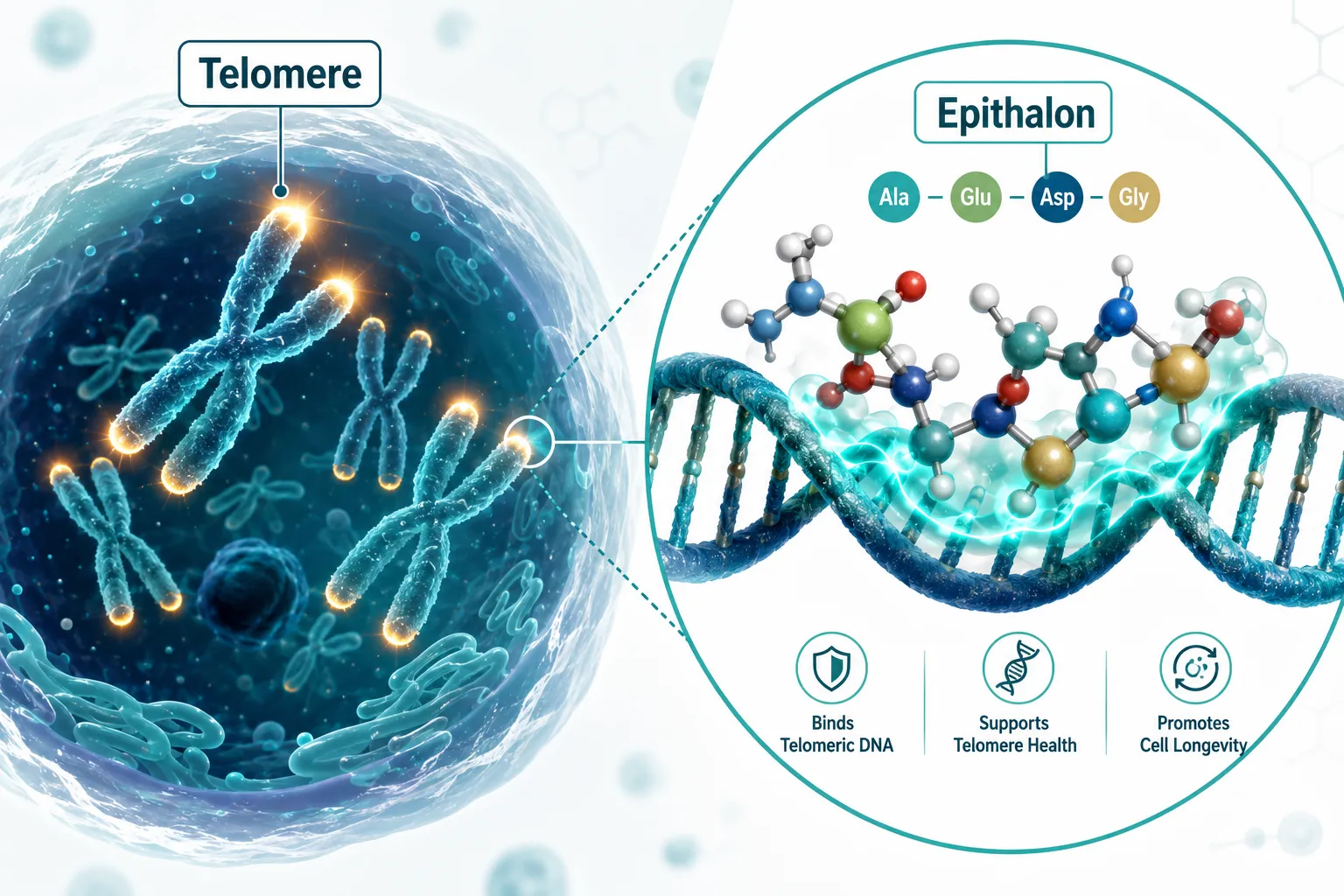
Epithalon (also written Epitalon) is a synthetic tetrapeptide with the sequence Ala-Glu-Asp-Gly. It was originally derived from the pineal gland peptide epithalamin and has been studied extensively in Russian biogerontology research since the 1980s.
How Epithalon Interfaces With DNA
Research suggests Epithalon may activate telomerase, the enzyme responsible for extending telomere length. In human cell line studies, Epithalon has been associated with increased telomere length, achieved either through direct telomerase upregulation or through alternative lengthening of telomeres (ALT) mechanisms.
Beyond telomere biology, Epithalon appears to interact with chromatin itself. Studies indicate it can bind directly to DNA and interact with histone proteins, influencing chromatin structure. This suggests a broader role in gene expression modulation, not merely telomere maintenance.
"Epithalon's interaction with histone proteins places it in the category of epigenetic modulators, a distinction that separates it from simpler antioxidant-based anti-aging compounds."
For a deeper look at Epithalon's longevity-related signaling, see the Epithalon longevity signals research overview.
MOTS‑c: Mitochondrial DNA and Metabolic Regulation
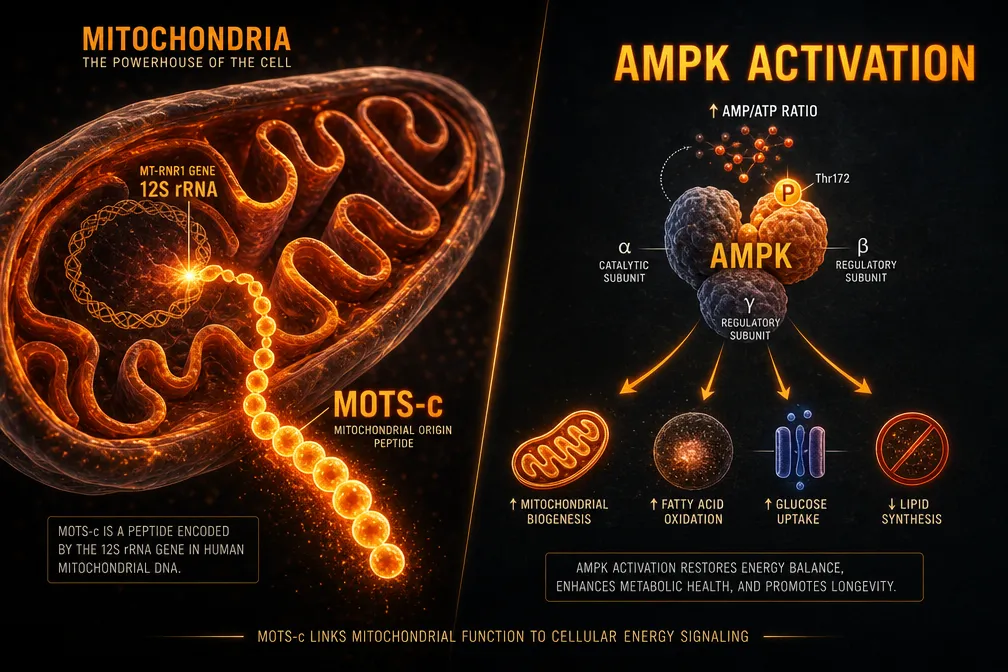
MOTS‑c is a 16-amino-acid peptide encoded within the mitochondrial 12S rRNA gene, making it one of the few known peptides of mitochondrial origin. This unique origin means MOTS‑c is directly tied to the mitochondrial genome, not the nuclear genome, which gives it a distinct biological identity.
MOTS‑c and the AMPK Pathway
MOTS‑c functions as a systemic metabolic regulator by activating AMP-activated protein kinase (AMPK), a master energy sensor in cells. Through AMPK activation, MOTS‑c influences:
- Insulin sensitivity, improving glucose uptake in muscle tissue
- Body composition, supporting fat metabolism
- Physical performance, acting as an exercise mimetic in aged animal models
Circulating MOTS‑c levels decline measurably with age in both humans and mice. Preclinical studies show that exogenous MOTS‑c administration in aged mice partially restores metabolic functions that had declined with age, a finding that has generated significant research interest.
For more on MOTS‑c's role in mitochondrial function, explore the MOTS‑c mitochondrial peptide research profile and MOTS‑c metabolic flexibility research themes.
Comparing the Two Pathways
Understanding DNA, Epithalon, and MOTS‑c: How Research Peptides Interface With Genomic and Telomeric Biology requires a clear comparison of their distinct mechanisms.
| Feature | Epithalon | MOTS‑c |
|---|---|---|
| Origin | Synthetic tetrapeptide | Mitochondrial DNA-encoded |
| Primary target | Nuclear DNA / telomeres | Mitochondrial signaling / AMPK |
| Key mechanism | Telomerase activation | Metabolic regulation |
| Age-related change | Telomere shortening increases | MOTS‑c levels decrease |
| Research model | Cell lines, animal studies | Animal models, human observational |
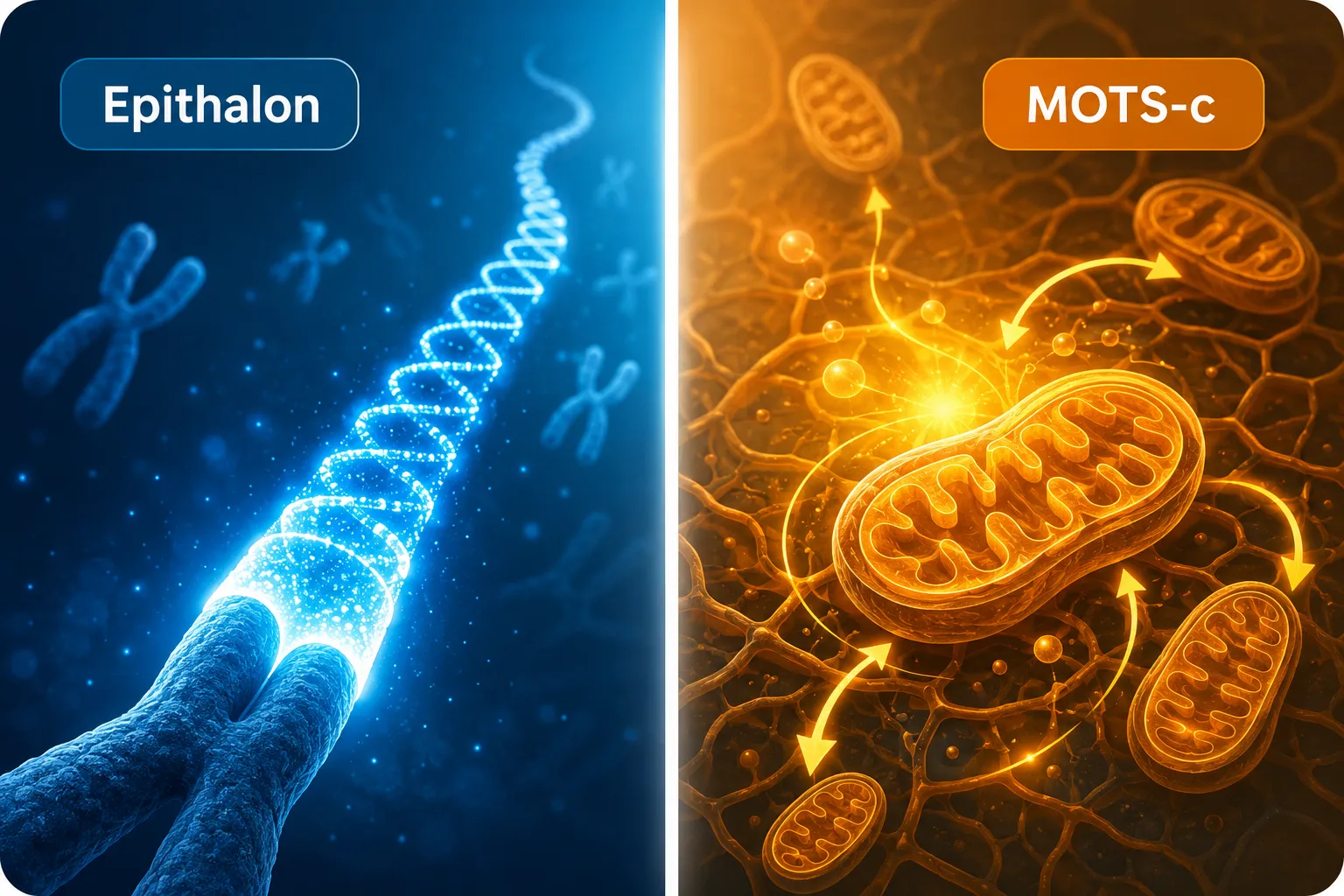
These two peptides represent complementary, not competing, approaches to genomic and cellular maintenance research.
Researchers interested in how other peptides interact with cellular repair systems may also find value in reviewing GHK-Cu peptide research and sourcing guidance, as GHK-Cu similarly influences gene expression pathways.
Research Considerations and Regulatory Status
Neither Epithalon nor MOTS‑c is approved by the FDA for human therapeutic use. Both compounds are available exclusively for scientific research purposes. Human clinical trial data remains limited, and preclinical findings, while promising, cannot be directly extrapolated to human outcomes without further controlled study.
Researchers sourcing these compounds should prioritize verified purity and documented testing. Reviewing quality testing protocols before procurement is a critical step in responsible research planning.
Those exploring broader peptide research themes may also find the MOTS‑c mitochondrial dynamics research and synergy of LL‑37 and MOTS‑c resources useful for contextualizing multi-peptide research frameworks.
Conclusion
The intersection of DNA, Epithalon, and MOTS‑c: How Research Peptides Interface With Genomic and Telomeric Biology represents one of the most scientifically nuanced areas of current peptide research. Epithalon's potential to activate telomerase and modulate chromatin structure addresses the nuclear genomic side of cellular aging. MOTS‑c, encoded within mitochondrial DNA itself, targets the metabolic and energetic dimensions of age-related decline through AMPK activation.
Actionable next steps for researchers in 2026:
- Review the current preclinical literature on telomerase activation and MOTS‑c metabolic signaling before designing any study protocol.
- Confirm peptide purity through third-party certificate of analysis documentation prior to use.
- Evaluate Epithalon and MOTS‑c as part of a broader genomic research framework, not as isolated compounds.
- Monitor emerging human observational data on MOTS‑c levels as a biomarker of metabolic aging.
Both compounds offer compelling research angles, but responsible science demands rigorous methodology, verified sourcing, and a clear understanding that preclinical findings are the starting point, not the conclusion.
Leave a Reply
Want to join the discussion?Feel free to contribute!