

Researchers searching for "GLP3 peptide" in 2026 are often looking for the same compound, yet the terminology they use can lead them to entirely different bodies of literature, products, and regulatory contexts. The conversation around GLP3 Peptide vs. Retatrutide: Understanding the Nomenclature and Research Implications matters because imprecise language in peptide science does not just cause confusion; it can distort research intent, misalign sourcing decisions, and obscure a compound's actual clinical standing.
Key Takeaways
- "GLP-3" is an informal, community-driven descriptor, not an official scientific classification for retatrutide.
- Retatrutide is a specific triple agonist targeting GLP-1, GIP, and glucagon receptors, developed by Eli Lilly.
- Phase 3 trials show up to 28.7% mean body weight reduction over approximately 68 weeks.
- As of 2026, retatrutide has not received FDA approval and carries no official brand name.
- Understanding this nomenclature gap is critical for accurate research, sourcing, and clinical interpretation.
What "GLP-3" Actually Means, and What It Does Not
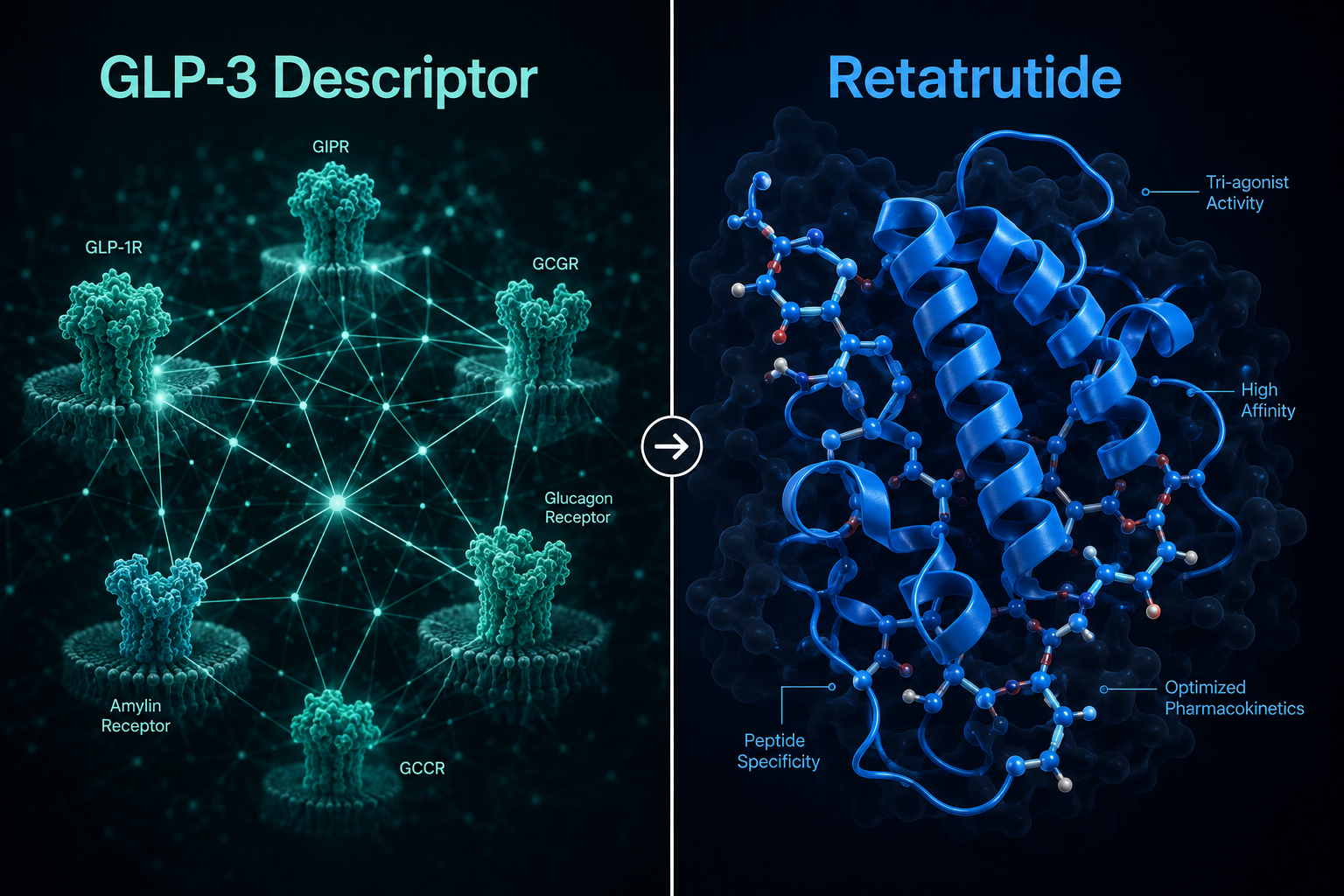
The label "GLP-3" did not originate in a peer-reviewed journal or a regulatory filing. It emerged organically in biohacking communities and research forums as shorthand for retatrutide's triple-receptor mechanism, activating glucagon-like peptide-1 (GLP-1), glucose-dependent insulinotropic polypeptide (GIP), and glucagon receptors simultaneously.
This is a meaningful distinction. GLP-1 and GLP-2 are actual endogenous peptides with defined biological roles. There is no naturally occurring "GLP-3" in human physiology. When researchers or enthusiasts use the term, they are borrowing the naming convention to signal a step beyond dual agonists like tirzepatide, not describing a distinct peptide family.
"GLP-3" functions as a category label born from search behavior, not from biochemistry.
For anyone exploring the newest GLP-1 triple agonist research, recognizing this distinction prevents conflating informal community terminology with peer-reviewed compound classifications. Related resources on GLP-3 and Retatrutide provide further context on how this terminology has evolved in the research space.
Retatrutide: The Compound Behind the Label
Retatrutide is a once-weekly subcutaneous injection developed by Eli Lilly. Its mechanism is what drives the "GLP-3" nickname, by activating three metabolic receptors at once, it amplifies both appetite suppression and energy expenditure beyond what single or dual agonists can achieve.
Clinical trial results have been striking:
- Phase 2 trials demonstrated a mean body weight reduction of 24.2% at 48 weeks using a 12 mg dose.
- Phase 3 data from the TRIUMPH program reported up to 28.7% weight loss over approximately 68 weeks.
- These figures surpass outcomes associated with semaglutide (Ozempic/Wegovy) and tirzepatide (Mounjaro/Zepbound).
Common side effects observed in trials include:
- Nausea
- Diarrhea
- Vomiting
- Constipation
Discontinuation rates at higher doses ranged from roughly 12-18%, compared to approximately 4% for placebo, a consideration for any research protocol design.
As of 2026, retatrutide remains in Phase 3 trials and has not been approved by the FDA. Eli Lilly is expected to pursue approval pending successful trial completion, possibly by the end of 2026. It currently carries no official brand name.
For researchers interested in how metabolic peptides interact with broader longevity pathways, the longevity peptide research overview offers relevant context. Those examining synergistic mechanisms may also find value in reviewing cagrilintide synergy with GLP-1 as a comparative framework.

Why the Nomenclature Gap Has Real Research Implications
Understanding GLP3 Peptide vs. Retatrutide: Understanding the Nomenclature and Research Implications is not purely academic. The terminology used when sourcing, citing, or designing studies around this compound has downstream consequences.
Three key implications stand out:
- Search intent misalignment, Researchers querying "GLP-3 peptide" may encounter products or literature that conflate the informal term with unrelated compounds, creating sourcing errors.
- Regulatory blind spots, Because retatrutide has no approved brand name yet, informal labels like "GLP-3" or "Reta" circulate in research communities without the traceability that official nomenclature provides.
- Comparative analysis errors, Treating "GLP-3" as equivalent to "triple agonist" as a class, rather than as a nickname for one specific molecule, can skew meta-analyses or literature reviews.
Researchers working with metabolic peptides should cross-reference compound identifiers carefully. Resources covering NAD research and where to buy peptides online illustrate how sourcing decisions intersect with nomenclature clarity in the broader peptide research space.
For those tracking the full pipeline of investigational metabolic compounds, reviewing tesofensine peptide research and MOTS-c mitochondrial research themes provides useful comparative framing for how novel compounds acquire informal labels before formal approval.

Conclusion
The debate around GLP3 Peptide vs. Retatrutide: Understanding the Nomenclature and Research Implications ultimately comes down to precision. Retatrutide is a well-defined, clinically investigated compound with Phase 3 data supporting extraordinary weight loss outcomes. "GLP-3" is a useful shorthand, but only when both parties in a research conversation understand it as informal nomenclature, not a recognized scientific category.
Actionable next steps for researchers and practitioners:
- Always use "retatrutide" as the primary identifier in formal documentation, protocols, and sourcing requests.
- Treat "GLP-3" and "Reta" as search and community terms, helpful for discovery, unreliable for precision.
- Monitor the TRIUMPH Phase 3 program and FDA submission timelines, as approval could reshape how the compound is officially labeled and referenced.
- Cross-reference any sourced material against verified compound identifiers to avoid conflation with unrelated peptides.
Clarity in nomenclature is not a minor detail, in peptide research, it is the foundation of reproducible, credible science.
Leave a Reply
Want to join the discussion?Feel free to contribute!