

Only one gene — KISS1 — encodes an entire family of signaling molecules now reshaping how researchers think about hormones, fertility, cancer biology, and sexual health. The kisspeptin peptide sits at the center of that revolution, acting as a master regulator of the hypothalamic-pituitary-gonadal (HPG) axis with a remarkably clean safety profile.
Key Takeaways 🔑
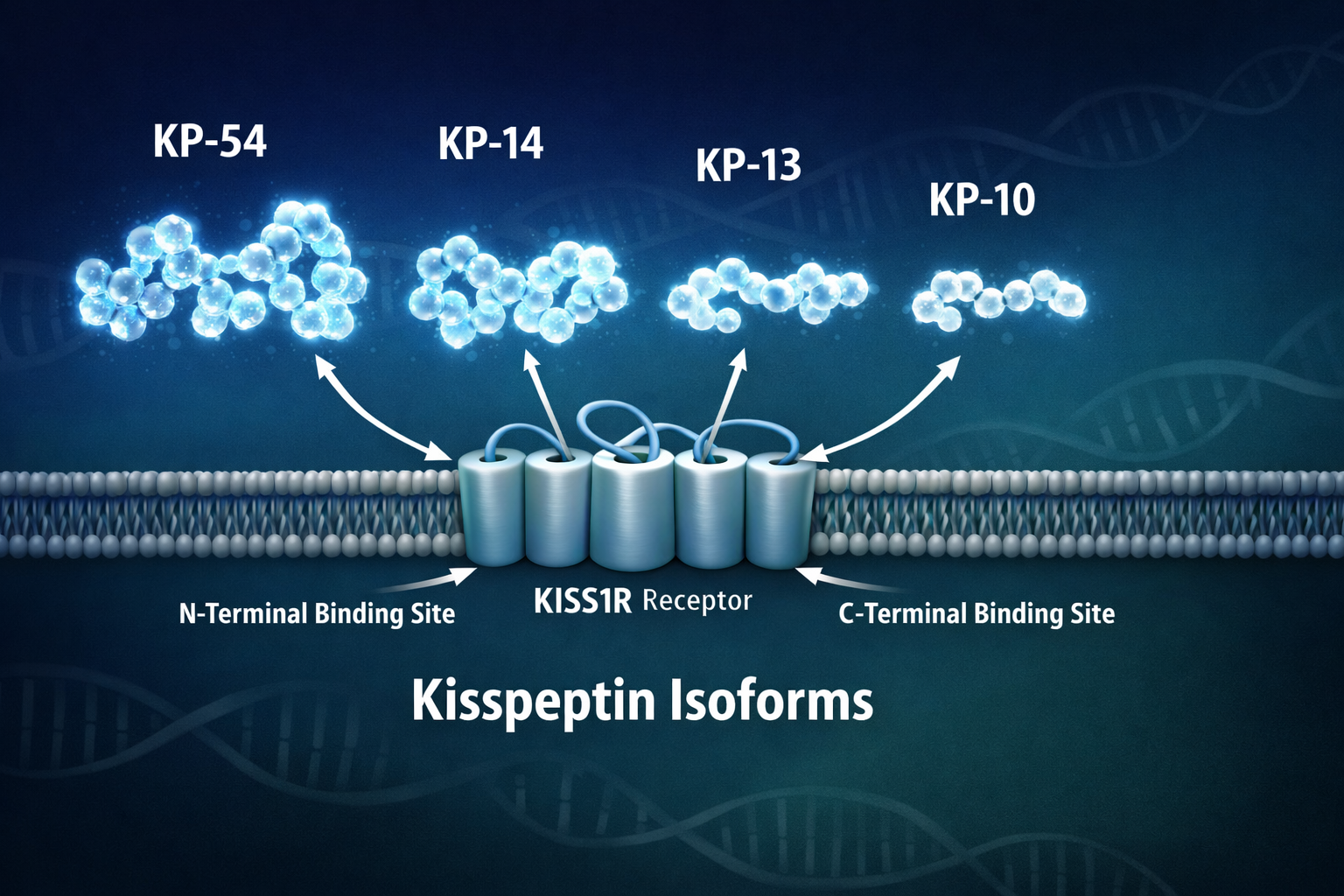
- The kisspeptin peptide exists in four active isoforms, with KP-54 being the most abundant and KP-10 the minimal receptor-binding form
- It acts as a pulsatile, self-limiting signaler — activating hormone pathways without causing long-term receptor burnout
- Research spans fertility restoration, prostate cancer, libido, and immunotherapy combinations
- Emerging formulations include intranasal and transdermal delivery to improve bioavailability
- Tolerability data from clinical cohorts shows no treatment-emergent adverse events reported to date
What Is the Kisspeptin Peptide? Structure and Isoforms
The kisspeptin peptide family is produced through proteolysis of a precursor protein called prepro-kisspeptin. This process yields four biologically active fragments:
| Isoform | Amino Acids | Key Feature |
|---|---|---|
| KP-54 | 54 | Most abundant in circulation |
| KP-14 | 14 | Active in central signaling |
| KP-13 | 13 | Regionally expressed |
| KP-10 | 10 | Minimal receptor-binding form |
All four bind the KISS1R receptor (also called GPR54), triggering downstream GnRH pulse release. What makes the kisspeptin peptide unique is its pulsatile signaling pattern — it activates endogenous feedback loops without desensitizing receptors over time, a critical advantage over synthetic hormone analogs.
💡 "Kisspeptin functions like a precision conductor — initiating hormonal cascades on cue, then stepping back before the system overloads."
[product_slider category="peptides" limit="8"]
7 Key Research Areas for the Kisspeptin Peptide
1. 🧬 Fertility Restoration
The kisspeptin peptide shows strong early results in reversing hypothalamic amenorrhea and inducing ovulation. Researchers view it as a hormone-sparing alternative to traditional fertility treatments, though multi-center verification is still ongoing.
2. ❤️ Low Libido in Men and Women
Two recent studies indicate that kisspeptin injections may meaningfully address low sexual desire in both male and female subjects experiencing distress from reduced libido — a significant finding for a condition with limited pharmacological options.
3. 🎯 Prostate Cancer Management
Phase-I studies using daily subcutaneous kisspeptin peptide injections show an early LH surge followed by sustained testosterone reduction to castrate levels — a self-limiting mechanism that may offer an alternative to long-acting GnRH agonists.
4. 🛡️ Cancer Immunotherapy Synergy
Combination trials are pairing kisspeptin with PD-1 checkpoint blockade. The mechanism: kisspeptin-induced translational stress downregulates PD-L1, increasing T-cell recognition and potentially converting immunologically "cold" tumors into checkpoint-responsive environments.
5. 🔬 Melanoma Chemotherapy Sensitization
Early oncology data shows that brief co-incubation of kisspeptin with vemurafenib reactivates EIF2AK2-mediated translational stress in melanoma cells, driving them past the apoptotic threshold while leaving healthy cells unharmed.
6. 📊 Biomarker-Guided Dosing Protocols
Regulatory agencies are now exploring adaptive, biomarker-driven trial designs that titrate kisspeptin dose in real time using LH pulse frequency or exosomal KISS1 mRNA — a closed-loop precision medicine approach.
7. 💊 Next-Generation Delivery Formats
Alongside injectable forms, researchers are developing nasal spray peptide formulations and transdermal depot nano-carriers for ultra-slow release — potentially enabling patient self-administration and bypassing first-pass metabolism.
Safety Profile: What the Data Shows
Tolerability of the kisspeptin peptide appears high across current research cohorts. No treatment-emergent adverse events have been reported in either male or female study groups. Researchers attribute this to the peptide's rapid enzymatic degradation and its status as an endogenous molecule — the body already knows how to process it.
For those exploring the broader landscape of research peptides, the complete guide to peptide therapy provides helpful context on mechanisms and expectations.
Conclusion: Actionable Next Steps
The kisspeptin peptide is one of the most multi-dimensional signaling molecules under active clinical investigation in 2026. Its applications span reproductive medicine, oncology, and sexual health — all backed by a growing body of peer-reviewed research and a clean safety record.
Actionable next steps for researchers and clinicians:
- ✅ Monitor adaptive biomarker trial outcomes for dosing guidance
- ✅ Explore combination protocols pairing kisspeptin with checkpoint inhibitors
- ✅ Watch for intranasal and depot formulation approvals
- ✅ Review longevity peptide research for complementary signaling pathways
Tags: kisspeptin peptide, kisspeptin hormone research, KISS1 gene peptide, kisspeptin fertility, kisspeptin libido, peptide therapy 2026, kisspeptin cancer research, kisspeptin isoforms, reproductive peptides, peptide signaling, KISS1R receptor, hormonal peptides