Call or Text 727-513-9780
  • Shopping Cart Shopping Cart
    0Shopping Cart
Pure Tested Peptides | America's most trusted Peptides for sale online
  • Peptides for sale
    • Oral Peptides for sale
      • Peptide Capsules for sale
      • BPC 157 Capsules 1000mcg
      • SLU-PP-332 Capsules | 1000 mcg
      • 5-Amino-1MQ 50mg Capsules
      • Tesofensine 500mcg
    • All Peptides for sale
    • Peptide Sprays
      • BPC 157 Nasal Spray Kit
      • BPC-157 TB500 Nasal Spray Kit
      • Semax Nasal Spray 10mg
      • Selank – Nasal Spray Kit – 10mg
      • Epithalon 50MG Nasal Spray Kit
      • Ipamorelin 10mg Nasal Spray
      • Klow Nasal Spray (BPC-157 + TB-500 + GHK-Cu + KPV) | 80mg
      • Hulk Nasal Spray Tesa / Ipa Blend 6/3 MG
      • Klow Nasal Spray
      • NAD + 500 mg Nasal Spray
      • PT-141 Nasal Spray Kit
    • GHRH Peptides
      • Ipa Peptides
      • CJC-1295 Peptides
        • CJC-1295 with DAC 5 mg
        • CJC-1295 without DAC 5 mg
        • CJC-1295 Ipa 10mg
      • Tesa Peptides
        • Tesa Peptide
        • Tesa 20 mg
    • GHK-Cu Peptides
      • All GHK-Cu Peptides
      • GHK-Cu 100mg
      • KLOW Peptide Blend – Buy KLOW blend online
    • BPC Peptides
      • All BPC Peptides
      • BPC-157
      • BPC-157 TB-500
      • BPC 157 capsules 1000mcg
    • SLU-PP-332 Peptides
      • All SLU-PP-332 Peptides
      • SLU-PP-332 5mg
    • GLP3 Peptides
      • GLP3-R
      • GLP3-R CAG 10mg
      • GLP3-R 20mg
    • PT-141 Peptides
      • PT-141 Peptides for sale
      • PT-141 10mg
      • PT-141 Nasal Spray
    • CAG Peptides
      • Lipo-C Peptide Blend
      • CAG 5mg
      • CAG 10mg
    • MOTS-C Peptides
      • MOTS-C Peptides for sale
      • MOTS-c peptide
      • MOTS-c 10mg *6 pack*
    • 5 Amino 1MQ Peptides
      • 5 Amino 1MQ Peptides for sale
      • 5-Amino-1MQ 50mg Capsules
      • 5-Amino-1MQ 5mg
    • Epithalon Peptides
      • Epithalon Peptides for sale
      • Epithalon 10mg
      • Epithalon 50mg
  • Shop
    • GLPs
      • 5-Amino-1MQ 50mg Capsules
      • 5-Amino-1MQ 5mg
      • GLP3-Reta
      • L-Carnitine 500mg/ml
      • Tesofensine 500mcg
      • SLU-PP-332 5mg
      • MOTS-c 10mg *6 pack*
    • Epithalon & BPC Peptides
      • Epithalon 10mg
      • Epithalon 50mg
      • BPC-157
      • BPC 157 capsules 1000mcg
      • BPC-157 TB-500
      • BPC-157 TB500 Nasal Spray Kit
      • BPC 157 Nasal Spray Kit
    • BPC TB-500 & NAD+ Peptides
      • NAD+ 500 mg
      • KLOW Peptide Blend – Buy KLOW blend online
      • GLOW Peptide Blend
      • TB 500 5mg
      • BPC 157 capsules 1000mcg – Supplement
      • BPC 157 Nasal Spray Kit
      • BPC-157
      • BPC-157 TB500 Nasal Spray Kit
      • BPC-157 TB-500
      • BPC 157 capsules 1000mcg
    • LL-37 Peptide
      • LL-37 10 mg
    • MOTS-C & Selank
      • MOTS-c peptide
      • Selank 10mg
    • GHK Peptides
      • GHK-Cu 100mg
      • GLOW Peptide Blend
      • KLOW Peptide Blend – Buy KLOW blend online
  • COAs
  • Wholesale
    • Wholesale Peptides for sale
  • PTP FAQ
  • Affiliates
    • Affiliate Program
    • Affiliate Signup
  • Contact
    • Contact Customer Service
    • Text Customer Support
  • About US
  • Shop all peptides
  • Login / Register Login / Register Page Link Login / Register Page Link
  • Click to open the search input field Click to open the search input field Search
  • Menu Menu
Peptide Purity Standards: How to Read a COA for Potency, Sterility, and Endotoxin

Peptide Purity Standards: How to Read a COA for Potency, Sterility, and Endotoxin

June 28, 2026/0 Comments/in Uncategorized/by

A peptide that tests at 85% purity on paper may contain enough impurities to invalidate an entire research protocol — yet many researchers order compounds without ever opening the Certificate of Analysis. Understanding peptide purity standards: how to read a COA for potency, sterility, and endotoxin is one of the most practical skills a researcher can develop in 2026, especially as the peptide research market continues to expand rapidly.
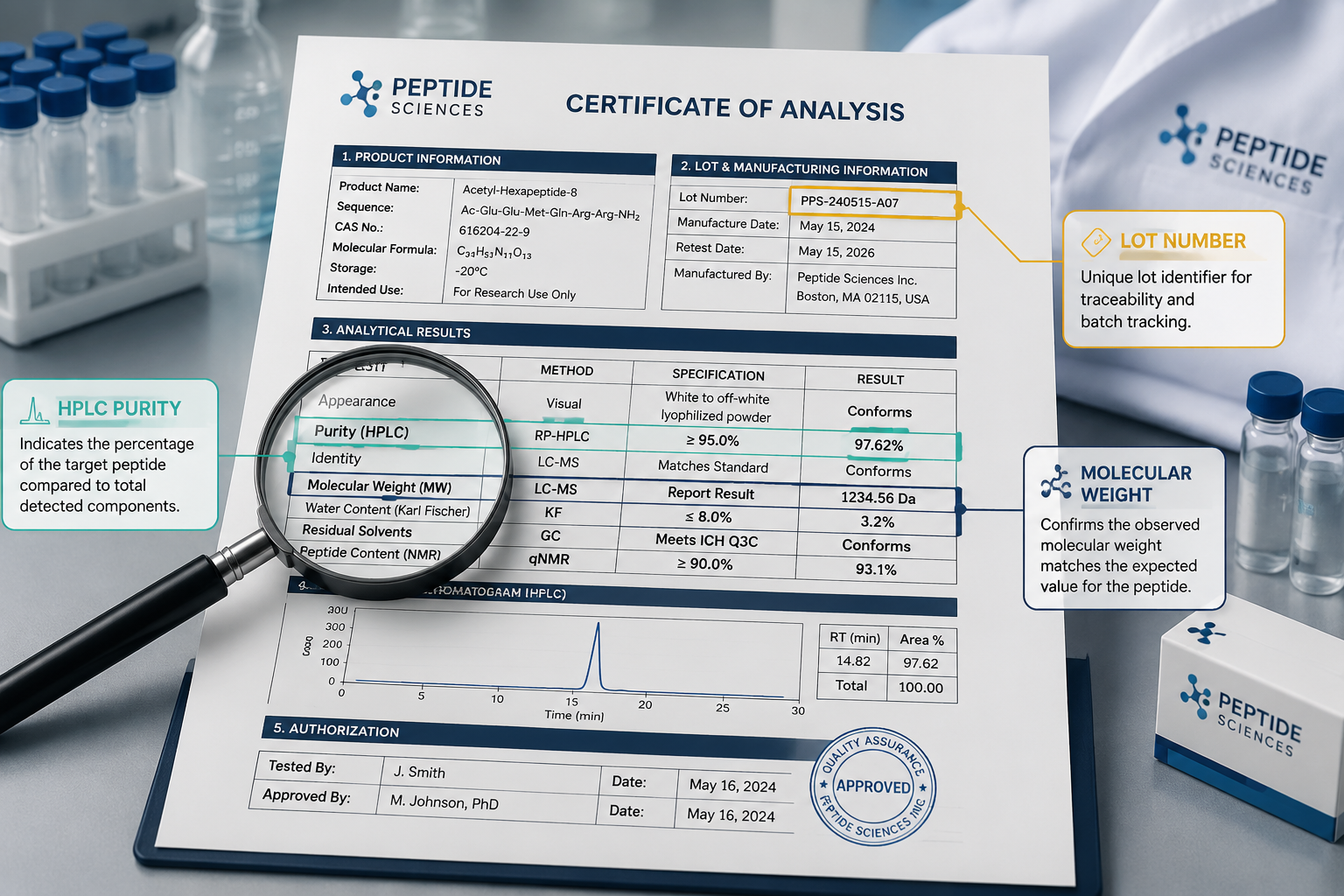
Detailed () infographic-style illustration showing the core sections of a peptide Certificate of Analysis document laid flat

Key Takeaways

  • A Certificate of Analysis (COA) is the primary document for verifying peptide quality before use in any research setting.
  • Purity should be confirmed by HPLC and expressed as a percentage, with research-grade peptides typically meeting a 98%+ threshold.
  • Sterility testing and endotoxin limits are separate, critical fields — both must pass independently.
  • Endotoxin results should be expressed in Endotoxin Units per milligram (EU/mg) and tested via a validated LAL method.
  • Always match the COA lot number to the physical vial before proceeding with any protocol.

What a Modern Peptide COA Must Show

A Certificate of Analysis is a supplier-issued document that records the results of quality testing for a specific batch of compound. Not all COAs are equal. A trustworthy document includes several non-negotiable fields.

Core COA Fields to Verify

Field What to Look For
Peptide identity Confirmed by MS or amino acid analysis
HPLC purity Percentage with chromatogram attached
Molecular weight Matches theoretical value within tolerance
Lot/batch number Must match the physical vial label
Sterility result Pass/Fail from validated test method
Endotoxin level Expressed in EU/mg with test method noted
Manufacture date Recent date confirms freshness

Researchers sourcing compounds like BPC-157 or SS-31 peptide should request a COA for every individual lot, not just a generic document posted on a supplier's website. Batch-specific documentation is the standard that separates reliable suppliers from unreliable ones.

"A COA without a matching lot number is a marketing document, not a quality record."


Peptide Purity Standards: How to Read a COA for Potency, Sterility, and Endotoxin — The Purity Section

Purity is typically the first number researchers look at, and for good reason. It reflects how much of the total material is actually the intended peptide versus degradation products, truncated sequences, or synthesis byproducts.

HPLC Purity: The Baseline Metric

High-Performance Liquid Chromatography (HPLC) separates a peptide sample by its chemical properties and reports each component as a percentage of the total. The main peak percentage equals the purity figure.

  • Research-grade standard: 98% or higher
  • Pharmaceutical-adjacent use: 99%+ with validated method
  • Below 95%: generally unsuitable for controlled research

The chromatogram itself — the graph attached to the COA — should show a dominant single peak with minimal secondary peaks. If a supplier provides only a number without the actual chromatogram, that is a red flag.

Mass Spectrometry (MS) Confirmation works alongside HPLC by confirming the molecular identity of the compound. The observed molecular weight should match the theoretical value within an acceptable margin (typically ±0.5 Da for smaller peptides).

Researchers reviewing documentation for compounds like tesa or MOTS-c should expect both HPLC and MS data on any reputable COA.


Sterility and Endotoxin: The Fields Most Researchers Skip
Sterility and Endotoxin: The Fields Most Researchers Skip

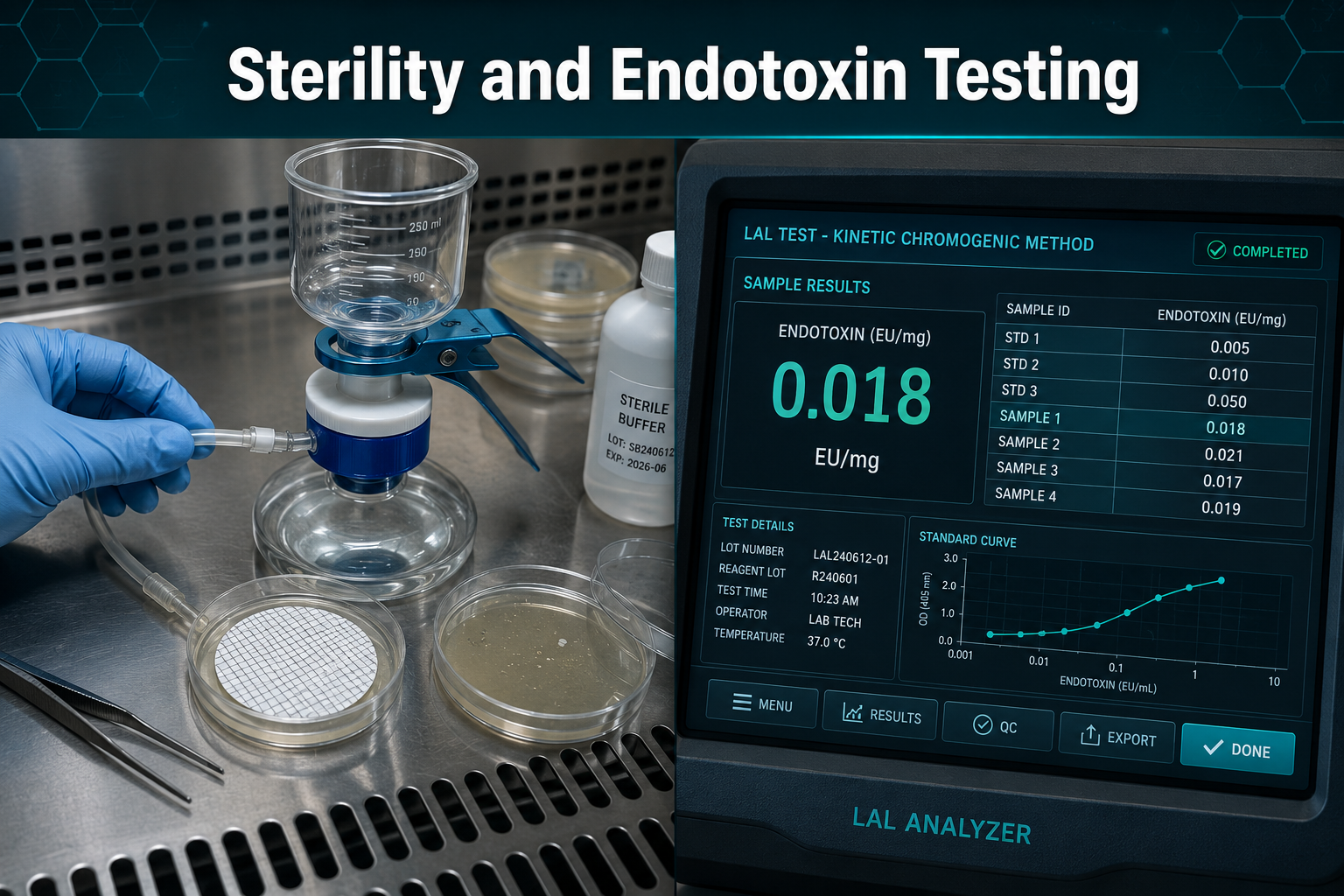
Purity addresses chemical composition. Sterility and endotoxin testing address biological contamination — a completely separate concern.

Sterility Testing

Sterility testing confirms the absence of viable microorganisms, including bacteria and fungi. The result should appear as a clear Pass on the COA, referencing the test method used (commonly USP <71> or equivalent).

A sterility pass does not automatically mean the peptide is endotoxin-free. These are independent tests.

Endotoxin Limits

Endotoxins are fragments of bacterial cell walls that remain even after bacteria are killed. They can trigger inflammatory responses in biological systems, which is why they matter enormously in research contexts.

The Limulus Amebocyte Lysate (LAL) test is the gold-standard method for endotoxin detection. COA results should show:

  • A numerical value in EU/mg (Endotoxin Units per milligram)
  • The test method (gel-clot, turbidimetric, or chromogenic LAL)
  • A passing threshold relative to the intended application

For research peptides, an endotoxin level below 1.0 EU/mg is a commonly cited benchmark, though specific thresholds vary by application.


How to Compare COAs Across Peptide Suppliers
How to Compare COAs Across Peptide Suppliers

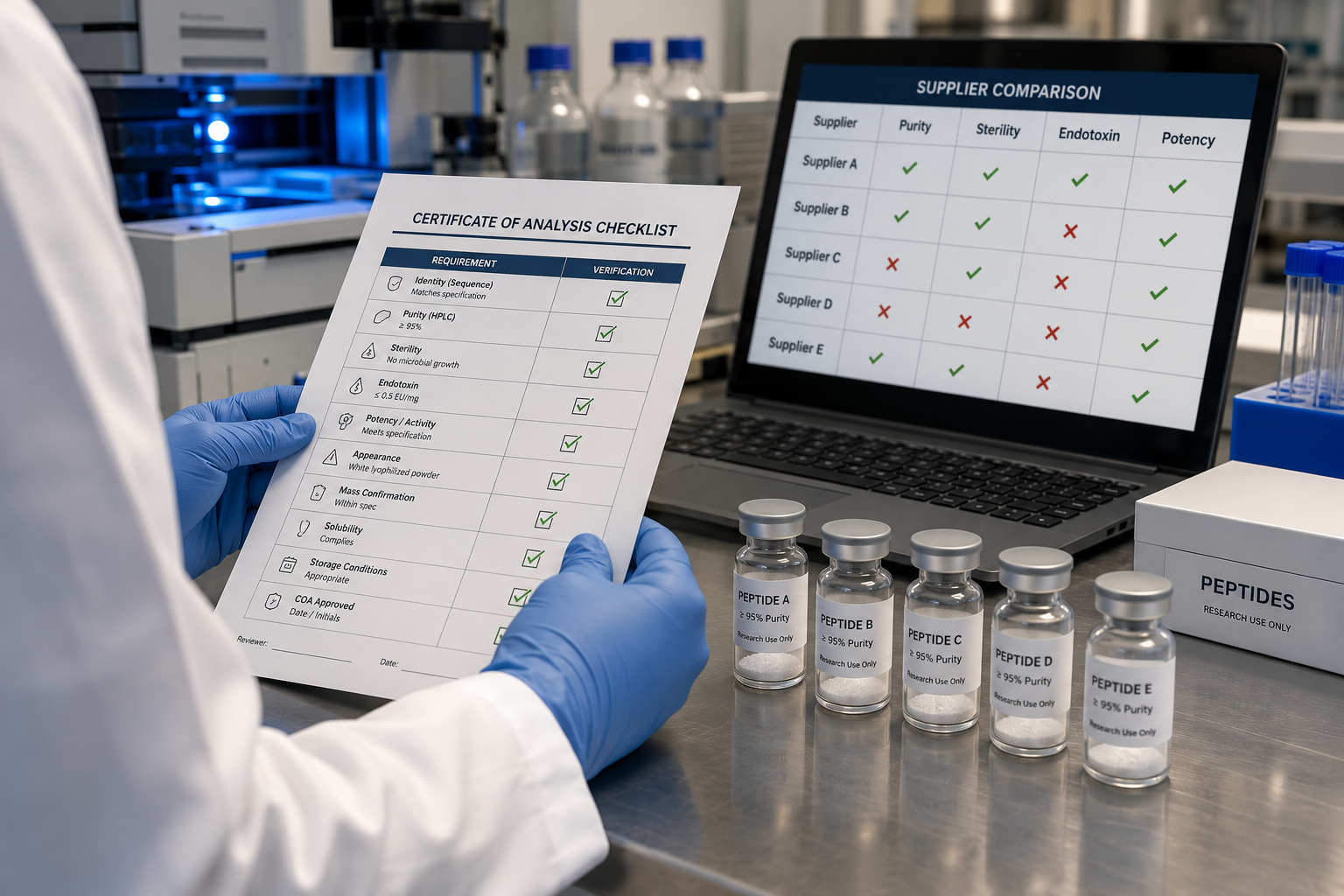
When evaluating multiple suppliers, use a consistent checklist rather than comparing headline purity numbers alone. Suppliers offering detailed documentation for products like PT-141, Ipamorelin, or CJC-1295 blends demonstrate a higher level of quality commitment.

Supplier COA Comparison Checklist

  • Lot-specific COA (not a generic document)
  • HPLC chromatogram included, not just a percentage
  • MS data confirming molecular identity
  • Sterility test result with method referenced
  • Endotoxin result in EU/mg with LAL method noted
  • Manufacture and expiration dates present
  • Third-party or independent lab testing disclosed

Reviewing the core product documentation standards used by established suppliers provides a useful benchmark for what thorough quality records look like in practice.


Conclusion

Reading a COA correctly is not optional for serious research — it is the first line of quality control. The key action steps are straightforward: verify HPLC purity with a chromatogram, confirm molecular identity via MS data, check sterility as a Pass/Fail result, and review endotoxin levels in EU/mg from a validated LAL test. Match every document to its specific lot number before use.

Researchers who apply these standards consistently will make better sourcing decisions, reduce experimental variables, and maintain the integrity of their work. Before placing any order, request the full COA, review each field against the benchmarks outlined above, and only proceed when every section meets the expected standard.

Tags: certificate of analysis, coa guide, endotoxin testing, hplc purity, lal test, peptide coa, peptide purity standards, peptide quality, peptide supplier verification, potency testing, research peptides, sterility testing
https://www.puretestedpeptides.com/wp-content/uploads/2026/06/Peptide-Purity-Standards-How-to-Read-a-COA-for-Potency-Sterility-and-Endotoxin.png 1024 1536 https://www.puretestedpeptides.com/wp-content/uploads/2026/01/buy-peptides-online.jpg 2026-06-28 13:03:372026-06-28 13:03:37Peptide Purity Standards: How to Read a COA for Potency, Sterility, and Endotoxin
You might also like
Slupp332 With 5-Amino-1MQ: How Researchers Think About Pairing NNMT Modulation With Metabolic Peptides Slupp332 With 5-Amino-1MQ: How Researchers Think About Pairing NNMT Modulation With Metabolic Peptides
Epithalon Peptide and Telomerase Activation: Unraveling Its Potential in Longevity Research Models Epithalon Peptide and Telomerase Activation: Unraveling Its Potential in Longevity Research Models
Selank and Semax Nasal Spray: Comparative Research on Anxiolytic and Nootropic Effects Selank and Semax Nasal Spray: Comparative Research on Anxiolytic and Nootropic Effects
Regulatory Scrutiny in the GLP‑1/GLP‑3 Era: How BPC‑157, PT‑141, and Enclomiphene Are Being Re‑Evaluated Regulatory Scrutiny in the GLP‑1/GLP‑3 Era: How BPC‑157, PT‑141, and Enclomiphene Are Being Re‑Evaluated
Best Research Peptides for Enhanced Cognitive Function: A Comparative Review Best Research Peptides for Enhanced Cognitive Function: A Comparative Review
Retatrutide (GLP-1/GIP/GCG) Mechanism of Action: A Triple Agonist Research Guide for Metabolic Studies Retatrutide (GLP-1/GIP/GCG) Mechanism of Action: A Triple Agonist Research Guide for Metabolic Studies
5-Amino-1MQ Peptide: NNMT Inhibition, NAD+ Preservation, and Metabolic Research Applications 5-Amino-1MQ Peptide: NNMT Inhibition, NAD+ Preservation, and Metabolic Research Applications
Semax Peptide Nasal Spray: Optimizing Delivery and Research Outcomes for Neurocognitive Studies Semax Peptide Nasal Spray: Optimizing Delivery and Research Outcomes for Neurocognitive Studies
0 replies

Leave a Reply

Want to join the discussion?
Feel free to contribute!

Leave a Reply Cancel reply

Your email address will not be published. Required fields are marked *

×

Helpful Links

  • My account
  • Cart
  • Checkout
  • Refund and Returns Policy
  • Privacy Policy
  • SMS Privacy Policy
  • Login
  • My Account
  • Logout

USA Made Lab Tested Peptides

All products are sold for research, laboratory, or analytical purposes only, and are not for human consumption


Pure Tested Peptides is a chemical supplier. Pure Tested Peptides is not a compounding / chemical compounding facility as defined under 503A of the Federal Food, Drug, and Cosmetic act. Pure Tested Peptides is not an outsourcing facility as defined under 503B of the Federal Food, Drug, and Cosmetic act.

The statements made within this website have not been evaluated by the US Food and Drug Administration. The products we offer are not intended to diagnose, treat, cure or prevent any disease.

Human/Animal Consumption Prohibited. Laboratory/In-Vitro Experimental Use Only

Link to: Tesamorelin and Ipamorelin Mechanism: How Their Growth-Hormone Signaling Differs in Research Models Link to: Tesamorelin and Ipamorelin Mechanism: How Their Growth-Hormone Signaling Differs in Research Models Tesamorelin and Ipamorelin Mechanism: How Their Growth-Hormone Signaling Differs...Tesamorelin and Ipamorelin Mechanism: How Their Growth-Hormone Signaling Differs in Research Models Link to: PT-141 and Melanocortin Receptor Research: What Makes It Different From PDE5 Inhibitor Models? Link to: PT-141 and Melanocortin Receptor Research: What Makes It Different From PDE5 Inhibitor Models? PT-141 and Melanocortin Receptor Research: What Makes It Different From PDE5 Inhibitor Models?PT-141 and Melanocortin Receptor Research: What Makes It Different From PDE5...
Scroll to top Scroll to top Scroll to top