

Only 0.093% of an administered dose reaches brain tissue per gram, yet that fraction is roughly nine times higher than what intravenous delivery achieves. That single data point sits at the center of every serious discussion about Semax peptide nasal spray: delivery route, brain-penetration questions, and cognitive research models, and it explains why researchers keep returning to intranasal administration as the preferred route for CNS-targeted peptide studies.
Key Takeaways
- Semax reaches the brain primarily through olfactory and trigeminal nerve pathways, bypassing the blood-brain barrier (BBB).
- Intranasal delivery produces roughly nine times greater brain tissue concentration than intravenous dosing in rodent models.
- Approximately 80% of the peptide detected in brain tissue after intranasal dosing is intact Semax, not metabolites.
- Cognitive research models focus on BDNF upregulation, neuroprotection, and attention-related endpoints.
- Purity and sourcing quality remain critical variables when evaluating research outcomes across studies.
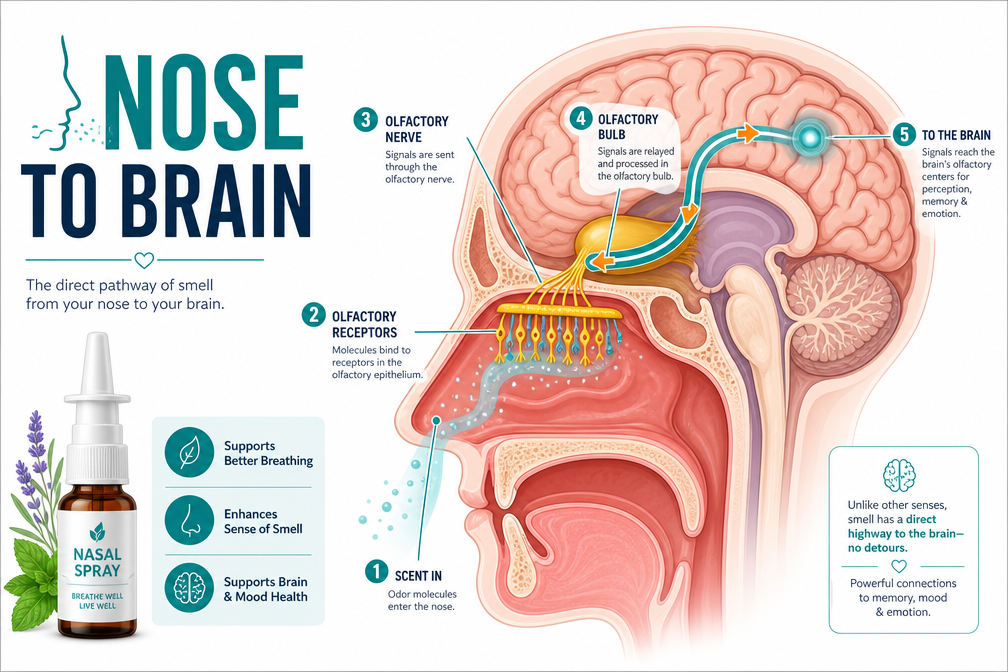
How the Delivery Route Works: Nose-to-Brain Pathways
The core question behind Semax peptide nasal spray delivery route research is straightforward: can a peptide applied to nasal mucosa actually reach the central nervous system in meaningful concentrations? The answer, based on tritium-labeled rodent studies, is yes, but the mechanism matters.
After intranasal application, Semax travels along two primary anatomical routes:
- Olfactory pathway: The olfactory epithelium in the upper nasal cavity sits in direct proximity to the olfactory bulb. Peptides can move along olfactory sensory neurons into the brain without crossing the BBB.
- Trigeminal pathway: Branches of the trigeminal nerve extend through the nasal cavity into brainstem regions, providing a second nerve-mediated transport corridor.
These pathways explain why nasal spray formulation is scientifically plausible for CNS delivery, not because the peptide floods the bloodstream and diffuses across the BBB, but because it essentially sidesteps it. This is a meaningful distinction for researchers designing studies, because systemic bioavailability and CNS bioavailability become partially decoupled.
For context on how other peptides use delivery-route optimization, the research on longevity peptide delivery models offers useful comparative framing.
Brain-Penetration Questions: What the Data Actually Show

The most-cited quantitative benchmark in Semax peptide nasal spray brain-penetration research comes from a rodent study using radiolabeled Semax. Two minutes after intranasal administration, 0.093% of total radioactivity per gram of brain tissue was detected. Crucially, about 80% of that signal represented intact peptide rather than breakdown metabolites, suggesting the molecule survives the nasal-to-brain transit in functional form.
By comparison, intravenous dosing produced only about 0.01% per gram of brain tissue under similar conditions. That roughly nine-fold difference is what makes intranasal delivery the dominant model in current Semax research.
Key caveats researchers should note:
| Variable | Research Implication |
|---|---|
| Absolute CNS fraction is small | High-dose or repeated dosing may be needed to reach target concentrations |
| Rodent nasal anatomy differs from humans | Direct extrapolation to human CNS penetration is not validated |
| Measurement window is narrow (2 min) | Longer kinetic profiles are not fully characterized |
| Peptide purity affects intact-fraction data | Low-purity samples may understate true penetration efficiency |
Purity is not a minor variable here. Research outcomes depend heavily on whether the compound used matches its stated sequence and concentration. Sourcing from lab-tested peptides with verified specifications is a foundational requirement for reproducible data.
For researchers exploring related neuroprotective peptide questions, the work on Epithalon and aging-support mechanisms provides relevant comparative context.
Cognitive Research Models and Endpoints
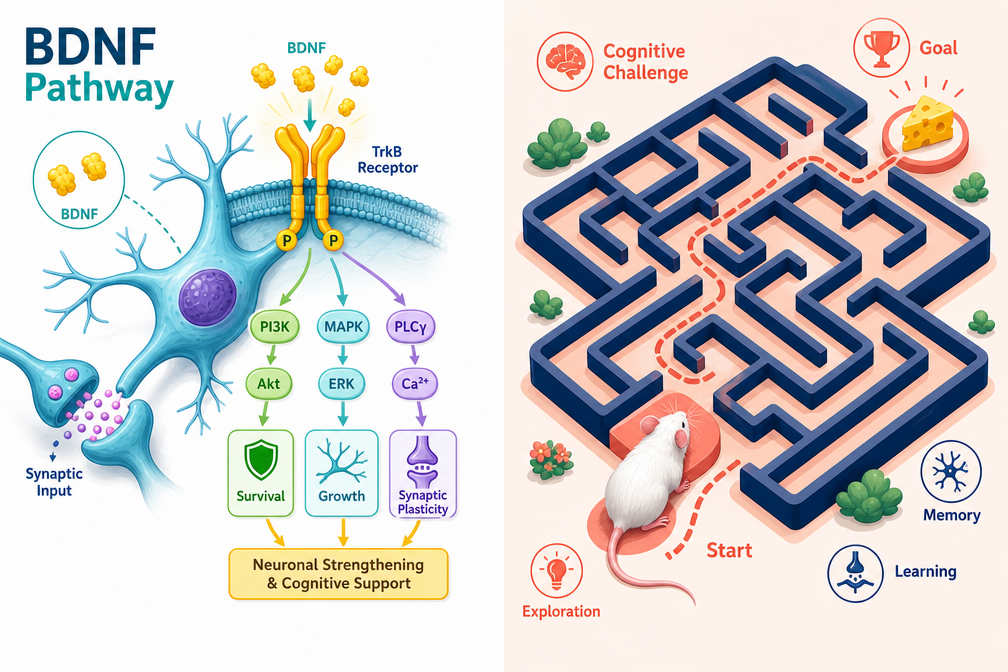
Understanding Semax cognitive research models requires clarity about what endpoints investigators are actually measuring. The peptide is a synthetic heptapeptide analogue of ACTH(4-10), and its proposed cognitive effects are primarily linked to:
- BDNF (Brain-Derived Neurotrophic Factor) upregulation in hippocampal and cortical regions
- Dopaminergic and serotonergic tone modulation, relevant to attention and working memory tasks
- Neuroprotective effects in ischemia and oxidative stress models
Rodent maze studies, including Morris water maze and radial arm maze protocols, have been used to assess spatial memory and learning retention after Semax administration. These models are well-validated for detecting BDNF-mediated cognitive changes, making them appropriate for Semax research design.
Researchers interested in how other peptides interact with similar neurological pathways may find value in reviewing what is new in peptide research for emerging study designs.
For metabolic peptide comparisons that share overlapping research infrastructure, AOD9604 metabolic research and CJC-1295 muscle research themes offer useful methodological parallels.
Conclusion
The science behind Semax peptide nasal spray: delivery route, brain-penetration questions, and cognitive research models is more nuanced than simple "it crosses the BBB" claims suggest. The olfactory and trigeminal nerve pathways provide a legitimate, data-supported mechanism for CNS access. The nine-fold advantage over intravenous delivery is real, but the absolute fraction reaching brain tissue remains small, and human extrapolation requires caution.
Actionable next steps for researchers in 2026:
- Prioritize verified, high-purity Semax from best peptide manufacturers to ensure intact-peptide fractions reflect true compound quality.
- Design studies with kinetic windows beyond two minutes to capture fuller CNS distribution profiles.
- Use BDNF-sensitive behavioral endpoints (maze models, attention tasks) to align with the most mechanistically supported cognitive pathways.
- Treat rodent-to-human extrapolation as a hypothesis, not a conclusion, until nasal anatomy differences are formally modeled.
The intranasal delivery model for Semax is scientifically credible. Rigorous study design is what converts credibility into reproducible, publishable data.
Leave a Reply
Want to join the discussion?Feel free to contribute!