

Regulatory Horizons for Research-Use Peptides: COA Compliance and Batch Identity Standards
Fewer than one in three research-grade peptide suppliers currently provide COAs that meet the orthogonal identity verification standards now expected by institutional procurement committees. That gap is closing fast. As regulatory frameworks converge around drug-substance benchmarks, laboratories sourcing synthetic peptides for in vitro and preclinical work face a new compliance reality in 2026 — one where a single HPLC purity percentage is no longer enough to satisfy internal audits or demonstrate rigorous research intent.
This article maps the updated landscape of regulatory horizons for research-use peptides: COA compliance and batch identity standards, explaining what analytical methods are now expected, how impurity thresholds are being applied to research reagents, and what a defensible COA looks like today.
Key Takeaways
- At least two orthogonal analytical methods — typically RP-HPLC and LC-MS — are now the baseline expectation for peptide identity confirmation on a COA.
- Impurity thresholds drawn from ICH Q3A/Q3B guidance are being mirrored in research-use peptide COAs, with unspecified impurities generally held below 0.5%.
- "Research Use Only" labeling does not shield suppliers from regulatory scrutiny if marketing language implies therapeutic use.
- Batch-specific COAs must include lot number, testing date, explicit methods, numerical purity, measured molecular weight, and laboratory identity.
- Stability data and re-test dating, guided by ICH Q1E principles, are increasingly expected on high-quality COA documents.
What COA Compliance Means for Research-Use Peptides in 2026
The regulatory horizons for research-use peptides: COA compliance and batch identity standards have shifted considerably over the past two years. Drug-substance guidelines from the EMA and USP now function as de facto benchmarks even for research reagents, because no dedicated RUO-specific COA standard exists in U.S. regulation.
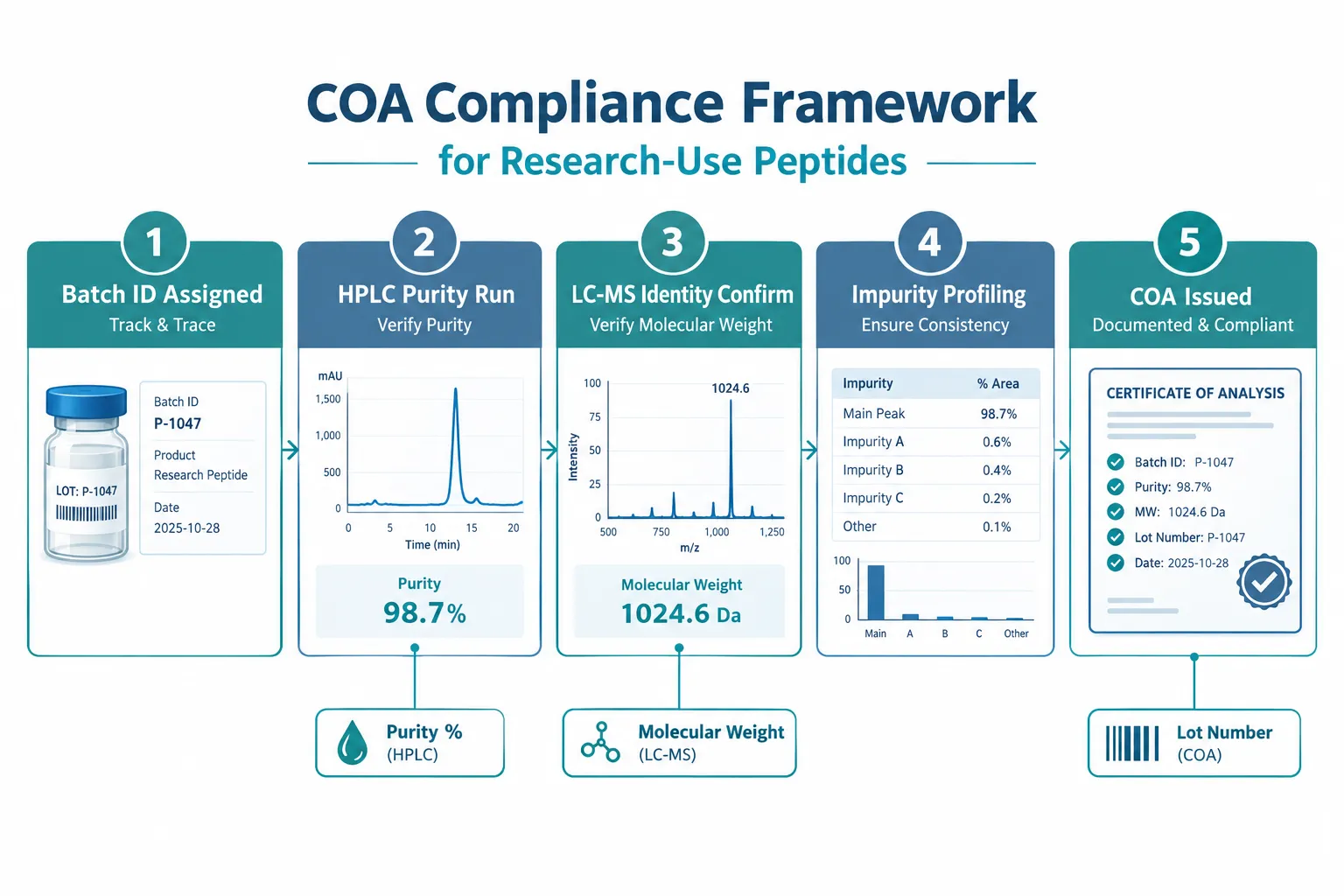
The EMA's 2026 guideline on synthetic peptide manufacture requires at least two orthogonal methods to unambiguously confirm sequence identity and sets this as a batch release specification. USP's chapter on quality attributes of synthetic peptide drug substances mirrors this, naming RP-HPLC and mass spectrometry as the primary tools while citing ICH Q6A's requirement that identity tests distinguish closely related structural analogues likely to appear as synthesis impurities.
A 2026 peer-reviewed regulatory review concluded that this cross-framework expectation — spanning ICH Q6A, USP-NF, EDQM, and EMA — is now being adopted by suppliers marketing any peptide as high-quality, including research reagents. For laboratories sourcing compounds such as lab-tested peptides, this translates directly into COA evaluation criteria.
The "Two Orthogonal Methods" Standard in Practice
Relying solely on HPLC purity is no longer defensible. Experts interpret current guidance as requiring at least one highly specific method — high-resolution mass spectrometry or sequence-confirming peptide mapping — complemented by chromatographic purity profiling. The combination must be capable of discriminating the target peptide from structural analogues.
Minimum COA identity section should include:
| Test | Acceptable Method | Purpose |
|---|---|---|
| Molecular weight confirmation | LC-MS or HR-MS | Confirms sequence-level identity |
| Purity profile | RP-HPLC (UV) | Quantifies related substances |
| Sequence confirmation | Peptide mapping or MS/MS | Discriminates analogues and truncations |
| Counter-ion / residuals | Ion chromatography or NMR | Verifies synthesis route integrity |
Impurity Thresholds and Batch Identity Requirements
The second pillar of evolving regulatory horizons for research-use peptides: COA compliance and batch identity standards concerns how impurities are controlled and reported.
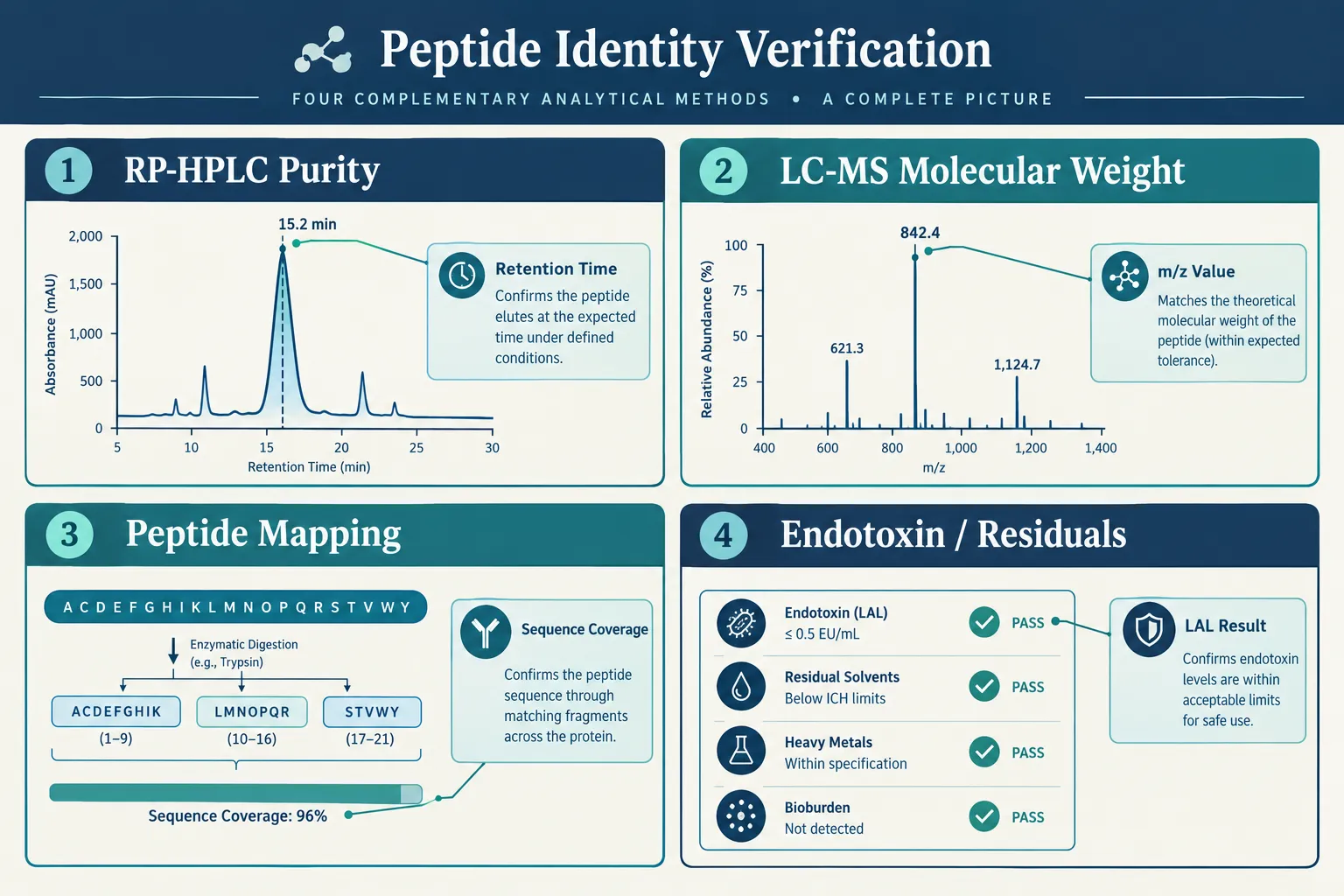
A 2025 analysis collating ICH Q3A/Q3B and the FDA's 2021 peptide ANDA guidance found that unspecified impurities in chemically synthesised molecules are generally limited to 0.5%, with specific peptide impurities controlled between 0.10% and 0.5% depending on risk classification. These thresholds are now appearing in research-use peptide COAs, which increasingly list individual impurity peaks by relative retention time alongside total related substances.
For peptides used in cell-based or immunological assays — such as those explored in GLP-1 peptide research and sourcing or GHK-Cu copper peptide sourcing — COAs are increasingly expected to include:
- Endotoxin levels (LAL or rFC method)
- Residual solvents (ICH Q3C class limits)
- Heavy metals (ICP-MS)
- Counter-ion content tied to TFA or acetate used in synthesis
A batch-specific COA — not a generic product-level document — is the minimum standard. It must carry: product name, batch/lot number, testing date, named analytical methods, numerical purity percentages, measured molecular weight (within +/-1 Da of theoretical), and the testing laboratory's identity. Chromatograms and mass spectra should accompany the document where possible.
Stability is also entering the conversation. The ICH Q1E draft guideline endorsed in April 2025 extends harmonised stability expectations to complex synthetic molecules. Industry commentaries note that COAs for research-use peptides are starting to carry re-test dates aligned with ICH-style protocols rather than vague shelf-life claims. This is particularly relevant for compounds covered in resources like SS-31 mechanism and research sourcing and SS-31 kidney health research.
RUO Labeling, Supplier Standards, and Institutional Procurement
The "Research Use Only" designation creates a regulatory gray zone that makes COA rigor even more critical. RUO is formally defined under 21 CFR 809.10(c)(2)(i) for in vitro diagnostic products — not for peptide reagents. This means the designation offers no automatic protection from FDA enforcement if supplier communications suggest human therapeutic use.

A 2026 sourcing advisory for institutional labs outlined four non-negotiable supplier criteria:
- US-based fulfillment with traceable logistics
- Batch-specific third-party COAs combining HPLC and LC-MS
- Nitrogen-purged vial packaging to prevent oxidative degradation
- Strict RUO positioning with zero therapeutic marketing claims
An October 2026 guide for state and institutional labs reinforced that reputable suppliers support peptides with documentation demonstrating control over purity and identity, framing RUO compounds explicitly as laboratory-grade materials not evaluated for safety or efficacy outside controlled research.
For researchers working with compounds such as those found in GHRP-2 vs. sermorelin comparisons or exploring GLP-3 triple agonist research planning, these criteria represent the floor, not the ceiling, of supplier evaluation.
"Robust COA documentation and clear batch identity are compliance prerequisites — not optional quality perks."
A 2025 immunogenicity review further noted that peptides used in immunological or cell-based research should carry COAs with extensive structural characterization, particularly where sequence features may affect biological responses. This has raised expectations for detailed MS fragmentation data on peptides with known receptor activity.
Conclusion
The regulatory horizons for research-use peptides: COA compliance and batch identity standards are no longer a future concern — they are a present-tense procurement requirement. Laboratories that treat COA review as a checkbox exercise risk using uncharacterized material that undermines data integrity and exposes institutions to compliance liability.
Actionable next steps for research teams:
- Audit every current peptide supplier against the two-orthogonal-methods standard for identity confirmation.
- Reject any COA that lacks a batch/lot number, named analytical methods, and numerical impurity data.
- Request endotoxin and residual solvent data for any peptide contacting biological systems.
- Verify that supplier marketing contains no therapeutic use language before issuing a purchase order.
- Align internal storage and re-test protocols with ICH Q1E-style stability expectations.
As drug-substance guidelines from EMA, USP, and ICH continue to set the de facto bar for research reagents, the laboratories that thrive will be those that treat identity documentation not as paperwork overhead but as foundational scientific infrastructure.