Call or Text 727-513-9780
  • Shopping Cart Shopping Cart
    0Shopping Cart
Pure Tested Peptides | America's most trusted Peptides for sale online
  • Peptides for sale
    • Oral Peptides for sale
      • Peptide Capsules for sale
      • BPC 157 Capsules 1000mcg
      • SLU-PP-332 Capsules | 1000 mcg
      • 5-Amino-1MQ 50mg Capsules
      • Tesofensine 500mcg
    • All Peptides for sale
    • Peptide Sprays
      • BPC 157 Nasal Spray Kit
      • BPC-157 TB500 Nasal Spray Kit
      • Semax Nasal Spray 10mg
      • Selank – Nasal Spray Kit – 10mg
      • Epithalon 50MG Nasal Spray Kit
      • Ipamorelin 10mg Nasal Spray
      • Klow Nasal Spray (BPC-157 + TB-500 + GHK-Cu + KPV) | 80mg
      • Hulk Nasal Spray Tesa / Ipa Blend 6/3 MG
      • Klow Nasal Spray
      • NAD + 500 mg Nasal Spray
      • PT-141 Nasal Spray Kit
    • GHRH Peptides
      • Ipa Peptides
      • CJC-1295 Peptides
        • CJC-1295 with DAC 5 mg
        • CJC-1295 without DAC 5 mg
        • CJC-1295 Ipa 10mg
      • Tesa Peptides
        • Tesa Peptide
        • Tesa 20 mg
    • GHK-Cu Peptides
      • All GHK-Cu Peptides
      • GHK-Cu 100mg
      • KLOW Peptide Blend – Buy KLOW blend online
    • BPC Peptides
      • All BPC Peptides
      • BPC-157
      • BPC-157 TB-500
      • BPC 157 capsules 1000mcg
    • SLU-PP-332 Peptides
      • All SLU-PP-332 Peptides
      • SLU-PP-332 5mg
    • GLP3 Peptides
      • GLP3-R
      • GLP3-R CAG 10mg
      • GLP3-R 20mg
    • PT-141 Peptides
      • PT-141 Peptides for sale
      • PT-141 10mg
      • PT-141 Nasal Spray
    • CAG Peptides
      • Lipo-C Peptide Blend
      • CAG 5mg
      • CAG 10mg
    • MOTS-C Peptides
      • MOTS-C Peptides for sale
      • MOTS-c peptide
      • MOTS-c 10mg *6 pack*
    • 5 Amino 1MQ Peptides
      • 5 Amino 1MQ Peptides for sale
      • 5-Amino-1MQ 50mg Capsules
      • 5-Amino-1MQ 5mg
    • Epithalon Peptides
      • Epithalon Peptides for sale
      • Epithalon 10mg
      • Epithalon 50mg
  • Shop
    • GLPs
      • 5-Amino-1MQ 50mg Capsules
      • 5-Amino-1MQ 5mg
      • GLP3-Reta
      • L-Carnitine 500mg/ml
      • Tesofensine 500mcg
      • SLU-PP-332 5mg
      • MOTS-c 10mg *6 pack*
    • Epithalon & BPC Peptides
      • Epithalon 10mg
      • Epithalon 50mg
      • BPC-157
      • BPC 157 capsules 1000mcg
      • BPC-157 TB-500
      • BPC-157 TB500 Nasal Spray Kit
      • BPC 157 Nasal Spray Kit
    • BPC TB-500 & NAD+ Peptides
      • NAD+ 500 mg
      • KLOW Peptide Blend – Buy KLOW blend online
      • GLOW Peptide Blend
      • TB 500 5mg
      • BPC 157 capsules 1000mcg – Supplement
      • BPC 157 Nasal Spray Kit
      • BPC-157
      • BPC-157 TB500 Nasal Spray Kit
      • BPC-157 TB-500
      • BPC 157 capsules 1000mcg
    • LL-37 Peptide
      • LL-37 10 mg
    • MOTS-C & Selank
      • MOTS-c peptide
      • Selank 10mg
    • GHK Peptides
      • GHK-Cu 100mg
      • GLOW Peptide Blend
      • KLOW Peptide Blend – Buy KLOW blend online
  • COAs
  • Wholesale
    • Wholesale Peptides for sale
  • PTP FAQ
  • Affiliates
    • Selank Peptide: Advanced Pharmacological Mechanisms Underlying Its Anxiolytic and Nootropic Effects in Research
      • 5-Amino-1MQ Peptide: Detailed Mechanisms of NNMT Inhibition and Its Impact on Cellular Metabolism Research
        • MOTS-C Peptide: Unraveling Its Role in Mitochondrial Dynamics and Energy Metabolism Research
          • Epithalon Peptide and Telomerase Regulation: Investigating Its Impact on Cellular Senescence and Lifespan Research Models
            • GLP2-T vs GLP2 Tirz Peptide: Understanding the Naming, Mechanistic Nuances, and Research Implications for Gut Health
      • Peptides and Polypeptides in Modern Pharmacology: What Research on Metoprolol, Prednisone, and Amlodipine Reveals
        • Polypeptide Peptides vs NSAIDs: What Naproxen and Diclofenac Teach Tissue-Repair Researchers About BPC‑157 and TB‑500
          • Peptides and Polypeptides in Endocrine Pharmacology: How GLP-1, GLP-2, and GLP-3 Retatrutide Differ From Classic Drugs Like Prednisone and Amlodipine
          • 5‑Amino‑1MQ Peptide and NNMT Inhibition: How It Compares With Statins Like Atorvastatin in Adipose and Lipid Metabolism Research
      • Enclomiphene, Estrogen Receptor Signaling, and Luteinizing Phase Biology: What Hormone Researchers Should Measure
        • Mesenchymal Stem Cells, BPC‑157, and GHK‑Cu: How Tissue Repair Peptides Compare With Classic NSAIDs Like Naproxen in Injury Models
          • Peptide Calculator Use Cases Beyond Growth Hormone: Working Through GLP‑3 Retatrutide, MOTS‑c, and BPC‑157 Research Dosing
        • Polypeptide Peptides in Endocrine and Metabolic Pharmacology: Lessons From Amlodipine, Prednisone, and Metoprolol
        • Peptides Calculator for Advanced Blends: Worked Examples for Tesamorelin, CJC‑1295, and Ipamorelin Stacks
          • Peptides and Polypeptides in Human Physiology: How Molecular Size Shapes Research Applications
            • Selank Peptide: Advanced Pharmacological Mechanisms Underlying Its Anxiolytic and Nootropic Effects in Research
          • 5-Amino-1MQ Peptide: Detailed Mechanisms of NNMT Inhibition and Its Impact on Cellular Metabolism Research
            • MOTS-C Peptide: Unraveling Its Role in Mitochondrial Dynamics and Energy Metabolism Research
              • Epithalon Peptide and Telomerase Regulation: Investigating Its Impact on Cellular Senescence and Lifespan Research Models
                • GLP2-T vs GLP2 Tirz Peptide: Understanding the Naming, Mechanistic Nuances, and Research Implications for Gut Health
                  • Peptides and Polypeptides in Endocrine Pharmacology: How GLP-1, GLP-2, and GLP-3 Retatrutide Differ From Classic Drugs Like Prednisone and Amlodipine
                    • Polypeptide Peptides vs NSAIDs: What Naproxen and Diclofenac Teach Tissue-Repair Researchers About BPC‑157 and TB‑500
                      • Peptides and Polypeptides in Modern Pharmacology: What Research on Metoprolol, Prednisone, and Amlodipine Reveals
                        • 5‑Amino‑1MQ Peptide and NNMT Inhibition: How It Compares With Statins Like Atorvastatin in Adipose and Lipid Metabolism Research
                        • Enclomiphene, Estrogen Receptor Signaling, and Luteinizing Phase Biology: What Hormone Researchers Should Measure
                        • Mesenchymal Stem Cells, BPC‑157, and GHK‑Cu: How Tissue Repair Peptides Compare With Classic NSAIDs Like Naproxen in Injury Models
                        • Peptide Calculator Use Cases Beyond Growth Hormone: Working Through GLP‑3 Retatrutide, MOTS‑c, and BPC‑157 Research Dosing
                        • Polypeptide Peptides in Endocrine and Metabolic Pharmacology: Lessons From Amlodipine, Prednisone, and Metoprolol
                        • Peptides Calculator for Advanced Blends: Worked Examples for Tesamorelin, CJC‑1295, and Ipamorelin Stacks
                        • Peptides and Polypeptides in Human Physiology: How Molecular Size Shapes Research Applications
                        • Selank Peptide: Advanced Pharmacological Mechanisms Underlying Its Anxiolytic and Nootropic Effects in Research
                        • MOTS-C Peptide: Unraveling Its Role in Mitochondrial Dynamics and Energy Metabolism Research
                        • Peptides and Polypeptides in Modern Pharmacology: What Research on Metoprolol, Prednisone, and Amlodipine Reveals
                        • Peptides and Polypeptides in Endocrine Pharmacology: How GLP-1, GLP-2, and GLP-3 Retatrutide Differ From Classic Drugs Like Prednisone and Amlodipine
                        • 5-Amino-1MQ Peptide: Detailed Mechanisms of NNMT Inhibition and Its Impact on Cellular Metabolism Research
                        • Mesenchymal Stem Cells, BPC‑157, and GHK‑Cu: How Tissue Repair Peptides Compare With Classic NSAIDs Like Naproxen in Injury Models
                        • Peptide Calculator Use Cases Beyond Growth Hormone: Working Through GLP‑3 Retatrutide, MOTS‑c, and BPC‑157 Research Dosing
                        • GLP2-T vs GLP2 Tirz Peptide: Understanding the Naming, Mechanistic Nuances, and Research Implications for Gut Health
                        • Polypeptide Peptides in Endocrine and Metabolic Pharmacology: Lessons From Amlodipine, Prednisone, and Metoprolol
                        • Polypeptide Peptides vs NSAIDs: What Naproxen and Diclofenac Teach Tissue-Repair Researchers About BPC‑157 and TB‑500
                        • Peptides and Polypeptides in Human Physiology: How Molecular Size Shapes Research Applications
                        • Peptides Calculator for Advanced Blends: Worked Examples for Tesamorelin, CJC‑1295, and Ipamorelin Stacks
                        • 5‑Amino‑1MQ Peptide and NNMT Inhibition: How It Compares With Statins Like Atorvastatin in Adipose and Lipid Metabolism Research
                        • Enclomiphene, Estrogen Receptor Signaling, and Luteinizing Phase Biology: What Hormone Researchers Should Measure
                        • Epithalon Peptide and Telomerase Regulation: Investigating Its Impact on Cellular Senescence and Lifespan Research Models
                        • Best research protocol Klow blend
                        • best time to take BPC-157
                        • best time to take DSIP (Delta Sleep Inducing Peptide)
                        • best time to take CJC-1295
                        • best time to take AOD-9604
                        • best time to take Follistatin 344
                        • best time to take Ipamorelin
                        • best time to take MK-677 (Ibutamoren)
                        • best time to take Ligandrol (LGD-4033) — research compound
                        • best time to take Ostarine (MK-2866) — research compound
                        • best time to take GHK-CU
                        • best time to take TB-500
                        • best time to take MOTS-c
                        • best time to take Semax
                        • best time to take RAD-140 (Testolone) — research compound
                        • best time to take Thymosin Alpha-1
                        • best time to take PEG-MGF
                        • Biolife Plasma, Octapharma Plasma, and Research Peptides: How Plasma Donation Labs Differ From Peptide Suppliers
                        • best time to take YK-11 — research compound
                        • best time to take PT-141 (Bremelanotide)
                        • Best research protocol Klow blend
  • Contact
    • Contact Customer Service
    • Text Customer Support
  • About US
  • Shop all peptides
  • Affiliate Program
    • Affiliate Signup
  • Login / Register Login / Register Page Link Login / Register Page Link
  • Click to open the search input field Click to open the search input field Search
  • Menu Menu

Tag Archive for: bdnf induction

Semax Nasal Spray and Selank Nasal Spray: Administration, Absorption, and Research Practicalities

Semax Nasal Spray and Selank Nasal Spray: Administration, Absorption, and Research Practicalities

June 15, 2026/0 Comments/by Pure Tested

Selank achieves an intranasal bioavailability of approximately 92.8% — a figure that rivals many injectable peptides and makes delivery method selection a genuinely consequential variable for research design. For anyone working with Semax nasal spray and Selank nasal spray, understanding administration, absorption, and research practicalities is not background knowledge; it is the foundation of reproducible results.

Key Takeaways

  • Both Semax and Selank use the nasal mucosa as a direct CNS delivery pathway, bypassing the blood-brain barrier.
  • Semax reaches peak cerebrospinal fluid concentrations within 3-10 minutes; Selank's plasma half-life is only 2-3 minutes yet its effects extend well beyond clearance.
  • Selank's intranasal bioavailability (92.8%) is notably higher than Semax's (60-70%), which affects dosing calculations in structured protocols.
  • Proper spray technique, nostril rotation, and cold-chain storage directly influence experimental consistency.
  • Oral administration is not viable for either peptide due to rapid enzymatic degradation in the gastrointestinal tract.

How Intranasal Delivery Works for These Peptides
How Intranasal Delivery Works for These Peptides

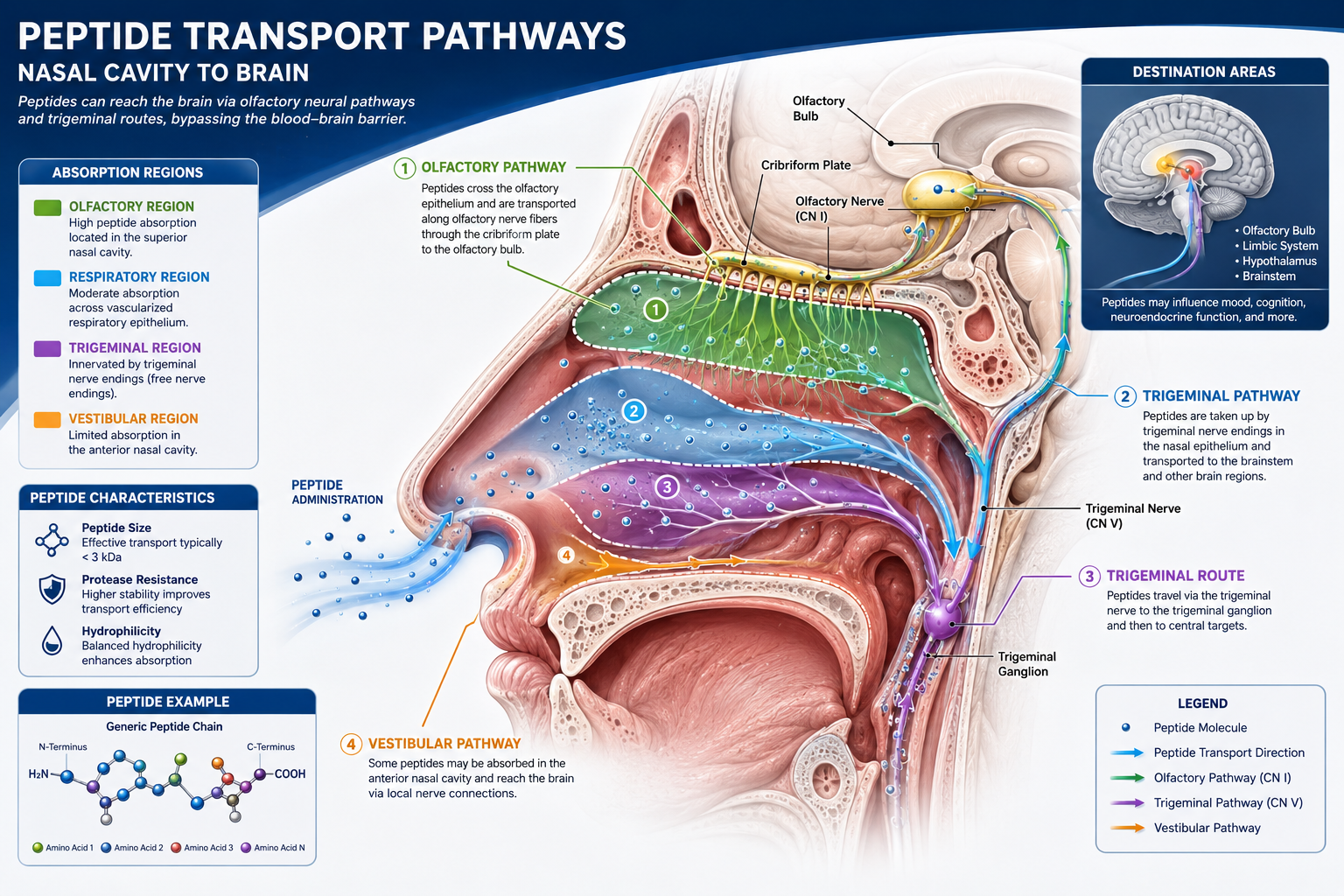
The nasal mucosa offers two primary nerve pathways to the central nervous system: the olfactory nerve and the trigeminal nerve. Both Semax and Selank exploit these routes, allowing peptide molecules to reach the brain without crossing the blood-brain barrier through systemic circulation.

This is a meaningful distinction. Subcutaneous injection delivers peptides into the bloodstream first, where enzymatic degradation begins immediately. Intranasal delivery sends a significant fraction of the dose directly toward CNS tissue, which is why researchers consistently favor this route for neuropeptide work.

Oral administration is not a viable alternative. Gastrointestinal enzymes break down both peptides before meaningful absorption can occur. For research requiring CNS-targeted delivery, intranasal remains the gold standard for these compounds.

Researchers interested in how other peptides navigate delivery challenges can review PT-141 neural and metabolic research themes for a comparative perspective on CNS-adjacent peptide work.


Absorption Profiles: Semax vs. Selank Side by Side
Absorption Profiles: Semax vs. Selank Side by Side

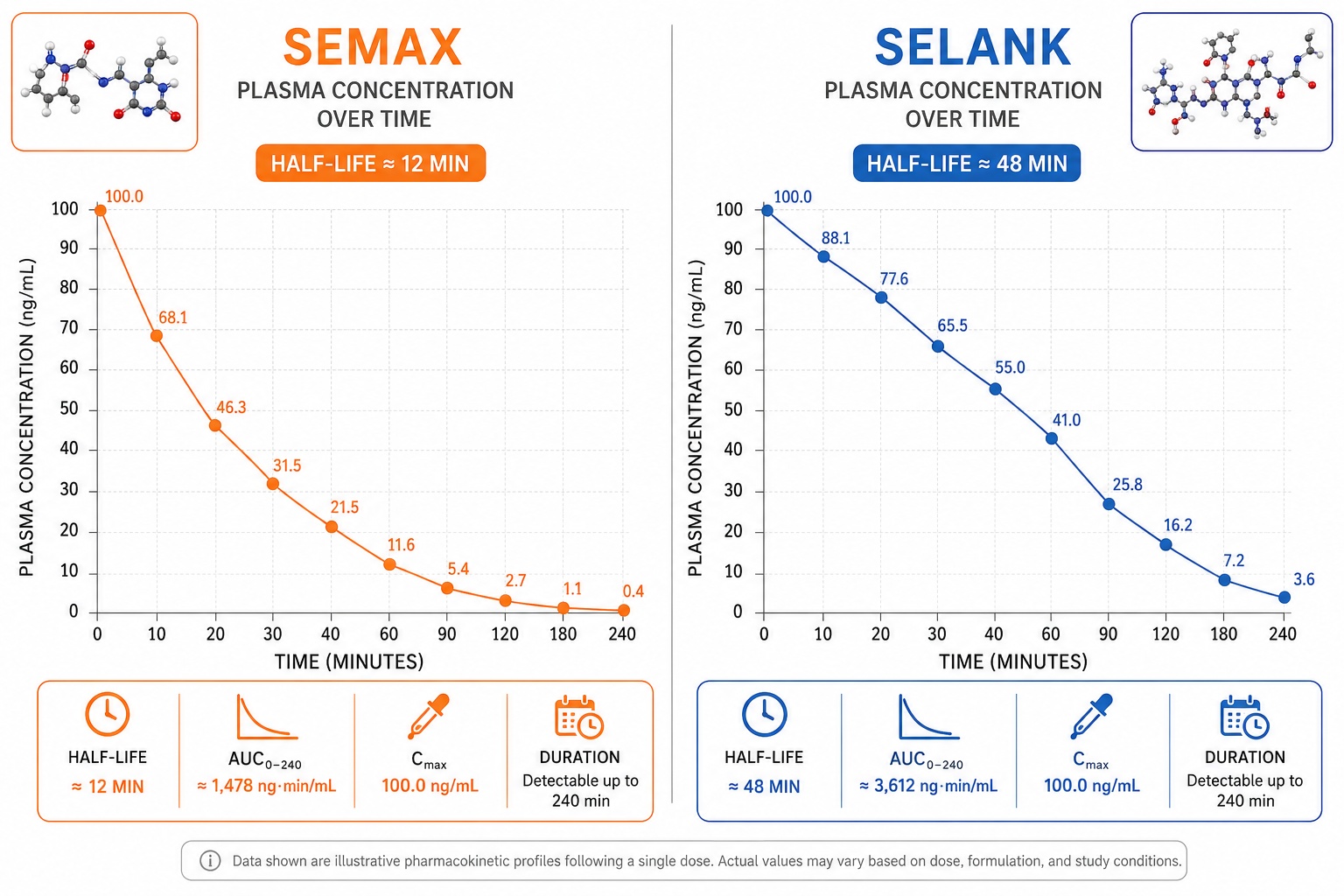
Understanding the absorption differences between these two peptides is central to Semax nasal spray and Selank nasal spray administration, absorption, and research practicalities.

Parameter Semax Selank
Intranasal Bioavailability ~60-70% ~92.8%
Peak CNS Concentration 3-10 minutes Rapid, within minutes
Plasma Half-Life 15-25 minutes 2-3 minutes
Pharmacodynamic Duration 24+ hours Extended beyond clearance
Cleared From Plasma ~90 minutes Very rapid

Semax induces brain-derived neurotrophic factor (BDNF) and nerve growth factor (NGF) expression. These downstream effects persist for over 24 hours after a single dose, even though the peptide itself clears plasma within 90 minutes. This dissociation between pharmacokinetics and pharmacodynamics is a critical variable when designing washout periods in research protocols.

Selank's short plasma half-life of 2-3 minutes is actually a structural achievement. Its parent peptide, tuftsin, degrades far faster. A C-terminal Pro-Gly-Pro extension was added specifically to improve metabolic stability — a detail that matters when comparing formulation batches for purity and structural integrity.

"The pharmacodynamic window of Semax extends far beyond its plasma half-life, meaning dosing frequency calculations cannot rely on clearance time alone."

For researchers also working with other neuropeptides, the Selank peptide benefits overview and the detailed Selank research profile provide useful mechanistic context.


Administration Technique, Dosing, and Storage for Research Protocols
Administration Technique, Dosing, and Storage for Research Protocols

Consistent technique is where many research protocols introduce unnecessary variability. For both Semax and Selank nasal spray administration, absorption, and research practicalities depend heavily on how the spray is delivered.

Recommended spray technique:

  • Tilt the head slightly forward, not back
  • Insert the tip gently into one nostril
  • Deliver the spray while inhaling gently
  • Alternate nostrils between administrations to reduce local irritation

Dosing reference for research use:

  • Semax: 200-300 mcg per nostril, typically administered twice daily at 8-hour intervals
  • Selank: Conservative starting point is 250 mcg once daily; standard anxiolytic research doses are 500 mcg once daily

Selank received regulatory approval in Russia in 2009 as a clinical anxiolytic, with trial data showing efficacy comparable to benzodiazepines — without sedation, dependence, or cognitive impairment. This clinical history gives researchers a useful benchmark when structuring behavioral endpoints.

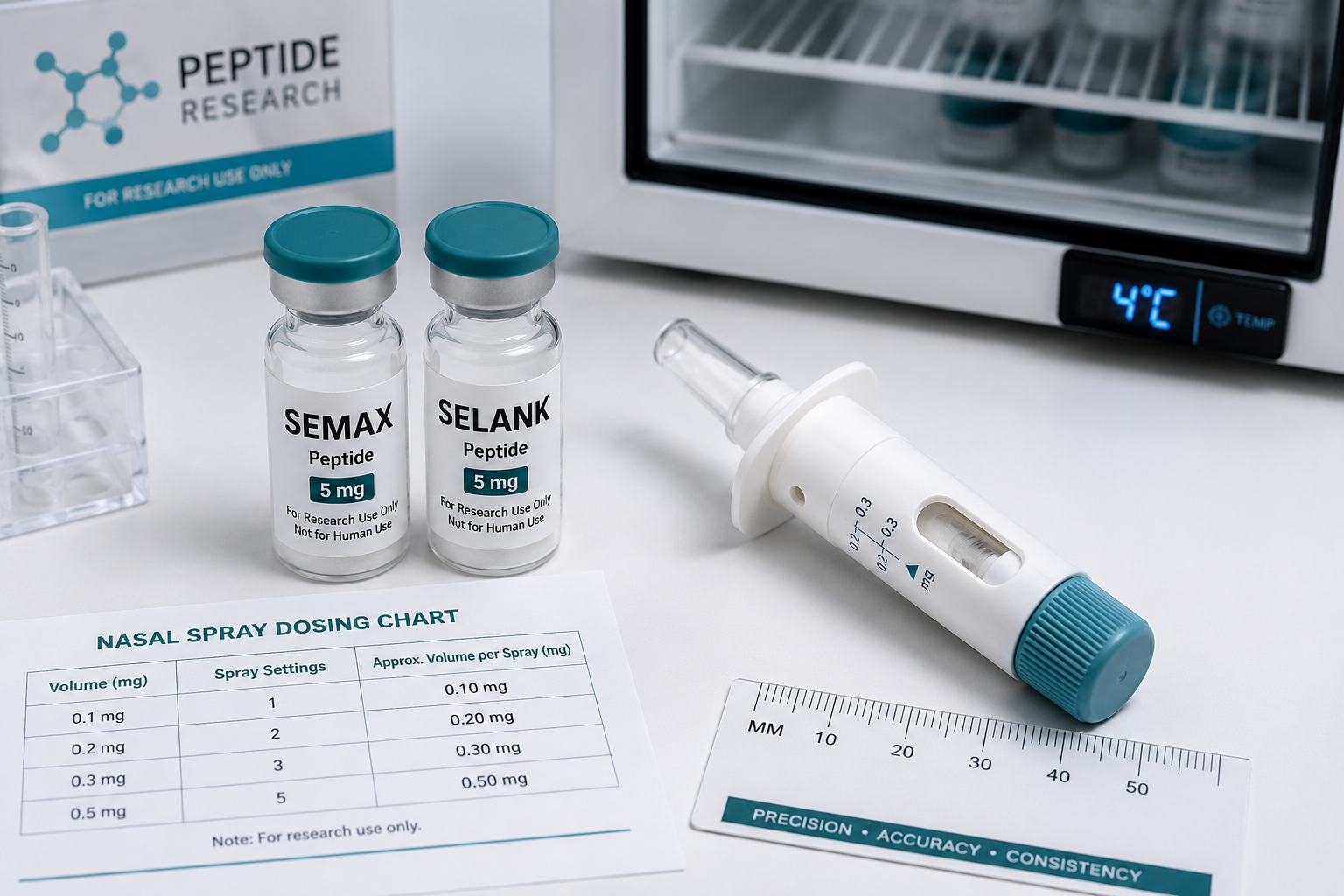
Storage is non-negotiable for data integrity. Reconstituted solutions for both peptides must be refrigerated at 2-8 degrees Celsius and remain stable for approximately four weeks. Deviations from cold-chain storage introduce degradation variables that compromise reproducibility.

Common side effects observed in research subjects include mild nasal irritation, transient sleep disturbances, and occasional anxiety at higher doses. Serious adverse events are rare but possible with excessive neurological stimulation or co-administration of psychoactive compounds.

Researchers sourcing verified peptides for structured protocols can review lab-tested peptide options to ensure formulation standards meet experimental requirements. Those interested in related neuropeptide delivery work may also find value in reviewing KPV peptide research and GHK-Cu peptide sourcing guidance for broader formulation context.


Conclusion

Semax nasal spray and Selank nasal spray administration, absorption, and research practicalities converge on one core principle: delivery method is not a secondary consideration. The nasal route offers direct CNS access, high bioavailability, and rapid onset — but only when technique, dosing, and storage are handled with precision.

Actionable next steps for researchers:

  1. Standardize spray technique across all subjects using the forward-tilt, gentle-inhalation method.
  2. Account for Semax's 24-hour pharmacodynamic window when designing washout periods.
  3. Verify cold-chain storage compliance before each experimental session.
  4. Source peptides with documented purity testing to eliminate formulation variability as a confounding factor.
  5. Review Selank's clinical approval history as a baseline for anxiolytic endpoint calibration.

Reproducibility in peptide research begins with delivery. Getting the administration variables right is the first step toward data that holds up.

https://www.puretestedpeptides.com/wp-content/uploads/2026/06/Semax-Nasal-Spray-and-Selank-Nasal-Spray-Administration-Absorption-and-Research-Practicalities.png 1024 1536 Pure Tested https://www.puretestedpeptides.com/wp-content/uploads/2026/01/buy-peptides-online.jpg Pure Tested2026-06-15 13:03:422026-07-20 15:03:01Semax Nasal Spray and Selank Nasal Spray: Administration, Absorption, and Research Practicalities
×

Helpful Links

  • My account
  • Cart
  • Checkout
  • Refund and Returns Policy
  • Privacy Policy
  • SMS Privacy Policy
  • Login
  • My Account
  • Logout

USA Made Lab Tested Peptides

All products are sold for research, laboratory, or analytical purposes only, and are not for human consumption


Pure Tested Peptides is a chemical supplier. Pure Tested Peptides is not a compounding / chemical compounding facility as defined under 503A of the Federal Food, Drug, and Cosmetic act. Pure Tested Peptides is not an outsourcing facility as defined under 503B of the Federal Food, Drug, and Cosmetic act.

The statements made within this website have not been evaluated by the US Food and Drug Administration. The products we offer are not intended to diagnose, treat, cure or prevent any disease.

Human/Animal Consumption Prohibited. Laboratory/In-Vitro Experimental Use Only

Scroll to top Scroll to top Scroll to top