

Semax and Selank Nasal Sprays vs Classic Anxiolytics: How Lorazepam and Buspirone Differ From Peptide-Based Nootropics in Bench Studies
Roughly 40 million adults in the United States live with an anxiety disorder, yet the pharmacological toolkit available to clinicians has barely expanded beyond benzodiazepines and serotonergic agents for decades. Against that backdrop, a growing number of researchers and peptide-oriented clinics are examining whether nasal-spray peptides such as Semax and Selank could occupy a different mechanistic lane. The comparison of Semax and Selank nasal sprays vs classic anxiolytics, specifically how lorazepam and buspirone differ from peptide-based nootropics in bench studies, is now a live question in pharmacology, even if the regulatory picture remains far from settled.
Key Takeaways
- Lorazepam is a direct positive allosteric modulator at GABA-A receptors; buspirone is a 5-HT1A partial agonist. Neither relies on enkephalinase inhibition, which is a shared mechanism of both Semax and Selank.
- Selank shows anxiolytic effects in preclinical elevated plus maze models without the sedation or motor impairment associated with benzodiazepines like lorazepam.
- In small human trials, Selank produced Hamilton Anxiety Rating Scale reductions comparable to medazepam and phenazepam, but the total evidence base covers roughly 192 patients, far below Phase 3 standards.
- Semax is primarily supported by cognitive and neuroprotective data; its human anxiety evidence is essentially absent, distinguishing it sharply from buspirone's dedicated GAD trial record.
- Both peptide sprays remain classified as research compounds in 2026, with no FDA or EMA approval for any anxiety indication.
Mechanistic Foundations: Where Lorazepam, Buspirone, and Peptides Diverge
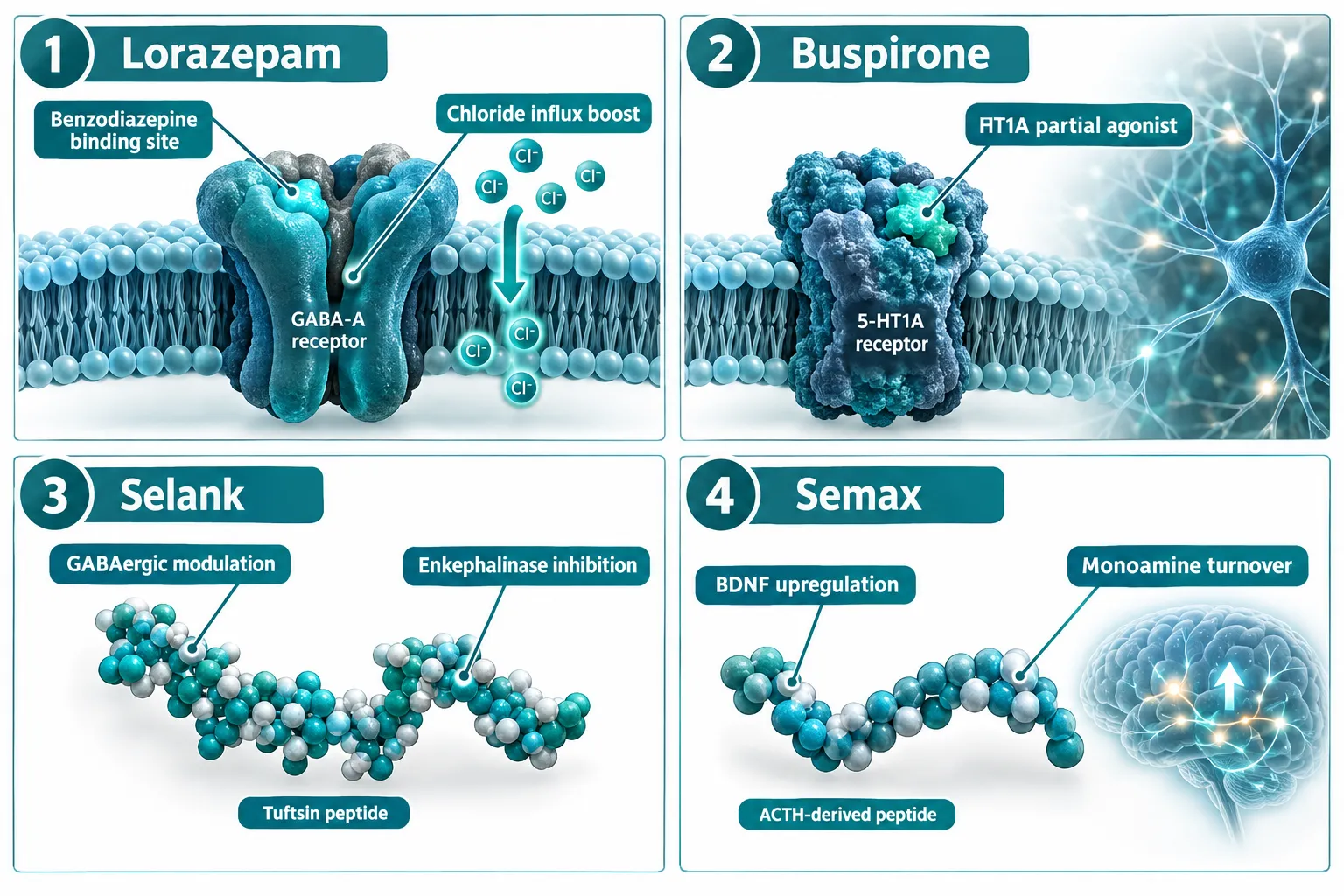
Understanding the comparison of Semax and Selank nasal sprays vs classic anxiolytics requires starting at the receptor level, because the mechanisms are genuinely distinct rather than merely variations on the same theme.
Lorazepam is a benzodiazepine that acts as a direct positive allosteric modulator at the GABA-A receptor. By binding to the benzodiazepine site, it amplifies chloride influx into neurons, producing rapid neural inhibition. The result is fast-acting anxiolysis, sedation, and muscle relaxation, but also tolerance, physical dependence, and cognitive slowing with sustained use.
Buspirone works through an entirely different pathway. As a 5-HT1A partial agonist, it modulates serotonergic tone without touching GABA-A receptors directly. It also carries mild dopaminergic activity. Because it lacks the sedative-hypnotic profile of benzodiazepines, it became a preferred option for generalized anxiety disorder (GAD), though its delayed onset of two to four weeks is a clinical limitation.
Selank is a synthetic heptapeptide analogue of tuftsin (Thr-Lys-Pro-Arg-Pro-Gly-Pro), engineered to produce anxiolytic effects through two overlapping mechanisms: GABAergic gene expression modulation and inhibition of enkephalin-degrading enzymes (enkephalinases). In vitro bench data place Selank's approximate IC50 for human serum enkephalinase inhibition at around 20 µM.
Semax, derived from the ACTH(4-7) sequence, targets monoamine turnover and promotes brain-derived neurotrophic factor (BDNF) upregulation rather than direct GABAergic or serotonergic receptor binding. Its in vitro enkephalinase IC50 is approximately 10 µM, slightly more potent than Selank at this enzyme level, though the clinical relevance of this difference is unknown.
"The peptides modulate upstream neurotrophic and neuropeptidergic systems, while classic anxiolytics work at well-defined receptor targets with predictable sedative and dependence profiles."
This upstream vs. direct-receptor distinction is the central mechanistic story when comparing peptide-based nootropics to lorazepam and buspirone in bench studies.
Bench and Preclinical Evidence: What Animal Models and Cellular Studies Show
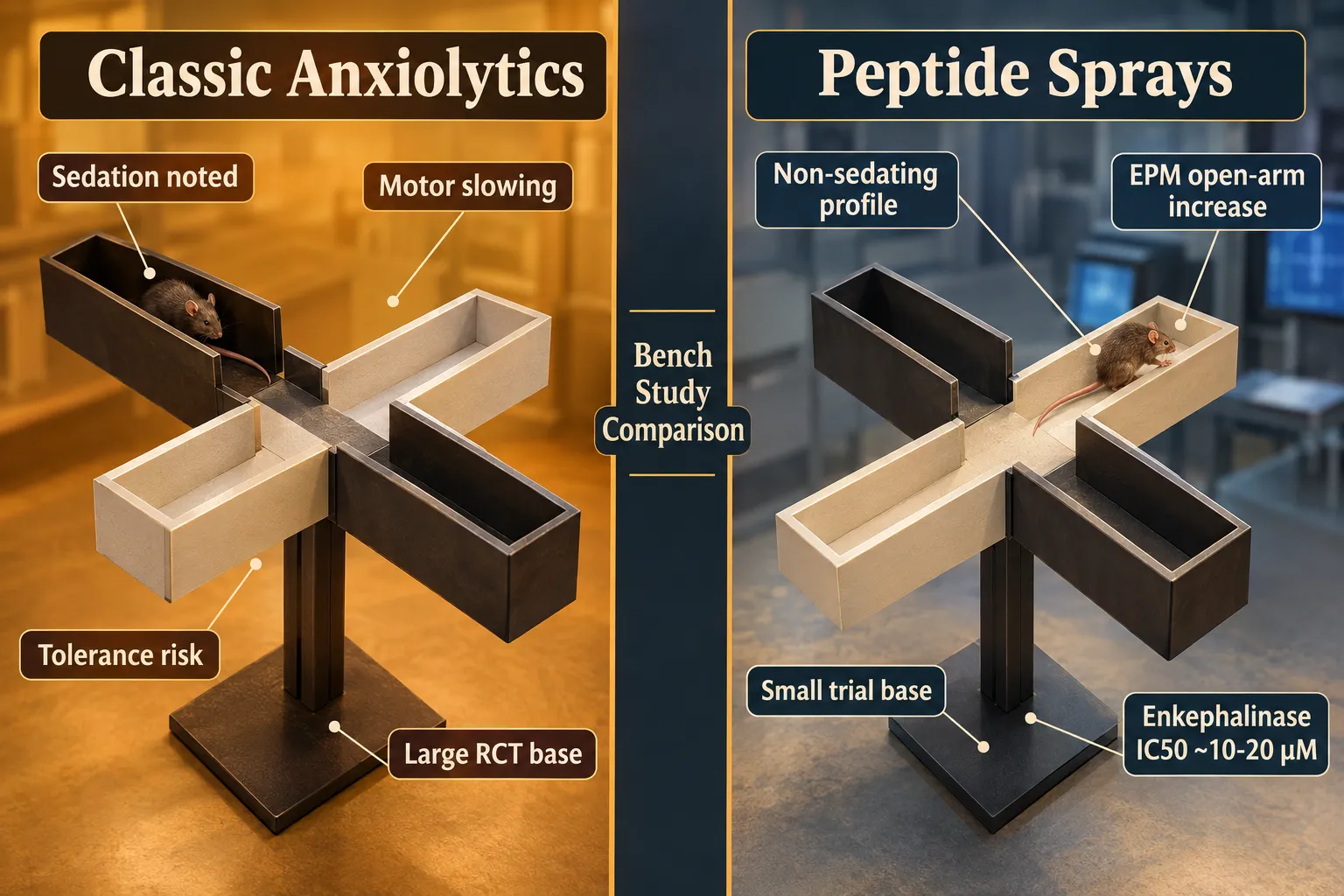
The preclinical data for Selank in rodent models are the most developed among the peptide sprays. In elevated plus maze (EPM) studies, the standard behavioral assay for anxiolysis, Selank increases both time spent in open arms and the number of open-arm entries. Critically, these effects appear comparable to diazepam in magnitude but without the motor impairment or sedation that benzodiazepines reliably produce in the same paradigm.
This non-sedating profile is a meaningful bench-level differentiator. Lorazepam and diazepam consistently produce dose-dependent motor slowing and cognitive interference at anxiolytically effective doses in animal models, a finding that translates directly to clinical sedation and psychomotor impairment in humans. Selank's EPM profile suggests a different side-effect architecture, possibly because its GABAergic influence operates through gene expression modulation rather than direct receptor potentiation.
For Semax, the preclinical picture is more cognitive than anxiolytic. A controlled resting-state fMRI study in 52 healthy adults compared acute Semax, Selank, and placebo, revealing that Semax produced more pronounced engagement of cortical executive networks (including the dorsolateral prefrontal cortex), while Selank tended toward reduced limbic hyperactivity, specifically in amygdala-temporal connectivity. These findings emerged within 5 to 20 minutes of dosing and are consistent with their respective "nootropic vs. anxiolytic" reputations.
A summarized crossover study in 45 patients with mild cognitive impairment quantified this split directly: Semax produced a larger effect size for memory enhancement (0.82 vs. 0.34 for Selank), while Selank showed greater anxiolytic efficacy (effect size 0.91 vs. 0.28 for Semax). These numbers are frequently cited in 2026 comparison guides, though the study is small and not independently replicated.
Researchers exploring other peptide research compounds can find lab tested peptides and review resources on sourcing from a best peptide manufacturer to ensure compound integrity in bench-level work.
Human Trial Data and the Evidence Gap Between Peptides and Classic Anxiolytics
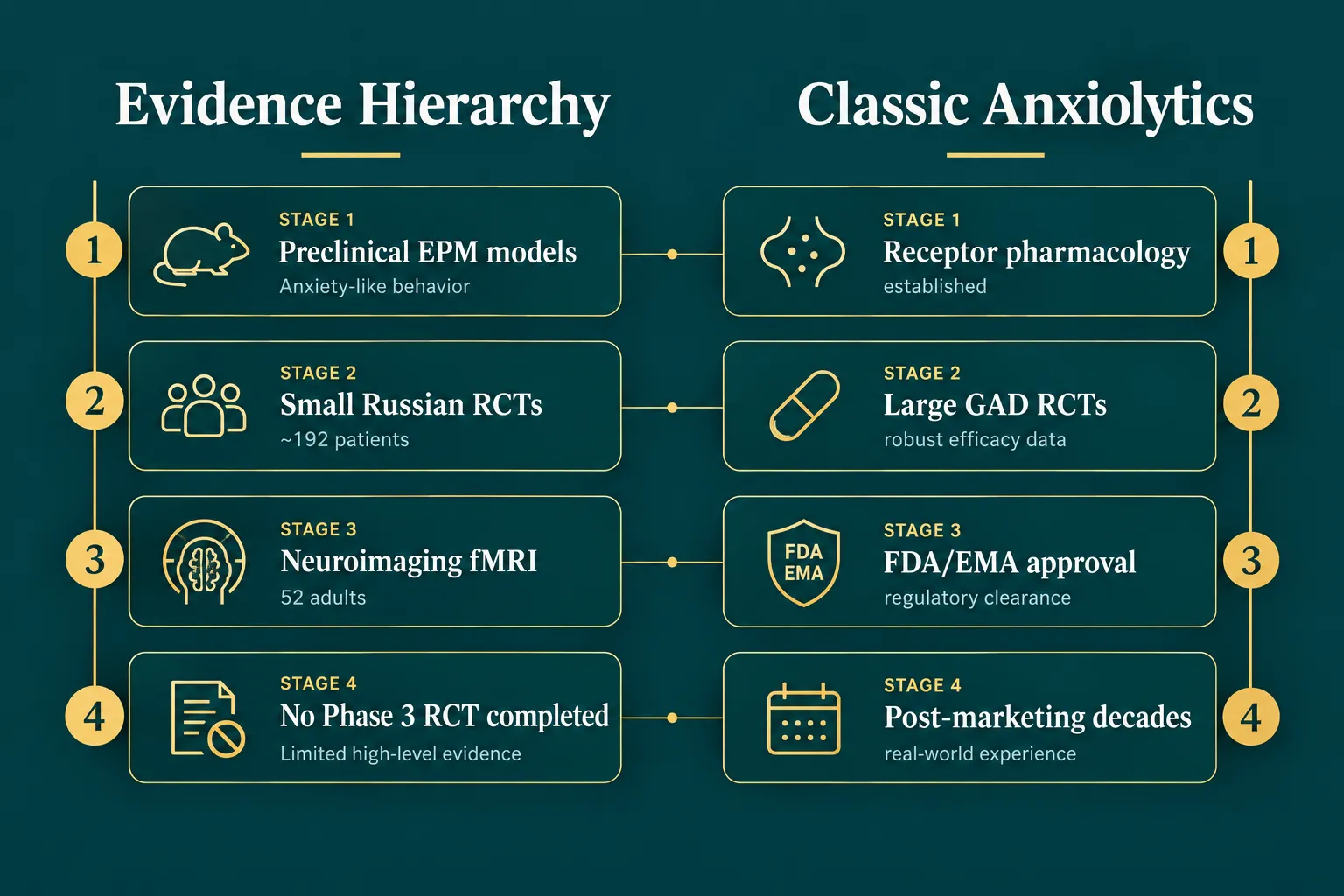
When examining Semax and Selank nasal sprays vs classic anxiolytics in terms of clinical evidence, the gap is stark. Lorazepam and buspirone are supported by large, multi-site, randomized controlled trials. One controlled GAD trial comparing lorazepam and buspirone directly found similar anxiolytic efficacy at day 56, with buspirone performing somewhat better on neurovegetative symptom scales, a finding that reinforced buspirone's status as a non-sedating first-line option for chronic anxiety.
Selank's human anxiety data, by contrast, derive from approximately three small trials totaling roughly 192 patients. The most frequently cited study enrolled 62 patients (30 on Selank, 32 on medazepam) and found comparable reductions on the Hamilton Anxiety Rating Scale, with Selank additionally showing antiasthenic and mild psychostimulant properties. A 60-patient phenazepam comparison produced similar findings. These are encouraging signals, but they originate from Eastern European clinical settings in the 2000s and have not been replicated in large international Phase 3 programs.
Semax's human anxiety data are even more limited. Its meaningful clinical record is restricted to ischemic stroke recovery and cognitive domains. No dedicated human anxiety trial for Semax exists as of 2026, making the comparison to buspirone, a compound designed and approved specifically as a non-sedating anxiolytic, particularly asymmetric.
- Lorazepam: Multiple large RCTs, FDA-approved, decades of post-marketing data
- Buspirone: Multiple GAD RCTs, FDA-approved, established non-sedating profile
- Selank: ~192 patients across three small trials, no Phase 3 RCT, research compound status
- Semax: No human anxiety RCT; cognitive and stroke data only
In terms of onset and sedation profiles, a 2026 clinical overview characterizes Selank's onset at 30 to 90 minutes and Semax's at 20 to 60 minutes, both described as non-sedating. This contrasts with lorazepam's rapid sedative onset and buspirone's delayed two-to-four-week therapeutic window. The peptides may thus offer a faster, non-sedative subjective profile more analogous to acute benzodiazepine relief, but this is based largely on small-study and anecdotal data rather than controlled comparisons.
In 2026, both Selank and Semax remain classified as experimental or adjunctive options in peptide-oriented clinical practices, used off-label under physician-guided protocols. Classic anxiolytics remain the backbone of evidence-based anxiety treatment algorithms, with standardized dosing, clear contraindications, and formal guideline support. Researchers interested in related peptide categories can also explore NAD peptides and SS-31 peptide benefits for adjacent neuroprotective research, or browse MOTC peptide categories for broader context on research-grade compounds. For nasal delivery format research, nasal spray with PT-141 offers a parallel example of intranasal peptide administration studied in controlled settings.
Conclusion
The comparison of Semax and Selank nasal sprays vs classic anxiolytics, and how lorazepam and buspirone differ from peptide-based nootropics in bench studies, reveals two genuinely different pharmacological philosophies. Lorazepam acts directly at GABA-A receptors for rapid, well-characterized anxiolysis with known dependence risk. Buspirone modulates serotonergic tone for sustained, non-sedating GAD management backed by large RCTs. Selank and Semax operate upstream through enkephalinase inhibition, GABAergic gene expression, BDNF upregulation, and monoaminergic modulation, mechanisms that show real promise in preclinical models and small human trials but have not yet cleared the Phase 3 evidentiary bar.
Actionable next steps for researchers and clinicians:
- Treat Selank and Semax as research-stage compounds requiring institutional or physician oversight; do not substitute them for approved anxiolytics in clinical practice.
- Prioritize studies that directly compare peptide sprays to buspirone in standardized GAD populations, this is the most meaningful gap in the current literature.
- When sourcing peptides for bench work, verify purity through third-party testing; compound integrity is essential for reproducible mechanistic data.
- Monitor 2026 and 2027 trial registries for emerging Phase 2 data on Selank, which represents the most clinically advanced peptide anxiolytic candidate.
The mechanistic story is compelling. The clinical story is still being written.