

Meloxicam, Naproxen, and Diclofenac in Peptide Research: A Comparative NSAID Confounder Guide
Roughly 30 million people take an NSAID every day, yet the specific drug chosen rarely appears as a controlled variable in published peptide studies. That omission matters enormously. When a research model co-administers BPC-157, TB-500, or a metabolic peptide alongside an anti-inflammatory drug, the identity of that NSAID quietly reshapes nearly every downstream readout, from prostaglandin flux to angiogenic signaling. This guide to meloxicam, naproxen, and diclofenac in peptide research: a comparative NSAID confounder guide unpacks why those three agents produce meaningfully different confounds, and how researchers can account for them before designing protocols.
Key Takeaways
- Meloxicam, naproxen, and diclofenac differ in COX-2 selectivity, half-life, and renal impact, each creates a distinct interference pattern in peptide assays.
- BPC-157 repair models are especially sensitive to prostaglandin suppression; COX selectivity determines how deeply each NSAID blunts that signal.
- Naproxen's long half-life and full COX-1/COX-2 blockade present the broadest confounder window in time-sensitive dosing schedules.
- Diclofenac's short half-life offers a narrower interference window, but its variable plasma peaks complicate washout calculations.
- Matching NSAID choice to the specific peptide pathway under study, rather than defaulting to the most prescribed agent, is the single highest-yield protocol adjustment available.
Why COX Selectivity Is the First Variable to Nail Down
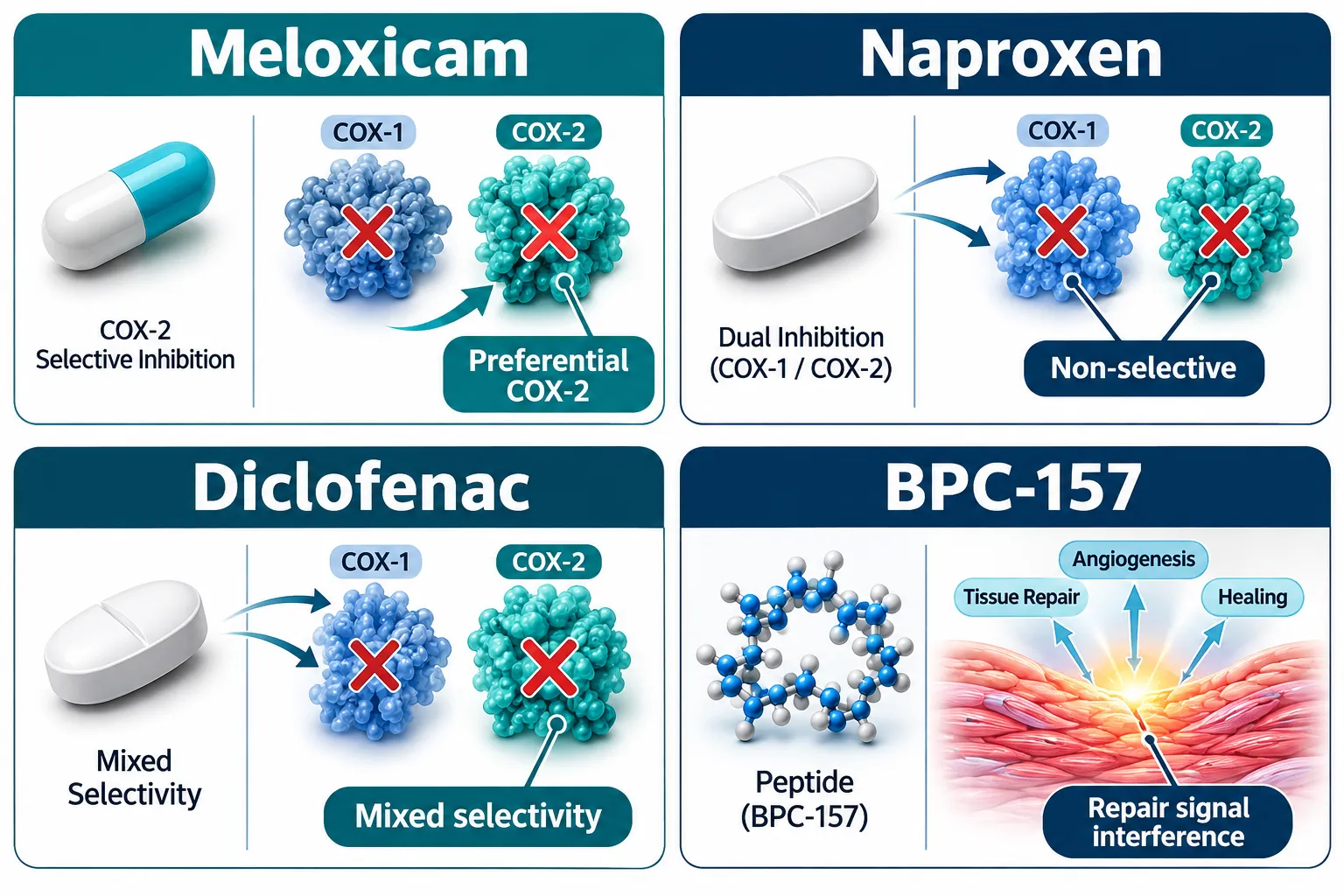
Every NSAID reduces inflammation by blocking cyclooxygenase enzymes, but the ratio of COX-1 to COX-2 inhibition differs sharply across the three agents.
Meloxicam is a preferential COX-2 inhibitor at standard doses (7.5-15 mg daily). It suppresses prostaglandin E2 production in inflamed tissue more than it disturbs constitutive COX-1 activity in the gastric mucosa. Naproxen is non-selective, blocking both isoforms roughly equally at its standard 250-500 mg twice-daily range. Diclofenac sits in the middle, it leans toward COX-2 at lower doses but loses selectivity as plasma concentration rises.
For peptide researchers, this hierarchy carries direct consequences:
| NSAID | COX-2 Preference | Standard Daily Dose Range | Plasma Half-Life |
|---|---|---|---|
| Meloxicam | High | 7.5-15 mg | ~20 hours |
| Naproxen | None (non-selective) | 500-1000 mg | ~12-17 hours |
| Diclofenac | Moderate | 75-150 mg | ~2 hours |
BPC-157 exerts part of its tissue-repair effect through prostaglandin-dependent pathways. A non-selective NSAID like naproxen suppresses that prostaglandin environment far more completely than meloxicam would, potentially masking BPC-157 efficacy in a wound-healing endpoint. Researchers sourcing peptides for these models can review purity benchmarks in the GHK-Cu peptide purchase and copper peptide research sourcing guide for related quality considerations.
Inflammation Timing, Half-Life, and the Dosing Window Problem
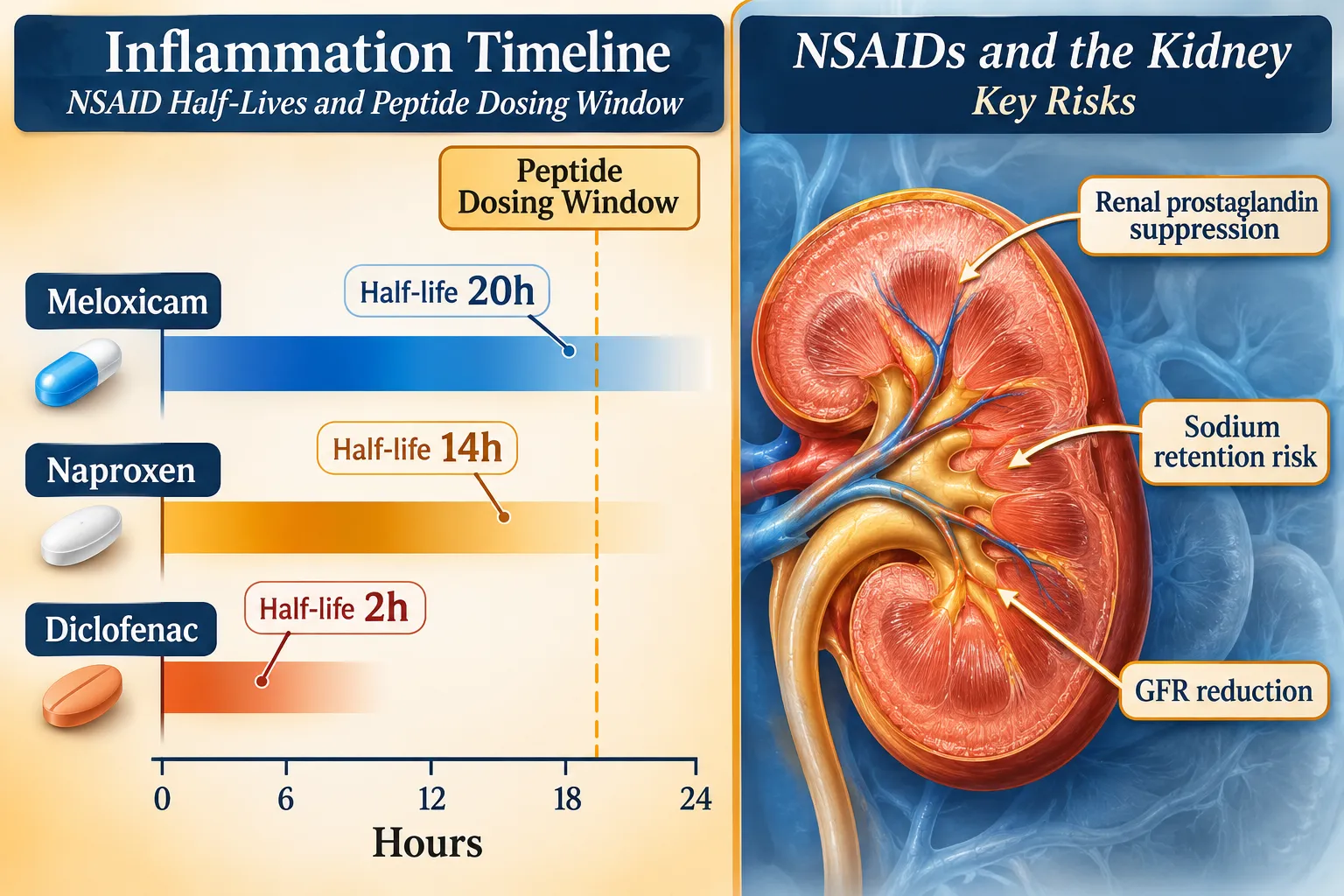
Half-life directly determines how long each NSAID occupies the inflammatory environment during a peptide experiment.
Naproxen's 12-to-17-hour half-life means that a morning dose still suppresses prostaglandins well into the following day. In a TB-500 actin-polymerization or angiogenesis study with once-daily peptide dosing, naproxen's persistent COX blockade overlaps almost entirely with the peptide's active window. Diclofenac, by contrast, clears rapidly, plasma levels drop steeply within four to six hours. That short window looks appealing for washout management, but diclofenac's variable absorption produces erratic peaks that are difficult to synchronize with peptide pharmacokinetics.
Meloxicam's ~20-hour half-life is the longest of the three, but because its COX-2 preference spares much of the COX-1-dependent prostanoid pool, the breadth of interference on repair-oriented pathways is narrower than naproxen's. For studies using mitochondria-targeted peptides, where researchers may want to explore products like SS-31 peptide, the renal prostaglandin implications of long-half-life agents deserve particular attention.
Renal effects are the second underappreciated confounder. All three NSAIDs reduce glomerular prostaglandin synthesis. In metabolic peptide models where GLP-related agents are under study, such as those listed on the GLP-3 peptide for sale page, NSAID-driven sodium retention and reduced GFR can directly alter peptide clearance rates and distort dose-response curves.
Matching Each NSAID to Specific Peptide Research Models

Applying the principles of a comparative NSAID confounder guide practically means mapping each drug to the peptide pathway it is most likely to disrupt.
BPC-157 models (tissue repair, tendon, gut)
BPC-157 stimulates angiogenesis partly through VEGF and nitric oxide pathways, but prostaglandin E2 is a co-signal in the early inflammatory phase of repair. Naproxen's full COX blockade presents the highest risk of attenuating early repair signals. Meloxicam is a lower-risk choice if an NSAID must be co-administered, though the ideal design uses a NSAID-free control arm. Researchers interested in peptide comparisons for repair models can also consult the LL-37 versus SS-31 benefits of each peptide overview for related mechanistic context.
TB-500 (thymosin beta-4) models
TB-500 accelerates actin remodeling and endothelial migration. COX-2-derived prostaglandins facilitate endothelial tube formation. Diclofenac's partial COX-2 inhibition at therapeutic doses may modestly blunt this effect, while naproxen's non-selective blockade is most likely to flatten angiogenic endpoints. Pharmacogenomic metabolism notes are also relevant: both meloxicam and diclofenac are CYP2C9 substrates, meaning subjects with poor CYP2C9 activity accumulate higher drug levels and produce disproportionate prostaglandin suppression.
Metabolic peptide models
For researchers working with GLP-related compounds, including those available via the GLP-3R 10mg peptide GA10 listing, NSAID-induced fluid retention and insulin-sensitivity shifts are genuine confounders. Naproxen's sustained COX-1 activity affects platelet thromboxane, which in turn modulates insulin secretion indirectly. Diclofenac's cardiovascular risk signal, stronger than meloxicam's in real-world prescribing data, also introduces hemodynamic variables that metabolic assays rarely account for. For quality assurance across peptide sourcing decisions, the lab tested peptides resource provides useful benchmarking context.
Practical NSAID selection hierarchy for peptide researchers:
- Avoid NSAIDs entirely when the primary endpoint is prostaglandin-dependent.
- Use meloxicam when an anti-inflammatory control is necessary and COX-1 preservation matters.
- Use diclofenac only when a short interference window is operationally required and CYP2C9 status is known.
- Avoid naproxen in any time-sensitive repair or angiogenesis model.
- Always include a NSAID-free arm regardless of which agent is selected.
"The NSAID chosen is not a neutral background variable, it is an active experimental input that reshapes the prostaglandin and renal environment in which every peptide signal is read."
For growth-hormone secretagogue studies, the GHRP-2 peptide vs Sermorelin comparison demonstrates how pharmacokinetic differences between agents in the same class produce measurably distinct outcomes, the same logic applies here.
Conclusion
Meloxicam, naproxen, and diclofenac in peptide research constitute a comparative NSAID confounder guide that every researcher using anti-inflammatory agents alongside bioactive peptides should review before finalizing a protocol. The three agents diverge on COX selectivity, half-life, renal impact, and CYP2C9 metabolism, each difference capable of shifting an endpoint enough to misrepresent the peptide's true effect.
Actionable next steps for 2026 research designs:
- Document the specific NSAID, dose, and timing in every protocol section, not just as a footnote.
- Pre-screen for CYP2C9 poor-metabolizer status when using meloxicam or diclofenac.
- Include a minimum 48-hour washout period for naproxen before any prostaglandin-sensitive peptide assay.
- Power studies to detect NSAID-by-peptide interaction effects, not just main peptide effects.
- Choose meloxicam over naproxen when an NSAID control arm is unavoidable in repair or angiogenesis models.
Treating NSAID selection as a true independent variable, not an administrative default, is one of the most cost-effective ways to improve the reproducibility of peptide research outcomes.