

PT-141 Melanocortin Assays: Comparing Receptor Selectivity, Calcium Signaling, and Functional Readouts
Binding affinity and functional potency are not the same thing, and nowhere is that distinction more consequential than in PT-141 melanocortin assays. PT-141 (bremelanotide) binds all five melanocortin receptor subtypes (MC1R through MC5R), yet its functional activity concentrates sharply at MC3R and MC4R. Understanding why that gap exists, and how to measure it reliably, is the central challenge of melanocortin receptor pharmacology in 2026.
Key Takeaways
- PT-141 binds all five melanocortin receptors but shows functional selectivity for MC3R and MC4R in cAMP-based assays.
- Ki values of approximately 2.3 nM at MC4R and 14.7 nM at MC3R confirm nanomolar potency at central melanocortin targets.
- PT-141 behaves as a partial agonist at MC4R, reaching roughly 85% of the maximal response produced by the full agonist alpha-MSH.
- Calcium-containing buffers are essential for physiologically relevant agonist functional readouts; omitting calcium distorts efficacy measurements.
- Meaningful selectivity comparisons require running PT-141 and comparator ligands in the same cell system, buffer, and assay format.
Understanding Receptor Selectivity in PT-141 Melanocortin Assays
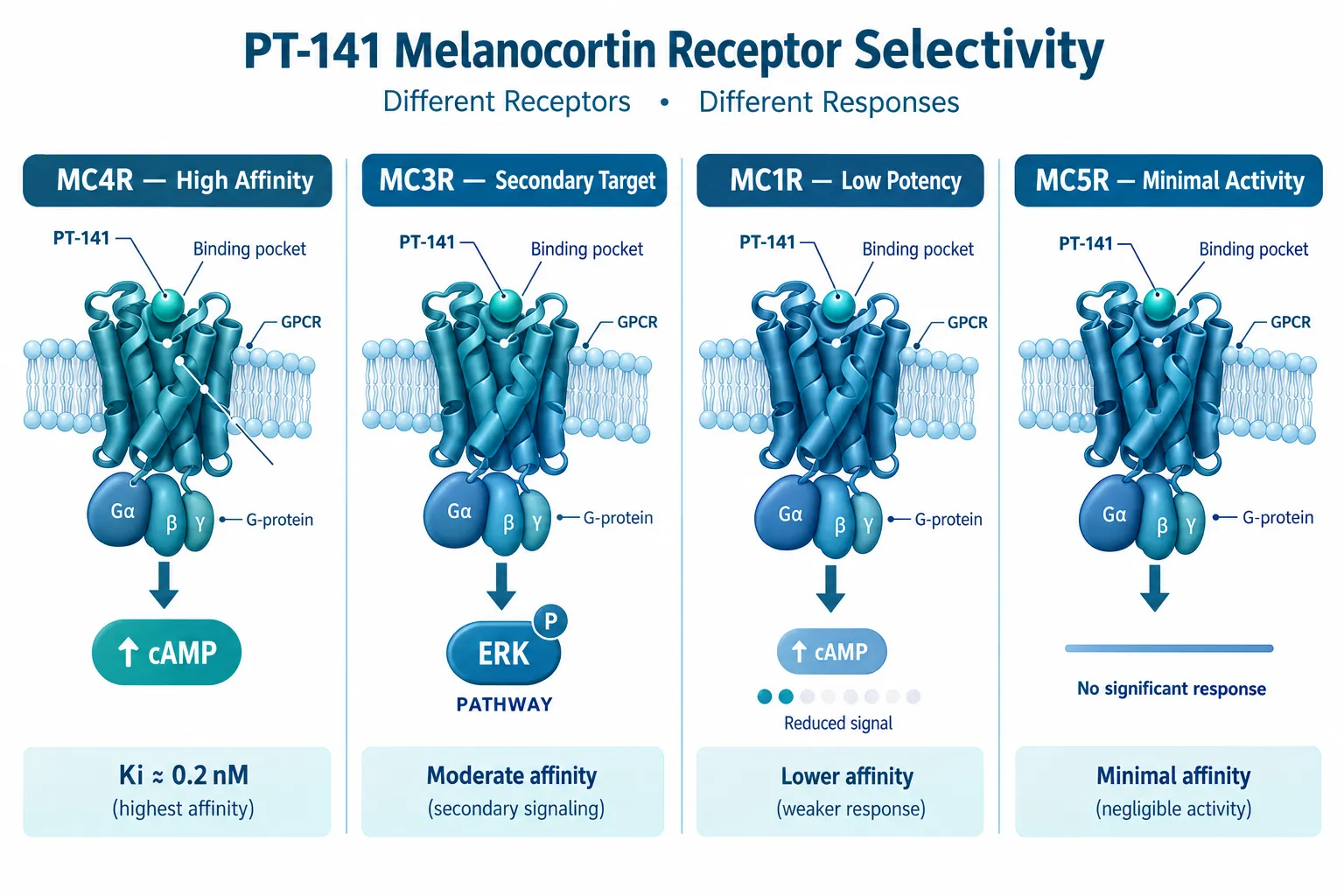
Receptor selectivity in melanocortin pharmacology is best understood as a two-layer concept: binding selectivity and functional selectivity. PT-141 does not display strong binding selectivity, competitive radioligand displacement assays using [¹²⁵I]-NDP-alpha-MSH show measurable affinity at all five receptor subtypes. The functional picture, however, is strikingly different.
In HEK293 and CHO cells transfected with human MC4R, PT-141 produces dose-dependent cAMP accumulation with EC50 values in the range of 1.8 to 18 nM, depending on assay conditions and receptor expression level. At MC1R and MC5R, functional responses under equivalent conditions are substantially weaker. This divergence between binding affinity and functional output defines PT-141 as a functionally MC3R/MC4R-selective compound.
Binding Affinity Values Across Receptor Subtypes
| Receptor | Approximate Ki | Functional Status |
|---|---|---|
| MC4R | ~2.3 nM | High functional activity |
| MC3R | ~14.7 nM | Moderate functional activity |
| MC1R | Higher (reduced) | Low functional potency |
| MC5R | Higher (reduced) | Minimal functional activity |
| MC2R | Not applicable | ACTH-specific; PT-141 inactive |
This selectivity profile makes PT-141 the preferred reference compound for assays targeting central melanocortin pathways, including those linked to energy homeostasis, sexual function, and reward circuitry. Researchers exploring broader peptide pharmacology, including lab tested peptides used as reference standards, will recognize this binding-versus-function distinction as a recurring theme across peptide classes.
Comparing Binding Assays and Functional Readouts
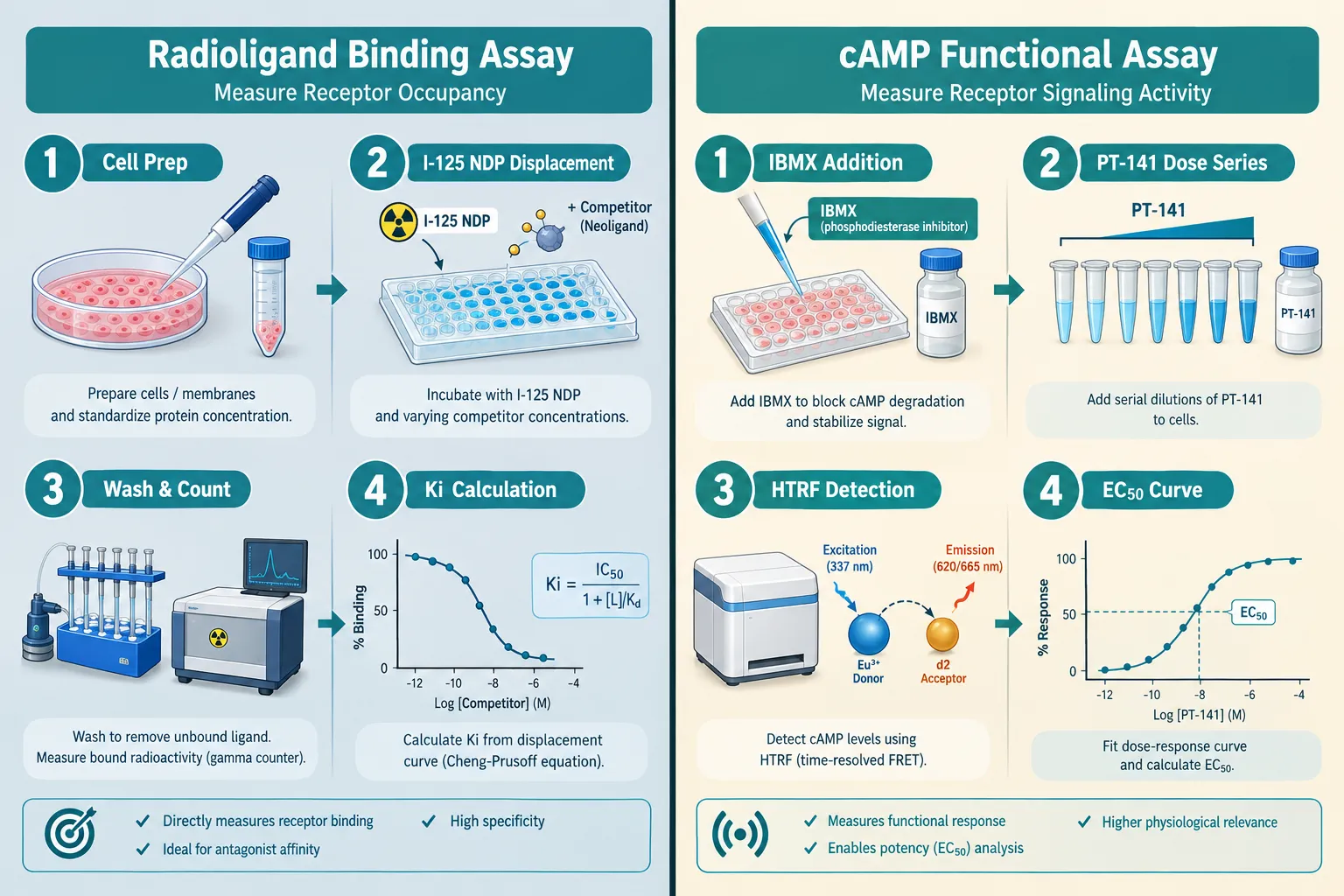
The choice between a binding assay and a functional assay is not merely technical, it determines what biological question gets answered.
Radioligand binding assays measure how well PT-141 displaces a labeled tracer (typically [¹²⁵I]-NDP-alpha-MSH) from the receptor. The output is a Ki value: a measure of affinity, not activity. A compound can have excellent binding affinity and still be an antagonist or a very weak partial agonist.
Functional assays measure what happens after the receptor is occupied. For melanocortin receptors, the primary functional readout is cAMP accumulation via Gs-protein coupling. Recommended formats include:
- HTRF (homogeneous time-resolved fluorescence) cAMP assays
- AlphaScreen cAMP detection
- Biosensor-based real-time cAMP monitoring
- Calcium flux assays using fluorescent dyes
"A selectivity experiment should report both binding (Ki) and functional (EC50/Emax) metrics, especially for compounds like PT-141 that exhibit partial agonism and pathway divergence."
PT-141 as a Partial Agonist at MC4R
PT-141 does not produce a maximal response equivalent to the endogenous full agonist alpha-MSH. In well-controlled CHO cell systems, PT-141 reaches approximately 85% of alpha-MSH efficacy, corresponding to intrinsic activity values of 0.7 to 0.9. This partial agonism has direct implications for assay design: Emax must always be reported alongside EC50, because two compounds with identical EC50 values can produce very different maximal responses.
Comparing PT-141 with Melanotan II (MT-II) illustrates this point further. MT-II shows 3 to 5 times greater potency at MC1R in functional assays, while PT-141 maintains comparable MC4R affinity. This shift toward MC3R/MC4R and away from MC1R activity is why PT-141 is considered more appropriate for central melanocortin signaling studies and less suitable for assays focused on cutaneous pigmentation pathways.
Calcium Signaling and Multichannel Functional Readouts in PT-141 Melanocortin Assays
cAMP is the dominant second messenger in melanocortin receptor pharmacology, but it is not the only relevant signal. PT-141's activation of MC4R also engages:
- ERK1/2 MAPK pathways in neuronal populations
- Intracellular calcium mobilization in specific central circuits
- Downstream dopamine and oxytocin release, linking receptor-level signaling to neuroendocrine outputs
This multi-pathway engagement means that a cAMP-only assay may underestimate the full functional profile of PT-141 at MC4R. Multiplexed platforms that simultaneously measure cAMP, calcium flux, and MAPK activation are increasingly recommended for comprehensive characterization.
The Critical Role of Calcium in Assay Buffers
One of the most practically important findings in recent melanocortin assay methodology is the calcium dependence of agonist efficacy. PT-141's functional activity at MC4R depends on the presence of extracellular calcium, while antagonist binding does not. This asymmetry means:
- Agonist assays must use calcium-containing buffers to generate physiologically relevant data.
- Calcium-free conditions will suppress apparent agonist efficacy without affecting binding measurements.
- Comparisons between studies conducted in different buffer compositions may not be directly valid.
This detail is frequently overlooked when interpreting published EC50 values across laboratories. Researchers working with peptide compounds that engage calcium-dependent pathways, including those studying IPA sermorelin stack research or related neuroendocrine peptides, encounter analogous buffer-composition challenges.
Designing a Rigorous Selectivity Experiment
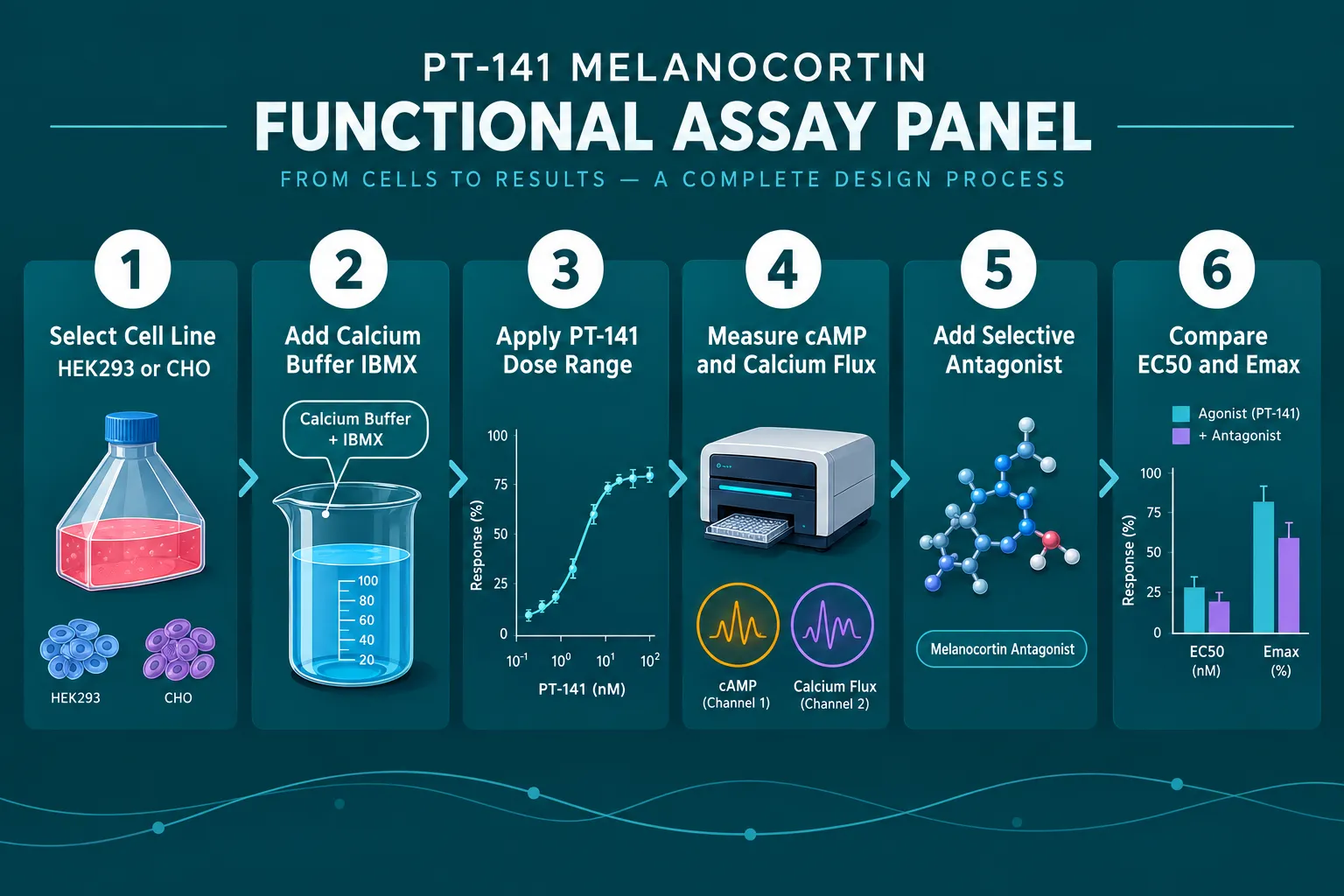
A complete PT-141 selectivity experiment in 2026 should include:
- Competitive binding at MC1R, MC3R, MC4R, and MC5R using [¹²⁵I]-NDP-alpha-MSH displacement to generate Ki values.
- cAMP functional assay in MC3R- and MC4R-transfected HEK293 or CHO cells, with IBMX added to prevent cAMP degradation, generating EC50 and Emax.
- Calcium flux assay in the same cell lines to capture non-cAMP signaling.
- Selective antagonist co-administration to confirm which receptor subtype drives the observed response, PT-141-induced cAMP elevation that is blocked by an MC4R-selective antagonist confirms MC4R functional expression.
- Comparator ligands (setmelanotide, MT-II, alpha-MSH) run in the same buffer and cell system on the same day.
Because PT-141 engages MC3R and MC4R with near-equivalent affinity, attributing a biological effect to one specific subtype without selective antagonist controls is methodologically unsound. This principle applies equally when PT-141 is used as a benchmark for structure-activity relationship work on novel melanocortin ligands.
Researchers sourcing reference peptides for such panels should prioritize verified purity. Resources such as guidance on where to buy research-grade Glow Blend peptide: evaluating purity illustrate the level of documentation, certificate of analysis, HPLC trace, mass spec confirmation, that should be expected for any compound used as an assay reference standard.
Conclusion
PT-141 melanocortin assays offer a powerful window into central melanocortin receptor pharmacology, but only when binding and functional data are collected and reported together. The key actionable steps for researchers in 2026 are clear:
- Always pair Ki values with EC50 and Emax data. Binding affinity alone does not predict functional selectivity.
- Use calcium-containing buffers in all agonist functional assays to avoid artificially suppressed efficacy readings.
- Include selective antagonists to assign observed cAMP and calcium responses to specific receptor subtypes.
- Run comparator ligands (MT-II, setmelanotide, alpha-MSH) in the same assay system to enable valid cross-compound selectivity comparisons.
- Report receptor species, cell line, and buffer composition in all published or shared data to enable meaningful cross-laboratory comparisons.
As multiplexed platforms that simultaneously capture cAMP, calcium flux, and MAPK activation become more accessible, the standard for what constitutes a complete PT-141 functional characterization will continue to rise. Investing in rigorous assay design now produces receptor selectivity data that remains interpretable and reproducible well beyond the initial study.