

Retatrutide and Cardiovascular Disease Research: Interpreting Weight, Glycemic, and Safety Endpoints Together
Fewer than 40% of adults with severe obesity and established cardiovascular disease achieve meaningful, sustained weight loss through lifestyle intervention alone, yet researchers increasingly face a more complex challenge: determining whether the dramatic weight reductions produced by newer agents like retatrutide actually translate into reduced cardiovascular events, or whether they simply improve the numbers on a lab report.
Retatrutide and cardiovascular disease research: interpreting weight, glycemic, and safety endpoints together has become one of the most consequential methodological questions in metabolic medicine as of 2026. The drug's triple agonist mechanism, targeting GIP, GLP-1, and glucagon receptors simultaneously, produces weight loss that surpasses nearly every prior pharmacological benchmark. But the population most likely to receive this therapy in clinical practice is not the uncomplicated obesity cohort studied in pivotal trials. It is the patient with prior myocardial infarction, heart failure, or advanced atherosclerosis, where surrogate endpoints and actual cardiovascular outcomes can diverge sharply.
Key Takeaways
- Retatrutide produced mean body weight reductions of up to 24.2% at 48 weeks in phase 2 trials, exceeding prior pharmacological benchmarks.
- Glycemic improvements, including HbA1c reductions of approximately 2.16 percentage points, occurred alongside weight loss in both diabetic and non-diabetic populations.
- Lipid panels, blood pressure, and inflammatory markers all shifted in a cardiovascular-favorable direction, but these remain surrogate endpoints.
- No completed cardiovascular outcomes trials have yet confirmed reductions in major adverse cardiovascular events (MACE) for retatrutide.
- Researchers must resist treating weight loss as a direct proxy for cardiovascular benefit, particularly in high-risk populations with established disease.
Why the Severe-Obesity CVD Population Demands a Different Analytical Frame
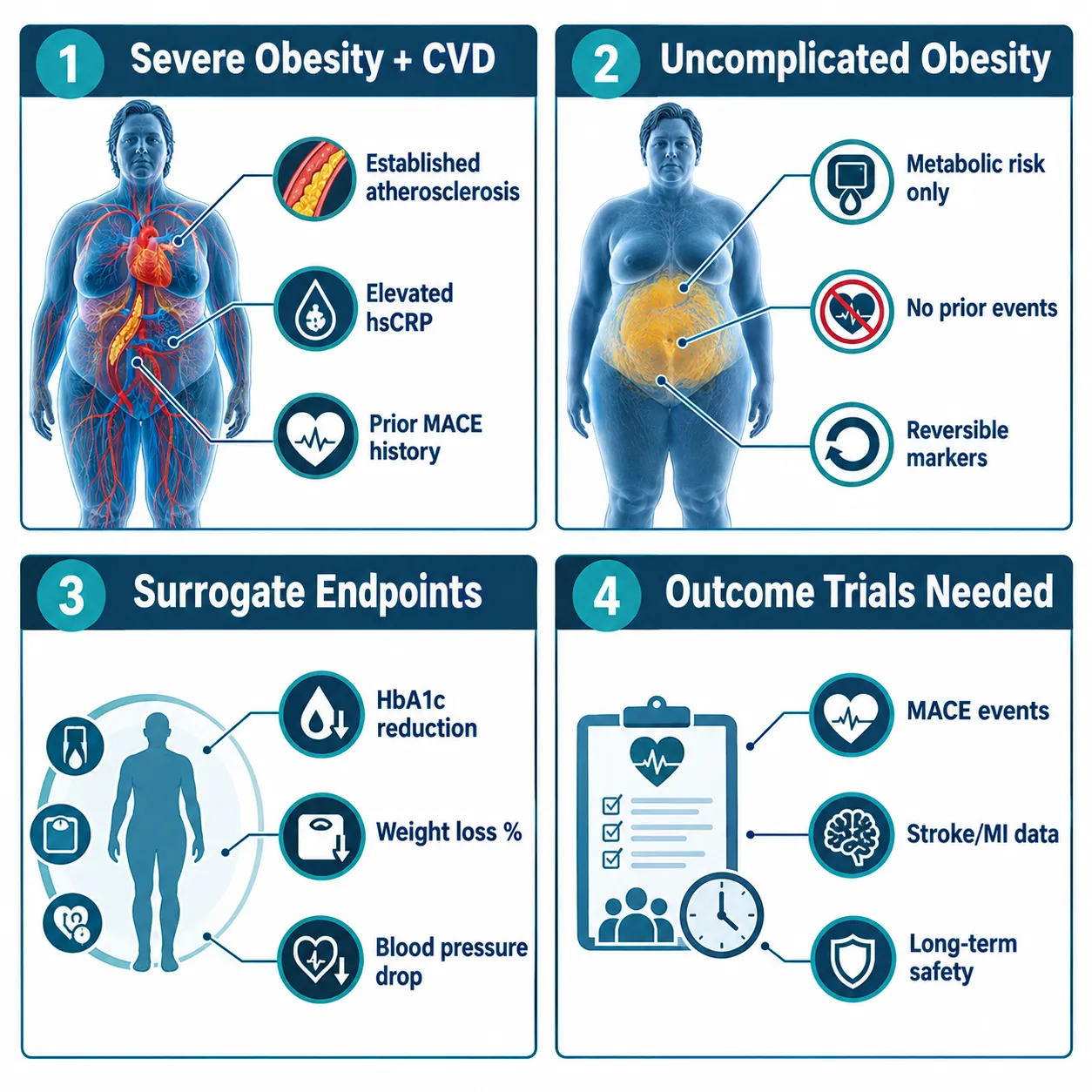
The distinction between uncomplicated obesity and obesity complicated by established cardiovascular disease is not semantic, it is mechanistically and statistically critical. In uncomplicated obesity cohorts, cardiovascular risk is largely driven by modifiable metabolic factors: insulin resistance, dyslipidemia, and hypertension. Meaningful weight loss reliably improves these factors, and the pathway from surrogate improvement to event reduction is relatively well-supported by prior evidence from bariatric surgery and GLP-1 receptor agonist outcomes trials.
In the severe-obesity CVD population, however, the risk architecture is different. Atherosclerotic plaques are already established. Inflammatory burden is higher. Cardiac remodeling may be present. The relationship between short-term biomarker improvement and long-term event reduction is less predictable, and the potential for adverse interactions, including changes in heart rate, volume shifts from rapid weight loss, or arrhythmia risk, requires independent evaluation rather than inference from surrogate data.
This is the central interpretive challenge for retatrutide and cardiovascular disease research: interpreting weight, glycemic, and safety endpoints together requires researchers to resist collapsing a multi-dimensional risk picture into a single headline number.
Researchers reviewing retatrutide endpoints data should note that the phase 2 obesity trial enrolled adults without diabetes and without prior cardiovascular events. Extrapolating those results to a post-MI population with preserved or reduced ejection fraction introduces assumptions that the data do not yet support.
What the Phase 2 Data Actually Show: Weight, Glycemic, and Lipid Endpoints
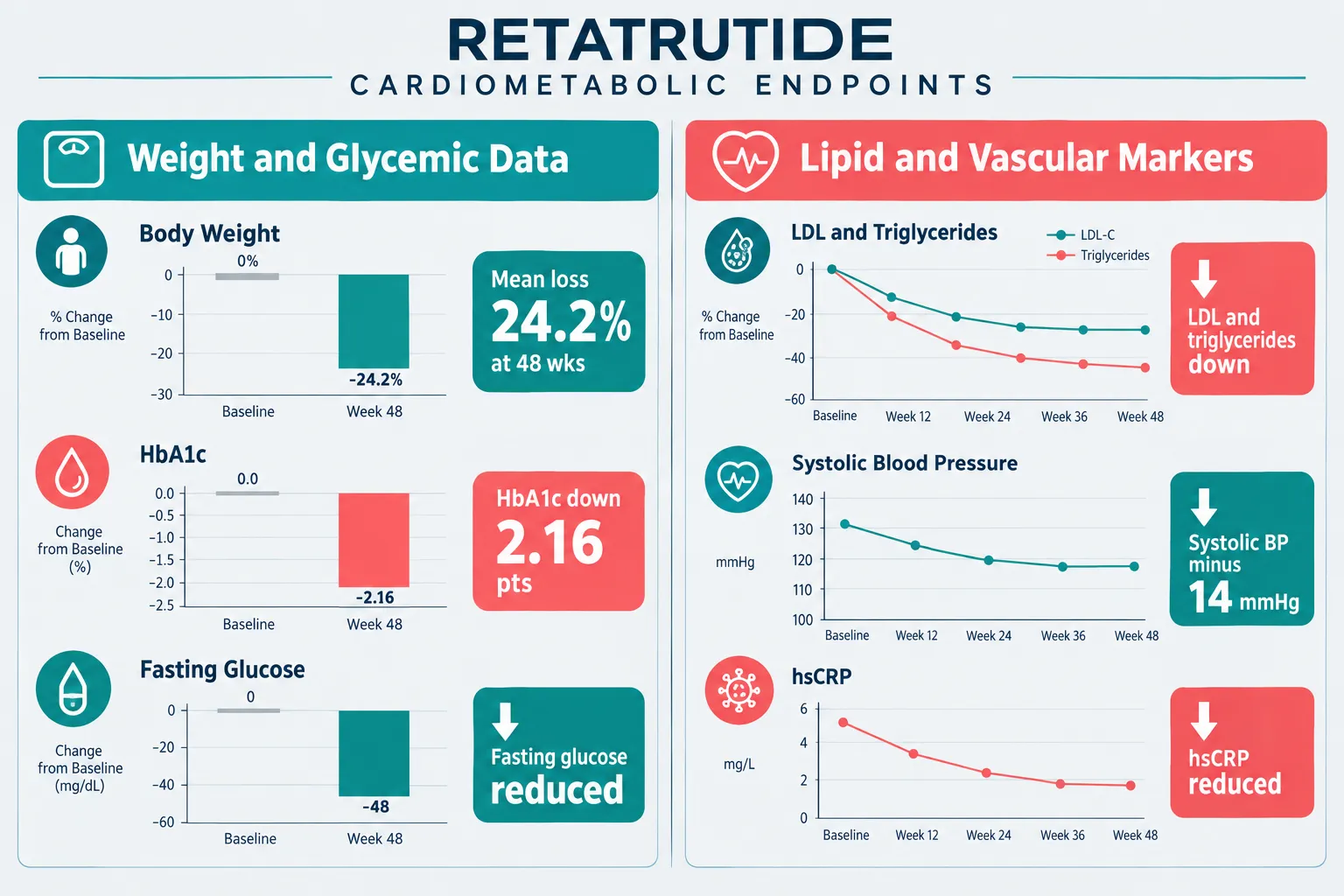
The phase 2 evidence base for retatrutide is genuinely impressive across multiple dimensions. In the pivotal obesity trial involving 338 adults, once-weekly retatrutide at 12 mg produced a mean body weight reduction of 24.2% at 48 weeks. The 8 mg dose achieved 22.8% mean loss. Placebo-adjusted weight reduction at 24 weeks was approximately 16%, with a continued downward trajectory through the trial period. Every participant receiving 8 or 12 mg weekly achieved at least 5% weight loss, a threshold widely cited in regulatory and guideline contexts as clinically meaningful for cardiovascular risk.
Glycemic endpoints reinforced the cardiometabolic signal. In a separate 36-week phase 2 study in adults with type 2 diabetes, the highest dose produced an average HbA1c decrease of approximately 2.16 percentage points alongside up to 16.9% weight reduction. Fasting glucose and fasting insulin also declined in parallel with weight loss in the obesity trial.
Lipid and inflammatory markers moved in favorable directions. Triglycerides, LDL cholesterol, non-HDL cholesterol, and total cholesterol all declined. HDL modestly improved. Systolic blood pressure fell by roughly 4-8 mmHg across effective dose arms in the obesity trial, and by approximately 14 mmHg at the highest dose in a manufacturer-reported analysis using an efficacy estimand. High-sensitivity C-reactive protein (hsCRP), a marker of systemic inflammation strongly associated with cardiovascular events, was also reduced.
Waist circumference decreased by approximately 10-15 cm across effective dose arms, a change relevant to visceral adiposity and its downstream effects on insulin sensitivity and hepatic lipid metabolism.
For researchers seeking GLP-3 Reta 30mg formulations for preclinical or translational research purposes, these multi-endpoint findings provide a rich framework for designing studies that go beyond single-biomarker outcomes.
Interpreting Safety Endpoints Alongside Efficacy: What Researchers Must Not Overlook
Safety data from phase 2 trials show a profile broadly consistent with potent incretin-based therapies. Adverse events were predominantly gastrointestinal, nausea, vomiting, and diarrhea, and were more frequent at higher doses, consistent with dose-dependent receptor engagement. Serious adverse events were infrequent, and the overall safety profile was considered acceptable for continued development.
Critically, available phase 2 summaries do not signal major cardiovascular safety concerns over 36-48 weeks. But this observation carries an important caveat: 36-48 weeks is insufficient to characterize arrhythmia risk, heart failure decompensation risk, or ischemic event rates in a population with established cardiovascular disease.
Researchers must treat the absence of a safety signal as a starting point for investigation, not a conclusion.
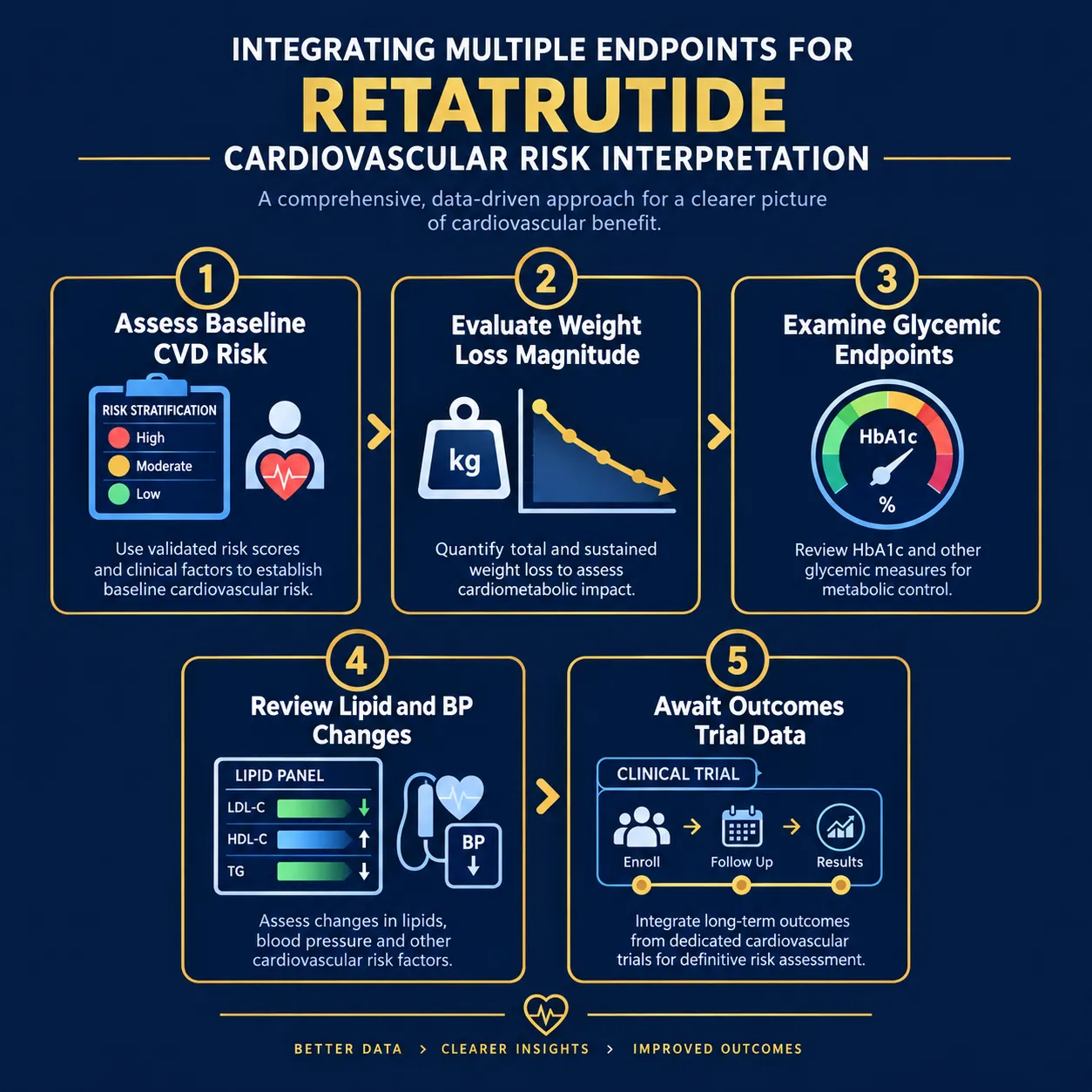
The integrated interpretation framework for retatrutide and cardiovascular disease research, interpreting weight, glycemic, and safety endpoints together, should follow a structured logic:
- Stratify baseline cardiovascular risk before interpreting any endpoint change.
- Evaluate weight loss magnitude in the context of rate and composition, not just percentage.
- Examine glycemic endpoints as independent contributors to risk, not simply as weight-loss correlates.
- Review lipid and blood pressure changes with attention to clinical significance thresholds.
- Identify gaps: no completed MACE outcomes trial exists for retatrutide as of 2026.
Researchers exploring adjacent cardiometabolic peptide research, including SS-31 kidney health research, will recognize this multi-endpoint interpretive discipline as standard practice in high-risk populations where organ-level interactions are complex.
Those sourcing compounds for translational research can review available Reta 20mg for sale options or GLP-3 Reta CAG 10mg for sale formulations through verified research-grade suppliers.
Conclusion
The surrogate endpoint data for retatrutide are among the most compelling seen in pharmacological obesity research. Weight loss of 24% at 48 weeks, combined with substantial HbA1c reduction, improved lipid panels, lower blood pressure, and reduced hsCRP, constructs a plausible and mechanistically coherent case for cardiovascular benefit.
But plausibility is not proof, particularly in the severe-obesity cardiovascular disease population where the stakes are highest and the biology is most complex.
Actionable next steps for researchers and clinicians:
- Design studies that explicitly enroll patients with established cardiovascular disease, not just metabolic risk factors.
- Pre-specify cardiovascular safety endpoints, including arrhythmia monitoring and heart failure hospitalization, as primary or co-primary outcomes, not secondary analyses.
- Avoid reporting weight loss as a cardiovascular outcome; report it as one component of a multi-endpoint risk profile.
- Track cardiovascular outcomes trial timelines for retatrutide and resist extrapolating event-level benefit from surrogate data until those trials report.
- When reviewing buy Reta online options for preclinical research, ensure purity and dosing specifications align with the phase 2 protocols to maintain translational relevance.
The science surrounding retatrutide and cardiovascular disease research: interpreting weight, glycemic, and safety endpoints together is advancing rapidly. The discipline required to interpret that science rigorously, especially in high-risk populations, must advance at the same pace.