

Research-Use Peptides in 2026: How Regulatory Classification Changes COA, Labeling, and Laboratory-Only Controls
Fewer than a third of research peptide vendors currently supply a Certificate of Analysis that meets the documentation standards regulators now expect, and that gap is no longer a minor administrative issue. In 2026, the regulatory environment surrounding research-use peptides has shifted decisively, turning what were once informal labeling conventions into enforceable compliance expectations. Understanding how peptide structure, mechanisms, and regulatory status intersect is now essential for any laboratory that procures these compounds.
Key Takeaways
- Regulators now treat "Research Use Only" disclaimers as largely irrelevant to legal status; intended use and distribution patterns determine enforcement exposure.
- COA quality for research peptides is under heightened scrutiny, requiring HPLC traces, mass spectrometry confirmation, lot numbers, and clear intended-use language.
- Laboratory-only controls, including labeling, segregated storage, and chain-of-custody records, are being formalized by compliant suppliers and expected by regulators.
- GLP-1 and related peptides have become primary enforcement targets, with recent FDA warning letters establishing clear precedent.
- Importation controls now focus on intended use rather than label language, making documentation the primary line of defense for legitimate research operations.
Why "Research Use Only" No Longer Means What It Used To
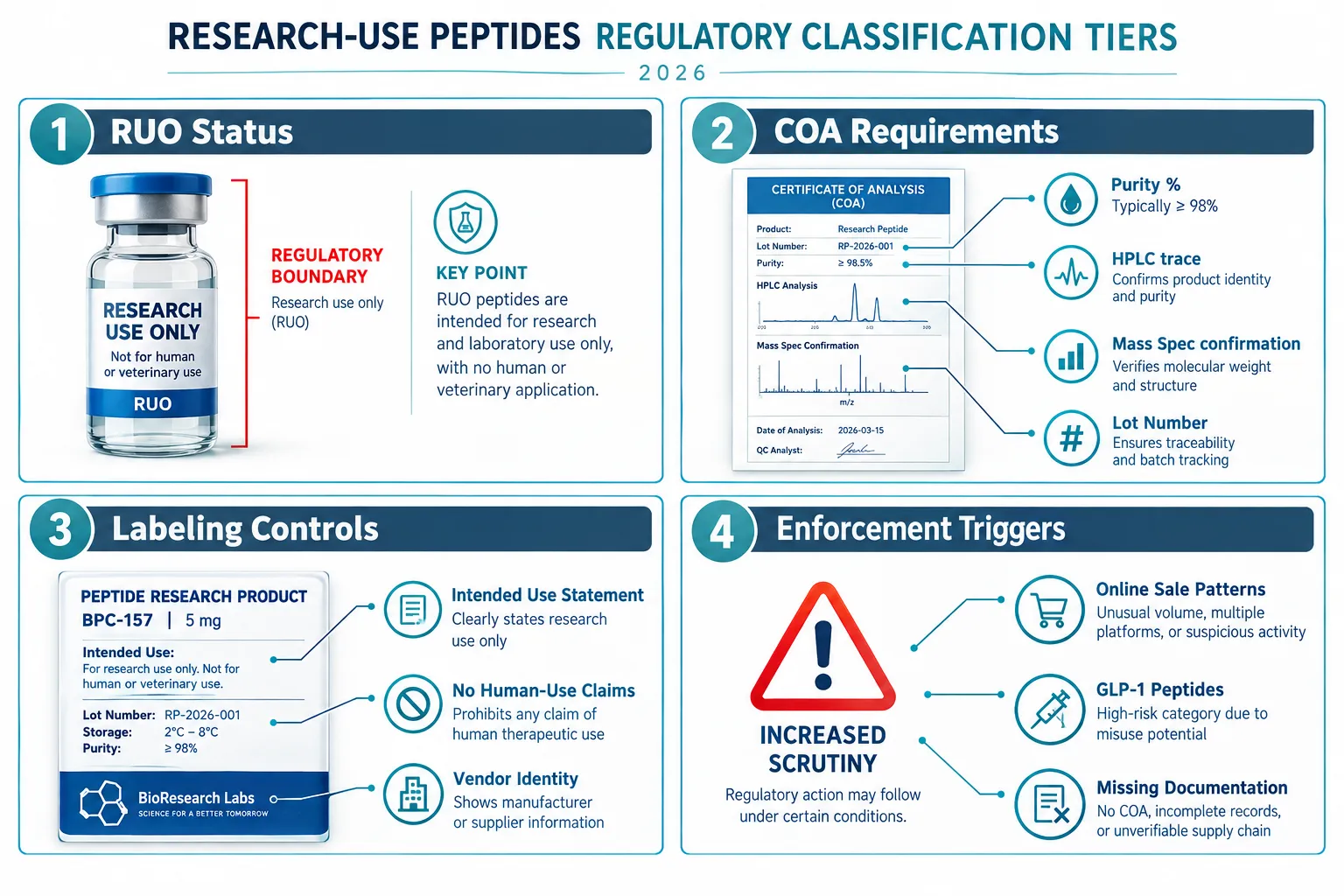
For years, affixing a "Research Use Only" (RUO) sticker to a peptide vial was treated as a legal firewall. That assumption has been dismantled. Regulatory agencies, particularly the FDA, now evaluate the totality of circumstances, marketing language, distribution channels, pricing, and customer communications, rather than accepting label disclaimers at face value.
The Swiss Chems enforcement action made this explicit. A vendor selling GLP-1 peptides online could not shield itself from regulatory action simply because its labels carried RUO language. The FDA's pattern of warning letters targeting online peptide sellers demonstrates that the agency looks at whether a product is effectively marketed for human use, regardless of what the label technically states.
This matters practically for laboratories. Purchasing from a vendor whose distribution model resembles a consumer health channel creates downstream documentation risk for the buyer, not just the seller. Customs and importation controls have similarly shifted toward assessing intended use from shipping records, order quantities, and accompanying documentation rather than relying on label language alone.
What this means for lab procurement teams: Vendor selection now requires due diligence on the supplier's entire compliance posture, not just the product specification sheet.
How Regulatory Classification Changes COA, Labeling, and Laboratory-Only Controls in Practice
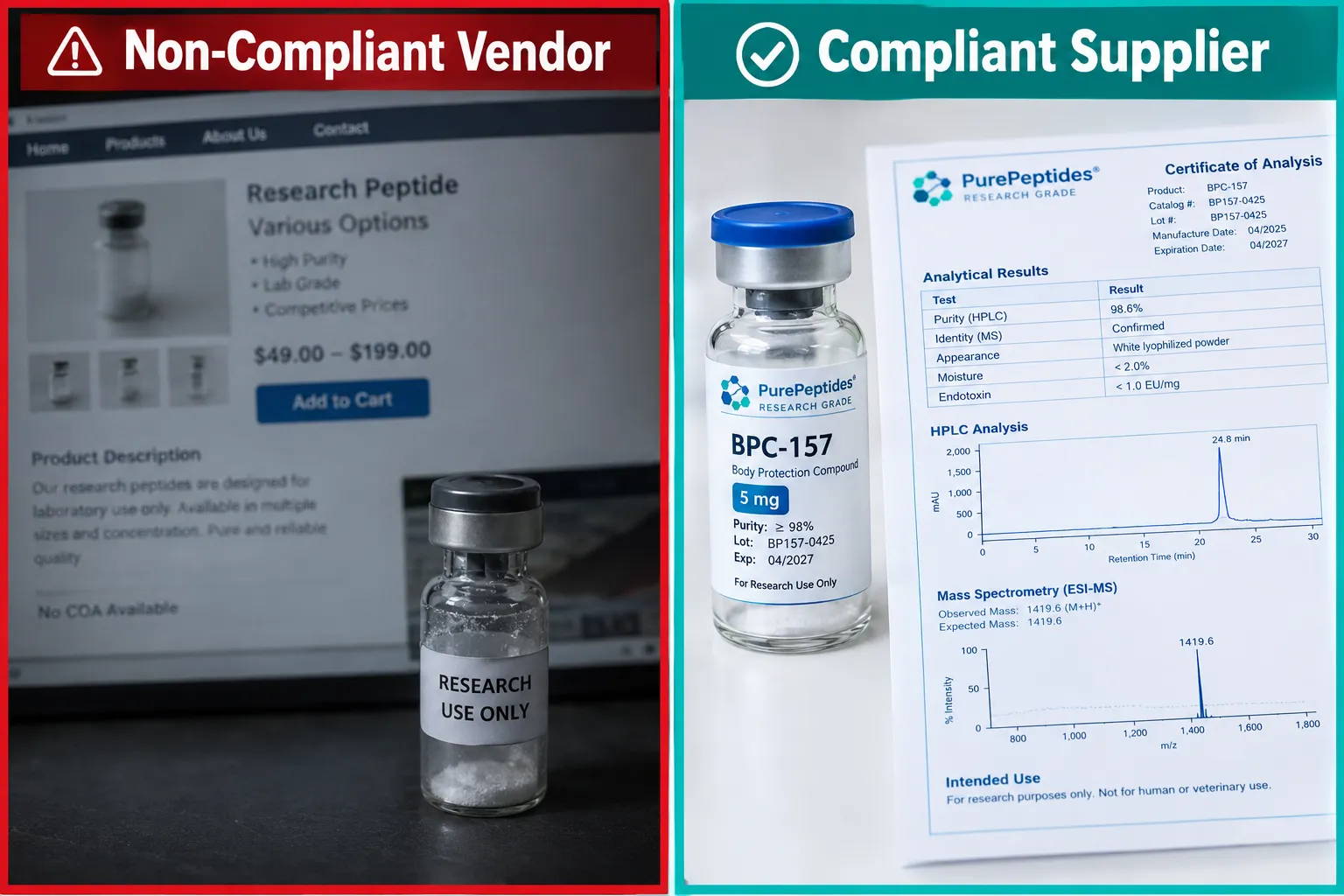
The practical consequence of tightened regulatory classification is a specific, elevated set of documentation expectations. A compliant COA for a research-use peptide in 2026 is no longer a single-page purity declaration. Reputable suppliers now provide:
| COA Element | Minimum Standard |
|---|---|
| Purity percentage | Confirmed by HPLC, typically greater than 98% |
| Mass spectrometry data | Molecular weight confirmation, sequence verification |
| Lot number | Unique, traceable to synthesis batch |
| Intended-use statement | Explicit laboratory/research language, no therapeutic claims |
| Storage conditions | Temperature, light, and moisture specifications |
| Vendor identity | Full legal name, contact, and country of origin |
Labeling on the vial itself must mirror the COA. Any mismatch between the COA lot number and the physical label is a red flag during regulatory inspection. Vendors who supply AOD-9604 with documented storage and traceability protocols exemplify the standard now expected across the category.
"The COA is no longer a formality, it is the primary instrument through which a research operation demonstrates that a compound was procured, handled, and used within the bounds of legitimate scientific inquiry."
For GLP-1 class peptides specifically, the documentation bar is higher still. Public-interest groups and enforcement bodies have flagged compounds such as retatrutide as priority concerns, meaning any laboratory working with these molecules should maintain exceptionally detailed procurement and usage records.
Building a Laboratory-Only Control Framework: Chain of Custody and Analytical Records
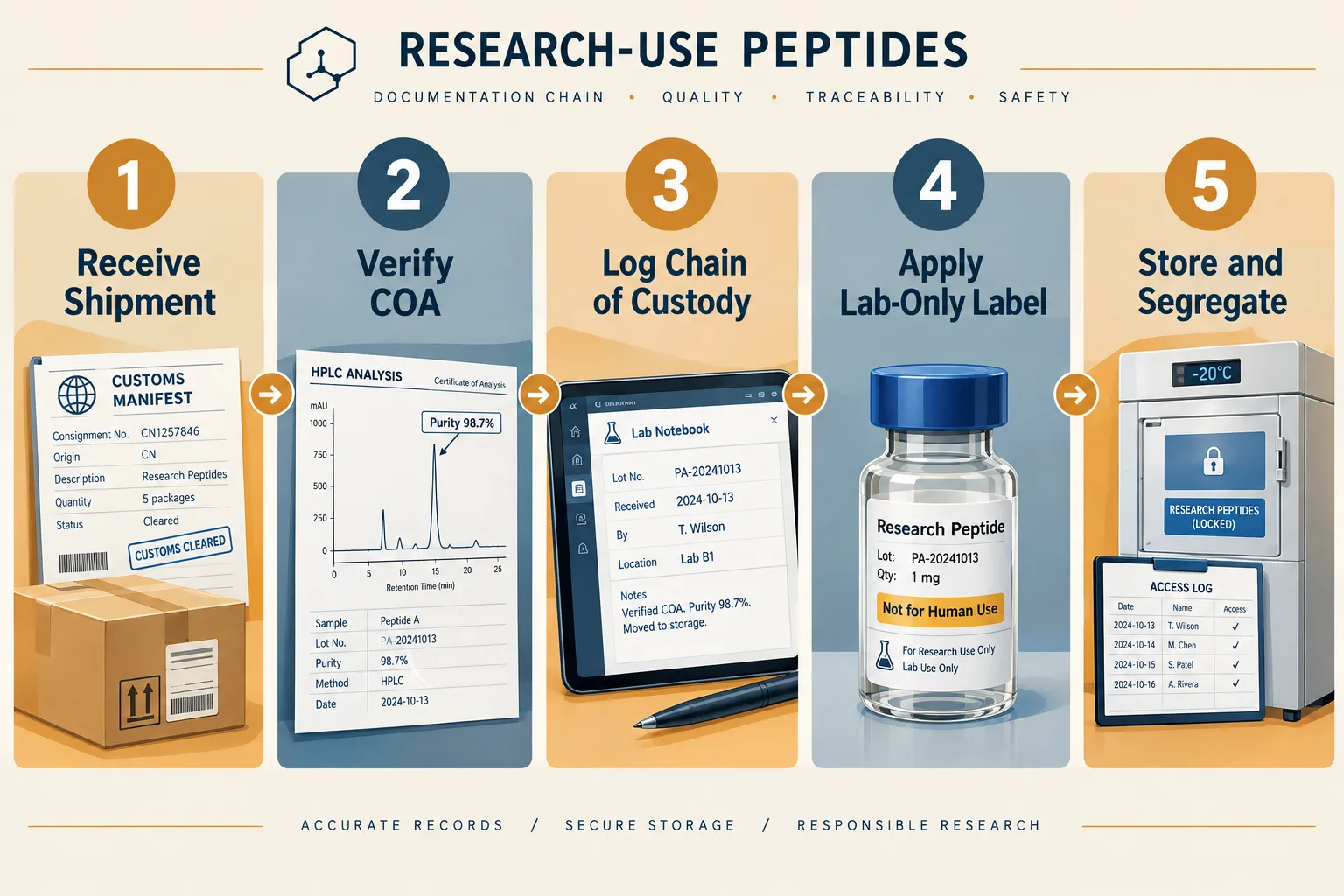
Laboratory-only controls are the operational layer that translates regulatory classification into daily practice. These controls serve two functions: they protect the institution during any regulatory inquiry, and they ensure research integrity by maintaining compound identity throughout the experiment lifecycle.
A functional framework includes four components:
- Intake verification, Upon receipt, confirm that the physical vial label matches the COA exactly. Log the lot number, receipt date, and storage location in a dedicated analytical record.
- Segregated storage, Research-use peptides must be physically separated from any compounds that could be misconstrued as clinical or patient-use materials. Locked refrigeration with an access log is the current best practice.
- Chain-of-custody log, Every transfer of a compound, from storage to bench, from one researcher to another, should be recorded with date, quantity, and purpose.
- Intended-use documentation, Each experiment using the peptide should reference the specific lot number and include a brief statement of research purpose. This creates an auditable link between procurement and use.
Laboratories sourcing compounds like SS-31 for mitochondrial research or exploring SS-31 in kidney health research should apply these controls uniformly, regardless of the peptide's perceived regulatory risk level. Consistency is itself a compliance signal.
What 2026 Enforcement Trends Mean for Research Operations
The 2025-2026 guidance tightening compounding pharmacy access to non-pharmaceutical-grade peptides has had a secondary effect: it has pushed more scrutiny onto the research-use supply chain. Clinics and prescribers have been explicitly warned against using RUO-grade peptides in patients, which means any vendor whose customer base blurs that line is now a higher-risk procurement source for legitimate researchers.
For laboratories, the actionable implication is straightforward: the vendor's compliance posture is part of your compliance posture. Purchasing from a supplier that maintains rigorous COA standards, clear intended-use labeling, and documented lot traceability, such as those offering GLP-3 peptides with full analytical documentation, reduces institutional risk materially.
The trajectory for the remainder of 2026 and beyond points toward further formalization. Regulatory bodies are expected to issue more specific guidance on RUO documentation requirements, and enforcement actions are likely to increase in frequency. Laboratories that have already built robust chain-of-custody and analytical record systems will be positioned to adapt quickly.
Conclusion
Research-use peptides in 2026 operate within a fundamentally different regulatory environment than they did even two years ago. The core shift is this: classification is now determined by conduct and documentation, not by label language. For laboratory operations, that means COA quality, intended-use labeling, chain-of-custody records, and segregated storage are no longer optional best practices, they are the practical expression of regulatory compliance.
Actionable next steps for research teams:
- Audit current vendor COAs against the six-element minimum standard outlined above.
- Implement a lot-number-linked intake and chain-of-custody log for all research peptide procurement.
- Review storage arrangements to ensure physical segregation from any clinical or patient-adjacent materials.
- Confirm that all peptide labels on-hand carry explicit intended-use language and match their corresponding COA.
- Prioritize suppliers who proactively publish analytical data and maintain transparent traceability practices.
Laboratories that treat documentation as a scientific discipline, not an administrative burden, will be best positioned as regulatory expectations continue to tighten.