

Collagen, GHK-Cu, and Glow Blend: How Classic Collagen Biology Intersects With Copper Peptide Research
Collagen accounts for roughly 30% of all protein in the human body, yet most people only think about it when their skin starts to show age. That gap between broad public interest and deeper scientific understanding is exactly where the conversation about Collagen, GHK-Cu, and Glow Blend: How Classic Collagen Biology Intersects With Copper Peptide Research becomes genuinely useful. Understanding the foundational biology of collagen first makes it far easier to appreciate why copper peptide research, and formulations like Glow Blend, has attracted serious scientific attention.
Key Takeaways
- Collagen synthesis depends on a tightly regulated cellular pathway involving fibroblasts, vitamin C, and enzymatic cross-linking.
- GHK-Cu (glycyl-L-histidyl-L-lysine copper) is a naturally occurring tripeptide-copper complex studied for its role in activating collagen-related gene expression.
- Glow Blend formulations combine GHK-Cu with complementary peptides to target multiple steps in skin and tissue remodeling.
- Research models suggest GHK-Cu may upregulate collagen I and III synthesis while also influencing matrix metalloproteinase (MMP) balance.
- Sourcing purity-verified peptides is critical for any research application involving copper peptide complexes.
The Collagen Synthesis Pathway: What the Biology Actually Shows
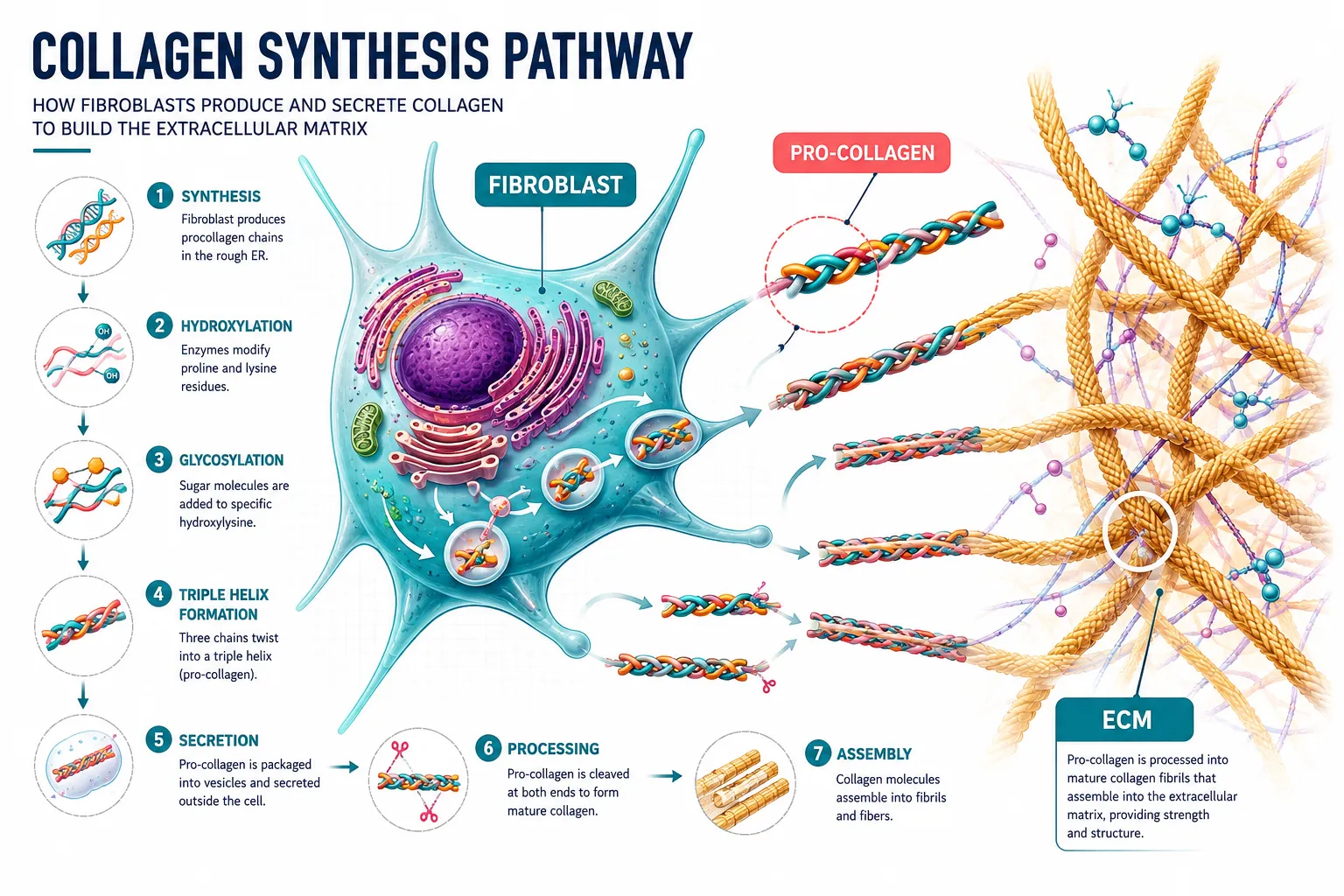
Collagen is not a single molecule, it is a family of at least 28 distinct structural proteins. Types I, II, and III are the most studied in skin and connective tissue contexts. Each collagen molecule begins as a precursor called pro-collagen, assembled inside fibroblast cells through a multi-step process:
- Transcription and translation, Genes encode alpha chains that are synthesized on ribosomes.
- Hydroxylation, Proline and lysine residues are hydroxylated, a step requiring vitamin C as a cofactor.
- Triple helix formation, Three alpha chains coil together into a stable triple-helix structure.
- Secretion, Pro-collagen is exported to the extracellular matrix (ECM).
- Cross-linking, Lysyl oxidase enzymes cross-link fibrils for tensile strength.
"Collagen remodeling is not a one-way street, synthesis and degradation happen simultaneously, governed by matrix metalloproteinases and their inhibitors."
This balance between synthesis and breakdown is central to understanding how peptide-based interventions are studied. When degradation outpaces production, as it does with UV exposure, aging, and oxidative stress, researchers look for compounds that can tip the balance back toward synthesis. That is where GHK-Cu enters the picture.
GHK-Cu Research: Copper Peptide Science and the Collagen Connection
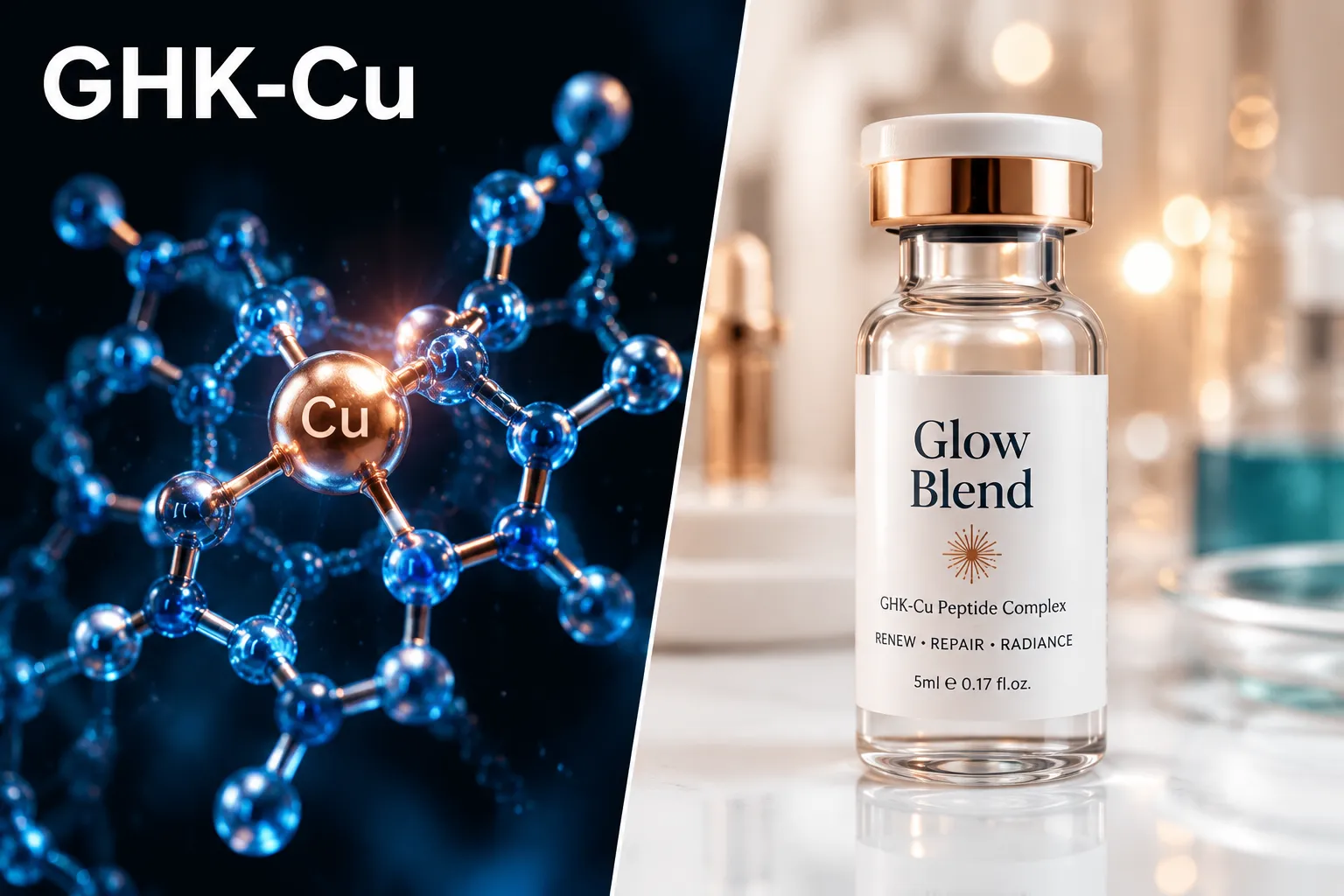
GHK-Cu (glycyl-L-histidyl-L-lysine bound to copper(II)) was first isolated from human plasma in the early 1970s. Decades of subsequent research have examined its behavior in cell culture and animal tissue models. The findings most relevant to Collagen, GHK-Cu, and Glow Blend: How Classic Collagen Biology Intersects With Copper Peptide Research fall into three categories:
Collagen Gene Upregulation
In vitro studies using human fibroblast cultures have shown that GHK-Cu can increase the expression of collagen I and collagen III genes. It appears to do this partly by activating TGF-beta signaling pathways, which are master regulators of ECM production. This is not the same as directly injecting collagen, it is a signaling-level intervention that prompts cells to produce more of their own structural proteins.
MMP Modulation
Matrix metalloproteinases (MMPs) are enzymes that break down collagen. GHK-Cu research has explored its apparent ability to modulate MMP-1 (collagenase) activity while simultaneously supporting tissue inhibitors of metalloproteinases (TIMPs). This dual action, slowing breakdown while encouraging synthesis, is what makes it a compelling subject in tissue remodeling research.
Antioxidant and Anti-Inflammatory Context
Copper in free ionic form is pro-oxidant. However, when chelated within the GHK tripeptide, the complex behaves differently. Research models suggest the chelated form may reduce oxidative stress markers in skin tissue, creating a more favorable environment for collagen-producing fibroblasts to function. For researchers interested in the broader landscape of peptides with anti-inflammatory profiles, comparisons with compounds like those covered in the LL-37 versus SS-31 peptide benefits guide offer useful context.
Those sourcing GHK-Cu for research purposes should consult a detailed GHK-Cu copper peptide sourcing guide to understand purity standards and certificate of analysis requirements before procurement.
Glow Blend Formulations: Combining Collagen Biology With Copper Peptide Research

The concept behind a Glow Blend is straightforward: instead of relying on a single peptide, a multi-peptide formulation targets several points in the collagen synthesis and skin remodeling cascade simultaneously. The Glow Blend peptide formulation is one such research-grade product designed with this multi-target approach in mind.
Why Blending Matters in Collagen Research
Single-ingredient approaches have limitations. Collagen synthesis is not controlled by one switch, it involves growth factors, enzymatic activity, cellular redox state, and ECM scaffold integrity. A well-designed blend can address several of these variables at once.
| Target Mechanism | Relevant Peptide Class |
|---|---|
| Fibroblast activation | GHK-Cu, growth factor peptides |
| ECM scaffold support | Matrikine peptides |
| Oxidative stress reduction | Antioxidant peptides |
| MMP balance | Signaling tripeptides |
This is also why researchers studying skin and tissue models increasingly look beyond isolated compounds. Peptides like Epithalon, studied in aging and cellular longevity contexts, and tissue-repair compounds like TB-500 are often examined alongside skin-focused peptides to understand overlapping mechanisms. For those exploring aging-support peptide categories more broadly, the aging support peptide category provides a useful reference point.
Research Considerations for Glow Blend Studies
When designing experiments around Glow Blend or similar formulations, researchers should account for:
- Peptide stability in the chosen vehicle or buffer system
- Concentration gradients used in published cell culture studies
- Endpoint selection, whether measuring gene expression, protein output, or histological markers
- Purity verification, mass spectrometry and HPLC data from the supplier
For researchers who also study tissue repair peptides, the BPC-157 and TB-500 blend represents another multi-peptide research model with a documented mechanistic rationale, useful for comparative study design.
Conclusion
The intersection of classic collagen biology and copper peptide research is not a niche curiosity, it is a well-supported area of inquiry with decades of published data behind it. Collagen, GHK-Cu, and Glow Blend: How Classic Collagen Biology Intersects With Copper Peptide Research represents a logical progression: start with the foundational science of how collagen is made and degraded, then examine how GHK-Cu interacts with those pathways at the gene and enzyme level, and finally consider how multi-peptide blends like Glow Blend are designed to engage those mechanisms more comprehensively.
Actionable next steps for researchers:
- Review primary literature on GHK-Cu and TGF-beta signaling before designing skin model experiments.
- Verify supplier purity documentation before sourcing any copper peptide complex.
- Consider multi-endpoint study designs that measure both collagen gene expression and MMP activity simultaneously.
- Explore how complementary peptides in aging-support categories may interact with collagen synthesis pathways.
Rigorous sourcing, clear experimental endpoints, and a grounded understanding of collagen biology remain the foundation of any credible copper peptide research program in 2026.