Call or Text 727-513-9780
  • Shopping Cart Shopping Cart
    0Shopping Cart
Pure Tested Peptides | America's most trusted Peptides for sale online
  • Peptides for sale
    • Oral Peptides for sale
      • Peptide Capsules for sale
      • BPC 157 Capsules 1000mcg
      • SLU-PP-332 Capsules | 1000 mcg
      • 5-Amino-1MQ 50mg Capsules
      • Tesofensine 500mcg
    • All Peptides for sale
    • Peptide Sprays
      • BPC 157 Nasal Spray Kit
      • BPC-157 TB500 Nasal Spray Kit
      • Semax Nasal Spray 10mg
      • Selank – Nasal Spray Kit – 10mg
      • Epithalon 50MG Nasal Spray Kit
      • Ipamorelin 10mg Nasal Spray
      • Klow Nasal Spray (BPC-157 + TB-500 + GHK-Cu + KPV) | 80mg
      • Hulk Nasal Spray Tesa / Ipa Blend 6/3 MG
      • Klow Nasal Spray
      • NAD + 500 mg Nasal Spray
      • PT-141 Nasal Spray Kit
    • GHRH Peptides
      • Ipa Peptides
      • CJC-1295 Peptides
        • CJC-1295 with DAC 5 mg
        • CJC-1295 without DAC 5 mg
        • CJC-1295 Ipa 10mg
      • Tesa Peptides
        • Tesa Peptide
        • Tesa 20 mg
    • GHK-Cu Peptides
      • All GHK-Cu Peptides
      • GHK-Cu 100mg
      • KLOW Peptide Blend – Buy KLOW blend online
    • BPC Peptides
      • All BPC Peptides
      • BPC-157
      • BPC-157 TB-500
      • BPC 157 capsules 1000mcg
    • SLU-PP-332 Peptides
      • All SLU-PP-332 Peptides
      • SLU-PP-332 5mg
    • GLP3 Peptides
    • PT-141 Peptides
      • PT-141 Peptides for sale
      • PT-141 10mg
      • PT-141 Nasal Spray
    • CAG Peptides
      • Lipo-C Peptide Blend
      • CAG 5mg
      • CAG 10mg
    • MOTS-C Peptides
      • MOTS-C Peptides for sale
      • MOTS-c peptide
      • MOTS-c 10mg *6 pack*
    • 5 Amino 1MQ Peptides
      • 5 Amino 1MQ Peptides for sale
      • 5-Amino-1MQ 50mg Capsules
      • 5-Amino-1MQ 5mg
    • Epithalon Peptides
      • Epithalon Peptides for sale
      • Epithalon 10mg
      • Epithalon 50mg
  • Shop
    • GLPs
      • 5-Amino-1MQ 50mg Capsules
      • 5-Amino-1MQ 5mg
      • L-Carnitine 500mg/ml
      • Tesofensine 500mcg
      • SLU-PP-332 5mg
      • MOTS-c 10mg *6 pack*
    • Epithalon & BPC Peptides
      • Epithalon 10mg
      • Epithalon 50mg
      • BPC-157
      • BPC 157 capsules 1000mcg
      • BPC-157 TB-500
      • BPC-157 TB500 Nasal Spray Kit
      • BPC 157 Nasal Spray Kit
    • BPC TB-500 & NAD+ Peptides
      • NAD+ 500 mg
      • KLOW Peptide Blend – Buy KLOW blend online
      • GLOW Peptide Blend
      • TB 500 5mg
      • BPC 157 capsules 1000mcg – Supplement
      • BPC 157 Nasal Spray Kit
      • BPC-157
      • BPC-157 TB500 Nasal Spray Kit
      • BPC-157 TB-500
      • BPC 157 capsules 1000mcg
    • LL-37 Peptide
      • LL-37 10 mg
    • MOTS-C & Selank
      • MOTS-c peptide
      • Selank 10mg
    • GHK Peptides
      • GHK-Cu 100mg
      • GLOW Peptide Blend
      • KLOW Peptide Blend – Buy KLOW blend online
  • COAs
  • Wholesale
    • Wholesale Peptides for sale
  • PTP FAQ
  • Affiliates
    • Selank Peptide: Advanced Pharmacological Mechanisms Underlying Its Anxiolytic and Nootropic Effects in Research
      • 5-Amino-1MQ Peptide: Detailed Mechanisms of NNMT Inhibition and Its Impact on Cellular Metabolism Research
        • MOTS-C Peptide: Unraveling Its Role in Mitochondrial Dynamics and Energy Metabolism Research
          • Epithalon Peptide and Telomerase Regulation: Investigating Its Impact on Cellular Senescence and Lifespan Research Models
            • GLP2-T vs GLP2 Tirz Peptide: Understanding the Naming, Mechanistic Nuances, and Research Implications for Gut Health
      • Peptides and Polypeptides in Modern Pharmacology: What Research on Metoprolol, Prednisone, and Amlodipine Reveals
        • Polypeptide Peptides vs NSAIDs: What Naproxen and Diclofenac Teach Tissue-Repair Researchers About BPC‑157 and TB‑500
          • Peptides and Polypeptides in Endocrine Pharmacology: How GLP-1, GLP-2, and GLP-3 Retatrutide Differ From Classic Drugs Like Prednisone and Amlodipine
          • 5‑Amino‑1MQ Peptide and NNMT Inhibition: How It Compares With Statins Like Atorvastatin in Adipose and Lipid Metabolism Research
      • Enclomiphene, Estrogen Receptor Signaling, and Luteinizing Phase Biology: What Hormone Researchers Should Measure
        • Mesenchymal Stem Cells, BPC‑157, and GHK‑Cu: How Tissue Repair Peptides Compare With Classic NSAIDs Like Naproxen in Injury Models
          • Peptide Calculator Use Cases Beyond Growth Hormone: Working Through GLP‑3 Retatrutide, MOTS‑c, and BPC‑157 Research Dosing
        • Polypeptide Peptides in Endocrine and Metabolic Pharmacology: Lessons From Amlodipine, Prednisone, and Metoprolol
        • Peptides Calculator for Advanced Blends: Worked Examples for Tesamorelin, CJC‑1295, and Ipamorelin Stacks
          • Peptides and Polypeptides in Human Physiology: How Molecular Size Shapes Research Applications
            • Selank Peptide: Advanced Pharmacological Mechanisms Underlying Its Anxiolytic and Nootropic Effects in Research
          • 5-Amino-1MQ Peptide: Detailed Mechanisms of NNMT Inhibition and Its Impact on Cellular Metabolism Research
            • MOTS-C Peptide: Unraveling Its Role in Mitochondrial Dynamics and Energy Metabolism Research
              • Epithalon Peptide and Telomerase Regulation: Investigating Its Impact on Cellular Senescence and Lifespan Research Models
                • GLP2-T vs GLP2 Tirz Peptide: Understanding the Naming, Mechanistic Nuances, and Research Implications for Gut Health
                  • Peptides and Polypeptides in Endocrine Pharmacology: How GLP-1, GLP-2, and GLP-3 Retatrutide Differ From Classic Drugs Like Prednisone and Amlodipine
                    • Polypeptide Peptides vs NSAIDs: What Naproxen and Diclofenac Teach Tissue-Repair Researchers About BPC‑157 and TB‑500
                      • Peptides and Polypeptides in Modern Pharmacology: What Research on Metoprolol, Prednisone, and Amlodipine Reveals
                        • 5‑Amino‑1MQ Peptide and NNMT Inhibition: How It Compares With Statins Like Atorvastatin in Adipose and Lipid Metabolism Research
                        • Enclomiphene, Estrogen Receptor Signaling, and Luteinizing Phase Biology: What Hormone Researchers Should Measure
                        • Mesenchymal Stem Cells, BPC‑157, and GHK‑Cu: How Tissue Repair Peptides Compare With Classic NSAIDs Like Naproxen in Injury Models
                        • Peptide Calculator Use Cases Beyond Growth Hormone: Working Through GLP‑3 Retatrutide, MOTS‑c, and BPC‑157 Research Dosing
                        • Polypeptide Peptides in Endocrine and Metabolic Pharmacology: Lessons From Amlodipine, Prednisone, and Metoprolol
                        • Peptides Calculator for Advanced Blends: Worked Examples for Tesamorelin, CJC‑1295, and Ipamorelin Stacks
                        • Peptides and Polypeptides in Human Physiology: How Molecular Size Shapes Research Applications
                        • Selank Peptide: Advanced Pharmacological Mechanisms Underlying Its Anxiolytic and Nootropic Effects in Research
                        • MOTS-C Peptide: Unraveling Its Role in Mitochondrial Dynamics and Energy Metabolism Research
                        • Peptides and Polypeptides in Modern Pharmacology: What Research on Metoprolol, Prednisone, and Amlodipine Reveals
                        • Peptides and Polypeptides in Endocrine Pharmacology: How GLP-1, GLP-2, and GLP-3 Retatrutide Differ From Classic Drugs Like Prednisone and Amlodipine
                        • 5-Amino-1MQ Peptide: Detailed Mechanisms of NNMT Inhibition and Its Impact on Cellular Metabolism Research
                        • Mesenchymal Stem Cells, BPC‑157, and GHK‑Cu: How Tissue Repair Peptides Compare With Classic NSAIDs Like Naproxen in Injury Models
                        • Peptide Calculator Use Cases Beyond Growth Hormone: Working Through GLP‑3 Retatrutide, MOTS‑c, and BPC‑157 Research Dosing
                        • GLP2-T vs GLP2 Tirz Peptide: Understanding the Naming, Mechanistic Nuances, and Research Implications for Gut Health
                        • Polypeptide Peptides in Endocrine and Metabolic Pharmacology: Lessons From Amlodipine, Prednisone, and Metoprolol
                        • Polypeptide Peptides vs NSAIDs: What Naproxen and Diclofenac Teach Tissue-Repair Researchers About BPC‑157 and TB‑500
                        • Peptides and Polypeptides in Human Physiology: How Molecular Size Shapes Research Applications
                        • Peptides Calculator for Advanced Blends: Worked Examples for Tesamorelin, CJC‑1295, and Ipamorelin Stacks
                        • 5‑Amino‑1MQ Peptide and NNMT Inhibition: How It Compares With Statins Like Atorvastatin in Adipose and Lipid Metabolism Research
                        • Enclomiphene, Estrogen Receptor Signaling, and Luteinizing Phase Biology: What Hormone Researchers Should Measure
                        • Epithalon Peptide and Telomerase Regulation: Investigating Its Impact on Cellular Senescence and Lifespan Research Models
                        • Best research protocol Klow blend
                        • best time to take BPC-157
                        • best time to take DSIP (Delta Sleep Inducing Peptide)
                        • best time to take CJC-1295
                        • best time to take AOD-9604
                        • best time to take Follistatin 344
                        • best time to take Ipamorelin
                        • best time to take MK-677 (Ibutamoren)
                        • best time to take Ligandrol (LGD-4033) — research compound
                        • best time to take Ostarine (MK-2866) — research compound
                        • best time to take GHK-CU
                        • best time to take TB-500
                        • best time to take MOTS-c
                        • best time to take Semax
                        • best time to take RAD-140 (Testolone) — research compound
                        • best time to take Thymosin Alpha-1
                        • best time to take PEG-MGF
                        • Biolife Plasma, Octapharma Plasma, and Research Peptides: How Plasma Donation Labs Differ From Peptide Suppliers
                        • best time to take YK-11 — research compound
                        • best time to take PT-141 (Bremelanotide)
                        • Best research protocol Klow blend
                        • 5-Amino-1MQ and MOTS-C Synergy: Metabolic Signaling, Mitochondria, and Research Design
                        • BPC-157 and TB-500: Investigating Their Combined Effects on Angiogenesis and Cellular Migration in Tissue Repair Models
                        • BPC-157 Peptide: Gut Barrier Function, Inflammation, and Tissue-Recovery Research
                        • 5‑Amino‑1MQ and MOTS‑c Synergy in Metabolic Research: Designing NNMT and Mitochondrial Biogenesis Stacks
                        • CJC-1295 with DAC vs. Without DAC: Half-Life, Release Kinetics, and Research Implications
                        • CJC‑1295 with DAC vs. Without DAC: Expanding on Half‑Life Differences Using Tesamorelin and Ipamorelin Blend Case Studies
                        • Collagen Biology and Copper‑Binding Peptides: How GHK‑Cu, Glow Blend, and Klow Blend Interact with Skin and Connective Tissue
                        • Collagen Biology and Regenerative Peptides: How GHK‑Cu, Glow Blend, and Klow Blend Affect Extracellular Matrix Research
                    • DNA, Telomeres, and Longevity Peptides: Positioning Epithalon and MOTS‑c in Genetic Aging Research
                      • Enclomiphene Citrate: serm Mechanism, Testosterone Research, and Stack Compatibility
                        • Enclomiphene vs Enclomiphene Citrate: Formulation, Bioavailability, and Research Distinctions
                        • Epithalon Peptide Research: Telomerase Activation, Aging, and Pineal Gland Function
                        • Estrogen Receptor Signaling and Enclomiphene: How Selective Modulators Compare with Classic Polypeptide Hormones
                        • GHK-Cu Peptide: Advanced Mechanisms in Extracellular Matrix Remodeling and Wound Healing Research
                        • GHK-Cu Peptide: Collagen Synthesis, Wound Repair, and Skin-Barrier Research Models
                        • GLP-1 vs GLP-3 vs GLP-2: Peptide Classification and Research Applications
                        • GLP-2 Peptide Research Guide: Gut Barrier Function, Nutrient Absorption, and Intestinal Recovery Models
                        • GLP-3 Retatrutide vs. GLP-1 Drugs: What Triple-Agonist Biology Changes in Research Models
                        • Ipamorelin and Tesamorelin Combination: Synergistic GH Secretagogue Research and Dosing Protocols
                        • GLP2 Tirz Peptide: What It Is, Why the Name Exists, and How Researchers Should Interpret It
                        • Klow Blend Peptide Nasal Spray: What the Formulation Is Trying to Do in Cognitive Research
                        • Mitochondria, NNMT Inhibition, and Peptide Modulators: Where MOTS‑c and 5‑Amino‑1MQ Fit in Cellular Energy Research
                        • MOTS-c Peptide: Mitochondrial Function, Energy Metabolism, and What Researchers Measure
                        • MOTS-c vs. 5-Amino-1MQ: Which Metabolic Research Questions Each Compound Actually Answers
                        • Nasal Spray Peptides: Bioavailability, Administration, and Semax/Selank Research Applications
                        • PT-141 Peptide Research: Mechanism of Action and Melanocortin Receptor Signaling
                        • Retatrutide for Research: Mechanism, Structure, and GLP-1/GLP-3 Dual Action
                        • Retatrutide for Obesity and Type 2 Diabetes: What the Latest Trial Data Suggest
                        • Tesofensine Peptide Research: Mechanism, Appetite Suppression, and Neuropeptide Y Pathways
  • Contact
    • Contact Customer Service
    • Text Customer Support
  • About US
  • Shop all peptides
  • Affiliate Program
    • Affiliate Signup
  • Login / Register Login / Register Page Link Login / Register Page Link
  • Click to open the search input field Click to open the search input field Search
  • Menu Menu

Tag Archive for: dermal mast cell research

Cetirizine and Histamine H1 Receptor Blockade in GHK-Cu Dermal Mast Cell Research Models

Cetirizine and Histamine H1 Receptor Blockade in GHK-Cu Dermal Mast Cell Research Models

October 28, 2026/0 Comments/in Uncategorized/by

Mast cells release histamine within seconds of activation, fast enough to corrupt every collagen assay in a dermal peptide study before a researcher has time to intervene. When GHK-Cu, the copper-peptide complex widely studied for its role in dermal regeneration and fibroblast stimulation, is introduced into skin cell cultures, resident mast cells can degranulate and flood the microenvironment with mediators that distort downstream readouts. Building a rigorous testing protocol around cetirizine and histamine H1 receptor blockade in GHK-Cu dermal mast cell research models addresses this problem directly, giving investigators a clean baseline from which to measure peptide-driven regenerative effects without interference from uncontrolled histamine signaling.

Key Takeaways

  • Cetirizine is a fast-acting, highly selective peripheral H1 receptor antagonist that suppresses histamine-driven responses in skin and vascular tissue.
  • GHK-Cu stimulates fibroblast activity and collagen synthesis, but mast cell co-presence in dermal models can introduce histamine noise that confounds regeneration assays.
  • Cetirizine pre-treatment offers a pharmacological strategy to establish a controlled histamine baseline before peptide introduction.
  • Beyond simple H1 blockade, cetirizine may also reduce mast cell mediator release through mechanisms that are still under investigation.
  • The combination of cetirizine-controlled mast cell activity with GHK-Cu represents a proposed framework, not yet a standardized experimental protocol, which makes a clear operating procedure especially valuable.

Understanding the Two Key Players: GHK-Cu and Cetirizine
Understanding the Two Key Players: GHK-Cu and Cetirizine

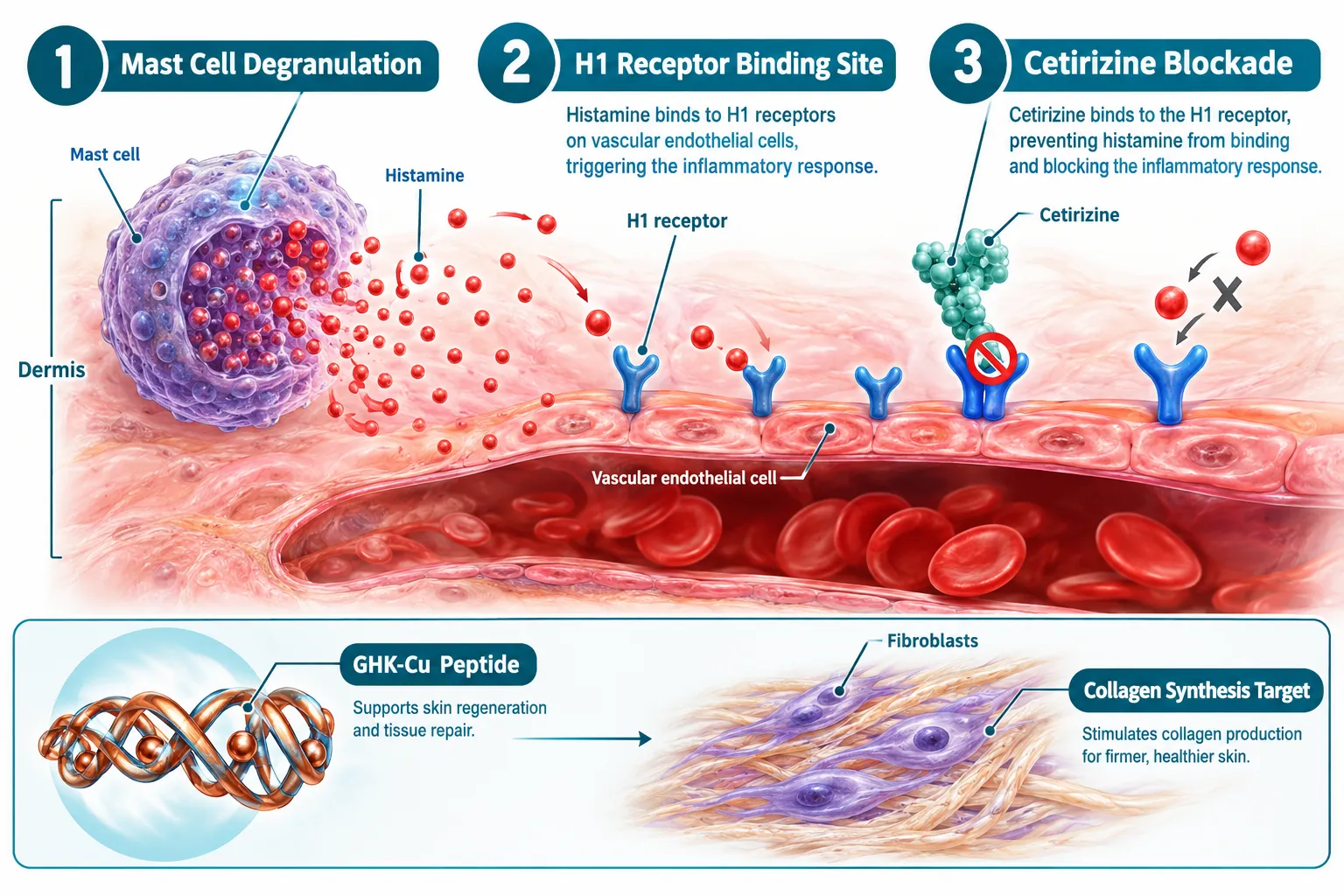
GHK-Cu (glycyl-L-histidyl-L-lysine copper II) is a naturally occurring tripeptide-copper complex found in human plasma. In research settings, it is primarily studied for its capacity to stimulate fibroblasts, upregulate collagen and elastin synthesis, and support tissue remodeling. It is a common subject in wound healing research and broader peptide documentation frameworks.

The challenge is that dermal cell models, whether primary fibroblast cultures, skin explants, or organotypic constructs, often contain mast cells or are co-cultured with them to replicate physiological conditions. Mast cells are exquisitely sensitive to copper-peptide introduction and mechanical disturbance, meaning any experiment that adds GHK-Cu risks triggering histamine release as a side effect of model setup rather than as a true biological readout.

Cetirizine is a second-generation, minimally sedating antihistamine. It is a fast-acting, highly selective peripheral H1 receptor antagonist. Its primary targets include vascular endothelial cells, respiratory smooth muscle, immune cells, and the gastrointestinal tract. In dermal research contexts, its value lies in its ability to block H1 receptors on skin cells and suppress both endogenous and exogenously triggered histamine-induced reactions, without the sedating central nervous system effects that complicate first-generation antihistamine use as a research tool.

"A controlled histamine baseline is not a luxury in peptide-induced dermal regeneration studies, it is a methodological requirement."


Why Histamine Contamination Undermines GHK-Cu Collagen Assays

When mast cells degranulate in a GHK-Cu model, several things happen simultaneously that damage assay integrity:

  • Histamine activates H1 receptors on fibroblasts, independently modulating proliferation rates and collagen gene expression.
  • Prostaglandins and tryptase released alongside histamine alter matrix metalloprotease activity, changing the enzymatic environment that collagen assays depend on.
  • Vascular permeability signals in vivo models alter nutrient and oxygen delivery to cells, introducing systemic variation.

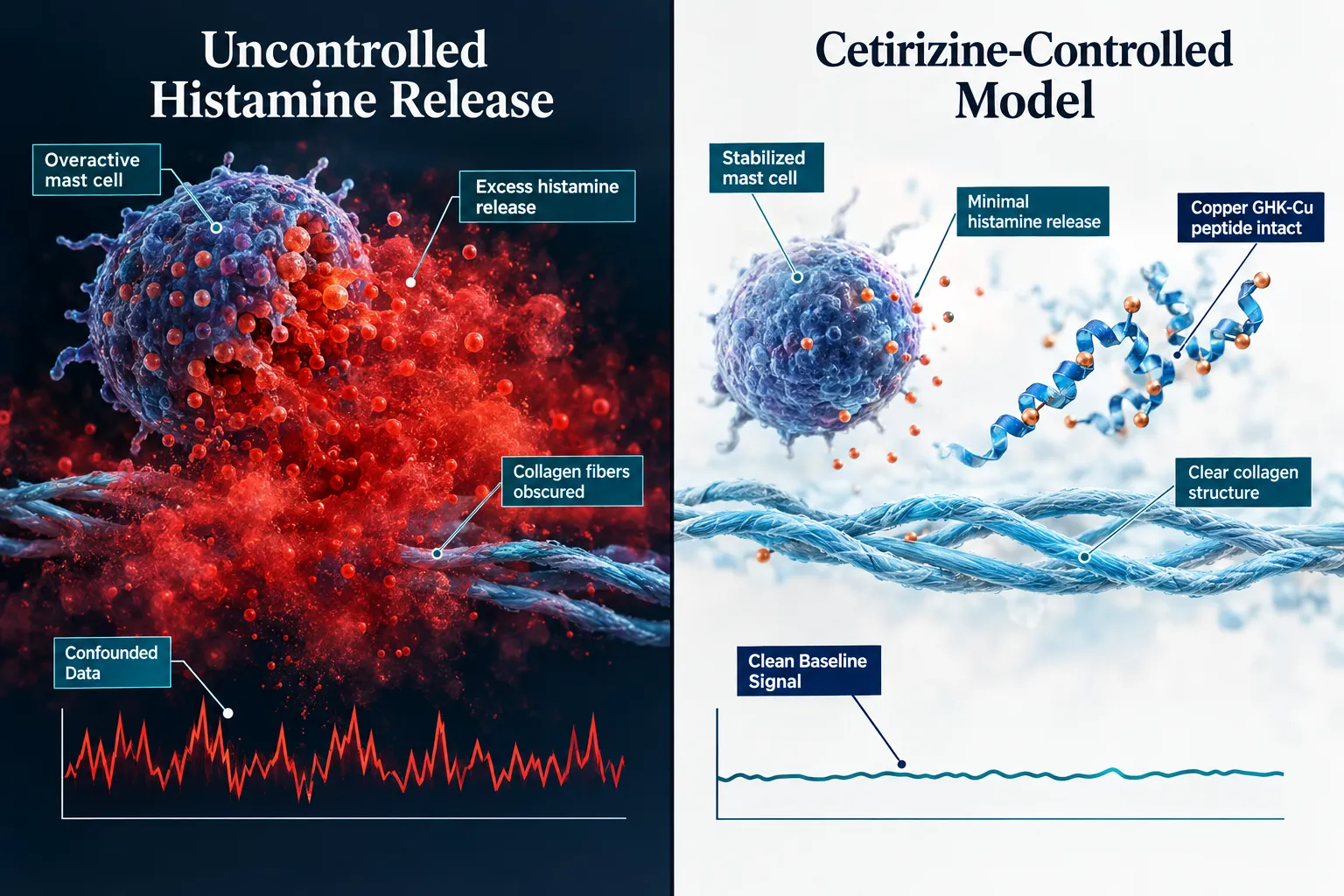
The result is that any measured change in collagen output, whether up or down, becomes difficult to attribute cleanly to GHK-Cu rather than to mast cell-derived mediator activity. This is the core problem that a cetirizine and histamine H1 receptor blockade strategy is designed to solve in GHK-Cu dermal mast cell research models.

Contaminant Source Effect on Collagen Assay Cetirizine Control?
Histamine (H1 pathway) Alters fibroblast proliferation Yes, directly
Histamine (H2 pathway) Modulates cAMP signaling Partial only
Tryptase Degrades matrix proteins No
Prostaglandins Shifts inflammation state No

A Baseline Control Protocol for Cetirizine and Histamine H1 Receptor Blockade in GHK-Cu Dermal Mast Cell Research Models
A Baseline Control Protocol for Cetirizine and Histamine H1 Receptor Blockade in GHK-Cu Dermal Mast Cell Research Models

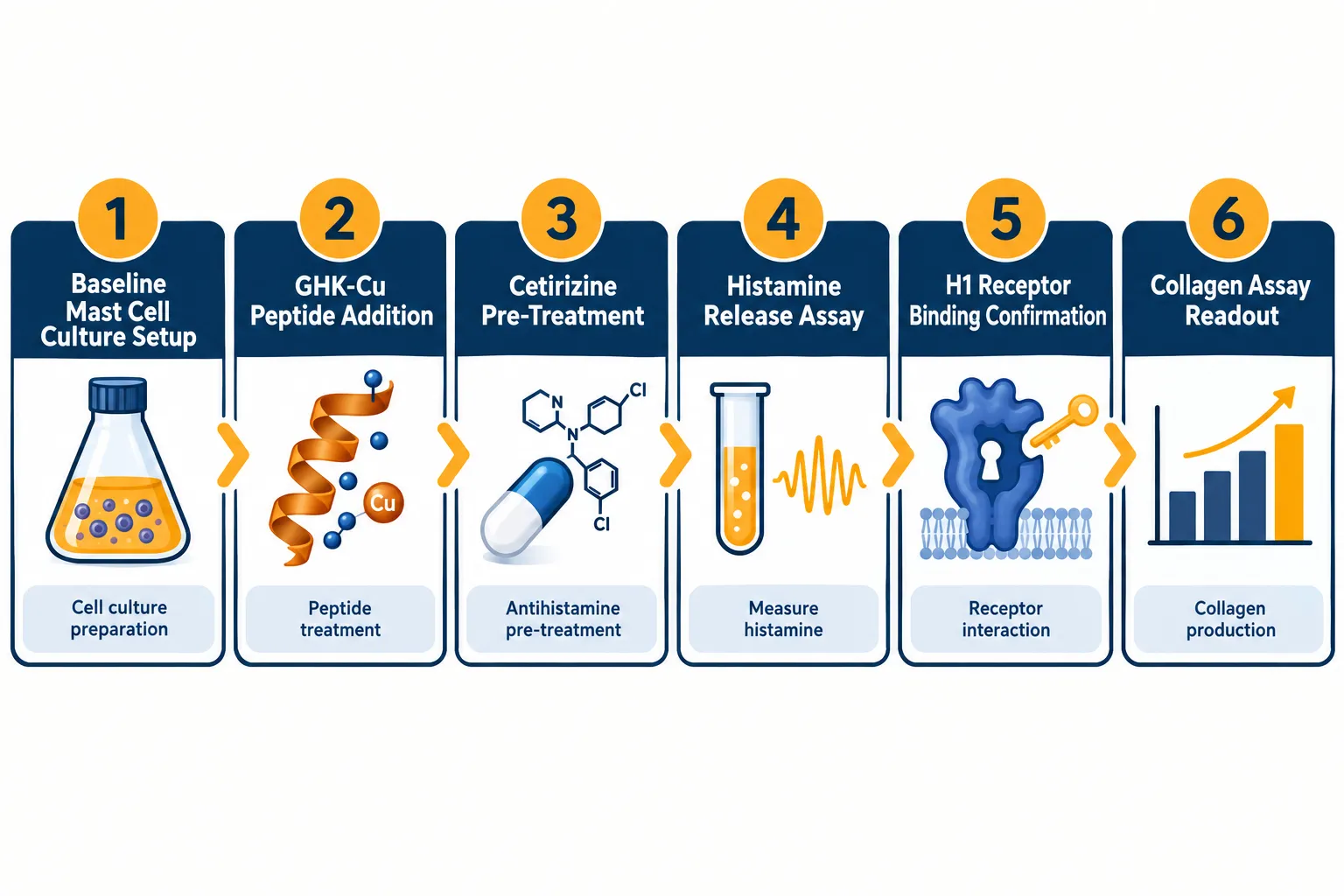
The following protocol is designed for researchers running in vitro or ex vivo dermal regeneration models that include mast cells alongside fibroblasts or skin explant tissue.

Step 1, Establish Mast Cell Baseline Activity

Before any peptide introduction, allow mast cell cultures to stabilize for 24-48 hours post-seeding. Measure spontaneous histamine release using ELISA or fluorometric histamine assay. This provides the true resting baseline.

Step 2, Cetirizine Pre-Treatment Window

Apply cetirizine at a concentration sufficient to achieve H1 receptor saturation in the model system. In receptor-binding studies, cetirizine achieves high H1 occupancy at low nanomolar concentrations, though in vitro models may require higher media concentrations depending on protein binding. Allow a 60-90 minute equilibration period before introducing GHK-Cu.

Step 3, GHK-Cu Introduction and Paired Controls

Introduce GHK-Cu to both:

  • Treated group: cetirizine pre-loaded cells
  • Control group: vehicle-only cells (no cetirizine)

Run a third arm with cetirizine and no GHK-Cu to isolate any antihistamine effect on basal fibroblast behavior.

Step 4, Post-Assay Mediator Panel

At each timepoint (4h, 24h, 48h), collect supernatant for:

  • Histamine quantification
  • Tryptase activity
  • Pro-collagen Type I C-peptide (PICP) as the collagen synthesis marker

Step 5, Data Interpretation

Attribute changes in PICP to GHK-Cu only after confirming that histamine levels in the cetirizine-treated arm remained suppressed relative to the vehicle control. If histamine suppression is incomplete, flag the data as potentially confounded and assess H2 receptor contribution separately.


Beyond H1 Blockade: What Cetirizine May Also Be Doing in Mast Cell Models

Research into antihistamines has documented that cetirizine, at relevant concentrations, can reduce mast cell mediator release and cellular traffic during the cutaneous late-phase reaction, an effect that goes beyond simple H1 antagonism. Many antihistamines show in vitro inhibition of mediator release from mast cells and basophils at higher concentrations, though these effects appear to be mechanistically separate from H1 receptor antagonism, and their precise pathways remain under investigation.

This has direct implications for dermal model design. If cetirizine reduces not just the signaling effect of histamine but also the total amount of mediator released, then a cetirizine-treated mast cell will present a fundamentally quieter inflammatory background. For GHK-Cu collagen assays, this is beneficial, but researchers must document whether their cetirizine concentration is achieving H1 blockade alone or a broader suppression of mast cell secretory activity.

This distinction matters when results are interpreted. A model using very high cetirizine concentrations may suppress mediators beyond histamine, meaning the clean collagen signal is partly an artifact of over-suppressed mast cell biology. Staying within concentrations that achieve H1 blockade without total mast cell silencing preserves the physiological relevance of the model.

For broader context on how controlled experimental models are designed in peptide research, the TB-500 controlled experimental models and QC workflow resource offers a useful parallel framework, and CJC-1295 Ipamorelin assay planning and sourcing checklist demonstrates how assay design discipline applies across peptide classes.


Designing Valid Comparator Arms and QC Checkpoints
Designing Valid Comparator Arms and QC Checkpoints

A well-designed GHK-Cu mast cell model using cetirizine H1 blockade requires at least four experimental arms:

  1. GHK-Cu alone (no mast cells, no cetirizine), isolates direct peptide-fibroblast effect
  2. GHK-Cu + mast cells, no cetirizine, reveals full histamine confound
  3. GHK-Cu + mast cells + cetirizine, the primary research condition
  4. Mast cells + cetirizine, no GHK-Cu, antihistamine background control

Quality control checkpoints should include:

  • Receptor binding confirmation via radiolabeled histamine displacement or functional H1 assay
  • Cell viability at each timepoint (cetirizine should not reduce viability at working concentrations)
  • Lot-to-lot verification of GHK-Cu purity, since copper content variation can independently trigger mast cell responses

Researchers exploring oxidative stress pathways in their models may also find value in reviewing SS-31 mitochondrial research themes, as mitochondrial integrity in mast cells affects degranulation thresholds. Similarly, the MOTS-C and elamipretide research context is relevant where cellular energy status is a confounding variable.


Conclusion

Controlling baseline histamine signaling is not optional in GHK-Cu dermal regeneration studies, it is what separates interpretable data from noise. The strategic application of cetirizine and histamine H1 receptor blockade in GHK-Cu dermal mast cell research models provides a tractable, pharmacologically well-characterized method for achieving that control.

Actionable next steps for researchers:

  • Map your model's mast cell density and spontaneous histamine output before any peptide introduction.
  • Select a cetirizine concentration that achieves H1 blockade at receptor level, confirmed by functional assay, rather than relying on nominal dosing from clinical literature.
  • Always run the four-arm comparator design described above; single-arm studies cannot distinguish GHK-Cu effects from histamine-driven artifacts.
  • Document whether observed collagen gains persist when cetirizine concentration is titrated down, this tests whether results depend on complete mast cell suppression or genuine peptide activity.
  • Cross-reference findings against existing peptide QC frameworks to maintain rigor across experimental platforms.

The field needs standardized, reproducible protocols for peptide-mast cell co-models. Building that standard now, with cetirizine as the H1 control agent, positions any laboratory to produce findings that hold up to scrutiny.

https://www.puretestedpeptides.com/wp-content/uploads/2026/10/cetirizine-and-histamine-h1-receptor-blockade-in-ghk-cu-dermal-mast-cell-researc.webp 1024 1536 https://www.puretestedpeptides.com/wp-content/uploads/2026/01/buy-peptides-online.jpg 2026-10-28 13:05:232026-10-28 13:05:23Cetirizine and Histamine H1 Receptor Blockade in GHK-Cu Dermal Mast Cell Research Models
×

Helpful Links

  • My account
  • Cart
  • Checkout
  • Refund and Returns Policy
  • Privacy Policy
  • SMS Privacy Policy
  • Login
  • My Account
  • Logout

USA Made Lab Tested Peptides

All products are sold for research, laboratory, or analytical purposes only, and are not for human consumption


Pure Tested Peptides is a chemical supplier. Pure Tested Peptides is not a compounding / chemical compounding facility as defined under 503A of the Federal Food, Drug, and Cosmetic act. Pure Tested Peptides is not an outsourcing facility as defined under 503B of the Federal Food, Drug, and Cosmetic act.

The statements made within this website have not been evaluated by the US Food and Drug Administration. The products we offer are not intended to diagnose, treat, cure or prevent any disease.

Human/Animal Consumption Prohibited. Laboratory/In-Vitro Experimental Use Only

Scroll to top Scroll to top Scroll to top