

GHK-Cu vs Glow Blend vs Klow Blend: What Each Copper- and Skin-Focused Formula Is Used For in Research
Copper peptides have generated more than three decades of peer-reviewed attention, yet researchers in 2026 still encounter significant confusion when supplier catalogs list "GHK-Cu," "Glow Blend," and "Klow Blend" as separate SKUs. These are not interchangeable names for the same compound. Understanding the compositional differences, and the distinct experimental goals each formula serves, is essential before designing any copper- or skin-focused research protocol.
This article breaks down GHK-Cu vs Glow Blend vs Klow Blend: What Each Copper- and Skin-Focused Formula Is Used For in Research, covering composition, proposed mechanisms, and the practical reasons blend naming drives search demand among researchers.
Key Takeaways
- GHK-Cu is a single-ingredient tripeptide-copper complex with a well-characterized research profile focused on skin remodeling and wound healing.
- Glow Blend combines GHK-Cu with complementary skin-focused peptides to address multiple dermal targets simultaneously in a single formulation.
- Klow Blend incorporates GHK-Cu alongside peptides studied for hair follicle support and scalp health, targeting a different tissue compartment.
- Blend naming creates search demand because researchers seek pre-combined formulas that reduce preparation complexity in multi-peptide studies.
- All three formulas are intended for research use only and are not approved for human therapeutic application.
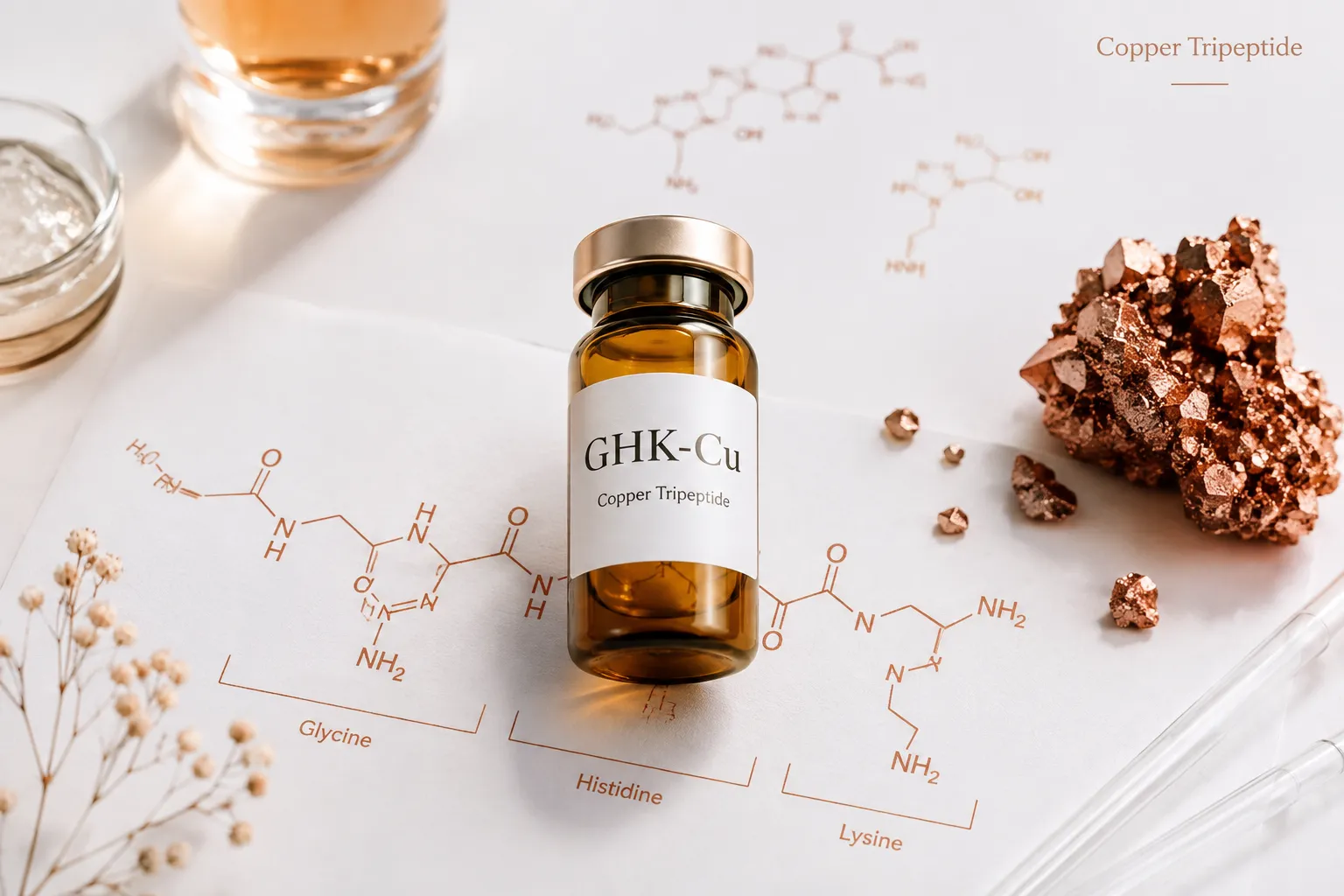
What Is GHK-Cu and Why Does It Anchor Every Comparison
GHK-Cu (glycyl-L-histidyl-L-lysine copper complex) is a naturally occurring tripeptide first isolated from human plasma. Its molecular structure, three amino acids chelated to a copper(II) ion, gives it a high affinity for copper transport across biological membranes.
Core research areas for GHK-Cu include:
- Collagen and elastin synthesis stimulation
- Matrix metalloproteinase (MMP) regulation
- Antioxidant gene expression
- Wound contraction and tissue remodeling
- Anti-inflammatory signaling pathways
Decades of in vitro and animal studies have documented GHK-Cu's ability to upregulate genes associated with skin repair. A landmark review by Pickart and Margolina (2018) catalogued over 4,000 human genes modulated by GHK-Cu, positioning it as one of the most studied tripeptides in dermatological research.
For researchers sourcing this compound independently, the GHK-Cu peptide purchase and copper peptide research sourcing guide provides purity benchmarks and quality criteria relevant to experimental design.
Because GHK-Cu is a single active ingredient, researchers can isolate its effects cleanly. This is its primary advantage over blended formulas when the experimental goal is mechanistic clarity.
How Glow Blend and Klow Blend Differ From Single-Ingredient GHK-Cu
When researchers move beyond single-compound studies, pre-formulated blends offer a different value proposition. The question in GHK-Cu vs Glow Blend vs Klow Blend: What Each Copper- and Skin-Focused Formula Is Used For in Research becomes one of experimental scope rather than ingredient quality.
Glow Blend: A Multi-Peptide Skin Remodeling Formula
Glow Blend is a pre-combined formulation that pairs GHK-Cu with additional peptides targeting complementary aspects of dermal biology. The blend is designed for research models where investigators want to assess synergistic effects across multiple skin-repair pathways in a single administration.
Typical research applications for Glow Blend:
- Photoaging and UV-damage repair models
- Collagen density studies in aged dermal tissue
- Comparative efficacy trials against single-ingredient GHK-Cu controls
- Multi-target anti-inflammatory skin protocols
The rationale for bundling is straightforward: skin aging involves simultaneous degradation of collagen, hyaluronic acid scaffolding, and vascular support structures. A single peptide addresses only one node of that network. Glow Blend allows researchers to probe whether combined peptide delivery produces additive or synergistic outcomes.
Klow Blend: Targeting Hair Follicle and Scalp Research Models
Klow Blend shifts the tissue target from dermal layers to the pilosebaceous unit. While it retains GHK-Cu as a core component, the additional peptides in Klow Blend are selected for their proposed roles in follicle cycling, scalp microcirculation, and keratinocyte activity.
Typical research applications for Klow Blend:
- Androgenic alopecia models in rodent studies
- Hair follicle miniaturization reversal protocols
- Scalp inflammation and sebaceous gland research
- Delivery vehicle comparisons (topical vs. nasal spray)
Notably, Klow Blend has also been studied in nasal delivery formats. Researchers interested in that delivery route can review research-use nasal spray peptide comparisons including Klow nasal for cognitive and anxiolytic models for context on how the same blend behaves across different administration routes.
For a comprehensive overview of both blends side by side, the Glow and Klow peptide blends product page details current formulation compositions relevant to research procurement.

Comparing Research Goals Across All Three Formulas
The table below summarizes the key distinctions that define the GHK-Cu vs Glow Blend vs Klow Blend comparison for research planning purposes.
| Parameter | GHK-Cu | Glow Blend | Klow Blend |
|---|---|---|---|
| Ingredient count | Single | Multi-peptide | Multi-peptide |
| Primary tissue target | Dermis / wound sites | Dermis / photoaging | Hair follicle / scalp |
| Best for | Mechanistic isolation | Synergy studies | Follicle cycling models |
| Delivery routes studied | Topical, subcutaneous | Topical | Topical, nasal |
| Experimental complexity | Lower | Moderate | Moderate-High |
"Single-ingredient studies establish mechanism. Multi-ingredient blends test real-world synergy. Both are necessary for a complete research picture."
Researchers building a broader skin and tissue recovery protocol may also consider pairing copper peptide work with synergistic compounds. The Skin Repair Stack combining BPC-157, TB-500, and GHK-Cu represents one such multi-compound research configuration.
For foundational context on how peptide structure influences experimental outcomes, the Peptides 101 guide for research-use buyers covers structure-mechanism relationships applicable across all three formulas discussed here.
Why Blend Naming Drives Search Demand in Peptide Research
The commercial naming of "Glow Blend" and "Klow Blend" is not arbitrary. It solves a practical problem for researchers: preparation complexity. Sourcing, weighing, and combining multiple peptides individually introduces compounding error at each step. Pre-formulated blends reduce that variability.
From an SEO and market perspective, blend names also signal intent. A researcher searching "Klow Blend" is specifically interested in the hair-and-scalp application stack, not a general copper peptide inquiry. This search specificity is why understanding GHK-Cu vs Glow Blend vs Klow Blend: What Each Copper- and Skin-Focused Formula Is Used For in Research matters beyond academic curiosity, it directly shapes how researchers find and evaluate the right compound for their model.
Researchers exploring broader peptide categories alongside copper-focused compounds may find value in the overview of polypeptide peptides from collagen and hormones to advanced research compounds for additional structural context.

Conclusion
The distinction between GHK-Cu, Glow Blend, and Klow Blend is fundamentally a question of experimental scope and tissue targeting. GHK-Cu delivers mechanistic precision as a single-ingredient copper peptide with a robust published literature. Glow Blend expands that scope into multi-pathway dermal remodeling research. Klow Blend redirects the focus toward follicle biology and scalp tissue, with additional delivery format flexibility.
Actionable next steps for researchers:
- Define the primary tissue target (dermis vs. follicle) before selecting a formula.
- Use single-ingredient GHK-Cu when mechanistic isolation is the priority.
- Select Glow Blend or Klow Blend when synergistic multi-peptide effects are the hypothesis.
- Verify purity certificates and third-party testing for any sourced compound before experimental use.
- Review delivery route data, particularly nasal vs. topical comparisons, when designing administration protocols for Klow Blend studies.
All compounds discussed are for research use only and are not approved for human therapeutic application.