

Spironolactone, Furosemide, and Hydrochlorothiazide: Fluid-Balance Controls in Peptide Studies
Fluid balance is not a passive backdrop in peptide research, it actively shapes the data. When plasma volume shifts by even 5 to 10 percent, circulating concentrations of growth hormone peptides, natriuretic peptides, and metabolic signaling molecules can move in ways that have nothing to do with the compound being studied. Understanding how spironolactone, furosemide, and hydrochlorothiazide: fluid-balance controls in peptide studies operate mechanistically is therefore essential for anyone interpreting or designing experiments that involve cardiovascular, renal, or growth-hormone endpoints.
Key Takeaways
- Spironolactone, furosemide, and hydrochlorothiazide each act on a different nephron segment, producing distinct fluid and electrolyte shifts that can distort peptide study outcomes.
- Plasma volume contraction, potassium dysregulation, and sodium changes all confound growth-hormone, natriuretic peptide, and metabolic peptide endpoints.
- Atrial natriuretic peptide (ANP) and antidiuretic hormone (ADH) are directly modulated by diuretic therapy, making them unreliable as isolated endpoints unless diuretic effects are controlled.
- Combination diuretic strategies, especially furosemide plus hydrochlorothiazide, are gaining renewed interest based on recent cardiorenal trial data.
- Rigorous pre-study electrolyte and renal function baselines are the single most important protocol step before introducing any peptide compound alongside diuretic agents.
How Each Diuretic Targets a Different Nephron Segment
The kidney filters roughly 180 liters of fluid daily, and diuretics interrupt that process at precise points. Knowing those points is the foundation of understanding spironolactone, furosemide, and hydrochlorothiazide: fluid-balance controls in peptide studies.
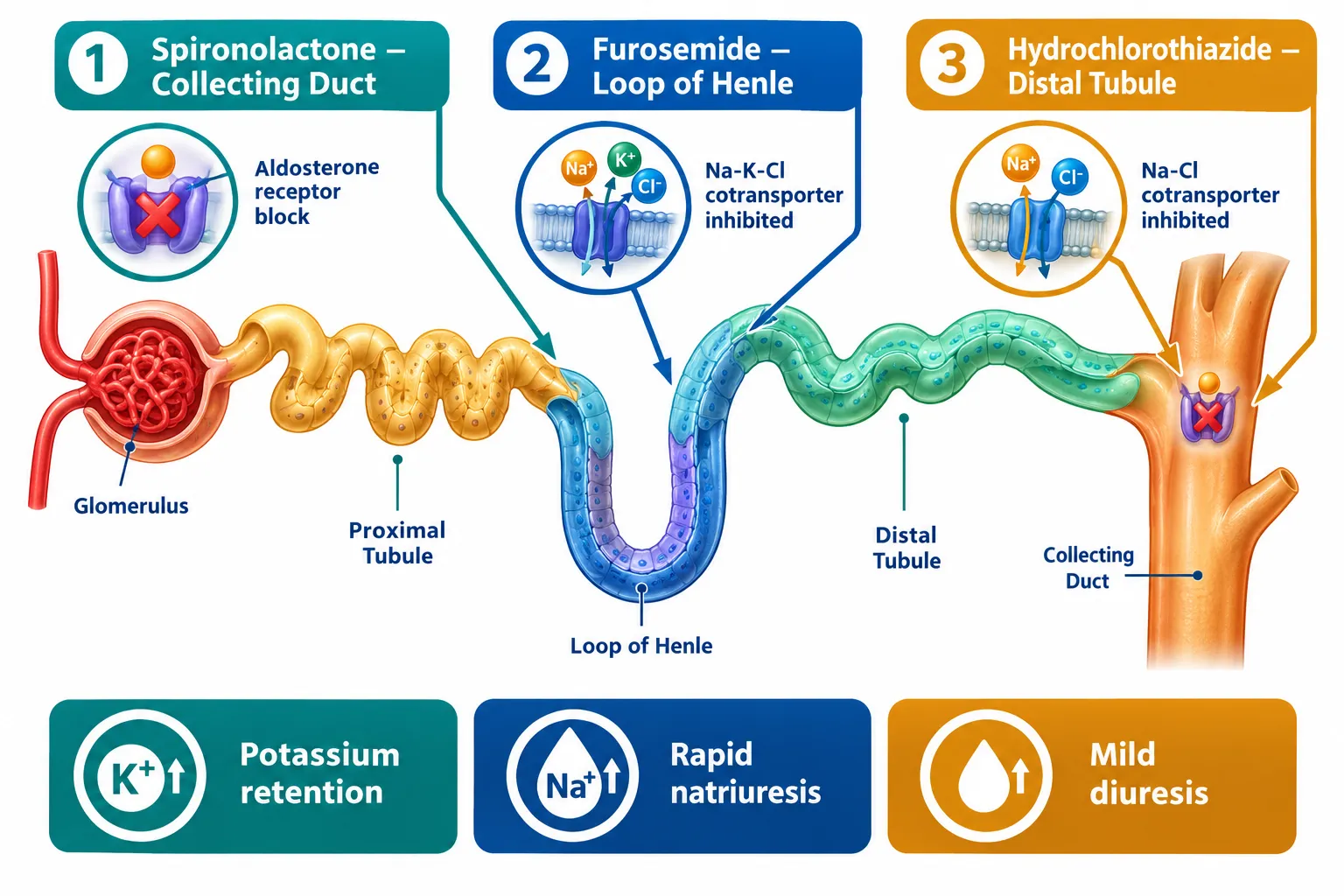
Furosemide is a loop diuretic. It blocks the sodium-potassium-chloride (Na-K-Cl) cotransporter in the thick ascending limb of the loop of Henle. This segment normally reabsorbs about 25 percent of filtered sodium, so furosemide produces rapid, high-volume natriuresis. The result is swift plasma volume contraction, a variable that directly affects the apparent concentration of any circulating peptide.
Hydrochlorothiazide (HCTZ) acts further downstream, at the sodium-chloride cotransporter in the distal convoluted tubule. Its diuretic effect is milder and slower than furosemide, making it useful for sustained, lower-magnitude volume reduction. However, it persistently lowers serum potassium and can raise blood glucose, both of which interfere with insulin-related and growth-hormone peptide assays.
Spironolactone is an aldosterone receptor antagonist that works in the collecting duct. By blocking aldosterone binding, it prevents the transcription of sodium channels, reducing sodium reabsorption and retaining potassium. This potassium-sparing property is critical in peptide research contexts where hypokalemia would itself alter cellular signaling.
| Diuretic | Site of Action | Key Ion Effect | Onset |
|---|---|---|---|
| Furosemide | Loop of Henle | Loses K+, Na+, Cl- | 30-60 min |
| Hydrochlorothiazide | Distal tubule | Loses K+, Na+ | 2-4 hours |
| Spironolactone | Collecting duct | Retains K+, loses Na+ | 24-48 hours |
Fluid Shifts, Electrolytes, and Peptide Endpoint Distortion
The core problem in peptide research is straightforward: volume, osmolality, and electrolyte status alter peptide secretion, distribution, and receptor sensitivity independent of any test compound.
This is especially relevant when studying cardioprotective agents. Research involving SS-31 peptide benefits in mitochondrial or cardiorenal models, for example, must account for baseline volume status because plasma volume contraction alone can trigger compensatory neurohumoral responses that mimic or mask peptide activity.
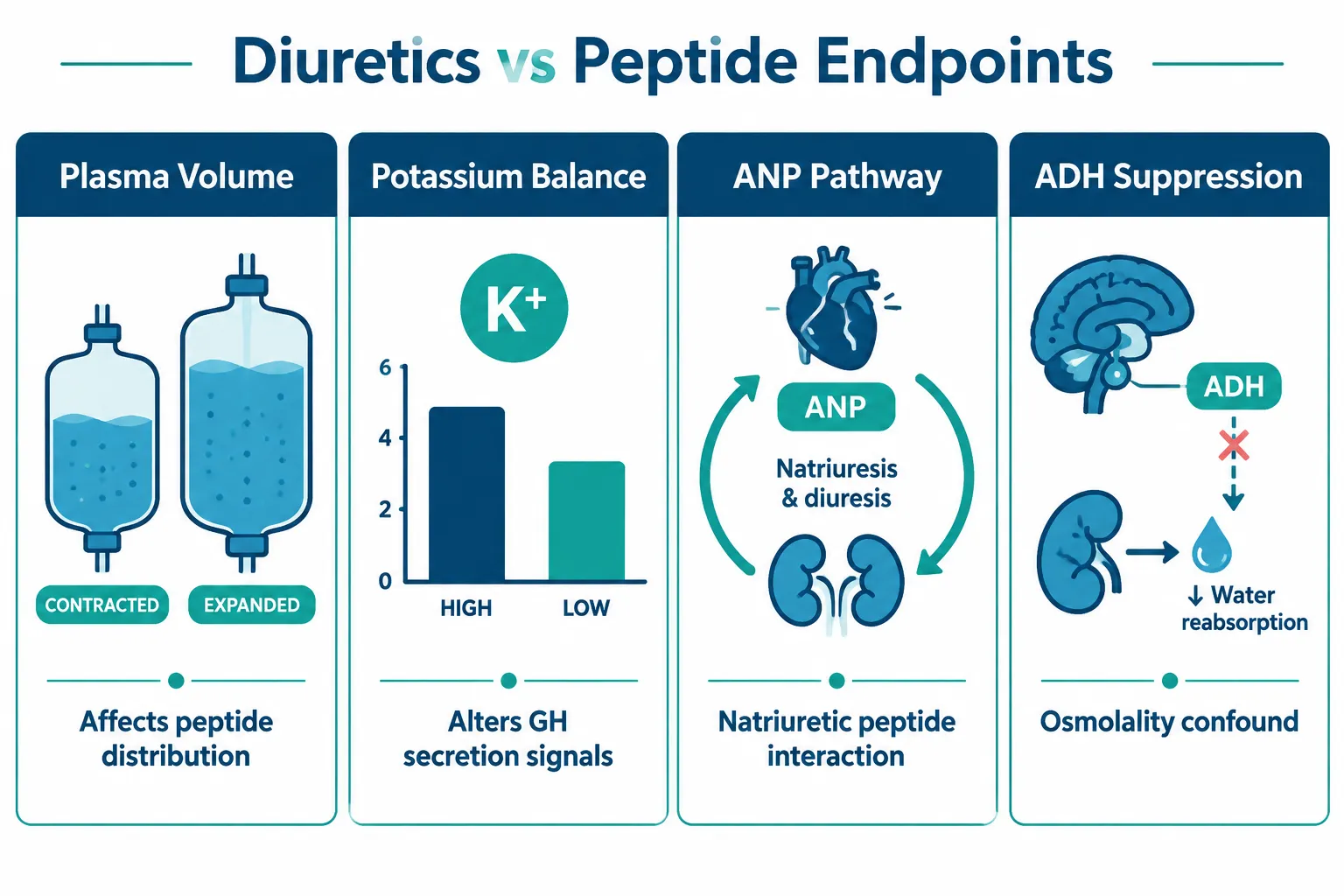
Potassium and growth hormone secretion are closely linked. Hypokalemia, a predictable consequence of both furosemide and HCTZ, suppresses insulin secretion and impairs the somatotropic axis. Studies involving growth-hormone-releasing peptides that do not account for thiazide-induced potassium losses risk attributing blunted GH responses to the peptide when the real cause is electrolyte imbalance.
Sodium and plasma osmolality govern ADH (antidiuretic hormone) release. Diuretic-induced hypernatremia or hyponatremia directly shifts ADH levels, which in turn modulates aquaporin-mediated water reabsorption throughout the nephron. In any study using natriuretic peptides or vasopressin-adjacent compounds, this represents a critical confound. The same principle applies when evaluating metabolic peptides such as GLP-3 research compounds, where fluid dynamics affect nutrient absorption and gut hormone signals.
ANP (atrial natriuretic peptide) is both a research target and a physiological variable. Diuresis reduces atrial wall tension, which suppresses ANP release. Any study measuring ANP as a primary endpoint, or using it as a proxy for cardiac stress, must document and control baseline diuretic exposure.
Key insight: Volume contraction caused by even modest furosemide doses can reduce measured ANP by 15 to 30 percent, a shift large enough to obscure a peptide's true cardioprotective signal.
Combination Strategies, Diuretic Resistance, and Implications for Research Protocols
Recent cardiorenal evidence has revived interest in combining diuretics rather than escalating single-agent doses. The CLOROTIC trial and follow-up 2026 synthesis data confirm that furosemide combined with hydrochlorothiazide achieves superior decongestion in acute heart failure compared with furosemide alone, with a manageable electrolyte burden when monitored carefully.
Spironolactone adds a complementary layer. Its aldosterone-blocking mechanism not only retains potassium but reduces cardiac fibrosis pathways, making it directly relevant to studies using cardioprotective peptides. Those exploring SS-31 10mg research peptide considerations in cardiomyopathy models should note that concurrent spironolactone use will alter aldosterone-related gene expression in the heart, a biological variable that must be controlled or documented.
Diuretic resistance, defined as inadequate response despite adequate dosing, is itself a significant confounder. It often reflects compensatory nephron hypertrophy, elevated aldosterone, or worsening renal function. In a peptide study context, diuretic resistance introduces non-linearity: the relationship between administered diuretic dose and actual volume effect becomes unpredictable, making peptide-endpoint interpretations unreliable.
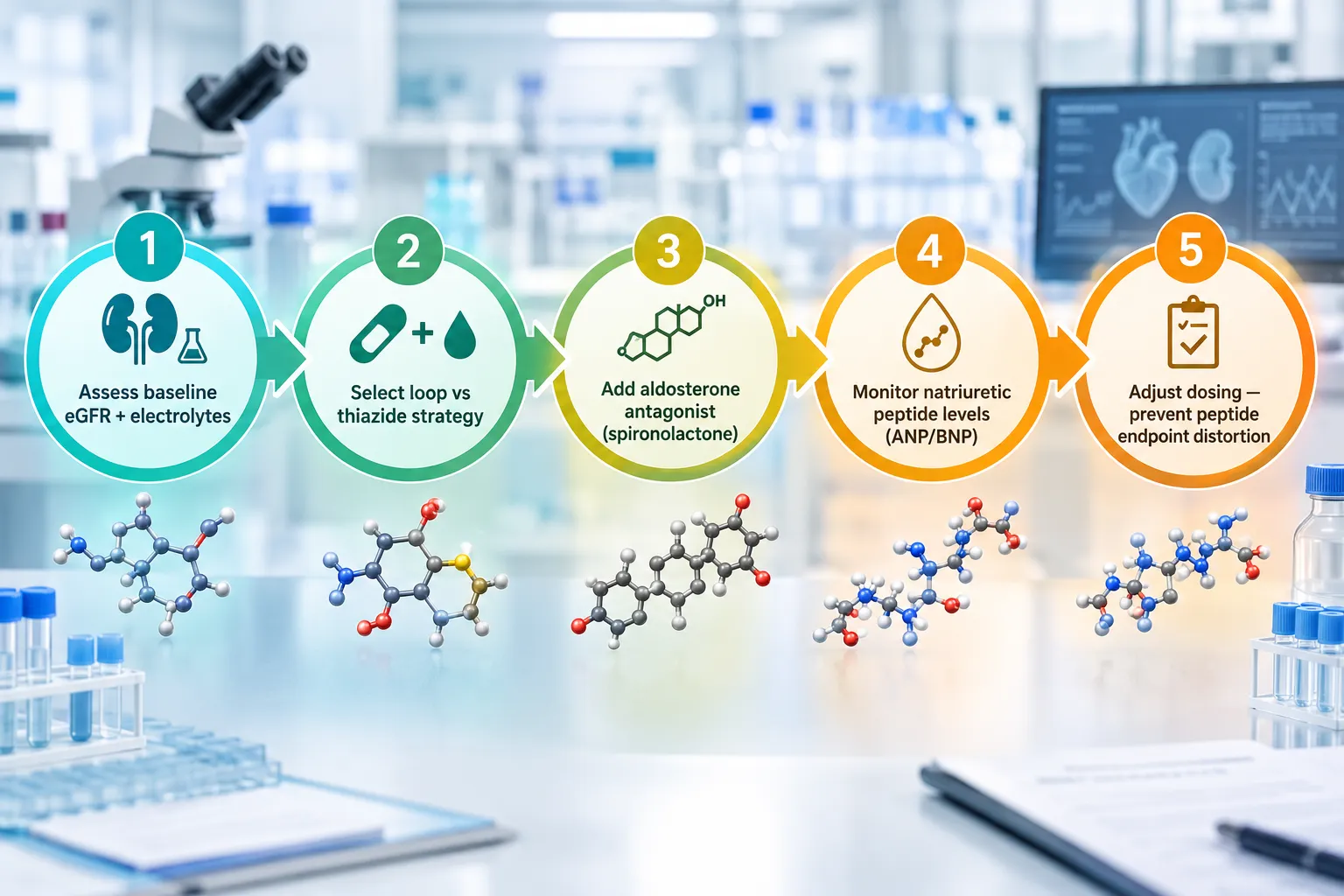
A practical protocol checklist for researchers includes:
- Measure serum potassium, sodium, creatinine, and eGFR at baseline and at each study interval
- Document exact diuretic dose, timing, and route before peptide administration
- Allow a sufficient washout period if switching diuretic classes between study arms
- Use ANP and BNP as co-variables, not primary endpoints, unless the study is specifically designed around natriuretic peptide dynamics
- For metabolic peptide studies, including compounds profiled in resources like Peptides 101 for research-use only buyers, document body weight, urine output, and hydration status at every checkpoint
For researchers working with PT-141 or other receptor-targeted peptides, hormonal cross-talk with aldosterone and ADH pathways can alter receptor expression profiles. Reviewing PT-141 research context, QA, and controls highlights how tightly controlled physiological variables must be before attributing receptor-level changes to the peptide alone.
Similarly, mitochondria-targeted peptides discussed under Peptide SS-31 research resources operate in a cellular environment that diuretic-driven electrolyte shifts can profoundly alter, particularly regarding mitochondrial membrane potential and potassium channel activity.
Conclusion
The interplay between spironolactone, furosemide, and hydrochlorothiazide, as fluid-balance controls in peptide studies, determines whether experimental data reflects actual peptide activity or uncontrolled physiological noise. Researchers and study designers should treat diuretic co-administration not as a peripheral clinical detail but as a primary methodological variable.
Actionable next steps:
- Establish a full electrolyte and renal function panel before any peptide study involving diuretics.
- Document diuretic class, dose, and timing in every study arm and report them as co-variables in analysis.
- Treat ANP, ADH, and aldosterone levels as confounders to be measured, not as spontaneous outcomes.
- When combining furosemide and hydrochlorothiazide based on current evidence, plan for potassium supplementation or spironolactone co-administration to maintain electrolyte stability.
- Apply the same rigor to metabolic, cardiovascular, and growth-hormone peptide studies alike, fluid balance does not discriminate by peptide class.
Controlling these variables is not overcaution. It is the minimum standard for producing interpretable, reproducible peptide research in 2026.