

The Fundamental Difference: Peptides vs. Polypeptides in Research and Their Distinct Applications
Over 40 peptide-based drugs have reached clinical use in the last decade alone, yet many researchers still use the terms "peptide" and "polypeptide" interchangeably, a habit that can blur critical distinctions in experimental design, sourcing, and application. Understanding the fundamental difference between peptides vs. polypeptides in research and their distinct applications is not a matter of pedantry. It directly shapes how compounds are synthesized, characterized, and deployed across therapeutic and biomaterial science.
Key Takeaways
- Peptides are short amino acid chains of 2-50 residues; polypeptides contain 51 or more residues and begin to adopt protein-like structural properties.
- Both are built from amino acids joined by peptide bonds, but size determines structural behavior and research function.
- Peptides are primarily used as active therapeutic agents targeting receptors and signaling pathways.
- Polypeptides serve as biodegradable carriers, scaffolds, and structural biomaterials in drug delivery systems.
- The operational distinction between the two is increasingly aligned with regulatory and industrial product categories.
Defining the Terms: Chain Length and Structural Behavior
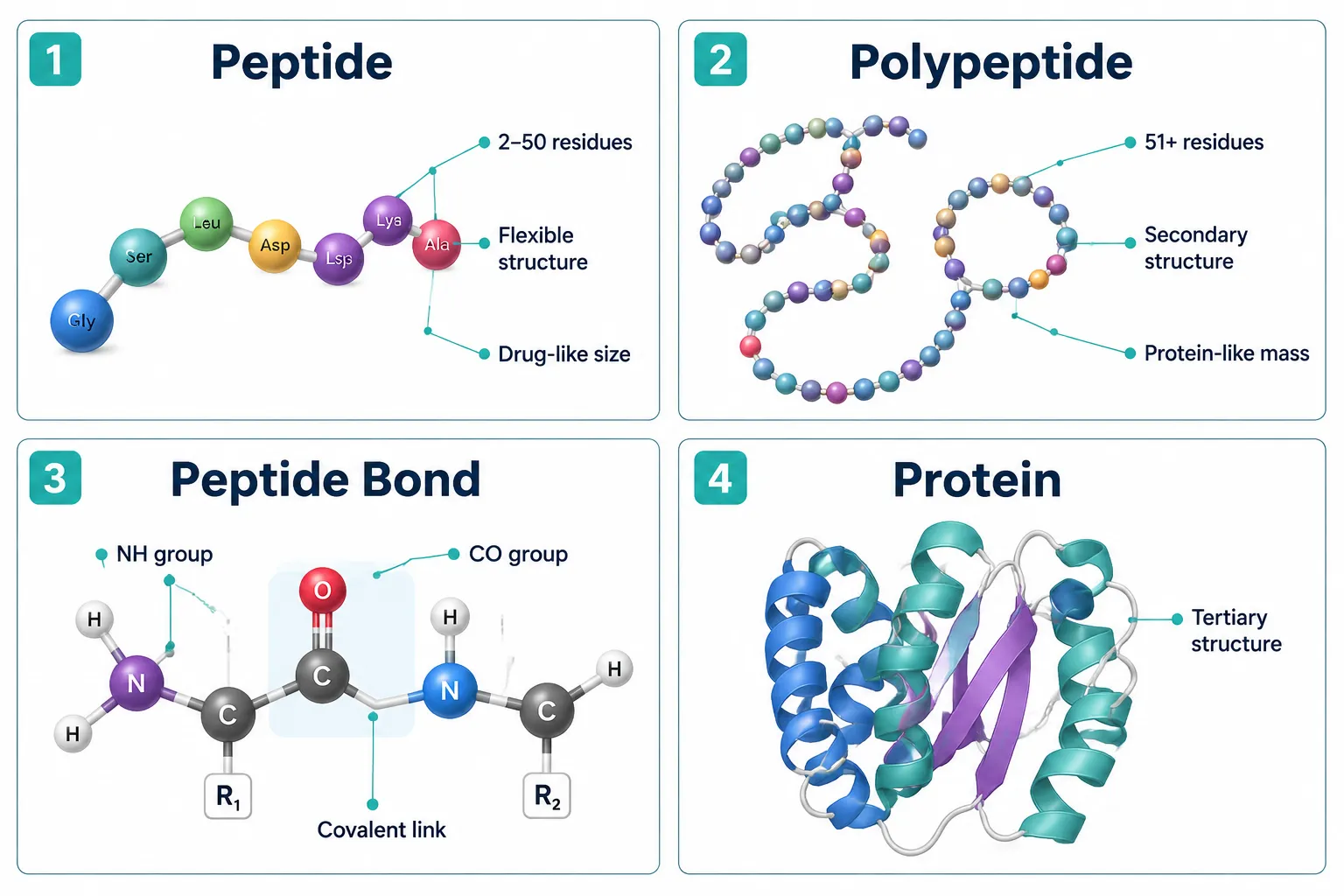
At the most basic level, a peptide is a chain of two to approximately 50 amino acid residues linked by peptide bonds. A polypeptide is a longer chain, generally 51 or more residues, that begins to exhibit structural complexity beyond what short peptides can achieve. Authoritative genetics and biochemistry glossaries now consistently frame this as a length-based distinction, while acknowledging that no single universal cut-off exists.
The chemistry underlying both is identical: amino acids are joined by covalent peptide bonds formed between the carboxyl group of one residue and the amino group of the next. What changes with length is behavior.
| Feature | Peptide (2-50 residues) | Polypeptide (51+ residues) |
|---|---|---|
| Typical molecular weight | Under ~5-10 kDa | Above ~10 kDa |
| Secondary structure | Rare or minimal | Increasingly common |
| Tertiary/folded structure | Generally absent | Possible; defines proteins |
| Research role | Active pharmacophore | Carrier, scaffold, or protein precursor |
"In strict biochemical usage, every peptide and every protein is technically a polypeptide, but the shorter 'peptide' label is reserved for when size and drug-like behavior are the central concern."
Polypeptides above roughly 50 residues can begin to form stable secondary structures such as alpha-helices and beta-sheets. Once a polypeptide folds into a defined three-dimensional shape, it crosses the threshold into what researchers call a protein. This means the terminology forms a nested hierarchy: all peptides are polypeptides, and all proteins are polypeptides, but not all polypeptides are proteins.
Why the Fundamental Difference Between Peptides vs. Polypeptides Matters in Research
The distinction is not merely academic. It has direct consequences for how compounds are synthesized, stored, tested, and regulated.
Peptides as Precision Therapeutics
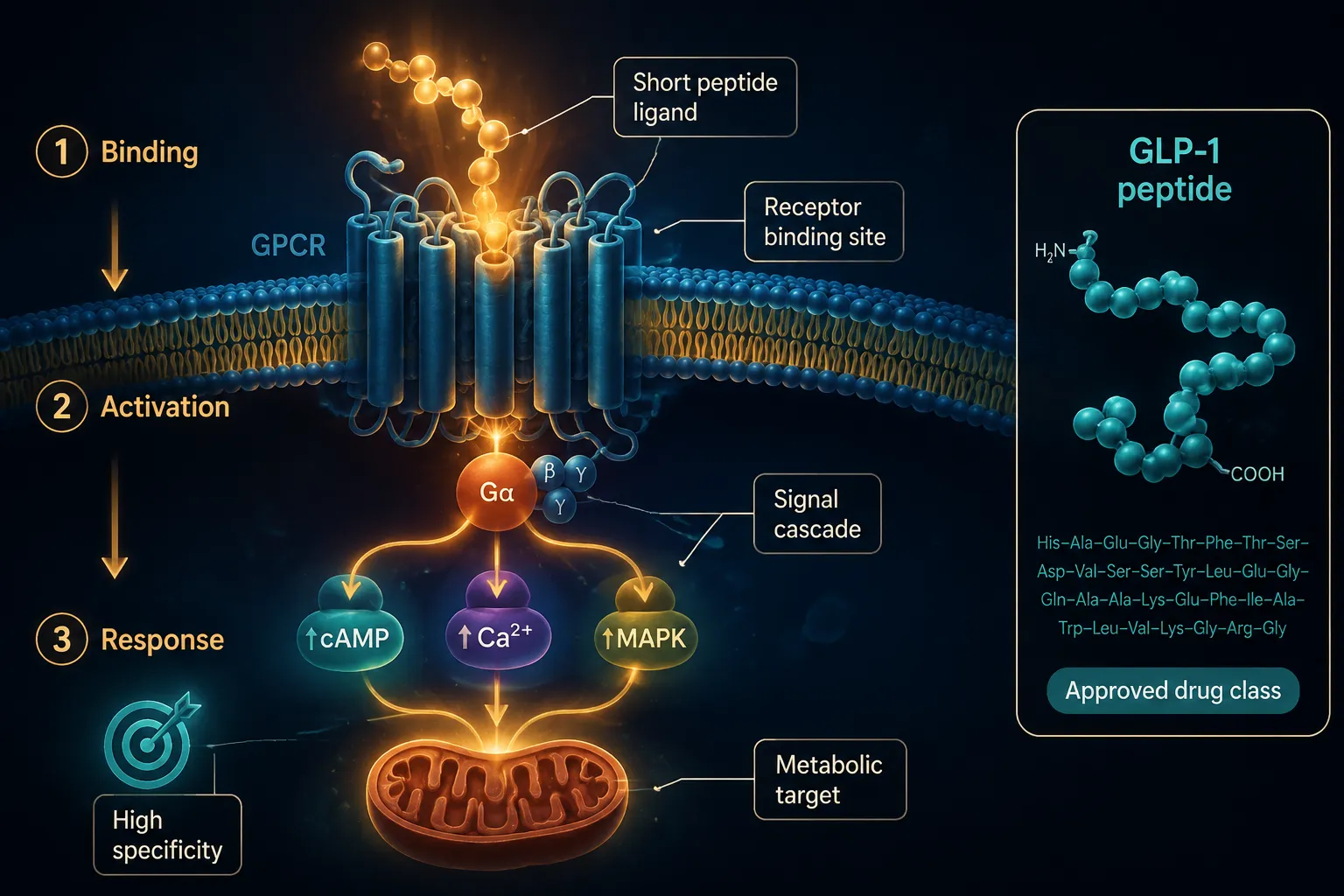
Short peptides have emerged as a major class of bioactive research compounds. Their small size gives them several advantages:
- High receptor specificity, short chains can be precisely engineered to fit receptor binding sites
- Favorable safety profiles, metabolized into natural amino acids
- Tunability, cyclization, PEGylation, and backbone modification extend stability and half-life
Research into top peptides for metabolic health illustrates how short peptide chains are designed to interact with specific receptors involved in energy regulation. Similarly, compounds such as those explored in GLP-1, GLP-2, and GLP-3 peptide family research demonstrate the precision with which short peptides can modulate metabolic signaling.
Peptides are also being investigated for growth hormone pathways. Research into CJC-1295 and half-life in growth hormone research shows how even small structural changes in a short peptide chain can dramatically alter its pharmacokinetic profile.
Polypeptides as Structural and Delivery Platforms
Polypeptides play a fundamentally different role. Because of their greater length and capacity to form secondary structures, they are engineered as:
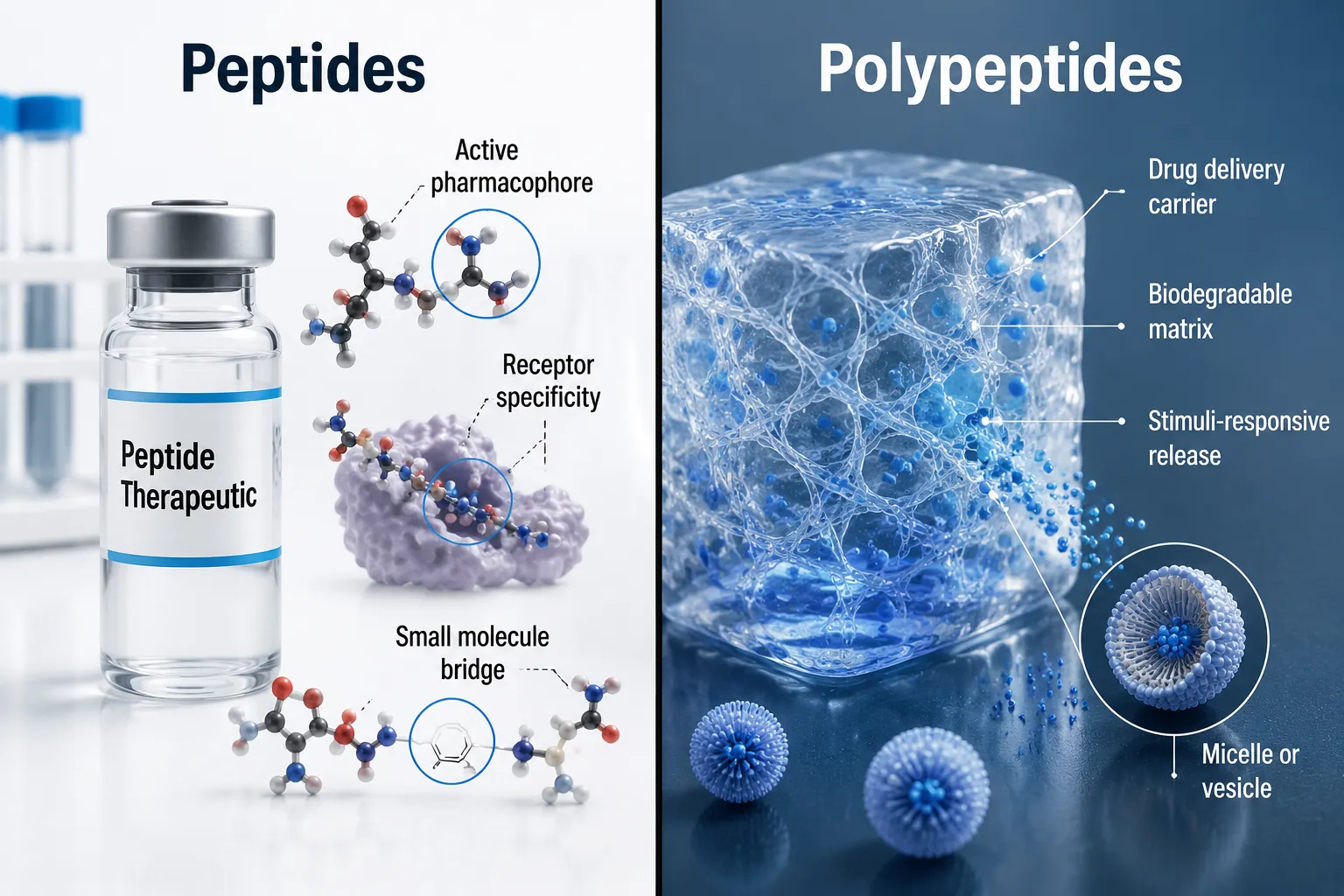
- Drug delivery vehicles, micelles, vesicles, and hydrogels built from polypeptide chains encapsulate active drugs and release them in a controlled manner
- Biodegradable scaffolds, used in implantable or injectable biomaterials
- Stimuli-responsive carriers, designed to respond to pH shifts, redox conditions, or enzymatic activity at target tissue sites
In this context, the polypeptide is not the active drug, it is the architecture that delivers it. This represents a clear functional divide from therapeutic peptides, which are themselves the pharmacologically active entities.
Distinct Applications Across Research Disciplines
Understanding the fundamental difference between peptides vs. polypeptides in research and their distinct applications becomes most practical when mapped to specific research domains.
Oncology and metabolic disease research predominantly uses short peptides as precision effectors. Compounds such as those examined in MOTS-C peptide and mitochondrial biogenesis research target cellular energy pathways with a specificity that larger polypeptide structures cannot achieve at the receptor level.
Cardioprotection and organ health research uses short peptides such as SS-31, which targets mitochondrial membranes. Researchers sourcing compounds for this work can explore SS-31 peptide research and mechanism studies to understand how a four-residue peptide achieves potent organelle-level activity.
Tissue repair and regeneration research uses peptides such as BPC-157 and TB-500. Resources covering BPC-157 and TB-500 peptides highlight how short chains modulate healing cascades at the cellular level.
Drug delivery and biomaterial science, by contrast, relies on polypeptide-length chains to build the scaffolding that transports active compounds to target sites. The mechanical properties, degradation rates, and structural tunability of polypeptides, not their receptor affinity, are what matter here.
Key Application Differences at a Glance
- Peptides: active drug, receptor agonist or antagonist, signaling modulator
- Polypeptides: carrier matrix, biodegradable scaffold, stimuli-responsive vehicle
- Proteins (folded polypeptides): enzymes, antibodies, structural biologics
Conclusion
The fundamental difference between peptides vs. polypeptides in research and their distinct applications comes down to chain length, structural capacity, and functional role. Short peptides, typically 2 to 50 residues, are optimized for receptor binding, signaling modulation, and therapeutic precision. Polypeptides, with their greater length and structural complexity, serve as the architectural platforms of modern drug delivery and biomaterial science.
Actionable next steps for researchers:
- Confirm residue count and molecular weight when classifying a compound as a peptide or polypeptide, do not rely on naming conventions alone.
- Match the compound class to its intended function: use short peptides for active pharmacophore applications and polypeptide systems for delivery or scaffold needs.
- When sourcing research-grade compounds, prioritize lab-tested peptides with verified purity documentation to ensure experimental reliability.
- Stay current with evolving regulatory language, as the distinction between "peptide therapeutics" and "polypeptide/protein biologics" is increasingly codified in approval pathways and market categories.
As the field advances, short peptides will increasingly rely on polypeptide-based delivery technologies to overcome stability and bioavailability challenges, making a clear understanding of both classes not just useful, but essential.