

Estrogen Receptor Biology for Peptide Researchers: How Enclomiphene and Related serms Interface With Endocrine Pathways
Testosterone levels in men have declined by roughly 1% per year since the 1980s, a trend that has pushed hormone optimization research, including the study of selective estrogen receptor modulators, squarely into the mainstream of endocrine science. For researchers working with peptides and growth hormone secretagogues, understanding estrogen receptor biology for peptide researchers: how enclomiphene and related serms interface with endocrine pathways is no longer optional. Estrogen receptors sit at the crossroads of the hypothalamic-pituitary-gonadal (HPG) axis, directly influencing the same feedback loops that peptide protocols are designed to modulate.
Key Takeaways
- Estrogen receptors exist in at least three functionally distinct forms, ERalpha, ERbeta, and GPER, each producing different downstream effects depending on tissue type.
- serms like enclomiphene act as tissue-selective modulators, blocking estrogen's negative feedback at the hypothalamus to elevate LH, FSH, and endogenous testosterone.
- Coregulator proteins determine whether a serm behaves as an agonist or antagonist in a given tissue, explaining the drug's differential effects across organ systems.
- Peptide researchers combining growth hormone secretagogues with serm protocols should understand how these pathways intersect to avoid redundant or counterproductive signaling.
- Purity and characterization of research compounds remain critical variables when studying serm-peptide interactions.
The Architecture of Estrogen Receptor Signaling
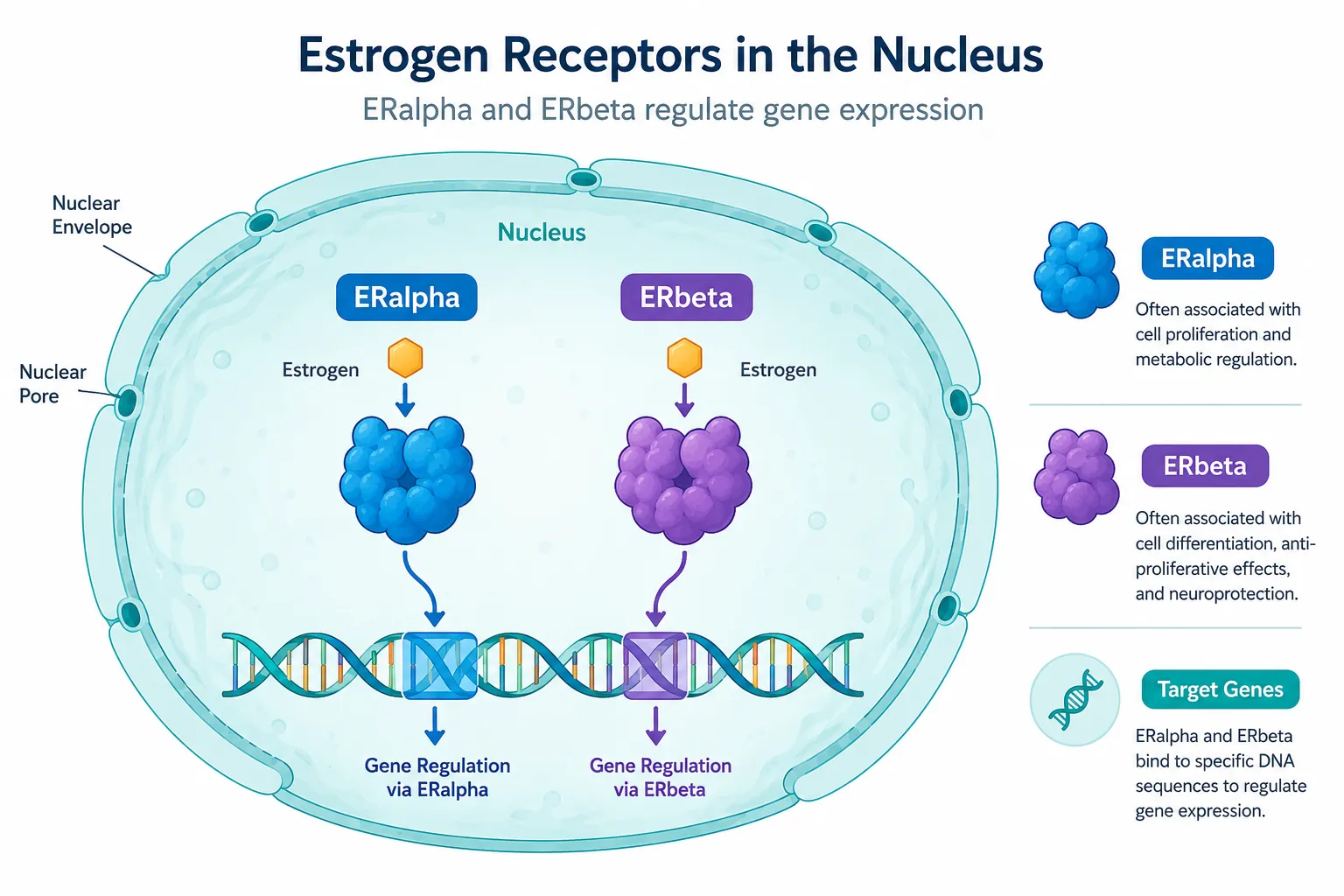
Estrogen does not act through a single receptor. Three receptor types carry its signal into cells: ERalpha (ERa), ERbeta (ERb), and the membrane-bound G protein-coupled estrogen receptor (GPER). Each has a distinct tissue distribution and a distinct set of coregulator proteins that shape its final biological output.
ERalpha dominates in the uterus, liver, bone, and the hypothalamus. ERbeta is more prominent in the ovaries, lungs, and central nervous system. GPER, a newer focus in endocrine and vascular biology, mediates rapid non-genomic estrogen responses, including vasodilation and insulin secretion, that occur too quickly to involve gene transcription.
Genomic vs. non-genomic signaling is a critical distinction:
| Pathway | Receptor Involved | Time to Effect | Mechanism |
|---|---|---|---|
| Classical genomic | ERalpha / ERbeta | Hours | DNA binding, gene transcription |
| Non-genomic | GPER, membrane ERs | Seconds to minutes | Second messengers (cAMP, MAPK) |
| Tethered genomic | ERalpha / ERbeta | Hours | AP-1 or Sp1 transcription factors |
When a serm binds to ERalpha or ERbeta, it induces a specific three-dimensional shape change in the receptor's ligand-binding domain. That shape change determines which coregulator proteins are recruited. Coactivators amplify gene transcription; corepressors suppress it. The ratio of these proteins in any given tissue is what makes tamoxifen estrogenic in bone but anti-estrogenic in breast tissue, and it is the same principle that governs enclomiphene's selectivity.
How Enclomiphene and Related serms Interface With Endocrine Pathways
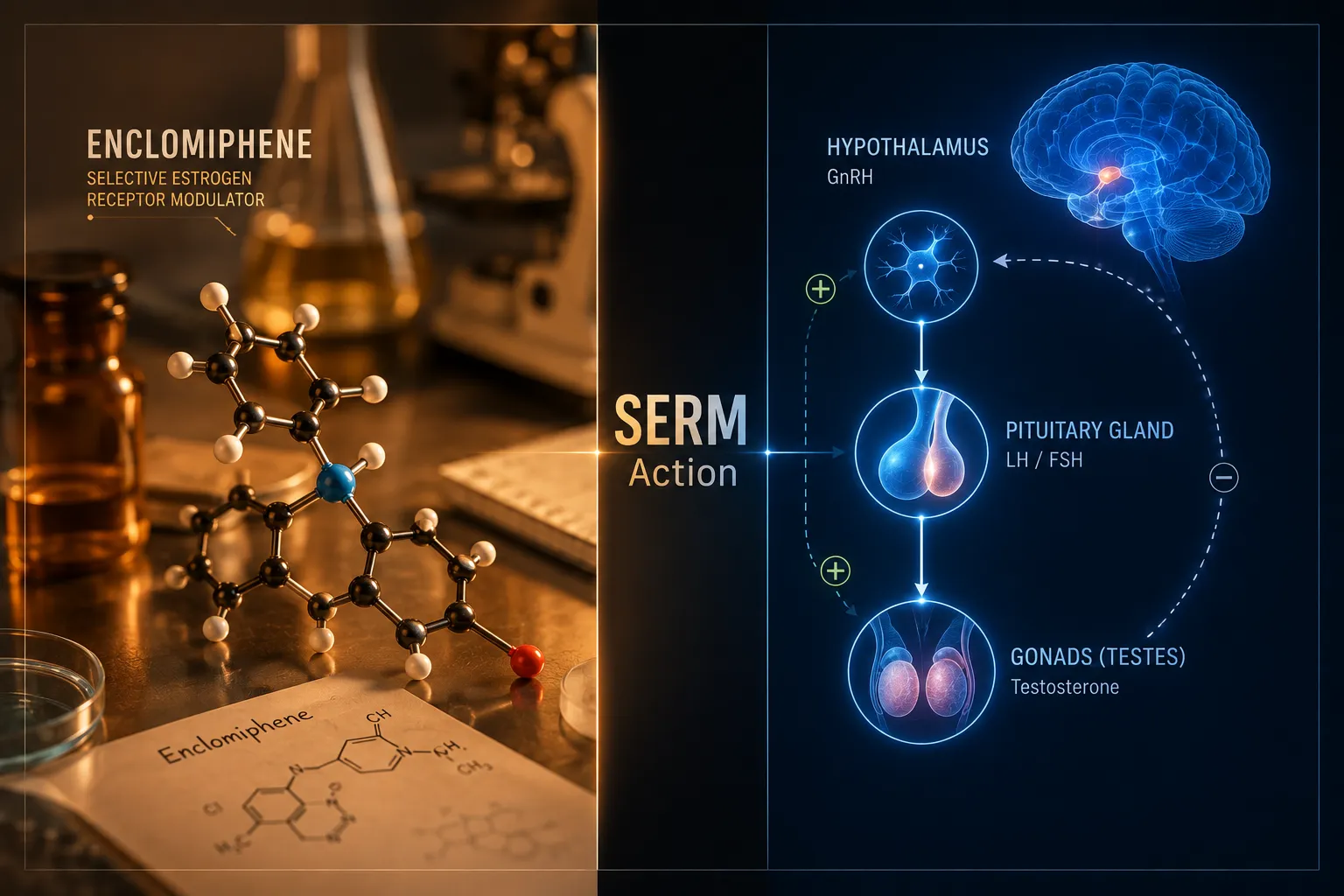
Clomiphene citrate has been used in fertility medicine for decades, but it is a racemic mixture of two isomers with opposing properties. Enclomiphene is the trans-isomer, the component responsible for the majority of the HPG axis stimulation. Zuclomiphene, the cis-isomer, is weakly estrogenic and has a much longer half-life, contributing to side effects in the original mixture.
Enclomiphene's primary mechanism is competitive antagonism at hypothalamic ERalpha receptors. Estrogen normally suppresses GnRH pulse frequency through negative feedback. By blocking that feedback signal, enclomiphene allows GnRH pulses to increase, which drives greater pituitary release of LH and FSH, which in turn stimulates testicular testosterone production.
"The HPG axis is a finely tuned feedback loop. serms like enclomiphene do not add hormones, they remove a brake."
This mechanism is directly relevant to researchers studying peptide stacks that include growth hormone secretagogues. Resources like the serm, Ipamorelin, and CJC-1295 research overview explore how these pathways can be studied together. Similarly, the serm, Ipamorelin, and CJC-1295 dosage considerations outline how researchers have approached combined protocols.
Other serms in current research include:
- Tamoxifen, strong ERalpha antagonist in breast, partial agonist in bone and uterus
- Raloxifene, bone-protective, neutral to antagonistic in breast, no uterine stimulation
- Toremifene, structural analog of tamoxifen with a slightly different coregulator recruitment profile
- Ospemifene, agonist in vaginal tissue, used in genitourinary research
Each of these compounds recruits a different coregulator constellation, reinforcing the coregulator-centric model of serm action that has replaced older simple agonist/antagonist frameworks.
Practical Implications for Peptide Research Protocols
Understanding estrogen receptor biology for peptide researchers: how enclomiphene and related serms interface with endocrine pathways becomes especially actionable when designing multi-compound research protocols. Growth hormone secretagogues such as tesa, ipamorelin, and CJC-1295 operate on the GHRH/somatostatin axis, a system that intersects with sex hormone signaling in several ways.
Estrogen modulates IGF-1 sensitivity and GH pulse amplitude. Blocking estrogenic feedback at the hypothalamus with a serm can therefore alter the baseline hormonal environment in which GH secretagogues operate. Researchers studying tesa peptide benefits or reviewing tesa dosage protocols should factor in this cross-axis interaction.
Peptide researchers sourcing compounds for endocrine studies should also consider purity standards. Exploring all peptides available for research from verified suppliers reduces confounding variables. Those investigating where to source serms for laboratory use can review where to buy a serm for research purposes for guidance on compound availability and quality standards.
Key research design considerations:
- Establish baseline LH, FSH, and total testosterone before introducing any serm
- Account for GPER-mediated non-genomic effects, which may not appear in standard genomic assays
- Recognize that zuclomiphene contamination in impure enclomiphene preparations will confound results
- Monitor coregulator expression patterns if tissue-specific agonism/antagonism is a study endpoint
Researchers working with aging-related endocrine models may also find value in the aging support peptide category, where serm-adjacent compounds are increasingly studied alongside secretagogues for their complementary effects on the HPG and GH axes.

Conclusion
Estrogen receptor biology for peptide researchers: how enclomiphene and related serms interface with endocrine pathways is a foundational topic for anyone designing serious hormone or peptide research protocols in 2026. The key actionable steps are clear: distinguish between ERalpha, ERbeta, and GPER when interpreting study outcomes; apply the coregulator-centric model to predict tissue-specific serm behavior; and account for HPG axis cross-talk when combining serms with growth hormone secretagogues like ipamorelin or tesa.
Researchers should prioritize high-purity, well-characterized compounds to minimize experimental noise. Reviewing the IPA and Sermorelin stack research alongside serm mechanism data provides a more complete picture of how these endocrine pathways interact. As the coregulator-centric model continues to mature, researchers who understand receptor-level selectivity will be best positioned to design protocols that yield reproducible, meaningful data.