Call or Text 727-513-9780
  • Shopping Cart Shopping Cart
    0Shopping Cart
Pure Tested Peptides | America's most trusted Peptides for sale online
  • Peptides for sale
    • Oral Peptides for sale
      • Peptide Capsules for sale
      • BPC 157 Capsules 1000mcg
      • SLU-PP-332 Capsules | 1000 mcg
      • 5-Amino-1MQ 50mg Capsules
      • Tesofensine 500mcg
    • All Peptides for sale
    • Peptide Sprays
      • BPC 157 Nasal Spray Kit
      • BPC-157 TB500 Nasal Spray Kit
      • Semax Nasal Spray 10mg
      • Selank – Nasal Spray Kit – 10mg
      • Epithalon 50MG Nasal Spray Kit
      • Ipamorelin 10mg Nasal Spray
      • Klow Nasal Spray (BPC-157 + TB-500 + GHK-Cu + KPV) | 80mg
      • Hulk Nasal Spray Tesa / Ipa Blend 6/3 MG
      • Klow Nasal Spray
      • NAD + 500 mg Nasal Spray
      • PT-141 Nasal Spray Kit
    • GHRH Peptides
      • Ipa Peptides
      • CJC-1295 Peptides
        • CJC-1295 with DAC 5 mg
        • CJC-1295 without DAC 5 mg
        • CJC-1295 Ipa 10mg
      • Tesa Peptides
        • Tesa Peptide
        • Tesa 20 mg
    • GHK-Cu Peptides
      • All GHK-Cu Peptides
      • GHK-Cu 100mg
      • KLOW Peptide Blend – Buy KLOW blend online
    • BPC Peptides
      • All BPC Peptides
      • BPC-157
      • BPC-157 TB-500
      • BPC 157 capsules 1000mcg
    • SLU-PP-332 Peptides
      • All SLU-PP-332 Peptides
      • SLU-PP-332 5mg
    • GLP3 Peptides
    • PT-141 Peptides
      • PT-141 Peptides for sale
      • PT-141 10mg
      • PT-141 Nasal Spray
    • CAG Peptides
      • Lipo-C Peptide Blend
      • CAG 5mg
      • CAG 10mg
    • MOTS-C Peptides
      • MOTS-C Peptides for sale
      • MOTS-c peptide
      • MOTS-c 10mg *6 pack*
    • 5 Amino 1MQ Peptides
      • 5 Amino 1MQ Peptides for sale
      • 5-Amino-1MQ 50mg Capsules
      • 5-Amino-1MQ 5mg
    • Epithalon Peptides
      • Epithalon Peptides for sale
      • Epithalon 10mg
      • Epithalon 50mg
  • Shop
    • GLPs
      • 5-Amino-1MQ 50mg Capsules
      • 5-Amino-1MQ 5mg
      • L-Carnitine 500mg/ml
      • Tesofensine 500mcg
      • SLU-PP-332 5mg
      • MOTS-c 10mg *6 pack*
    • Epithalon & BPC Peptides
      • Epithalon 10mg
      • Epithalon 50mg
      • BPC-157
      • BPC 157 capsules 1000mcg
      • BPC-157 TB-500
      • BPC-157 TB500 Nasal Spray Kit
      • BPC 157 Nasal Spray Kit
    • BPC TB-500 & NAD+ Peptides
      • NAD+ 500 mg
      • KLOW Peptide Blend – Buy KLOW blend online
      • GLOW Peptide Blend
      • TB 500 5mg
      • BPC 157 capsules 1000mcg – Supplement
      • BPC 157 Nasal Spray Kit
      • BPC-157
      • BPC-157 TB500 Nasal Spray Kit
      • BPC-157 TB-500
      • BPC 157 capsules 1000mcg
    • LL-37 Peptide
      • LL-37 10 mg
    • MOTS-C & Selank
      • MOTS-c peptide
      • Selank 10mg
    • GHK Peptides
      • GHK-Cu 100mg
      • GLOW Peptide Blend
      • KLOW Peptide Blend – Buy KLOW blend online
  • COAs
  • Wholesale
    • Wholesale Peptides for sale
  • PTP FAQ
  • Affiliates
    • Selank Peptide: Advanced Pharmacological Mechanisms Underlying Its Anxiolytic and Nootropic Effects in Research
      • 5-Amino-1MQ Peptide: Detailed Mechanisms of NNMT Inhibition and Its Impact on Cellular Metabolism Research
        • MOTS-C Peptide: Unraveling Its Role in Mitochondrial Dynamics and Energy Metabolism Research
          • Epithalon Peptide and Telomerase Regulation: Investigating Its Impact on Cellular Senescence and Lifespan Research Models
            • GLP2-T vs GLP2 Tirz Peptide: Understanding the Naming, Mechanistic Nuances, and Research Implications for Gut Health
      • Peptides and Polypeptides in Modern Pharmacology: What Research on Metoprolol, Prednisone, and Amlodipine Reveals
        • Polypeptide Peptides vs NSAIDs: What Naproxen and Diclofenac Teach Tissue-Repair Researchers About BPC‑157 and TB‑500
          • Peptides and Polypeptides in Endocrine Pharmacology: How GLP-1, GLP-2, and GLP-3 Retatrutide Differ From Classic Drugs Like Prednisone and Amlodipine
          • 5‑Amino‑1MQ Peptide and NNMT Inhibition: How It Compares With Statins Like Atorvastatin in Adipose and Lipid Metabolism Research
      • Enclomiphene, Estrogen Receptor Signaling, and Luteinizing Phase Biology: What Hormone Researchers Should Measure
        • Mesenchymal Stem Cells, BPC‑157, and GHK‑Cu: How Tissue Repair Peptides Compare With Classic NSAIDs Like Naproxen in Injury Models
          • Peptide Calculator Use Cases Beyond Growth Hormone: Working Through GLP‑3 Retatrutide, MOTS‑c, and BPC‑157 Research Dosing
        • Polypeptide Peptides in Endocrine and Metabolic Pharmacology: Lessons From Amlodipine, Prednisone, and Metoprolol
        • Peptides Calculator for Advanced Blends: Worked Examples for Tesamorelin, CJC‑1295, and Ipamorelin Stacks
          • Peptides and Polypeptides in Human Physiology: How Molecular Size Shapes Research Applications
            • Selank Peptide: Advanced Pharmacological Mechanisms Underlying Its Anxiolytic and Nootropic Effects in Research
          • 5-Amino-1MQ Peptide: Detailed Mechanisms of NNMT Inhibition and Its Impact on Cellular Metabolism Research
            • MOTS-C Peptide: Unraveling Its Role in Mitochondrial Dynamics and Energy Metabolism Research
              • Epithalon Peptide and Telomerase Regulation: Investigating Its Impact on Cellular Senescence and Lifespan Research Models
                • GLP2-T vs GLP2 Tirz Peptide: Understanding the Naming, Mechanistic Nuances, and Research Implications for Gut Health
                  • Peptides and Polypeptides in Endocrine Pharmacology: How GLP-1, GLP-2, and GLP-3 Retatrutide Differ From Classic Drugs Like Prednisone and Amlodipine
                    • Polypeptide Peptides vs NSAIDs: What Naproxen and Diclofenac Teach Tissue-Repair Researchers About BPC‑157 and TB‑500
                      • Peptides and Polypeptides in Modern Pharmacology: What Research on Metoprolol, Prednisone, and Amlodipine Reveals
                        • 5‑Amino‑1MQ Peptide and NNMT Inhibition: How It Compares With Statins Like Atorvastatin in Adipose and Lipid Metabolism Research
                        • Enclomiphene, Estrogen Receptor Signaling, and Luteinizing Phase Biology: What Hormone Researchers Should Measure
                        • Mesenchymal Stem Cells, BPC‑157, and GHK‑Cu: How Tissue Repair Peptides Compare With Classic NSAIDs Like Naproxen in Injury Models
                        • Peptide Calculator Use Cases Beyond Growth Hormone: Working Through GLP‑3 Retatrutide, MOTS‑c, and BPC‑157 Research Dosing
                        • Polypeptide Peptides in Endocrine and Metabolic Pharmacology: Lessons From Amlodipine, Prednisone, and Metoprolol
                        • Peptides Calculator for Advanced Blends: Worked Examples for Tesamorelin, CJC‑1295, and Ipamorelin Stacks
                        • Peptides and Polypeptides in Human Physiology: How Molecular Size Shapes Research Applications
                        • Selank Peptide: Advanced Pharmacological Mechanisms Underlying Its Anxiolytic and Nootropic Effects in Research
                        • MOTS-C Peptide: Unraveling Its Role in Mitochondrial Dynamics and Energy Metabolism Research
                        • Peptides and Polypeptides in Modern Pharmacology: What Research on Metoprolol, Prednisone, and Amlodipine Reveals
                        • Peptides and Polypeptides in Endocrine Pharmacology: How GLP-1, GLP-2, and GLP-3 Retatrutide Differ From Classic Drugs Like Prednisone and Amlodipine
                        • 5-Amino-1MQ Peptide: Detailed Mechanisms of NNMT Inhibition and Its Impact on Cellular Metabolism Research
                        • Mesenchymal Stem Cells, BPC‑157, and GHK‑Cu: How Tissue Repair Peptides Compare With Classic NSAIDs Like Naproxen in Injury Models
                        • Peptide Calculator Use Cases Beyond Growth Hormone: Working Through GLP‑3 Retatrutide, MOTS‑c, and BPC‑157 Research Dosing
                        • GLP2-T vs GLP2 Tirz Peptide: Understanding the Naming, Mechanistic Nuances, and Research Implications for Gut Health
                        • Polypeptide Peptides in Endocrine and Metabolic Pharmacology: Lessons From Amlodipine, Prednisone, and Metoprolol
                        • Polypeptide Peptides vs NSAIDs: What Naproxen and Diclofenac Teach Tissue-Repair Researchers About BPC‑157 and TB‑500
                        • Peptides and Polypeptides in Human Physiology: How Molecular Size Shapes Research Applications
                        • Peptides Calculator for Advanced Blends: Worked Examples for Tesamorelin, CJC‑1295, and Ipamorelin Stacks
                        • 5‑Amino‑1MQ Peptide and NNMT Inhibition: How It Compares With Statins Like Atorvastatin in Adipose and Lipid Metabolism Research
                        • Enclomiphene, Estrogen Receptor Signaling, and Luteinizing Phase Biology: What Hormone Researchers Should Measure
                        • Epithalon Peptide and Telomerase Regulation: Investigating Its Impact on Cellular Senescence and Lifespan Research Models
                        • Best research protocol Klow blend
                        • best time to take BPC-157
                        • best time to take DSIP (Delta Sleep Inducing Peptide)
                        • best time to take CJC-1295
                        • best time to take AOD-9604
                        • best time to take Follistatin 344
                        • best time to take Ipamorelin
                        • best time to take MK-677 (Ibutamoren)
                        • best time to take Ligandrol (LGD-4033) — research compound
                        • best time to take Ostarine (MK-2866) — research compound
                        • best time to take GHK-CU
                        • best time to take TB-500
                        • best time to take MOTS-c
                        • best time to take Semax
                        • best time to take RAD-140 (Testolone) — research compound
                        • best time to take Thymosin Alpha-1
                        • best time to take PEG-MGF
                        • Biolife Plasma, Octapharma Plasma, and Research Peptides: How Plasma Donation Labs Differ From Peptide Suppliers
                        • best time to take YK-11 — research compound
                        • best time to take PT-141 (Bremelanotide)
                        • Best research protocol Klow blend
                        • 5-Amino-1MQ and MOTS-C Synergy: Metabolic Signaling, Mitochondria, and Research Design
                        • BPC-157 and TB-500: Investigating Their Combined Effects on Angiogenesis and Cellular Migration in Tissue Repair Models
                        • BPC-157 Peptide: Gut Barrier Function, Inflammation, and Tissue-Recovery Research
                        • 5‑Amino‑1MQ and MOTS‑c Synergy in Metabolic Research: Designing NNMT and Mitochondrial Biogenesis Stacks
                        • CJC-1295 with DAC vs. Without DAC: Half-Life, Release Kinetics, and Research Implications
                        • CJC‑1295 with DAC vs. Without DAC: Expanding on Half‑Life Differences Using Tesamorelin and Ipamorelin Blend Case Studies
                        • Collagen Biology and Copper‑Binding Peptides: How GHK‑Cu, Glow Blend, and Klow Blend Interact with Skin and Connective Tissue
                        • Collagen Biology and Regenerative Peptides: How GHK‑Cu, Glow Blend, and Klow Blend Affect Extracellular Matrix Research
                    • DNA, Telomeres, and Longevity Peptides: Positioning Epithalon and MOTS‑c in Genetic Aging Research
                      • Enclomiphene Citrate: serm Mechanism, Testosterone Research, and Stack Compatibility
                        • Enclomiphene vs Enclomiphene Citrate: Formulation, Bioavailability, and Research Distinctions
                        • Epithalon Peptide Research: Telomerase Activation, Aging, and Pineal Gland Function
                        • Estrogen Receptor Signaling and Enclomiphene: How Selective Modulators Compare with Classic Polypeptide Hormones
                        • GHK-Cu Peptide: Advanced Mechanisms in Extracellular Matrix Remodeling and Wound Healing Research
                        • GHK-Cu Peptide: Collagen Synthesis, Wound Repair, and Skin-Barrier Research Models
                        • GLP-1 vs GLP-3 vs GLP-2: Peptide Classification and Research Applications
                        • GLP-2 Peptide Research Guide: Gut Barrier Function, Nutrient Absorption, and Intestinal Recovery Models
                        • GLP-3 Retatrutide vs. GLP-1 Drugs: What Triple-Agonist Biology Changes in Research Models
                        • Ipamorelin and Tesamorelin Combination: Synergistic GH Secretagogue Research and Dosing Protocols
                        • GLP2 Tirz Peptide: What It Is, Why the Name Exists, and How Researchers Should Interpret It
                        • Klow Blend Peptide Nasal Spray: What the Formulation Is Trying to Do in Cognitive Research
                        • Mitochondria, NNMT Inhibition, and Peptide Modulators: Where MOTS‑c and 5‑Amino‑1MQ Fit in Cellular Energy Research
                        • MOTS-c Peptide: Mitochondrial Function, Energy Metabolism, and What Researchers Measure
                        • MOTS-c vs. 5-Amino-1MQ: Which Metabolic Research Questions Each Compound Actually Answers
                        • Nasal Spray Peptides: Bioavailability, Administration, and Semax/Selank Research Applications
                        • PT-141 Peptide Research: Mechanism of Action and Melanocortin Receptor Signaling
                        • Retatrutide for Research: Mechanism, Structure, and GLP-1/GLP-3 Dual Action
                        • Retatrutide for Obesity and Type 2 Diabetes: What the Latest Trial Data Suggest
                        • Tesofensine Peptide Research: Mechanism, Appetite Suppression, and Neuropeptide Y Pathways
  • Contact
    • Contact Customer Service
    • Text Customer Support
  • About US
  • Shop all peptides
  • Affiliate Program
    • Affiliate Signup
  • Login / Register Login / Register Page Link Login / Register Page Link
  • Click to open the search input field Click to open the search input field Search
  • Menu Menu

Tag Archive for: endpoint timing

Retatrutide Dose-Escalation Research: Comparing Exposure, Tolerability, and Endpoint Timing Across Study Designs

Retatrutide Dose-Escalation Research: Comparing Exposure, Tolerability, and Endpoint Timing Across Study Designs

October 3, 2026/0 Comments/in Uncategorized/by

Roughly 26% of adults worldwide meet clinical criteria for obesity, yet fewer than half of those enrolled in weight-loss drug trials complete the full escalation phase without a dose reduction or dropout. That gap between protocol intent and real-world completion sits at the center of retatrutide dose-escalation research: comparing exposure, tolerability, and endpoint timing across study designs, and it is now driving a new generation of deliberately structured trials.

Key Takeaways

  • Retatrutide is titrated stepwise from 2 mg once weekly to target doses of 4, 9, or 12 mg, with escalation lasting approximately 16 weeks before a prolonged maintenance phase.
  • Gastrointestinal adverse events, nausea, diarrhea, and vomiting, are clearly dose-dependent and concentrate during the escalation phase rather than maintenance.
  • A dedicated phase 3b trial is directly comparing alternative escalation schedules to determine whether slower titration improves the efficacy-tolerability balance without sacrificing weight-loss outcomes.
  • Endpoint timing across studies is deliberately staggered: Week 24 captures early escalation impact, while 80-week designs assess long-term durability at steady-state exposure.
  • Emerging non-GI signals, including dysesthesia at the highest doses, are beginning to shape thinking about maximum recommended doses and future flexible titration labels.

How Escalation Schedules Shape Drug Exposure

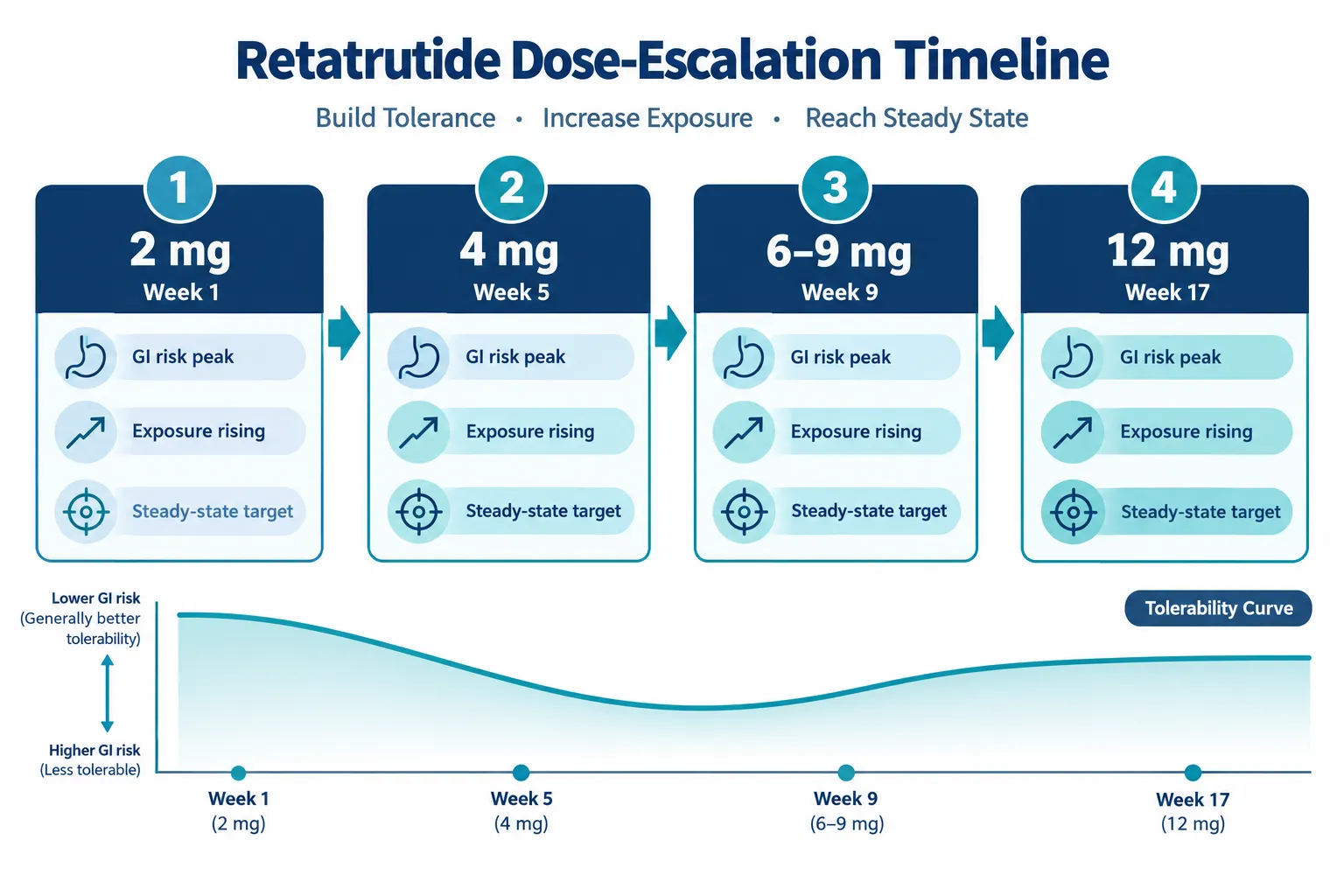
The pharmacological foundation of any retatrutide dose-escalation study rests on a straightforward principle: the rate at which a participant reaches their target dose directly determines how quickly and how intensely the body is exposed to the drug's full activity. Retatrutide is a triple GIP, GLP-1, and glucagon receptor agonist, and its cardiometabolic mechanism differs meaningfully from classic small-molecule drugs.
How Escalation Schedules Shape Drug Exposure

In the TRIUMPH program trials, the standard titration schedule moves participants from 2 mg once weekly to their assigned maintenance dose in four-weekly steps. The 4 mg arm requires only one step up (2 mg to 4 mg). The 9 mg arm moves through 2, 4, 6, and 9 mg over approximately 12 weeks. The 12 mg arm adds one further step to reach the ceiling dose, with escalation spanning roughly 16 weeks in total before a 64-week maintenance period begins.

This design has an important implication for exposure measurement. Participants spend a relatively short time in the escalation phase and a much longer time at steady-state. Any pharmacokinetic or pharmacodynamic endpoint measured early in the study reflects a rapidly changing exposure environment, while endpoints measured later reflect stable, high-exposure conditions. Comparing results across studies that use different escalation speeds therefore requires careful attention to when in the titration curve each measurement was taken.

Key exposure variables across escalation designs:

Design Feature Faster Escalation Slower Escalation
Time to target dose Shorter Longer
Peak early exposure Higher Lower
GI adverse event timing Earlier, more intense Spread over more weeks
Steady-state onset Earlier Delayed
Week 24 endpoint context Near or at maintenance Still escalating

Tolerability Data Across Dose Levels and Titration Speeds

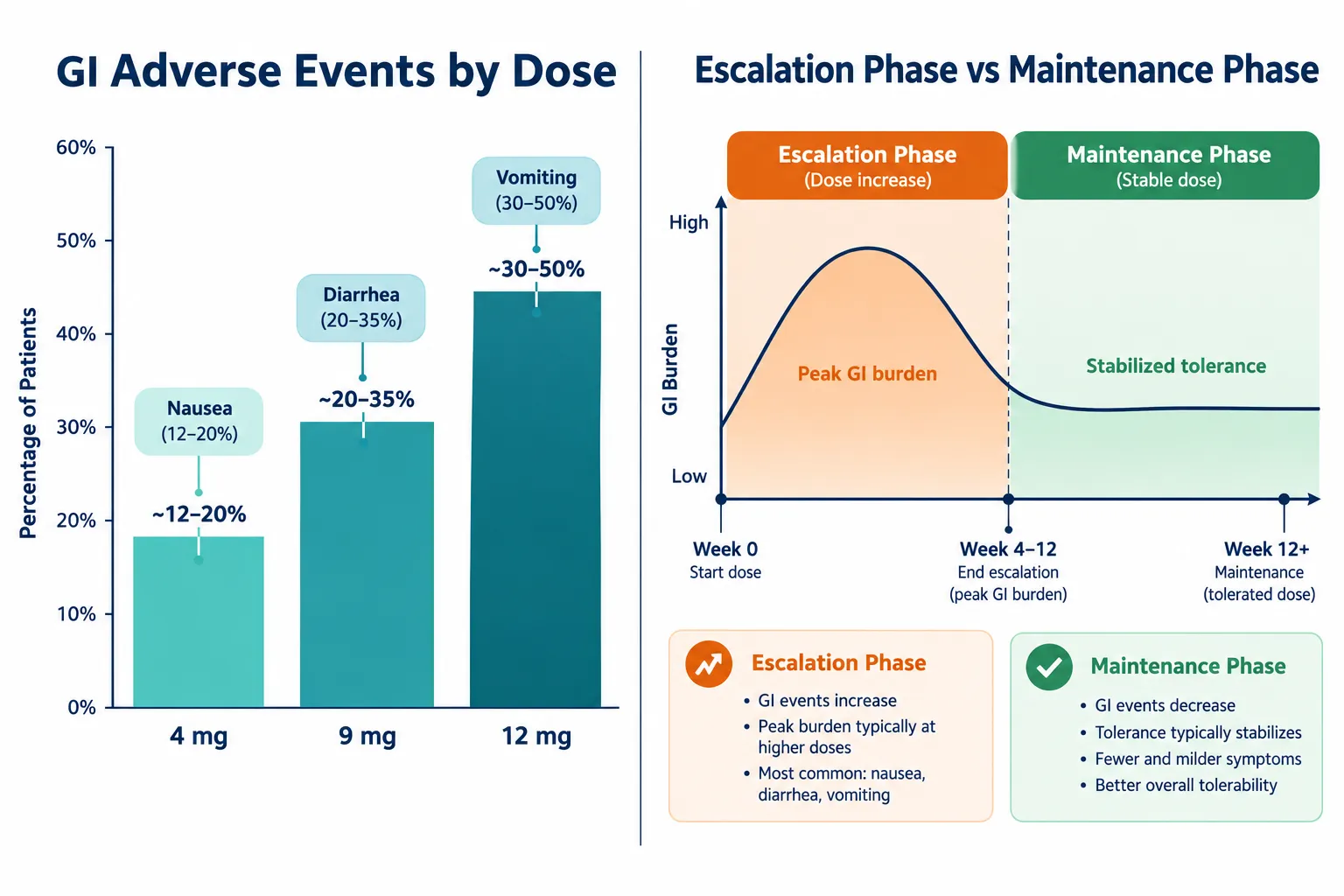
The tolerability profile of retatrutide is one of the most closely tracked variables in current dose-escalation research. Across TRIUMPH program data, nausea was reported in approximately 16%, 20%, and 27% of participants at 4, 9, and 12 mg respectively, compared with under 4% on placebo. Diarrhea followed a similar gradient, rising from roughly 19% at 4 mg to 23% at 12 mg. Vomiting appeared in 16% to 18% of actively treated participants across dose levels.
Tolerability Data Across Dose Levels and Titration Speeds

At the highest tested doses, pooled safety analyses report nausea in up to 43% of participants, diarrhea in approximately 33%, and vomiting in around 21%. These figures are substantial, but discontinuation rates remained relatively low, 2.2% at 4 mg, 4.5% at 9 mg, and 5.1% at 12 mg, suggesting that most participants tolerate the burden, particularly when escalation is gradual.

The phase 2 obesity trial published in the New England Journal of Medicine provided early evidence that starting at 2 mg or 4 mg and increasing every four weeks meaningfully reduced GI symptom severity compared with more aggressive approaches. This finding now underpins the entire TRIUMPH escalation framework.

"Gastrointestinal adverse events are not only dose-related but also mitigated by starting at a lower dose and escalating gradually, a principle that is now being tested head-to-head in dedicated escalation-comparison trials."

Beyond GI symptoms, emerging data from TRIUMPH-4 topline results identified dysesthesia, abnormal skin sensations, in approximately 21% of participants at the highest dose. While GI events remain the primary tolerability concern, this non-GI signal is beginning to inform discussions about maximum recommended doses and the design of future long-duration studies.


Endpoint Timing and Study Design Across Current Trials

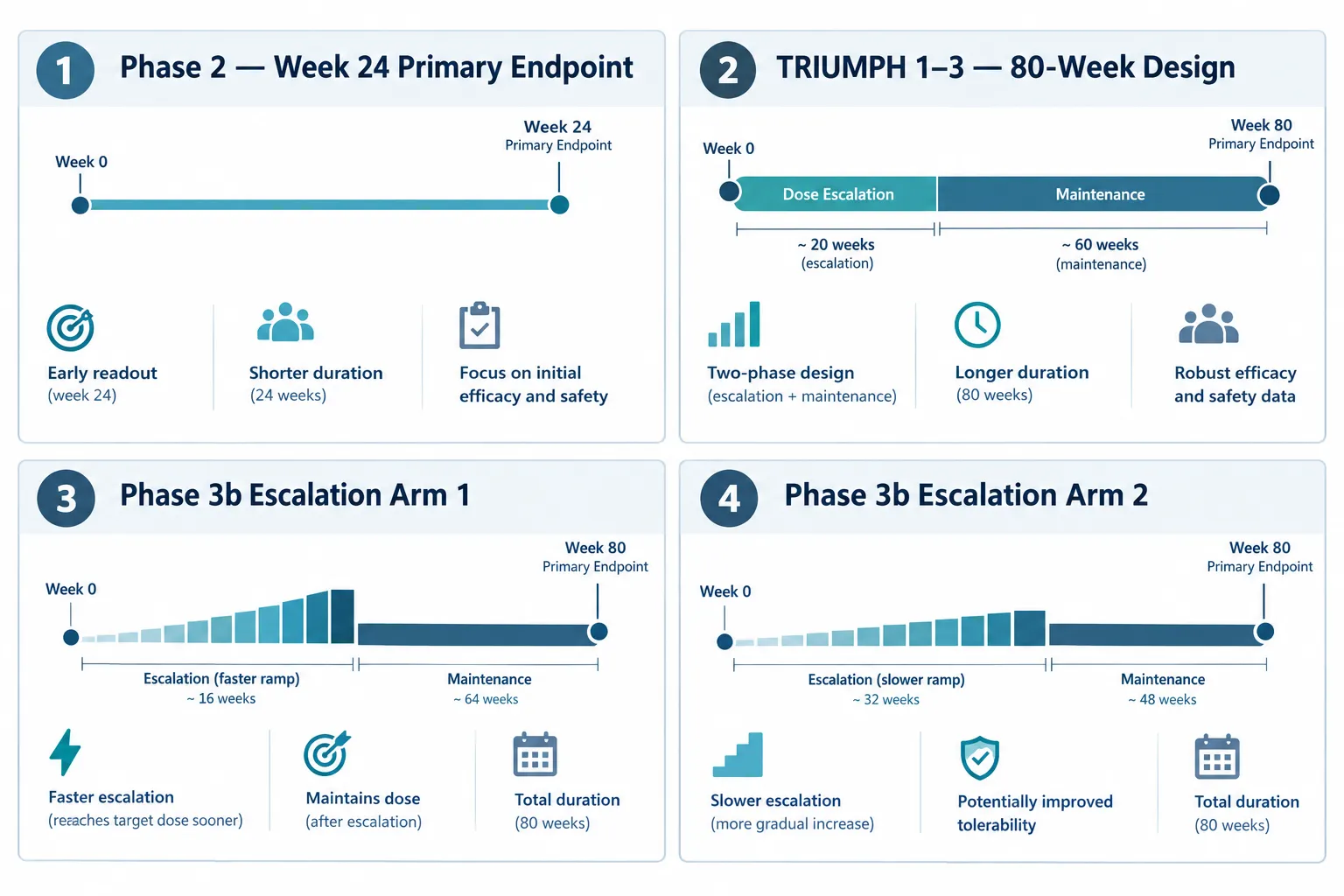
The most direct test of retatrutide dose-escalation research: comparing exposure, tolerability, and endpoint timing across study designs is now underway in a phase 3b trial registered in June 2026. This randomized, double-blind, parallel-assignment study includes at least two experimental arms, labeled "Retatrutide Dose Escalation 1" and "Retatrutide Dose Escalation 2", specifically designed to determine whether alternative titration schedules can shift the efficacy-tolerability balance without reducing the final maintenance dose.
Endpoint Timing and Study Design Across Current Trials

A multicenter phase 2 study adds further granularity. Participants are randomized to maintenance doses of 1, 4, 8, and 12 mg, but the 4 mg and 8 mg arms each include alternative escalation schedules to isolate the effect of titration speed from the effect of final dose. The primary endpoint, percent body weight change at Week 24, is strategically placed at a point when some participants will have just reached maintenance while others, on slower schedules, may still be escalating. This deliberate misalignment is not a flaw; it is the research question.

Why endpoint timing matters for interpretation:

  • Week 24 endpoints capture the combined effect of escalation intensity and early maintenance exposure, making them sensitive to titration speed differences.
  • Week 48 assessments provide extended anthropometric and safety data that reflect more stable exposure conditions.
  • 80-week TRIUMPH designs (16 weeks escalation plus 64 weeks maintenance) are built to evaluate long-term durability, metabolic improvements, and safety at sustained high-dose exposure.

This staggered endpoint strategy allows researchers and regulators to distinguish between the short-term impact of how fast a patient escalates and the long-term consequences of sustained high-dose therapy, two questions that earlier single-arm trials could not cleanly separate.

For context on how other research peptides approach dosing and timing considerations, the literature on SS-31 ideal dosage and timing illustrates how titration decisions affect both tolerability and endpoint interpretation across different compound classes. Similarly, CJC-1295 pharmacokinetic comparison research demonstrates how half-life and exposure curves shape study design choices more broadly.

Researchers interested in the broader RETA 10mg research context or the GLP3-RETA 20mg formulation will find that these product-level considerations connect directly to the dose-level questions being tested in current escalation trials.


Conclusion

Retatrutide dose-escalation research: comparing exposure, tolerability, and endpoint timing across study designs has moved from a secondary consideration to the central question of the current trial generation. The evidence is clear that slower titration reduces early GI burden without eliminating it, that adverse events are dose-dependent and concentrated in the escalation phase, and that endpoint timing must be interpreted relative to where each participant sits on their titration curve.

Actionable next steps for researchers and clinicians following this space:

  1. Track the phase 3b escalation-comparison trial results, which will provide the first head-to-head data on alternative titration schedules at identical maintenance doses.
  2. When reviewing published trial data, note the escalation schedule used and the timing of primary endpoints relative to when participants reached maintenance dose.
  3. Anticipate that future regulatory labels for retatrutide at 9-12 mg may embed flexible titration options rather than a single fixed schedule, based on the tolerability evidence accumulating in 2026 trials.
  4. Consider non-GI signals, particularly dysesthesia at the highest doses, as part of the full exposure-tolerability profile when evaluating study designs.

The field is moving toward individualized titration, not as a clinical convenience, but as a scientifically validated strategy supported by rigorously designed comparative trials.

https://www.puretestedpeptides.com/wp-content/uploads/2026/10/retatrutide-dose-escalation-research-comparing-exposure-tolerability-and-endpoin.webp 1024 1536 https://www.puretestedpeptides.com/wp-content/uploads/2026/01/buy-peptides-online.jpg 2026-10-03 13:08:342026-10-03 13:08:34Retatrutide Dose-Escalation Research: Comparing Exposure, Tolerability, and Endpoint Timing Across Study Designs
×

Helpful Links

  • My account
  • Cart
  • Checkout
  • Refund and Returns Policy
  • Privacy Policy
  • SMS Privacy Policy
  • Login
  • My Account
  • Logout

USA Made Lab Tested Peptides

All products are sold for research, laboratory, or analytical purposes only, and are not for human consumption


Pure Tested Peptides is a chemical supplier. Pure Tested Peptides is not a compounding / chemical compounding facility as defined under 503A of the Federal Food, Drug, and Cosmetic act. Pure Tested Peptides is not an outsourcing facility as defined under 503B of the Federal Food, Drug, and Cosmetic act.

The statements made within this website have not been evaluated by the US Food and Drug Administration. The products we offer are not intended to diagnose, treat, cure or prevent any disease.

Human/Animal Consumption Prohibited. Laboratory/In-Vitro Experimental Use Only

Scroll to top Scroll to top Scroll to top